1) Draw all possible structures of VO(acac)2. What is the true structure of this complex? 2)...
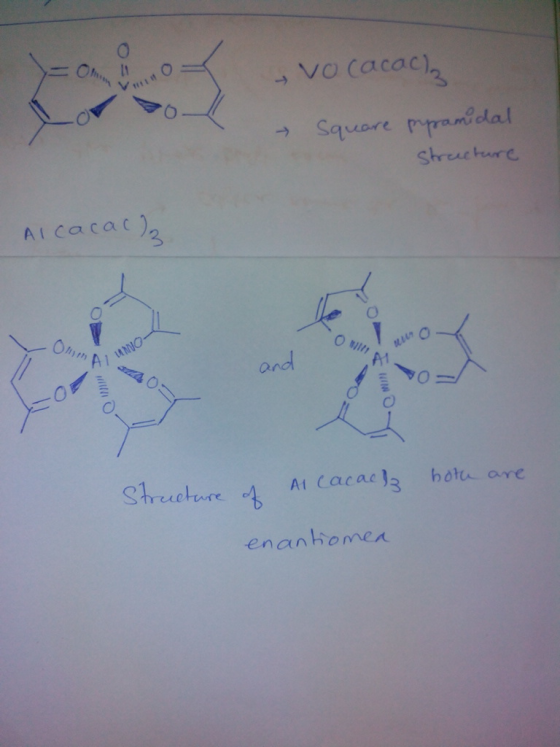
1) Draw all possible structures of VO(acac)2. What is the true structure of this complex?
2) Draw all the possible structures of Al(acac)3. Are any of the structures related to one another? If so, in what way? What special property, if any, does this relationship impart on Al(acac)3?
Homework Answers
Add Answer to:
1) Draw all possible structures of VO(acac)2. What is the true
structure of this complex?
2)...
EO 3- resonance structures, formal charges, stability 1. Draw ONE possible significant additional resonance structure for...
 EO 3- resonance structures, formal charges, stability
1. Draw ONE possible significant additional resonance structure for each of the following ions. Use curved arrows to show the movement of electrons that creates each new resonance structure. (Hint: lone pairs are not shown. Start by drawing in all one pairs, and include all lone pairs and formal charges in your additional resonance structure.) Page 1 of 3 2. For each structure, draw the resonance structure that is indicated by the curved...
EO 3- resonance structures, formal charges, stability
1. Draw ONE possible significant additional resonance structure for each of the following ions. Use curved arrows to show the movement of electrons that creates each new resonance structure. (Hint: lone pairs are not shown. Start by drawing in all one pairs, and include all lone pairs and formal charges in your additional resonance structure.) Page 1 of 3 2. For each structure, draw the resonance structure that is indicated by the curved...
Draw the Lewis structure of bicarbonate (HCO3-) showing all possible resonance structures if there are any. Determine th...
Draw the Lewis structure of bicarbonate (HCO3-) showing all possible resonance structures if there are any. Determine the formal charge of each atom.
For 2-chloro-3-hexanol: Draw the structure of all the possible stereoisomers with Fischer Projection and Perspective Formulas...
 For 2-chloro-3-hexanol: Draw the structure of all the possible stereoisomers with Fischer Projection and Perspective Formulas showing both eclipsed and staggered conformations). 2) Assign the configuration of all chiral centers with R or S. (3) Give the complete IUPAC name for each stereoisomers. (4) Indicate the relationship among the structures, indicating which are the threo or erythro enantiomer, and diastereoisomer pairs.
Draw all possible stereoisomers of 1,3-dichlorocyclopentane, and label each structure as A, B etc. a) Label all chira...
Draw all possible stereoisomers of 1,3-dichlorocyclopentane, and label each structure as A, B etc. a) Label all chiral C's, b) write "chiral" by chiral isomers, c) write "meso" if appropriate, and d) Classify the relationship between any two structures, for example A/B enantiomers, or A/B diatereomers, etc.. (For any that are the same, scratch out the duplicate!)
Please answer these multiple choice questions asap 1:True for trans 1-tert-butyl-3-propylyclohexane a: 2 unique structure b:...
Please answer these multiple choice questions asap 1:True for trans 1-tert-butyl-3-propylyclohexane a: 2 unique structure b: 1 unique structure c: 3 unique structure d: 4 unique structure 2:True for cis 1-tert-butyl-3-propylcyclohexane a: 3 unique structure b; 4 unique structure c: 1 unique structure d: 2 unique structure 3: true for trans 1-bromo-4-fluorocyclohexane a: 1 unique structure b: 2 unique structure c: 3 unique structure d: 4 unique structure 4: True for cis 1-bromo-4-flouorcyclohexane a: 3 unique structure b: 1 unique...
Please answer all of the following: a) Give the correct IUPAC name and sketch the structure...
Please answer all of the following: a) Give the correct IUPAC name and sketch the structure of the transition metal complex for each of the following compounds. If multiple stereoisomers are possible, give both names and structures: 1) [Pt(NH3)2Cl2] 2) [Cr(NMe3)4Br2]PF6 3) K[Co(edta)], where H4(edta) = ethylenediaminetetraacetic acid 4) [Ir(CO)Cl(PPh3)2] 5) Hg[Co(NCO)4] 6) [Fe(acac)3], where H(acac) = acetylacetone 7) [Co(NH3)6]3+[Cr(CN)6]3- 8) [{Co(NH3)5}2(μ-OH)]Cl5 9) [TiCl3(thf)3], where thf = tetrahydrofuran 10) [Ru(bpy)2Cl2], where bpy = 2,2’-bipyridine 11) V(O)(acac)2, where H(acac) = acetylacetone...
1. Draw the Lewis structure of water showing all valence electrons with lines for covalent bonds...
 1. Draw the Lewis structure of water showing all valence electrons with lines for covalent bonds and dots for unshared electrons. Add a box around each hydrogen- bonding donor site and add a circle around any hydrogen- bonding acceptor sites in your structure. (Hint: there are two of each. The equal number of donors and acceptors is why water hydrogen-bonds so well with other waters.) Draw the Lewis structure of hydrofluoric acid, HF, showing all valence electrons with lines for...
1. Draw out the other 2 structures for C2H2Cl2. Determine if they are polar or non-polar....
1. Draw out the other 2 structures for C2H2Cl2. Determine if they are polar or non-polar. 2. Draw out the other 2 structures of NO3-. What property does this particular molecule have? Answer the following questions about the molecule PCl3. 1. Determine the number of valence electrons. 2. Draw out the Lewis structure of PCl3. 3. What geometry does PCl3 exhibit? 4. What would you expect the bond angle to be? 5. Is PCl3 polar or non-po
Question 1 (2 points) Select all that are true. Using Maxwell's equations it is possible to show ...
 Special Relativity help
Question 1 (2 points) Select all that are true. Using Maxwell's equations it is possible to show that electromagnetic waves must travel at a constant speed (c 3x10 8 m/s) The only assumption needed for special relativity to work is for nothing in the universe to go faster than the speed of light. The only assumption needed for special relativity to work is for the speed of light to be a constant in the universe. Assuming the...
Special Relativity help
Question 1 (2 points) Select all that are true. Using Maxwell's equations it is possible to show that electromagnetic waves must travel at a constant speed (c 3x10 8 m/s) The only assumption needed for special relativity to work is for nothing in the universe to go faster than the speed of light. The only assumption needed for special relativity to work is for the speed of light to be a constant in the universe. Assuming the...
1. What does the term 'resonance structures' refer to? 2. Write out the electron dot structure...
1. What does the term 'resonance structures' refer to? 2. Write out the electron dot structure for SO3. 3. What is the name of SO3? 4. Does SO3 have any resonance structures? If so how many? How do they differ? 5. Is SO3 a polar or non-polar molecule? Why? 6. What is the shape of the molecule?
 EO 3- resonance structures, formal charges, stability
1. Draw ONE possible significant additional resonance structure for each of the following ions. Use curved arrows to show the movement of electrons that creates each new resonance structure. (Hint: lone pairs are not shown. Start by drawing in all one pairs, and include all lone pairs and formal charges in your additional resonance structure.) Page 1 of 3 2. For each structure, draw the resonance structure that is indicated by the curved...
EO 3- resonance structures, formal charges, stability
1. Draw ONE possible significant additional resonance structure for each of the following ions. Use curved arrows to show the movement of electrons that creates each new resonance structure. (Hint: lone pairs are not shown. Start by drawing in all one pairs, and include all lone pairs and formal charges in your additional resonance structure.) Page 1 of 3 2. For each structure, draw the resonance structure that is indicated by the curved...
 For 2-chloro-3-hexanol: Draw the structure of all the possible stereoisomers with Fischer Projection and Perspective Formulas showing both eclipsed and staggered conformations). 2) Assign the configuration of all chiral centers with R or S. (3) Give the complete IUPAC name for each stereoisomers. (4) Indicate the relationship among the structures, indicating which are the threo or erythro enantiomer, and diastereoisomer pairs.
 1. Draw the Lewis structure of water showing all valence electrons with lines for covalent bonds and dots for unshared electrons. Add a box around each hydrogen- bonding donor site and add a circle around any hydrogen- bonding acceptor sites in your structure. (Hint: there are two of each. The equal number of donors and acceptors is why water hydrogen-bonds so well with other waters.) Draw the Lewis structure of hydrofluoric acid, HF, showing all valence electrons with lines for...
 Special Relativity help
Question 1 (2 points) Select all that are true. Using Maxwell's equations it is possible to show that electromagnetic waves must travel at a constant speed (c 3x10 8 m/s) The only assumption needed for special relativity to work is for nothing in the universe to go faster than the speed of light. The only assumption needed for special relativity to work is for the speed of light to be a constant in the universe. Assuming the...
Special Relativity help
Question 1 (2 points) Select all that are true. Using Maxwell's equations it is possible to show that electromagnetic waves must travel at a constant speed (c 3x10 8 m/s) The only assumption needed for special relativity to work is for nothing in the universe to go faster than the speed of light. The only assumption needed for special relativity to work is for the speed of light to be a constant in the universe. Assuming the...
Most questions answered within 3 hours.
-
Where is the error in this code sequence?
String s1 = "Hello";
String s2 = "ello";...
asked 10 months ago -
Financial data for Joel de Paris, Inc., for last year
follow:
Joel de Paris, Inc.
Balance...
asked 10 months ago -
Consider this reaction:
Al2(SO4)3 (aq)+ BaCl3
(aq) Al2Cl6 (aq)- +
3BaSO4(s) . What is the...
asked 10 months ago -
Suppose that Savneet is considering increasing her
recent random sample from 20 car rentals to 40...
asked 10 months ago -
Trucks arrive at an unloading terminal at an average rate of 120
per hour.
Trucks arrive...
asked 10 months ago -
Why are methanol and ethanol completely soluble in water while
octanol is not very little soluble....
asked 10 months ago -
A facilities manager at a university reads in a research report
that the mean amount of...
asked 10 months ago -
When the CuSO4 is rehydrated by adding water to the anhydrous
compound, is this an endothermic...
asked 10 months ago -
A ray of sunlight is passing from diamond into crown glass; the
angle of incidence is...
asked 10 months ago -
A block of mass 0.249 kg is placed on top of a light, vertical
spring of...
asked 10 months ago -
how do the kidneys compensate in the presences of acidosis
a) trigger hyperventilate
b) reserve acid...
asked 10 months ago -
Question 501 pts
The rental rate of capital to the firm increases. Which of the
following...
asked 10 months ago