
Homework Answers
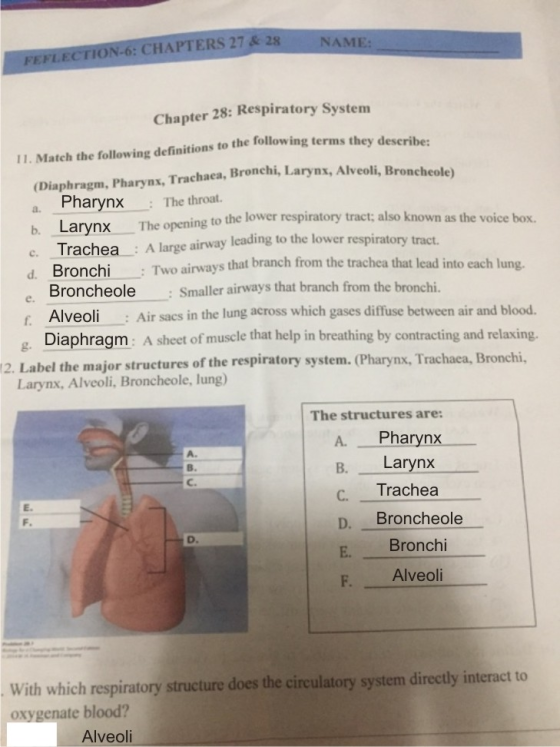
Answer: please refer below diagram.
Add Answer to:
NAME. FEFLECTION-6: CHAPTERS 27 & 28 Chapter 28: Respiratory System 11. Match the following definitions to...
needs assistance with biology 2 - Chapter 28829 3e (1) [Compatibility Mode] - Word Tell me...
 needs assistance with biology 2
- Chapter 28829 3e (1) [Compatibility Mode] - Word Tell me what you want to do nces Mailings Review View Help FEFLECTION 6: CHAPTERS 27 & 28 NAME: LLEN Chapter 28: Respiratory System 11. Match the following definitions to the following terms they describe: (Diaphragm, Pharynx, Trachaea, Bronchi, Larynx, Alveoli, Broncheole) _: The throat The opening to the lower respiratory tract; also known as the voice box. : A large airway leading to the lower...
needs assistance with biology 2
- Chapter 28829 3e (1) [Compatibility Mode] - Word Tell me what you want to do nces Mailings Review View Help FEFLECTION 6: CHAPTERS 27 & 28 NAME: LLEN Chapter 28: Respiratory System 11. Match the following definitions to the following terms they describe: (Diaphragm, Pharynx, Trachaea, Bronchi, Larynx, Alveoli, Broncheole) _: The throat The opening to the lower respiratory tract; also known as the voice box. : A large airway leading to the lower...
10. The Respiratory System A. Anatomy of the respiratory system 1. Label the parts of the...
 10. The Respiratory System A. Anatomy of the respiratory system 1. Label the parts of the upper respiratory system: cente, epiglottis, external naris, laryngopharynx, nasal cavity, nasopharynx, lingual tonsil, opening of eustachian tube, oropharynx, palatine tonsil, thyroid cartilage, trachea, vocal folds, pharyngeal tonsil, nasal vestibule Opening of eustechian tube Oral cavity- Esophagus 113 2. Label the parts of the lower respiratory system: epiglottis, inferior lobe of left lung, inferior lobe of right lung, larynx, middle lobe of right lung, primary...
The path of air resembles the path of blood in the circulatory system. It starts off...
 The path of air resembles the path of blood in the circulatory system. It starts off with bigger tubes, and as it moves in deeper into the lungs, it goes through intensive and extensive branching to reach the site of gas exchange (alveoli). Study the anatomy of the lungs and follow the path of air through the respiratory structures. View Available Hint(s) Reset Help External nares Alveoli Nasal cavity Pharynx Larynx Trachea Bronchi Respiratory bronchioles Terminal bronchioles Internal nares
Choose the correct Answer. 1. What is the function of goblet cells in the respiratory tract?...
Choose the correct Answer. 1. What is the function of goblet cells in the respiratory tract? These alveolar cells are thin and therefore function in gas transport. These alveolar cells function in the production of surfactant production. These cells are macrophages and therefore function in immune response/defense. These ciliated cells are found in the bronchi and function to move mucus up the respiratory tract. These cells are found in trachea and bronchi, and function in the production of mucus. 2....
what is the correct answer 1. Which of the following definitions would best describe asthma? Pulmonary...
what is the correct answer 1. Which of the following definitions would best describe asthma? Pulmonary disease is characterized by a permanent enlargement of the alveoli. Inflammation of the bronchi in the lungs that causes coughing. Long-term inflammatory disease of the lungs characterized by airflow obstruction and bronchospasms. Inflammatory condition of the lung affecting primarily the alveoli. Inflammation of the larynx (voice box). Symptoms often include a hoarse voice and may include fever, cough, pain in the front of the...
6. a correct order of events of a muscle contraction stars correct Which of the following (A-E) represents with the...
 6. a correct order of events of a muscle contraction stars correct Which of the following (A-E) represents with the binding of ATP to the myosin head? (I point) 9. 1- () The myosin head binds to the actin filament to form a cross bridge myosin and actin separate (3) ATP is hydrolyzed to ADP and P (4) The power stroke is initiated A. 1, 2, 3,4 B. 2, 1. 4, 3 C. 3, 2, 1, 4 D. 2, 3,...
pre-lab exercise 21-1 Name Section Date PRE-LAB EXERCISES Complete the following esxercises prior to coming to...
 pre-lab exercise 21-1
Name Section Date PRE-LAB EXERCISES Complete the following esxercises prior to coming to lab, using your textbook and lab manvual for seference Pre-Lab Exercise 21-1 Key Terms You should be familiar with the following terms before coming to lab. Term General Structures of the Respiratory System Respiratory tract finition Parietal pleura Visceral pleura Pleural cavity Lungs and lobes Structures of the Respiratory Tract Nasal cavity Pharynx 21 Larynx Trachea Primary bronchi Secondary bronchi 510 I Exploring Anatomy...
pre-lab exercise 21-1
Name Section Date PRE-LAB EXERCISES Complete the following esxercises prior to coming to lab, using your textbook and lab manvual for seference Pre-Lab Exercise 21-1 Key Terms You should be familiar with the following terms before coming to lab. Term General Structures of the Respiratory System Respiratory tract finition Parietal pleura Visceral pleura Pleural cavity Lungs and lobes Structures of the Respiratory Tract Nasal cavity Pharynx 21 Larynx Trachea Primary bronchi Secondary bronchi 510 I Exploring Anatomy...
The Conducting and Respiratory Divisions The conducting division is involved in exchange of air entilation but...
 The Conducting and Respiratory Divisions The conducting division is involved in exchange of air entilation but not in respiration. It is the passageway air takes from your nose or mouth to where as exchange takes place in the lunes. Nos exchange takes place in the conducting division, because the layers of the passway are too thick for the pases to diffuse through. It includes the nose, the pharynx, the larynx, the trachea, and the bronchi. List, in order, the pathway...
1. a form in which carbon dioxide is transported in blood A. pH B. hydrogen ions...
 1. a form in which carbon dioxide is transported in blood A. pH B. hydrogen ions C. bicarbonate D. pharynx E. larynx F. respiratory exchange G. conducting H. mucus membrane I. mucociliary clearance J. diffusion K. osmosis L. peritubular capillaries M. glomerular capillaries N. bronchi O. alveoli P. nephrons 2. where sound is produced 3. a measure of the hydrogen ion concentration 4. microscopic structures in the kidneys that produce urine - _ _5. the name of the tiny air...
D 1. These are peripheral chemoreceptors that monitor changes in respiratory gasses and blood acidity levels...
 D 1. These are peripheral chemoreceptors that monitor changes in respiratory gasses and blood acidity levels carotid bodies medulla oblongata vagus nerve D 2. The region of the lung served by secondary, or lobar, bronchi. lobule bronchopulmonary segment lobe D 3. The respiratory zone begins at the large bronchioles. False True D 4. The serous membrane lining of the wall of the thoracic cavity. parietal pericardium visceral pleura parietal pleura visceral pericardium D 5. The smallest airway of the bronchial...
 needs assistance with biology 2
- Chapter 28829 3e (1) [Compatibility Mode] - Word Tell me what you want to do nces Mailings Review View Help FEFLECTION 6: CHAPTERS 27 & 28 NAME: LLEN Chapter 28: Respiratory System 11. Match the following definitions to the following terms they describe: (Diaphragm, Pharynx, Trachaea, Bronchi, Larynx, Alveoli, Broncheole) _: The throat The opening to the lower respiratory tract; also known as the voice box. : A large airway leading to the lower...
needs assistance with biology 2
- Chapter 28829 3e (1) [Compatibility Mode] - Word Tell me what you want to do nces Mailings Review View Help FEFLECTION 6: CHAPTERS 27 & 28 NAME: LLEN Chapter 28: Respiratory System 11. Match the following definitions to the following terms they describe: (Diaphragm, Pharynx, Trachaea, Bronchi, Larynx, Alveoli, Broncheole) _: The throat The opening to the lower respiratory tract; also known as the voice box. : A large airway leading to the lower...
 10. The Respiratory System A. Anatomy of the respiratory system 1. Label the parts of the upper respiratory system: cente, epiglottis, external naris, laryngopharynx, nasal cavity, nasopharynx, lingual tonsil, opening of eustachian tube, oropharynx, palatine tonsil, thyroid cartilage, trachea, vocal folds, pharyngeal tonsil, nasal vestibule Opening of eustechian tube Oral cavity- Esophagus 113 2. Label the parts of the lower respiratory system: epiglottis, inferior lobe of left lung, inferior lobe of right lung, larynx, middle lobe of right lung, primary...
 The path of air resembles the path of blood in the circulatory system. It starts off with bigger tubes, and as it moves in deeper into the lungs, it goes through intensive and extensive branching to reach the site of gas exchange (alveoli). Study the anatomy of the lungs and follow the path of air through the respiratory structures. View Available Hint(s) Reset Help External nares Alveoli Nasal cavity Pharynx Larynx Trachea Bronchi Respiratory bronchioles Terminal bronchioles Internal nares
 6. a correct order of events of a muscle contraction stars correct Which of the following (A-E) represents with the binding of ATP to the myosin head? (I point) 9. 1- () The myosin head binds to the actin filament to form a cross bridge myosin and actin separate (3) ATP is hydrolyzed to ADP and P (4) The power stroke is initiated A. 1, 2, 3,4 B. 2, 1. 4, 3 C. 3, 2, 1, 4 D. 2, 3,...
 pre-lab exercise 21-1
Name Section Date PRE-LAB EXERCISES Complete the following esxercises prior to coming to lab, using your textbook and lab manvual for seference Pre-Lab Exercise 21-1 Key Terms You should be familiar with the following terms before coming to lab. Term General Structures of the Respiratory System Respiratory tract finition Parietal pleura Visceral pleura Pleural cavity Lungs and lobes Structures of the Respiratory Tract Nasal cavity Pharynx 21 Larynx Trachea Primary bronchi Secondary bronchi 510 I Exploring Anatomy...
pre-lab exercise 21-1
Name Section Date PRE-LAB EXERCISES Complete the following esxercises prior to coming to lab, using your textbook and lab manvual for seference Pre-Lab Exercise 21-1 Key Terms You should be familiar with the following terms before coming to lab. Term General Structures of the Respiratory System Respiratory tract finition Parietal pleura Visceral pleura Pleural cavity Lungs and lobes Structures of the Respiratory Tract Nasal cavity Pharynx 21 Larynx Trachea Primary bronchi Secondary bronchi 510 I Exploring Anatomy...
 The Conducting and Respiratory Divisions The conducting division is involved in exchange of air entilation but not in respiration. It is the passageway air takes from your nose or mouth to where as exchange takes place in the lunes. Nos exchange takes place in the conducting division, because the layers of the passway are too thick for the pases to diffuse through. It includes the nose, the pharynx, the larynx, the trachea, and the bronchi. List, in order, the pathway...
 1. a form in which carbon dioxide is transported in blood A. pH B. hydrogen ions C. bicarbonate D. pharynx E. larynx F. respiratory exchange G. conducting H. mucus membrane I. mucociliary clearance J. diffusion K. osmosis L. peritubular capillaries M. glomerular capillaries N. bronchi O. alveoli P. nephrons 2. where sound is produced 3. a measure of the hydrogen ion concentration 4. microscopic structures in the kidneys that produce urine - _ _5. the name of the tiny air...
 D 1. These are peripheral chemoreceptors that monitor changes in respiratory gasses and blood acidity levels carotid bodies medulla oblongata vagus nerve D 2. The region of the lung served by secondary, or lobar, bronchi. lobule bronchopulmonary segment lobe D 3. The respiratory zone begins at the large bronchioles. False True D 4. The serous membrane lining of the wall of the thoracic cavity. parietal pericardium visceral pleura parietal pleura visceral pericardium D 5. The smallest airway of the bronchial...
Most questions answered within 3 hours.
-
Where is the error in this code sequence?
String s1 = "Hello";
String s2 = "ello";...
asked 10 months ago -
Financial data for Joel de Paris, Inc., for last year
follow:
Joel de Paris, Inc.
Balance...
asked 10 months ago -
Consider this reaction:
Al2(SO4)3 (aq)+ BaCl3
(aq) Al2Cl6 (aq)- +
3BaSO4(s) . What is the...
asked 10 months ago -
Suppose that Savneet is considering increasing her
recent random sample from 20 car rentals to 40...
asked 10 months ago -
Trucks arrive at an unloading terminal at an average rate of 120
per hour.
Trucks arrive...
asked 10 months ago -
Why are methanol and ethanol completely soluble in water while
octanol is not very little soluble....
asked 10 months ago -
A facilities manager at a university reads in a research report
that the mean amount of...
asked 10 months ago -
When the CuSO4 is rehydrated by adding water to the anhydrous
compound, is this an endothermic...
asked 10 months ago -
A ray of sunlight is passing from diamond into crown glass; the
angle of incidence is...
asked 10 months ago -
A block of mass 0.249 kg is placed on top of a light, vertical
spring of...
asked 10 months ago -
how do the kidneys compensate in the presences of acidosis
a) trigger hyperventilate
b) reserve acid...
asked 10 months ago -
Question 501 pts
The rental rate of capital to the firm increases. Which of the
following...
asked 10 months ago