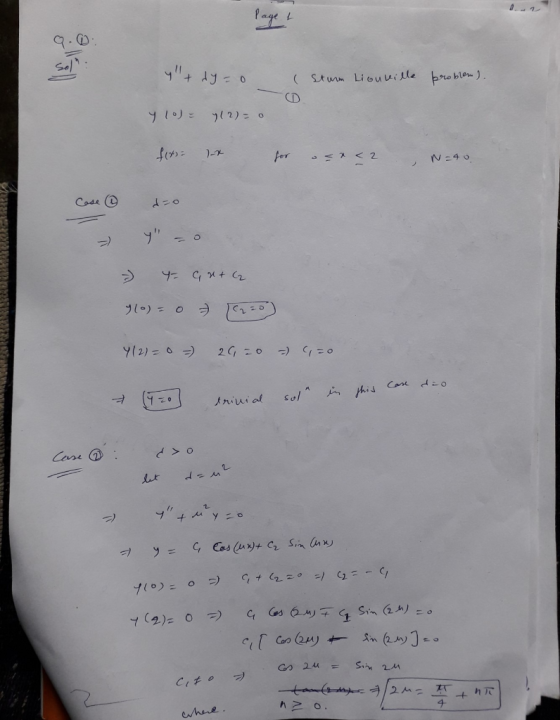
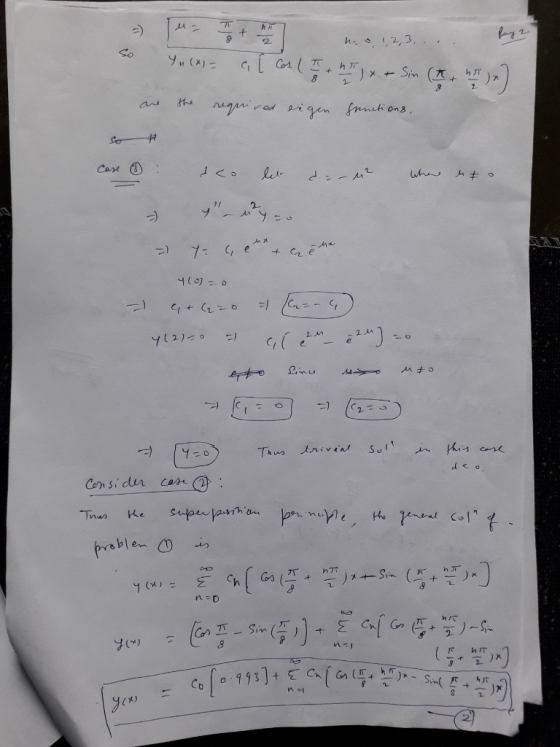
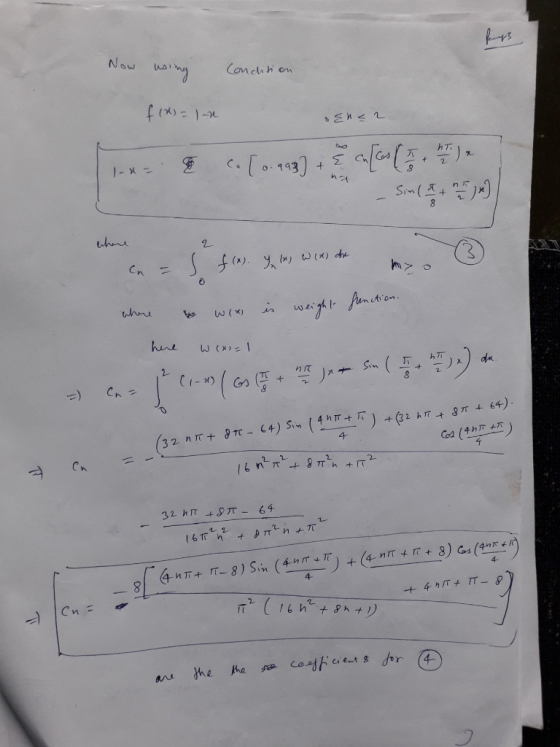
Hi! Please help me with this question #1.
Thank you so much!

Homework Answers
Add Answer to:
Hi! Please help me with this question #1.
Thank you so much!
In each of Problems...
1. Consider the non-Sturm-Liouville differential equation Multiply this equation by H(x). Determi...
 #2 ONLY PLEASE
1. Consider the non-Sturm-Liouville differential equation Multiply this equation by H(x). Determine H(x) such that the equation may be reduced to the standard Sturm-Liouville form: do Given a(z), 3(2), and 7(2), what are p(x), σ(x), and q(x) 2. Consider the eigenvalue problem (a) Use the result from the previous problem to put this in Sturm-Liouville form (b) Using the Rayleigh quotient, show that λ > 0. (c) Solve this equation subject to the boundary conditions and determine...
#2 ONLY PLEASE
1. Consider the non-Sturm-Liouville differential equation Multiply this equation by H(x). Determine H(x) such that the equation may be reduced to the standard Sturm-Liouville form: do Given a(z), 3(2), and 7(2), what are p(x), σ(x), and q(x) 2. Consider the eigenvalue problem (a) Use the result from the previous problem to put this in Sturm-Liouville form (b) Using the Rayleigh quotient, show that λ > 0. (c) Solve this equation subject to the boundary conditions and determine...
6. Consider the eigenvalue problem 1 < x < 2, y(1) = 0, y(2) = 0. (a) Write the problem in Sturm-Liouville form,...
 6. Consider the eigenvalue problem 1 < x < 2, y(1) = 0, y(2) = 0. (a) Write the problem in Sturm-Liouville form, identifying p, q, and w. (b) Is the problem regular? Explain |(c) Is the operator S symmetric? Explain. (d) Find all eigenvalues and eigenfunctions. Discuss in light of Theorem 4.3 (e) Find the orthogonal expansion of f(x) = ln x, 1 < x < 2, in terms of these eigenfunctions. (f) Find the smallest N such that...
Hi! Please help me on this question #41. Thank you so much! (by giving the p.m.f....
 Hi! Please help me on this question #41.
Thank you so much!
(by giving the p.m.f. or p.d.f.) whose the cumulative distribution function F(t) satisfies F(n) = 1 - 1 for each positive integer n. Exercise 3.41. We produce a random real number X through the following two- stage experiment. First roll a fair die to get an outcome Y in the set {1,2,...,6}. Then, if Y = k, choose X uniformly from the interval (0, k]. Find the cumulative...
Hi! Please help me on this question #41.
Thank you so much!
(by giving the p.m.f. or p.d.f.) whose the cumulative distribution function F(t) satisfies F(n) = 1 - 1 for each positive integer n. Exercise 3.41. We produce a random real number X through the following two- stage experiment. First roll a fair die to get an outcome Y in the set {1,2,...,6}. Then, if Y = k, choose X uniformly from the interval (0, k]. Find the cumulative...
Solve part (d) 6. Consider the eigenvalue problem 2"xy3y Ay 0 y(1)0, y(2)= 0. + 1 < x< 2, (a) Write the proble...
 Solve part (d)
6. Consider the eigenvalue problem 2"xy3y Ay 0 y(1)0, y(2)= 0. + 1 < x< 2, (a) Write the problem in Sturm-Liouville form, identifying p, q, and w. (b) Is the problem regular? Explain (c) Is the operator S symmetric? Explain (d) Find all eigenvalues and eigenfunctions. Discuss in light of Theorem 4.3 ln x, 1 < 2, in terms of these (e) Find the orthogonal expansion of f(x) eigenfunctions _
6. Consider the eigenvalue problem 2"xy3y...
Solve part (d)
6. Consider the eigenvalue problem 2"xy3y Ay 0 y(1)0, y(2)= 0. + 1 < x< 2, (a) Write the problem in Sturm-Liouville form, identifying p, q, and w. (b) Is the problem regular? Explain (c) Is the operator S symmetric? Explain (d) Find all eigenvalues and eigenfunctions. Discuss in light of Theorem 4.3 ln x, 1 < 2, in terms of these (e) Find the orthogonal expansion of f(x) eigenfunctions _
6. Consider the eigenvalue problem 2"xy3y...
Hi! Please help me with question #1. Thank you so much! 1) Let F be the...
 Hi!
Please help me with question #1.
Thank you so much!
1) Let F be the function from R x (-1,1) to R3 given by F(u,0)= ( (2- sin u, vsin (2+v cos vcos COS u Let (u, ) and (u2, 2) belong to the domain R x (-1, 1) of F. Prove that F(u1, U1) (u1(4k 2),-v1) for some relative integer k. Hint: In terms of the spacial coordinates a, y,z compare the quantities 2 +y2 F(u2, 2) if...
Hi!
Please help me with question #1.
Thank you so much!
1) Let F be the function from R x (-1,1) to R3 given by F(u,0)= ( (2- sin u, vsin (2+v cos vcos COS u Let (u, ) and (u2, 2) belong to the domain R x (-1, 1) of F. Prove that F(u1, U1) (u1(4k 2),-v1) for some relative integer k. Hint: In terms of the spacial coordinates a, y,z compare the quantities 2 +y2 F(u2, 2) if...
Just solve it without plotting Solve the eigen value problem problem x2y" + xy' + ly...
 Just solve it without plotting Solve the eigen value problem problem x2y" + xy' + ly = 0 On boundary conditions y(1) = 0 and y(5) = 0. a) Find the eigen values and eigen functions b) Using the eigen functions, expand the following function -1, 1<x<3 f(x) = { 1, 3<x< 5 into a series of Eigenfunctions and plot the result using n = 5, 10, 25, 100 terms to examine the convergence of series.
Please help me. these go together. if you help then i will definitely rate!:) (a) Use...
 Please help me. these go together. if you help then i will
definitely rate!:)
(a) Use the power series for 1 to prove that the Taylor series centered at x = 0 for In(1+x) is 1+1 + (-1)" 2"41 2 3 4 5 7+1 (b) The Taylor series centered at 1 = 0 for In (1+1) given in part (a) converges to In(1+1) on its interval of convergence. Let g(x) = (x - 3)2 In 1 + Write the Taylor...
Please help me. these go together. if you help then i will
definitely rate!:)
(a) Use the power series for 1 to prove that the Taylor series centered at x = 0 for In(1+x) is 1+1 + (-1)" 2"41 2 3 4 5 7+1 (b) The Taylor series centered at 1 = 0 for In (1+1) given in part (a) converges to In(1+1) on its interval of convergence. Let g(x) = (x - 3)2 In 1 + Write the Taylor...
(1 point) Consider the Fourier sine series: ) 14, sin( f(z) a. Find the Fourier coefficients for the function f(x)-9, 0, TL b. Use the computer to draw the Fourier sine series of f(x), for x E-15, 15...
 (1 point) Consider the Fourier sine series: ) 14, sin( f(z) a. Find the Fourier coefficients for the function f(x)-9, 0, TL b. Use the computer to draw the Fourier sine series of f(x), for x E-15, 151, showing clearly all points of convergence. Also, show the graphs with the partial sums of the Fourier series using n = 5 and n = 20 terms.
(1 point) Consider the Fourier sine series: ) 14, sin( f(z) a. Find the Fourier...
(1 point) Consider the Fourier sine series: ) 14, sin( f(z) a. Find the Fourier coefficients for the function f(x)-9, 0, TL b. Use the computer to draw the Fourier sine series of f(x), for x E-15, 151, showing clearly all points of convergence. Also, show the graphs with the partial sums of the Fourier series using n = 5 and n = 20 terms.
(1 point) Consider the Fourier sine series: ) 14, sin( f(z) a. Find the Fourier...
A tinctlon of series y I Taylor The 6. Taylor's Remainder Theorem. fn)(0) where fw) is the n-th d...
 a tinctlon of series y I Taylor The 6. Taylor's Remainder Theorem. fn)(0) where fw) is the n-th derivative of f, and the remainder term Ry is given by NN+1 for some point c between 0 and z. (Note. You do not need to prove Taylor's Remainder Theorem.) Problems (a) (5%) write this series for the function ez for a general N (b) (10%) Apply Taylor's Remainder Theorem to show that the Taylor series of function f = ez converges...
3. For each n E N let fn : (1, 0) -+ R be given by f/(x) = Find the function f : (1, 0) - R to which {fn} converges poi...
 3. For each n E N let fn : (1, 0) -+ R be given by f/(x) = Find the function f : (1, 0) - R to which {fn} converges pointwise. Prove that the convergence is not uniform
3. For each n E N let fn : (1, 0) -+ R be given by f/(x) = Find the function f : (1, 0) - R to which {fn} converges pointwise. Prove that the convergence is not uniform
3. For each n E N let fn : (1, 0) -+ R be given by f/(x) = Find the function f : (1, 0) - R to which {fn} converges pointwise. Prove that the convergence is not uniform
 #2 ONLY PLEASE
1. Consider the non-Sturm-Liouville differential equation Multiply this equation by H(x). Determine H(x) such that the equation may be reduced to the standard Sturm-Liouville form: do Given a(z), 3(2), and 7(2), what are p(x), σ(x), and q(x) 2. Consider the eigenvalue problem (a) Use the result from the previous problem to put this in Sturm-Liouville form (b) Using the Rayleigh quotient, show that λ > 0. (c) Solve this equation subject to the boundary conditions and determine...
#2 ONLY PLEASE
1. Consider the non-Sturm-Liouville differential equation Multiply this equation by H(x). Determine H(x) such that the equation may be reduced to the standard Sturm-Liouville form: do Given a(z), 3(2), and 7(2), what are p(x), σ(x), and q(x) 2. Consider the eigenvalue problem (a) Use the result from the previous problem to put this in Sturm-Liouville form (b) Using the Rayleigh quotient, show that λ > 0. (c) Solve this equation subject to the boundary conditions and determine...
 6. Consider the eigenvalue problem 1 < x < 2, y(1) = 0, y(2) = 0. (a) Write the problem in Sturm-Liouville form, identifying p, q, and w. (b) Is the problem regular? Explain |(c) Is the operator S symmetric? Explain. (d) Find all eigenvalues and eigenfunctions. Discuss in light of Theorem 4.3 (e) Find the orthogonal expansion of f(x) = ln x, 1 < x < 2, in terms of these eigenfunctions. (f) Find the smallest N such that...
 Hi! Please help me on this question #41.
Thank you so much!
(by giving the p.m.f. or p.d.f.) whose the cumulative distribution function F(t) satisfies F(n) = 1 - 1 for each positive integer n. Exercise 3.41. We produce a random real number X through the following two- stage experiment. First roll a fair die to get an outcome Y in the set {1,2,...,6}. Then, if Y = k, choose X uniformly from the interval (0, k]. Find the cumulative...
Hi! Please help me on this question #41.
Thank you so much!
(by giving the p.m.f. or p.d.f.) whose the cumulative distribution function F(t) satisfies F(n) = 1 - 1 for each positive integer n. Exercise 3.41. We produce a random real number X through the following two- stage experiment. First roll a fair die to get an outcome Y in the set {1,2,...,6}. Then, if Y = k, choose X uniformly from the interval (0, k]. Find the cumulative...
 Solve part (d)
6. Consider the eigenvalue problem 2"xy3y Ay 0 y(1)0, y(2)= 0. + 1 < x< 2, (a) Write the problem in Sturm-Liouville form, identifying p, q, and w. (b) Is the problem regular? Explain (c) Is the operator S symmetric? Explain (d) Find all eigenvalues and eigenfunctions. Discuss in light of Theorem 4.3 ln x, 1 < 2, in terms of these (e) Find the orthogonal expansion of f(x) eigenfunctions _
6. Consider the eigenvalue problem 2"xy3y...
Solve part (d)
6. Consider the eigenvalue problem 2"xy3y Ay 0 y(1)0, y(2)= 0. + 1 < x< 2, (a) Write the problem in Sturm-Liouville form, identifying p, q, and w. (b) Is the problem regular? Explain (c) Is the operator S symmetric? Explain (d) Find all eigenvalues and eigenfunctions. Discuss in light of Theorem 4.3 ln x, 1 < 2, in terms of these (e) Find the orthogonal expansion of f(x) eigenfunctions _
6. Consider the eigenvalue problem 2"xy3y...
 Hi!
Please help me with question #1.
Thank you so much!
1) Let F be the function from R x (-1,1) to R3 given by F(u,0)= ( (2- sin u, vsin (2+v cos vcos COS u Let (u, ) and (u2, 2) belong to the domain R x (-1, 1) of F. Prove that F(u1, U1) (u1(4k 2),-v1) for some relative integer k. Hint: In terms of the spacial coordinates a, y,z compare the quantities 2 +y2 F(u2, 2) if...
Hi!
Please help me with question #1.
Thank you so much!
1) Let F be the function from R x (-1,1) to R3 given by F(u,0)= ( (2- sin u, vsin (2+v cos vcos COS u Let (u, ) and (u2, 2) belong to the domain R x (-1, 1) of F. Prove that F(u1, U1) (u1(4k 2),-v1) for some relative integer k. Hint: In terms of the spacial coordinates a, y,z compare the quantities 2 +y2 F(u2, 2) if...
 Just solve it without plotting Solve the eigen value problem problem x2y" + xy' + ly = 0 On boundary conditions y(1) = 0 and y(5) = 0. a) Find the eigen values and eigen functions b) Using the eigen functions, expand the following function -1, 1<x<3 f(x) = { 1, 3<x< 5 into a series of Eigenfunctions and plot the result using n = 5, 10, 25, 100 terms to examine the convergence of series.
 Please help me. these go together. if you help then i will
definitely rate!:)
(a) Use the power series for 1 to prove that the Taylor series centered at x = 0 for In(1+x) is 1+1 + (-1)" 2"41 2 3 4 5 7+1 (b) The Taylor series centered at 1 = 0 for In (1+1) given in part (a) converges to In(1+1) on its interval of convergence. Let g(x) = (x - 3)2 In 1 + Write the Taylor...
Please help me. these go together. if you help then i will
definitely rate!:)
(a) Use the power series for 1 to prove that the Taylor series centered at x = 0 for In(1+x) is 1+1 + (-1)" 2"41 2 3 4 5 7+1 (b) The Taylor series centered at 1 = 0 for In (1+1) given in part (a) converges to In(1+1) on its interval of convergence. Let g(x) = (x - 3)2 In 1 + Write the Taylor...
 (1 point) Consider the Fourier sine series: ) 14, sin( f(z) a. Find the Fourier coefficients for the function f(x)-9, 0, TL b. Use the computer to draw the Fourier sine series of f(x), for x E-15, 151, showing clearly all points of convergence. Also, show the graphs with the partial sums of the Fourier series using n = 5 and n = 20 terms.
(1 point) Consider the Fourier sine series: ) 14, sin( f(z) a. Find the Fourier...
(1 point) Consider the Fourier sine series: ) 14, sin( f(z) a. Find the Fourier coefficients for the function f(x)-9, 0, TL b. Use the computer to draw the Fourier sine series of f(x), for x E-15, 151, showing clearly all points of convergence. Also, show the graphs with the partial sums of the Fourier series using n = 5 and n = 20 terms.
(1 point) Consider the Fourier sine series: ) 14, sin( f(z) a. Find the Fourier...
 a tinctlon of series y I Taylor The 6. Taylor's Remainder Theorem. fn)(0) where fw) is the n-th derivative of f, and the remainder term Ry is given by NN+1 for some point c between 0 and z. (Note. You do not need to prove Taylor's Remainder Theorem.) Problems (a) (5%) write this series for the function ez for a general N (b) (10%) Apply Taylor's Remainder Theorem to show that the Taylor series of function f = ez converges...
 3. For each n E N let fn : (1, 0) -+ R be given by f/(x) = Find the function f : (1, 0) - R to which {fn} converges pointwise. Prove that the convergence is not uniform
3. For each n E N let fn : (1, 0) -+ R be given by f/(x) = Find the function f : (1, 0) - R to which {fn} converges pointwise. Prove that the convergence is not uniform
3. For each n E N let fn : (1, 0) -+ R be given by f/(x) = Find the function f : (1, 0) - R to which {fn} converges pointwise. Prove that the convergence is not uniform
Most questions answered within 3 hours.
-
Where is the error in this code sequence?
String s1 = "Hello";
String s2 = "ello";...
asked 10 months ago -
Financial data for Joel de Paris, Inc., for last year
follow:
Joel de Paris, Inc.
Balance...
asked 10 months ago -
Consider this reaction:
Al2(SO4)3 (aq)+ BaCl3
(aq) Al2Cl6 (aq)- +
3BaSO4(s) . What is the...
asked 10 months ago -
Suppose that Savneet is considering increasing her
recent random sample from 20 car rentals to 40...
asked 10 months ago -
Trucks arrive at an unloading terminal at an average rate of 120
per hour.
Trucks arrive...
asked 10 months ago -
Why are methanol and ethanol completely soluble in water while
octanol is not very little soluble....
asked 10 months ago -
A facilities manager at a university reads in a research report
that the mean amount of...
asked 10 months ago -
When the CuSO4 is rehydrated by adding water to the anhydrous
compound, is this an endothermic...
asked 10 months ago -
A ray of sunlight is passing from diamond into crown glass; the
angle of incidence is...
asked 10 months ago -
A block of mass 0.249 kg is placed on top of a light, vertical
spring of...
asked 10 months ago -
how do the kidneys compensate in the presences of acidosis
a) trigger hyperventilate
b) reserve acid...
asked 10 months ago -
Question 501 pts
The rental rate of capital to the firm increases. Which of the
following...
asked 10 months ago