
Homework Answers
Ans:
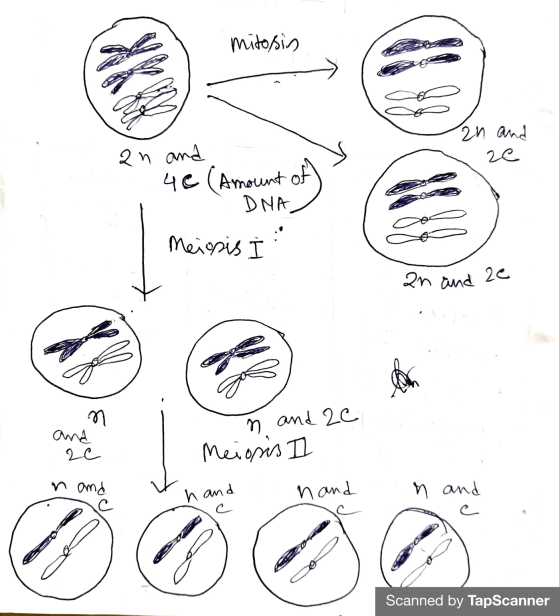
In both mitosis and meiosis II, a spindle forms and separates sister chromatids. While mitosis produces two nuclei, meiosis II produces four nuclei.
Explanation: In both mitosis and meiosis II spindle fibres are attached to kinetochore and sister chromatids of the chromosome separates and moves to the opposite pole in anaphase and anaphase II. After mitosis, each parental cell produces two genetically identical daughter nuclei but after meiosis II, each parent cell produces four haploid daughter nuclei of different allelic combination.
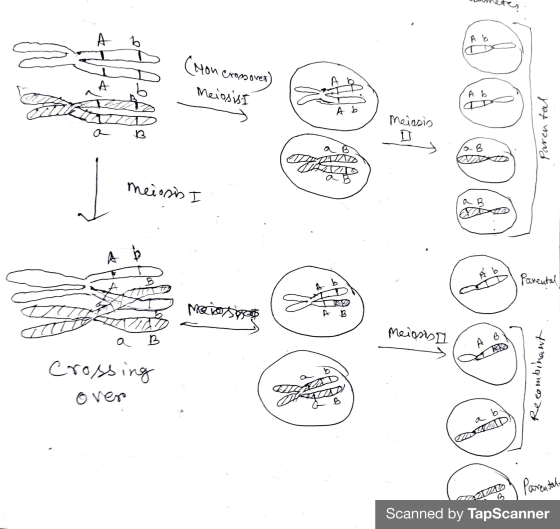
The introduction of novel combinations of alleles in offspring
Explanation: Crossing over is the physical exchange between non-sister chromatids of homologous chromosome. It occurs in the pachytene stage of meiosis I where a new novel combinations of alleles (recombinant genes) are formed by this process. Zygote is formed by a process called fertilization where male and female gametes are fused. Genetically identical offspring are produced in mitosis and when crossing over doesn't occur. Gametes is produced by a process called meiosis.
Add Answer to:
In both mitosis and select answer a spindle forms and separates sister chromatids. While mitosis produces...
Compare mitosis and meiosis by filling in the chart below. Meiosis Mitosis Characteristic Are daughter cells...
 Compare mitosis and meiosis by filling in the chart below. Meiosis Mitosis Characteristic Are daughter cells genetically identical or different from the parent? Involves how many cell divisions? Produces how many daughter cells? Produces haploid or diploid cells? Produces what type of cell? Sister chromatids or homologous chromosomes separate? What are the functions of the cells produced? 05 Answer the following Explain how segregation of chromosomes during meiosis can generate four types of gametes (assume four chromosomes, two homologous pairs)...
all these questions have more than one correct answers 1) Meiosis & mitosis have similarities as...
all these questions have more than one correct answers 1) Meiosis & mitosis have similarities as well as differences. Which of the following represent similarities? a) Both increases genetic variation b) Both change in chromosomes number in daughter cells c) Both only occur in eukaryotes D) DNA replication must occur prior to both e) Both make use of a spindle to separate chromatids 2) Meiosis is a special form of cell division. Select any of the following that applies to...
The following figure shows a cell containing a pair of homologous chromosomes. The alleles for the...
 The following figure shows a cell containing a pair of
homologous chromosomes. The alleles for the F gene are indicated on
each chromosome. Which of the following most accurately represents
the configuration of chromosomes within the cell following DNA
replication, prior to meiosis?
Select one:
a.
b.
c.
d.
Which term is used to describe a pair of similar chromosomes in
a cell:
Select one:
a. bifurcates
b. homologous
c. chromatids
d. replicants
Which of the following statements is TRUE...
The following figure shows a cell containing a pair of
homologous chromosomes. The alleles for the F gene are indicated on
each chromosome. Which of the following most accurately represents
the configuration of chromosomes within the cell following DNA
replication, prior to meiosis?
Select one:
a.
b.
c.
d.
Which term is used to describe a pair of similar chromosomes in
a cell:
Select one:
a. bifurcates
b. homologous
c. chromatids
d. replicants
Which of the following statements is TRUE...
Answer Key: Mitosis only, Meiosis Only, Both Mitosis and Meiosis, Neither In , independent assortment of...
Answer Key: Mitosis only, Meiosis Only, Both Mitosis and Meiosis, Neither In , independent assortment of chromosomes occurs. In , daughter cells are identical to the mother cell. In , homologous chromosomes consisting of sister chromatids line up separately along the metaphase plate. In , the synaptonemal complex forms between homologous chromosomes. A haploid cell can replicate by A gametophyte produces eggs and sperm by Cytokinesis generally occurs in
Match the following terms to the correct definition Match the following terms to the correct definition. 1. term used t...
 Match the following terms to the correct definition
. 1. term used to describe the double stranded chromosomes present after DNA replication alleles A. cell division that results in the formation of B 4 cells each containing haploid number of chromosomes crossing over division of the cytoplasm type of cell division that results in the formation of 2 daughter cells genetically identical to parent cell pairing of homologous sister chromatids during prophase I...
Match the following terms to the correct definition
Match the following terms to the correct definition. 1. term used to describe the double stranded chromosomes present after DNA replication alleles A. cell division that results in the formation of B 4 cells each containing haploid number of chromosomes crossing over division of the cytoplasm type of cell division that results in the formation of 2 daughter cells genetically identical to parent cell pairing of homologous sister chromatids during prophase I...
Quession 14 Which statement about mitosis is true? Select one a. DNA replication is completed in...
 Quession 14 Which statement about mitosis is true? Select one a. DNA replication is completed in prophase. b. The chromosome number in the resulting cells is halved c. Two genetically identical daughter cells are formed. d Crossing over occurs during prophase e. It consists of two nuclear divisions. Quession 15 How does a nucleus in G2 difler from a nucleus in G17 Select one a. DNA synthesis occurs only in G1 phase. b Inactive cells are arrested only in G2...
underers meiosis, how many cells will result, 12) If a eukaryotic cell has 20 chromosomes and...
 underers meiosis, how many cells will result, 12) If a eukaryotic cell has 20 chromosomes and and how many chromosomes will they contain? A) 4 cells, each with 20 chromosomes B) 4 cells, each with 10 chromosomes C) 2 cells, each with 10 chromosomes D) 2 cells, each with 20 chromosomes Answer: 13) Crossing over occurs during which stage of meiosis? A) telophase I B) metaphase II C) anaphase II D) prophase II E) prophase I Answer: 14) Which of...
7. What are chiasmata in a nucleus going through meiosis? a. they are sites where non-sister...
7. What are chiasmata in a nucleus going through meiosis? a. they are sites where non-sister chromatids can exchange genetic material during meiosis. b. they are sites where sister chromatids can exchange genetic material during meiosis. c. they ensure that homologous chromosomes remain homologous after meiosis. d. they increase genetic variation among the products of mitosis. e. they prevent sister chromatids from separating. 8. A chromatid is: a. one of the pairs of homologous chromosomes. b. a homologous chromosome. c....
Which of the following is the result of meiosis? (Select all that apply) A The production...
 Which of the following is the result of meiosis? (Select all that apply) A The production of four genetically identical daughter cells B. The production of four genetically different daughter cels C. No change in chromosome number from the parent cel D. A doubling of the chromosome number E. A reduction in the chromosome number by haif 13. Mitosis and cytokinesis function in which of the following? (Select all that apply) A. Asexual reproduction in unicellular eukaryotic organisms B. Gamete...
Multiple answer: select all that apply. Which of the following charecteristics of cell division are specific...
 Multiple answer: select all that apply. Which of the following charecteristics of cell division are specific to MEIOSIS? [mark all correct answers] a. Chromosomes condense and are visible. b. Sister chromatids line up at the metaphase plate C. Homologous pairs (or tetrads) line up at the metaphase plate. d. Homologous chromosomes form tetrads and where the two homologs touch, synapsis occurs. e. Sister chromatids are pulled to opposite ends of the cell. f. Homolgous pairs of chromosomes are pulled to...
 Compare mitosis and meiosis by filling in the chart below. Meiosis Mitosis Characteristic Are daughter cells genetically identical or different from the parent? Involves how many cell divisions? Produces how many daughter cells? Produces haploid or diploid cells? Produces what type of cell? Sister chromatids or homologous chromosomes separate? What are the functions of the cells produced? 05 Answer the following Explain how segregation of chromosomes during meiosis can generate four types of gametes (assume four chromosomes, two homologous pairs)...
 The following figure shows a cell containing a pair of
homologous chromosomes. The alleles for the F gene are indicated on
each chromosome. Which of the following most accurately represents
the configuration of chromosomes within the cell following DNA
replication, prior to meiosis?
Select one:
a.
b.
c.
d.
Which term is used to describe a pair of similar chromosomes in
a cell:
Select one:
a. bifurcates
b. homologous
c. chromatids
d. replicants
Which of the following statements is TRUE...
The following figure shows a cell containing a pair of
homologous chromosomes. The alleles for the F gene are indicated on
each chromosome. Which of the following most accurately represents
the configuration of chromosomes within the cell following DNA
replication, prior to meiosis?
Select one:
a.
b.
c.
d.
Which term is used to describe a pair of similar chromosomes in
a cell:
Select one:
a. bifurcates
b. homologous
c. chromatids
d. replicants
Which of the following statements is TRUE...
 Match the following terms to the correct definition
. 1. term used to describe the double stranded chromosomes present after DNA replication alleles A. cell division that results in the formation of B 4 cells each containing haploid number of chromosomes crossing over division of the cytoplasm type of cell division that results in the formation of 2 daughter cells genetically identical to parent cell pairing of homologous sister chromatids during prophase I...
Match the following terms to the correct definition
Match the following terms to the correct definition. 1. term used to describe the double stranded chromosomes present after DNA replication alleles A. cell division that results in the formation of B 4 cells each containing haploid number of chromosomes crossing over division of the cytoplasm type of cell division that results in the formation of 2 daughter cells genetically identical to parent cell pairing of homologous sister chromatids during prophase I...
 Quession 14 Which statement about mitosis is true? Select one a. DNA replication is completed in prophase. b. The chromosome number in the resulting cells is halved c. Two genetically identical daughter cells are formed. d Crossing over occurs during prophase e. It consists of two nuclear divisions. Quession 15 How does a nucleus in G2 difler from a nucleus in G17 Select one a. DNA synthesis occurs only in G1 phase. b Inactive cells are arrested only in G2...
 underers meiosis, how many cells will result, 12) If a eukaryotic cell has 20 chromosomes and and how many chromosomes will they contain? A) 4 cells, each with 20 chromosomes B) 4 cells, each with 10 chromosomes C) 2 cells, each with 10 chromosomes D) 2 cells, each with 20 chromosomes Answer: 13) Crossing over occurs during which stage of meiosis? A) telophase I B) metaphase II C) anaphase II D) prophase II E) prophase I Answer: 14) Which of...
 Which of the following is the result of meiosis? (Select all that apply) A The production of four genetically identical daughter cells B. The production of four genetically different daughter cels C. No change in chromosome number from the parent cel D. A doubling of the chromosome number E. A reduction in the chromosome number by haif 13. Mitosis and cytokinesis function in which of the following? (Select all that apply) A. Asexual reproduction in unicellular eukaryotic organisms B. Gamete...
 Multiple answer: select all that apply. Which of the following charecteristics of cell division are specific to MEIOSIS? [mark all correct answers] a. Chromosomes condense and are visible. b. Sister chromatids line up at the metaphase plate C. Homologous pairs (or tetrads) line up at the metaphase plate. d. Homologous chromosomes form tetrads and where the two homologs touch, synapsis occurs. e. Sister chromatids are pulled to opposite ends of the cell. f. Homolgous pairs of chromosomes are pulled to...
Most questions answered within 3 hours.
-
Where is the error in this code sequence?
String s1 = "Hello";
String s2 = "ello";...
asked 10 months ago -
Financial data for Joel de Paris, Inc., for last year
follow:
Joel de Paris, Inc.
Balance...
asked 10 months ago -
Consider this reaction:
Al2(SO4)3 (aq)+ BaCl3
(aq) Al2Cl6 (aq)- +
3BaSO4(s) . What is the...
asked 10 months ago -
Suppose that Savneet is considering increasing her
recent random sample from 20 car rentals to 40...
asked 10 months ago -
Trucks arrive at an unloading terminal at an average rate of 120
per hour.
Trucks arrive...
asked 10 months ago -
Why are methanol and ethanol completely soluble in water while
octanol is not very little soluble....
asked 10 months ago -
A facilities manager at a university reads in a research report
that the mean amount of...
asked 10 months ago -
When the CuSO4 is rehydrated by adding water to the anhydrous
compound, is this an endothermic...
asked 10 months ago -
A ray of sunlight is passing from diamond into crown glass; the
angle of incidence is...
asked 10 months ago -
A block of mass 0.249 kg is placed on top of a light, vertical
spring of...
asked 10 months ago -
how do the kidneys compensate in the presences of acidosis
a) trigger hyperventilate
b) reserve acid...
asked 10 months ago -
Question 501 pts
The rental rate of capital to the firm increases. Which of the
following...
asked 10 months ago