Under certain nonstandard conditions, oxidation byO2(g) of 1 mol of SO2(g) to SO3(g) absorbs 89.3 kJ...
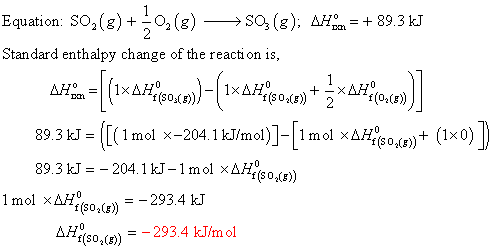
Under certain nonstandard conditions, oxidation byO2(g) of 1 mol of SO2(g) to SO3(g) absorbs 89.3 kJ . The heat of formation of SO3(g) is -204.1 kJ/mol under these conditions.
Find the heat of formation of SO2(g). [in kJ/mol]
Homework Answers
Add Answer to:
Under certain nonstandard conditions, oxidation byO2(g)
of 1 mol of SO2(g) to SO3(g) absorbs 89.3 kJ...
A) An important reaction in the manufacture of sulfuric acid is the oxidation of SO2(g) to SO3(g)...
 a) An important reaction in the manufacture of sulfuric acid is the oxidation of SO2(g) to SO3(g): 2. 2SO2(g) O2(g)SO3(g) dGo, ΔΗο, and ASo values for the reaction are-141 .6kJ/mol,-1984kJ/mol and -187.9J/Kmol, respectively. Evaluate whether or not the reaction is spontaneous under standard conditions at 298K, predict the effect of increasing temperature on spontaneity and calculate the value of T at which the reaction becomes nonspontaneous. b) The reaction described in part (a) is too slow at room temperature to...
The reaction NO2(g) + SO2(g) ⇌NO (g) + SO3(g) has a Kc =10 under some conditions....
The reaction NO2(g) + SO2(g) ⇌NO (g) + SO3(g) has a Kc =10 under some conditions. If the initial concentrations of both NO2 and SO2 are 0.5 M, then calculate the equilibrium concentrations of all four species. [NO2]eq= __________ [SO2]eq= __________ [NO]eq= __________ [SO3]eq= _________
At a certain temperature, 0.780 mol SO2 is placed in a 4.00 L container. 2 SO3(g)...
 At a certain temperature, 0.780 mol SO2 is placed in a 4.00 L container. 2 SO3(g) = 2 SO2(g) + O2(g) At equilibrium, 0.180 mol O2 is present. Calculate Kc. Kc =
Question 55 (1 point) Calculate AGrxn at 398 K under the nonstandard conditions shown below for...
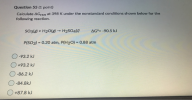 Question 55 (1 point) Calculate AGrxn at 398 K under the nonstandard conditions shown below for the following reaction. SO3(8) + H2O(g) + H2SO4(1) AG°- -90.5 kJ P(SO3) = 0.20 atm, P(H2O) = 0.88 atm 0-93.2 kJ +93.2 kJ -86.2 kJ -84.8kJ +87.8 kJ
One step in the manufacture of sulfuric acid is the oxidation of SO2 gas to SO3:...
One step in the manufacture of sulfuric acid is the oxidation of SO2 gas to SO3: 2SO2 (g) + O2 (g) 2SO3 (g) ΔH = ‒196 kJ mol–1 This reaction is usually performed at 698 K and 1-2 atmospheres of pressure. 2. Use Le Chatelier’s principle to explain why decreasing the temperature of the reaction vessel to 298 K should theoretically increase the yield of SO3 (g)
Sulfur dioxide, SO2(g), can react with oxygen to produce sulfur trioxide, SO3(g), by the reaction 2...
 Sulfur dioxide, SO2(g), can react with oxygen to produce sulfur trioxide, SO3(g), by the reaction 2 50, (g) + O2(g) 250, (g) The standard enthalpies of formation for SO2(g) and SO2(g) are AH (SO2(g)] = –296.8 kJ/mol AH (SO2(g)] = -395.7 kJ/mol Calculate the amount of energy in the form of heat that is produced when a volume of 1.09 L of So, (g) is converted to 1.09 L of So, (g) according to this process at a constant pressure...
For the reaction 2 SO2(g) + O2(g) →→2 SO3(g) AG° = -140.3 kJ and AS =...
 For the reaction 2 SO2(g) + O2(g) →→2 SO3(g) AG° = -140.3 kJ and AS = -187.9 J/K at 306 K and 1 atm. This reaction is (reactant, product) favored under standard conditions at 306 K. The standard enthalpy change for the reaction of 1.79 moles of so,(g) at this temperature would be
1.For the reaction at equilibrium 2 SO3↔ 2 SO2 + O2 (∆Horxn= 198 kJ/mol), if we...
1.For the reaction at equilibrium 2 SO3↔ 2 SO2 + O2 (∆Horxn= 198 kJ/mol), if we increase the reaction temperature, the equilibrium will (1 point ) * No shift None of the above Question lacks sufficient information Shift to the right 2. For the equilibrium reaction 2 SO2(g) + O2(g) ↔ 2 SO3(g), ∆Horxn = -198 kJ/mol. Which one of these factors would cause the equilibrium constant to increase? (1 point ) * Add a catalyst Decrease the temperature None...
For the chemical equation SO2(g)+NO2(g)↽−−⇀SO3(g)+NO(g) the equilibrium constant at a certain temperature is 2.70. At this...
For the chemical equation SO2(g)+NO2(g)↽−−⇀SO3(g)+NO(g) the equilibrium constant at a certain temperature is 2.70. At this temperature, calculate the number of moles of NO2(g) that must be added to 2.20 mol SO2(g) in order to form 1.00 mol SO3(g) at equilibrium. moles of NO2(g):
Calculate AG for the reaction 2 SO2 (g) + O2 (g) → 2 SO3 (g) when...
 Calculate AG for the reaction 2 SO2 (g) + O2 (g) → 2 SO3 (g) when P of SO2 = 0.500 atm, P of O2 = 0.0100 atm, and P of SO3 = 0.100 atm. The value for AGº for this reaction at 298 K is -141.6 kJ. AG= O * kJ Is this reaction spontaneous or non-spontaneous under these conditions? Spontaneous or non-spontaneous? spontaneous
 a) An important reaction in the manufacture of sulfuric acid is the oxidation of SO2(g) to SO3(g): 2. 2SO2(g) O2(g)SO3(g) dGo, ΔΗο, and ASo values for the reaction are-141 .6kJ/mol,-1984kJ/mol and -187.9J/Kmol, respectively. Evaluate whether or not the reaction is spontaneous under standard conditions at 298K, predict the effect of increasing temperature on spontaneity and calculate the value of T at which the reaction becomes nonspontaneous. b) The reaction described in part (a) is too slow at room temperature to...
 At a certain temperature, 0.780 mol SO2 is placed in a 4.00 L container. 2 SO3(g) = 2 SO2(g) + O2(g) At equilibrium, 0.180 mol O2 is present. Calculate Kc. Kc =
 Question 55 (1 point) Calculate AGrxn at 398 K under the nonstandard conditions shown below for the following reaction. SO3(8) + H2O(g) + H2SO4(1) AG°- -90.5 kJ P(SO3) = 0.20 atm, P(H2O) = 0.88 atm 0-93.2 kJ +93.2 kJ -86.2 kJ -84.8kJ +87.8 kJ
 Sulfur dioxide, SO2(g), can react with oxygen to produce sulfur trioxide, SO3(g), by the reaction 2 50, (g) + O2(g) 250, (g) The standard enthalpies of formation for SO2(g) and SO2(g) are AH (SO2(g)] = –296.8 kJ/mol AH (SO2(g)] = -395.7 kJ/mol Calculate the amount of energy in the form of heat that is produced when a volume of 1.09 L of So, (g) is converted to 1.09 L of So, (g) according to this process at a constant pressure...
 For the reaction 2 SO2(g) + O2(g) →→2 SO3(g) AG° = -140.3 kJ and AS = -187.9 J/K at 306 K and 1 atm. This reaction is (reactant, product) favored under standard conditions at 306 K. The standard enthalpy change for the reaction of 1.79 moles of so,(g) at this temperature would be
 Calculate AG for the reaction 2 SO2 (g) + O2 (g) → 2 SO3 (g) when P of SO2 = 0.500 atm, P of O2 = 0.0100 atm, and P of SO3 = 0.100 atm. The value for AGº for this reaction at 298 K is -141.6 kJ. AG= O * kJ Is this reaction spontaneous or non-spontaneous under these conditions? Spontaneous or non-spontaneous? spontaneous
Most questions answered within 3 hours.
-
Where is the error in this code sequence?
String s1 = "Hello";
String s2 = "ello";...
asked 10 months ago -
Financial data for Joel de Paris, Inc., for last year
follow:
Joel de Paris, Inc.
Balance...
asked 10 months ago -
Consider this reaction:
Al2(SO4)3 (aq)+ BaCl3
(aq) Al2Cl6 (aq)- +
3BaSO4(s) . What is the...
asked 10 months ago -
Suppose that Savneet is considering increasing her
recent random sample from 20 car rentals to 40...
asked 10 months ago -
Trucks arrive at an unloading terminal at an average rate of 120
per hour.
Trucks arrive...
asked 10 months ago -
Why are methanol and ethanol completely soluble in water while
octanol is not very little soluble....
asked 10 months ago -
A facilities manager at a university reads in a research report
that the mean amount of...
asked 10 months ago -
When the CuSO4 is rehydrated by adding water to the anhydrous
compound, is this an endothermic...
asked 10 months ago -
A ray of sunlight is passing from diamond into crown glass; the
angle of incidence is...
asked 10 months ago -
A block of mass 0.249 kg is placed on top of a light, vertical
spring of...
asked 10 months ago -
how do the kidneys compensate in the presences of acidosis
a) trigger hyperventilate
b) reserve acid...
asked 10 months ago -
Question 501 pts
The rental rate of capital to the firm increases. Which of the
following...
asked 10 months ago