
Homework Answers
Add Answer to:
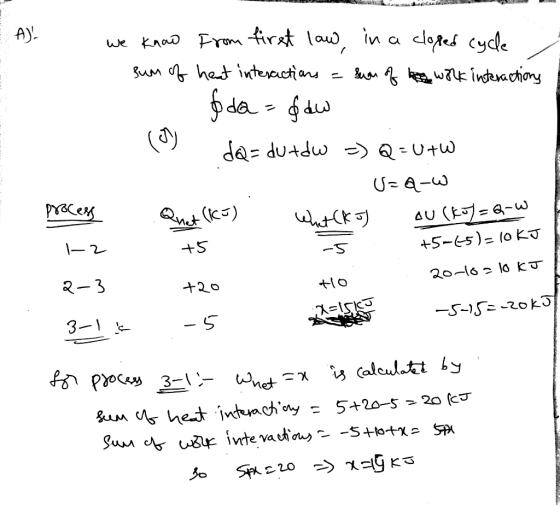
Example 1: Complete the table given below for a closed system undergoing a cycle. Process Qnet...
A "thermodynamic cycle” is a process that creates state changes in a gas in such a...
 A "thermodynamic cycle” is a process that creates state changes in a gas in such a way that the final state is the same as the initial state. Such a process thus forms a closed path in the T-s diagram, and one "cycle” of the process corresponds to one complete progression around this closed path. The "net work” Wner produced by one cycle is the difference between the total work done by the gas and the total work done on...
Problem 7 A system undergoes a thermodynamic cycle consisting of four processes in series. The table...
 Problem 7 A system undergoes a thermodynamic cycle consisting of four processes in series. The table below provides some data, where the familiar sign convention for first-law analysis is adopted. The system is a closed system. Kinetic energy and potential energy effects can be neglected. a. Using first-law analysis and the energy balance for a cycle, find the missing values in the table. b. Determine whether the cycle is a power cycle or refrigeration cycle. c.Show that the net amount...
A gas is taken through the cyclic process shown in the figure below. For one complete cycle how much heat is transferred to the system given the points of interest shown below?
 A gas is taken through the cyclic process shown in the figure below. For one complete cycle how much heat is transferred to the system given the points of interest shown below?
Simple & clear please 3.34 A closed cycle consists of the three processes listed in the...
 Simple & clear please
3.34 A closed cycle consists of the three processes listed in the table below. Fill in the missing values if all the quantities are in Btu/Ib (Hint: A closed cycle returns to its starting point.) Process q Au 200100 100 2+3 3- y150 300
Simple & clear please
3.34 A closed cycle consists of the three processes listed in the table below. Fill in the missing values if all the quantities are in Btu/Ib (Hint: A closed cycle returns to its starting point.) Process q Au 200100 100 2+3 3- y150 300
Multiple choice questions (Explanation Requried) (1). The work between two specified states of a closed system...
Multiple choice questions (Explanation Requried) (1). The work between two specified states of a closed system is the same regardless of the nature of the system and the pass of the process if the process is (A) Isobaric. (B) Isochoric. (C) Isothermal. (D) Adiabatic. (E) All of the above. (2). For a closed system undergoing a cycle the following may differ from zero… (A) Total energy of the system at any time instant. (B) Change in total energy of the...
A closed system undergoes a cyclic process involving three processes. The initial state is defined by...
 A closed system undergoes a cyclic process involving three processes. The initial state is defined by P1-101325 Pa and V-1x10³ m3. Details regarding the three 4-2. processes are as follows Process 1-2: Adiabatic compression (polytropic process with n-1.4) that doubles the pressure. Process 2-3: Constant volume cooling Process 3-1: Constant pressure heating. Complete the table below for the 3-pocess cycle. Ui-f Q-f Wif Process (i-f 1-2 2-3 3-1 -75
Isotherms Adiabatic process T. Figure 1 5. Given is the P-V diagram, a gas system from...
 Isotherms Adiabatic process T. Figure 1 5. Given is the P-V diagram, a gas system from state is undergoing a thermodynamic process which lead to a different state f. Assume the gas is monoatomic and following the ideal gas condition ) Show that the, area under i-flineP 1-7 i) If the system contains 5 mol of this gas with an initially temperature of 293 1 m3 to Vi K. Calculate the work done by the system expanding from V -4m3...
Question 1: (1 2 Marks) A gas contained in a piston and cylinder device passes through...
 Question 1: (1 2 Marks) A gas contained in a piston and cylinder device passes through a complete cycle of four processes. The sum of all heat transferred during the cycle is -340 kJ. The system completes 200 cycles per minutes. Complete the following table showing the method for each process and compute the net rate work output (Wont) in kW. Note that for a cyclic process the change in internal energy is zero (AU = 0) Process Q (kJ/min)...
Refer to Figure 3 (below), depicting a regenerative Rankine cycle with a closed feedwater heater (CFWH) when considering the following system description. Saturated liquid water at a pressure of P b...
 Refer to Figure 3 (below), depicting a regenerative Rankine cycle with a closed feedwater heater (CFWH) when considering the following system description. Saturated liquid water at a pressure of P before entering the CFWH. 12 kPa is pumped to a pressure of Pi-5 MPa After leaving the CFWH as a saturated liquid, the water continues to a Steam Generator which heats the water to a temperature of Ts 600°C. This superheated steam is used to drive a Turbine. A quantity...
An air-standard cycle is executed within a closed piston–cylinder system, and it consists of the following...
 An air-standard cycle is
executed within a closed piston–cylinder system, and it consists of
the following three processes: 1–2 V = Constant heat addition from
100 kPa and 30°C to 850 kPa 2–3 Isothermal expansion until V3 =
8.5V2 3–1 P = Constant heat rejection to the initial state Assume
air has constant properties with cv = 0.718 kJ/kg·K, cp = 1.005
kJ/kg·K, R = 0.287 kJ/kg·K, and k = 1.4.
Required information An air-standard cycle is executed within a...
An air-standard cycle is
executed within a closed piston–cylinder system, and it consists of
the following three processes: 1–2 V = Constant heat addition from
100 kPa and 30°C to 850 kPa 2–3 Isothermal expansion until V3 =
8.5V2 3–1 P = Constant heat rejection to the initial state Assume
air has constant properties with cv = 0.718 kJ/kg·K, cp = 1.005
kJ/kg·K, R = 0.287 kJ/kg·K, and k = 1.4.
Required information An air-standard cycle is executed within a...
 A "thermodynamic cycle” is a process that creates state changes in a gas in such a way that the final state is the same as the initial state. Such a process thus forms a closed path in the T-s diagram, and one "cycle” of the process corresponds to one complete progression around this closed path. The "net work” Wner produced by one cycle is the difference between the total work done by the gas and the total work done on...
 Problem 7 A system undergoes a thermodynamic cycle consisting of four processes in series. The table below provides some data, where the familiar sign convention for first-law analysis is adopted. The system is a closed system. Kinetic energy and potential energy effects can be neglected. a. Using first-law analysis and the energy balance for a cycle, find the missing values in the table. b. Determine whether the cycle is a power cycle or refrigeration cycle. c.Show that the net amount...
 Simple & clear please
3.34 A closed cycle consists of the three processes listed in the table below. Fill in the missing values if all the quantities are in Btu/Ib (Hint: A closed cycle returns to its starting point.) Process q Au 200100 100 2+3 3- y150 300
Simple & clear please
3.34 A closed cycle consists of the three processes listed in the table below. Fill in the missing values if all the quantities are in Btu/Ib (Hint: A closed cycle returns to its starting point.) Process q Au 200100 100 2+3 3- y150 300
 A closed system undergoes a cyclic process involving three processes. The initial state is defined by P1-101325 Pa and V-1x10³ m3. Details regarding the three 4-2. processes are as follows Process 1-2: Adiabatic compression (polytropic process with n-1.4) that doubles the pressure. Process 2-3: Constant volume cooling Process 3-1: Constant pressure heating. Complete the table below for the 3-pocess cycle. Ui-f Q-f Wif Process (i-f 1-2 2-3 3-1 -75
 Isotherms Adiabatic process T. Figure 1 5. Given is the P-V diagram, a gas system from state is undergoing a thermodynamic process which lead to a different state f. Assume the gas is monoatomic and following the ideal gas condition ) Show that the, area under i-flineP 1-7 i) If the system contains 5 mol of this gas with an initially temperature of 293 1 m3 to Vi K. Calculate the work done by the system expanding from V -4m3...
 Question 1: (1 2 Marks) A gas contained in a piston and cylinder device passes through a complete cycle of four processes. The sum of all heat transferred during the cycle is -340 kJ. The system completes 200 cycles per minutes. Complete the following table showing the method for each process and compute the net rate work output (Wont) in kW. Note that for a cyclic process the change in internal energy is zero (AU = 0) Process Q (kJ/min)...
 Refer to Figure 3 (below), depicting a regenerative Rankine cycle with a closed feedwater heater (CFWH) when considering the following system description. Saturated liquid water at a pressure of P before entering the CFWH. 12 kPa is pumped to a pressure of Pi-5 MPa After leaving the CFWH as a saturated liquid, the water continues to a Steam Generator which heats the water to a temperature of Ts 600°C. This superheated steam is used to drive a Turbine. A quantity...
 An air-standard cycle is
executed within a closed piston–cylinder system, and it consists of
the following three processes: 1–2 V = Constant heat addition from
100 kPa and 30°C to 850 kPa 2–3 Isothermal expansion until V3 =
8.5V2 3–1 P = Constant heat rejection to the initial state Assume
air has constant properties with cv = 0.718 kJ/kg·K, cp = 1.005
kJ/kg·K, R = 0.287 kJ/kg·K, and k = 1.4.
Required information An air-standard cycle is executed within a...
An air-standard cycle is
executed within a closed piston–cylinder system, and it consists of
the following three processes: 1–2 V = Constant heat addition from
100 kPa and 30°C to 850 kPa 2–3 Isothermal expansion until V3 =
8.5V2 3–1 P = Constant heat rejection to the initial state Assume
air has constant properties with cv = 0.718 kJ/kg·K, cp = 1.005
kJ/kg·K, R = 0.287 kJ/kg·K, and k = 1.4.
Required information An air-standard cycle is executed within a...
Most questions answered within 3 hours.
-
Where is the error in this code sequence?
String s1 = "Hello";
String s2 = "ello";...
asked 11 months ago -
Financial data for Joel de Paris, Inc., for last year
follow:
Joel de Paris, Inc.
Balance...
asked 11 months ago -
Consider this reaction:
Al2(SO4)3 (aq)+ BaCl3
(aq) Al2Cl6 (aq)- +
3BaSO4(s) . What is the...
asked 11 months ago -
Suppose that Savneet is considering increasing her
recent random sample from 20 car rentals to 40...
asked 11 months ago -
Trucks arrive at an unloading terminal at an average rate of 120
per hour.
Trucks arrive...
asked 11 months ago -
Why are methanol and ethanol completely soluble in water while
octanol is not very little soluble....
asked 11 months ago -
A facilities manager at a university reads in a research report
that the mean amount of...
asked 11 months ago -
When the CuSO4 is rehydrated by adding water to the anhydrous
compound, is this an endothermic...
asked 11 months ago -
A ray of sunlight is passing from diamond into crown glass; the
angle of incidence is...
asked 11 months ago -
A block of mass 0.249 kg is placed on top of a light, vertical
spring of...
asked 11 months ago -
how do the kidneys compensate in the presences of acidosis
a) trigger hyperventilate
b) reserve acid...
asked 11 months ago -
Question 501 pts
The rental rate of capital to the firm increases. Which of the
following...
asked 11 months ago