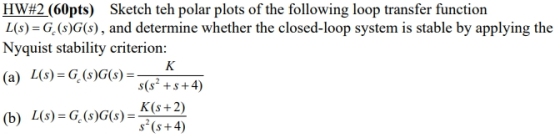
Sketch teh polar plots of the following loop transfer function () () () Ls G sGs = c , and determine whether the closed-loop system is stable by applying the Nyquist stability criterion:
Homework Answers
Request Answer!
We need at least 10 more requests to produce the answer.
0 / 10 have requested this problem solution
The more requests, the faster the answer.
Add Answer to:
Sketch teh polar plots of the following loop transfer function () () () Ls G sGs = c , and determine whether the closed-loop system is stable by applying the Nyquist stability criterion:
(9) Draw a Nyquist plot of the following open-loop transfer function, and determine whether the closed-loop system is stable by using the Nyquist stability criterion. (12 points) Go)HG)(45+8)...
 (9) Draw a Nyquist plot of the following open-loop transfer function, and determine whether the closed-loop system is stable by using the Nyquist stability criterion. (12 points) Go)HG)(45+8)
(9) Draw a Nyquist plot of the following open-loop transfer function, and determine whether the closed-loop system is stable by using the Nyquist stability criterion. (12 points) Go)HG)(45+8)
(9) Draw a Nyquist plot of the following open-loop transfer function, and determine whether the closed-loop system is stable by using the Nyquist stability criterion. (12 points) Go)HG)(45+8)
A unity feedback system has a loop transfer function,dDetermine the range of K for which the system is stable by using the Nyquist stability criterion

Sketch the Nyquist plots of the following loop transfer functions L(S) = Gc(s)G(s), and determine whether...
 Sketch the Nyquist plots of the following loop transfer functions L(S) = Gc(s)G(s), and determine whether the system is stable by applying the Nyquist criterion: KS + 1) (b) L(s) = G (9)G(s) = 318+) If the system is stable, find the maximum value for K by determining the point where the Nyquist plot crosses the u-axis.
Problem #4: Applying Routh's Criterion, use the following transfer function to compute the closed-loop system from...
 Problem #4: Applying Routh's Criterion, use the following transfer function to compute the closed-loop system from applying a unity feedback. K(s +4) Gis)- NS D(s) (s+0.4s+4)(s+1)s + 0.5)] a) Find the range of K that makes the system stable? Show your work. You are free to use MATLAB to help with the computation to get to your end results.
A closed-loop system has the following transfer function. To make the system stable, the value of...
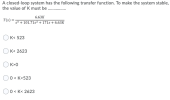 A closed-loop system has the following transfer function. To make the system stable, the value of K must be ....... 6.63K T(s) $3 + 101.7152 + 1715 + 6.63K K< 523 K< 2623 K>0 0 <K«523 0<K< 2623
4. Consider a unity-feedback control system with the following open-loop transfer function: G(s)3 Sketch a Nyquist...
 4. Consider a unity-feedback control system with the following open-loop transfer function: G(s)3 Sketch a Nyquist plot of G(s) and examine the stability of the system.
Sketch the Bode plots for the transfer function. Determine the : (i)Phase Margin (ii)Gain Margin (iii )Stability of the system.

For the following closed-loop transfer functions, sketch the bode plots (magnitude and phase), id...
 For the following closed-loop transfer functions, sketch the bode plots (magnitude and phase), iden- tifying the zero gain, the slopes (in Decibels) and the high-frequency cutt-off rate. Then verify with Matlab C()101 100) s 0.1) (s 10) 100 s(s +10)2 G(s) = (56) G(s) = s+10(s+100)
For the following closed-loop transfer functions, sketch the bode plots (magnitude and phase), iden- tifying the zero gain, the slopes (in Decibels) and the high-frequency cutt-off rate. Then verify with Matlab C()101 100) s...
For the following closed-loop transfer functions, sketch the bode plots (magnitude and phase), iden- tifying the zero gain, the slopes (in Decibels) and the high-frequency cutt-off rate. Then verify with Matlab C()101 100) s 0.1) (s 10) 100 s(s +10)2 G(s) = (56) G(s) = s+10(s+100)
For the following closed-loop transfer functions, sketch the bode plots (magnitude and phase), iden- tifying the zero gain, the slopes (in Decibels) and the high-frequency cutt-off rate. Then verify with Matlab C()101 100) s...
For the following closed-loop transfer functions, sketch the bode plots (magnitude and phase), id...
 For the following closed-loop transfer functions, sketch the bode plots (magnitude and phase), iden- tifying the zero gain, the slopes (in Decibels) and the high-frequency cutt-off rate. Then verify with Matlab (6) wn = 1, 〈 0.0.1, and 0.707. (8) Assuming the system of Problem 6 above, and an input of r(t) = 30sin(1000 t), use your bode plot to obtain the steady-state response
For the following closed-loop transfer functions, sketch the bode plots (magnitude and phase), iden- tifying the...
For the following closed-loop transfer functions, sketch the bode plots (magnitude and phase), iden- tifying the zero gain, the slopes (in Decibels) and the high-frequency cutt-off rate. Then verify with Matlab (6) wn = 1, 〈 0.0.1, and 0.707. (8) Assuming the system of Problem 6 above, and an input of r(t) = 30sin(1000 t), use your bode plot to obtain the steady-state response
For the following closed-loop transfer functions, sketch the bode plots (magnitude and phase), iden- tifying the...
4. (10 points) For the feedback system with open loop transfer function 16/3 a. (6 pts) Draw the Root Locus and Nyquist plot of the system with no 16/3 S41 Using Nyquist stability criterion, find...
 4. (10 points) For the feedback system with open loop transfer function 16/3 a. (6 pts) Draw the Root Locus and Nyquist plot of the system with no 16/3 S41 Using Nyquist stability criterion, find the critical value of the delay. b. (4 pts)
4. (10 points) For the feedback system with open loop transfer function 16/3 a. (6 pts) Draw the Root Locus and Nyquist plot of the system with no 16/3 S41 Using Nyquist stability criterion, find the...
4. (10 points) For the feedback system with open loop transfer function 16/3 a. (6 pts) Draw the Root Locus and Nyquist plot of the system with no 16/3 S41 Using Nyquist stability criterion, find the critical value of the delay. b. (4 pts)
4. (10 points) For the feedback system with open loop transfer function 16/3 a. (6 pts) Draw the Root Locus and Nyquist plot of the system with no 16/3 S41 Using Nyquist stability criterion, find the...
 (9) Draw a Nyquist plot of the following open-loop transfer function, and determine whether the closed-loop system is stable by using the Nyquist stability criterion. (12 points) Go)HG)(45+8)
(9) Draw a Nyquist plot of the following open-loop transfer function, and determine whether the closed-loop system is stable by using the Nyquist stability criterion. (12 points) Go)HG)(45+8)
(9) Draw a Nyquist plot of the following open-loop transfer function, and determine whether the closed-loop system is stable by using the Nyquist stability criterion. (12 points) Go)HG)(45+8)
 Sketch the Nyquist plots of the following loop transfer functions L(S) = Gc(s)G(s), and determine whether the system is stable by applying the Nyquist criterion: KS + 1) (b) L(s) = G (9)G(s) = 318+) If the system is stable, find the maximum value for K by determining the point where the Nyquist plot crosses the u-axis.
 Problem #4: Applying Routh's Criterion, use the following transfer function to compute the closed-loop system from applying a unity feedback. K(s +4) Gis)- NS D(s) (s+0.4s+4)(s+1)s + 0.5)] a) Find the range of K that makes the system stable? Show your work. You are free to use MATLAB to help with the computation to get to your end results.
 A closed-loop system has the following transfer function. To make the system stable, the value of K must be ....... 6.63K T(s) $3 + 101.7152 + 1715 + 6.63K K< 523 K< 2623 K>0 0 <K«523 0<K< 2623
 4. Consider a unity-feedback control system with the following open-loop transfer function: G(s)3 Sketch a Nyquist plot of G(s) and examine the stability of the system.
 For the following closed-loop transfer functions, sketch the bode plots (magnitude and phase), iden- tifying the zero gain, the slopes (in Decibels) and the high-frequency cutt-off rate. Then verify with Matlab C()101 100) s 0.1) (s 10) 100 s(s +10)2 G(s) = (56) G(s) = s+10(s+100)
For the following closed-loop transfer functions, sketch the bode plots (magnitude and phase), iden- tifying the zero gain, the slopes (in Decibels) and the high-frequency cutt-off rate. Then verify with Matlab C()101 100) s...
For the following closed-loop transfer functions, sketch the bode plots (magnitude and phase), iden- tifying the zero gain, the slopes (in Decibels) and the high-frequency cutt-off rate. Then verify with Matlab C()101 100) s 0.1) (s 10) 100 s(s +10)2 G(s) = (56) G(s) = s+10(s+100)
For the following closed-loop transfer functions, sketch the bode plots (magnitude and phase), iden- tifying the zero gain, the slopes (in Decibels) and the high-frequency cutt-off rate. Then verify with Matlab C()101 100) s...
 For the following closed-loop transfer functions, sketch the bode plots (magnitude and phase), iden- tifying the zero gain, the slopes (in Decibels) and the high-frequency cutt-off rate. Then verify with Matlab (6) wn = 1, 〈 0.0.1, and 0.707. (8) Assuming the system of Problem 6 above, and an input of r(t) = 30sin(1000 t), use your bode plot to obtain the steady-state response
For the following closed-loop transfer functions, sketch the bode plots (magnitude and phase), iden- tifying the...
For the following closed-loop transfer functions, sketch the bode plots (magnitude and phase), iden- tifying the zero gain, the slopes (in Decibels) and the high-frequency cutt-off rate. Then verify with Matlab (6) wn = 1, 〈 0.0.1, and 0.707. (8) Assuming the system of Problem 6 above, and an input of r(t) = 30sin(1000 t), use your bode plot to obtain the steady-state response
For the following closed-loop transfer functions, sketch the bode plots (magnitude and phase), iden- tifying the...
 4. (10 points) For the feedback system with open loop transfer function 16/3 a. (6 pts) Draw the Root Locus and Nyquist plot of the system with no 16/3 S41 Using Nyquist stability criterion, find the critical value of the delay. b. (4 pts)
4. (10 points) For the feedback system with open loop transfer function 16/3 a. (6 pts) Draw the Root Locus and Nyquist plot of the system with no 16/3 S41 Using Nyquist stability criterion, find the...
4. (10 points) For the feedback system with open loop transfer function 16/3 a. (6 pts) Draw the Root Locus and Nyquist plot of the system with no 16/3 S41 Using Nyquist stability criterion, find the critical value of the delay. b. (4 pts)
4. (10 points) For the feedback system with open loop transfer function 16/3 a. (6 pts) Draw the Root Locus and Nyquist plot of the system with no 16/3 S41 Using Nyquist stability criterion, find the...
Most questions answered within 3 hours.
-
Where is the error in this code sequence?
String s1 = "Hello";
String s2 = "ello";...
asked 11 months ago -
Financial data for Joel de Paris, Inc., for last year
follow:
Joel de Paris, Inc.
Balance...
asked 11 months ago -
Consider this reaction:
Al2(SO4)3 (aq)+ BaCl3
(aq) Al2Cl6 (aq)- +
3BaSO4(s) . What is the...
asked 11 months ago -
Suppose that Savneet is considering increasing her
recent random sample from 20 car rentals to 40...
asked 11 months ago -
Trucks arrive at an unloading terminal at an average rate of 120
per hour.
Trucks arrive...
asked 11 months ago -
Why are methanol and ethanol completely soluble in water while
octanol is not very little soluble....
asked 11 months ago -
A facilities manager at a university reads in a research report
that the mean amount of...
asked 11 months ago -
When the CuSO4 is rehydrated by adding water to the anhydrous
compound, is this an endothermic...
asked 11 months ago -
A ray of sunlight is passing from diamond into crown glass; the
angle of incidence is...
asked 11 months ago -
A block of mass 0.249 kg is placed on top of a light, vertical
spring of...
asked 11 months ago -
how do the kidneys compensate in the presences of acidosis
a) trigger hyperventilate
b) reserve acid...
asked 11 months ago -
Question 501 pts
The rental rate of capital to the firm increases. Which of the
following...
asked 11 months ago