
Homework Answers
Add Answer to:
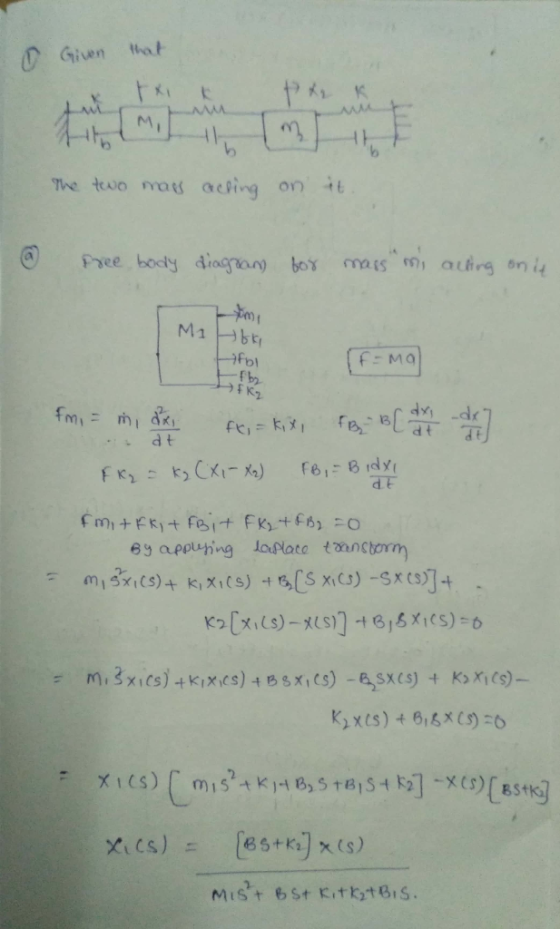
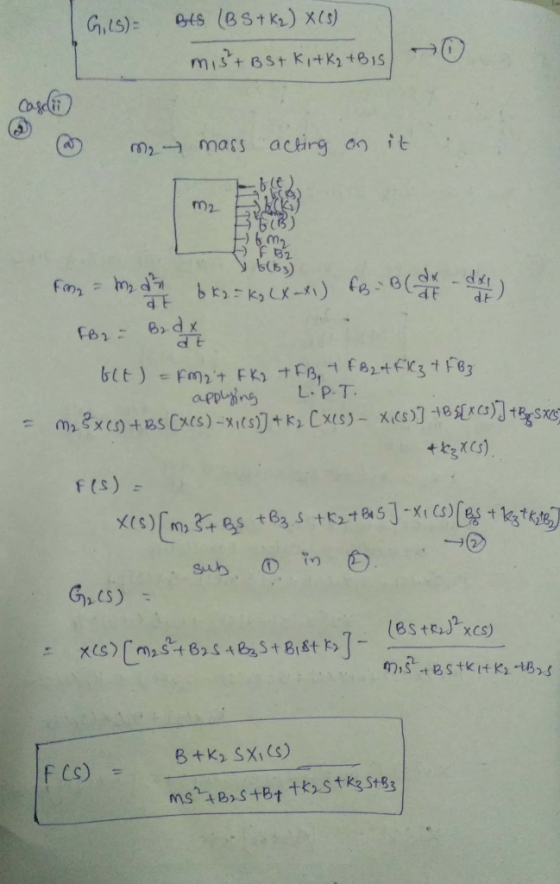
3. A bandage is made up of two identical patches of equal mass M, linked by...
Figure 1 shows a system comprising a bar with mass m=12 kg and the length of...
 Figure 1 shows a system comprising a bar with mass m=12 kg and
the length of the bar L=2 m, two springs with stiffness k_t=1000
N-m/rad and k=2000 N/m, one damper with damping coefficient c=50
N-s/m and two additive masses at the end of the bar, where each
mass (M) is equal to 50 kg. The rotation about the hinge A,
measured with respect to the static equilibrium position of the
system is θ(t). The system is excited by force...
Figure 1 shows a system comprising a bar with mass m=12 kg and
the length of the bar L=2 m, two springs with stiffness k_t=1000
N-m/rad and k=2000 N/m, one damper with damping coefficient c=50
N-s/m and two additive masses at the end of the bar, where each
mass (M) is equal to 50 kg. The rotation about the hinge A,
measured with respect to the static equilibrium position of the
system is θ(t). The system is excited by force...
3. Consider the spring - mass system shown below, consisting of two masses mi and ma sus- pended ...
 3. Consider the spring - mass system shown below, consisting of two masses mi and ma sus- pended from springs with spring constants ki and k, respectively. Assume that there is no damping in the system. a) Show that the displacements z1 and 2 of the masses from their respective equilibrium positions satisfy the differential equations b) Use the above resuit to show that the spring-mass system satisfies the following fourth order differential equation. and ) Find the general solution...
Consider the forced vibration in Figure 1. We mass, m Figure 1: Forced Vibration 1. Use...
 Consider the forced vibration in Figure 1. We mass, m Figure 1: Forced Vibration 1. Use a free-body diagram and apply Newton's 2nd Law to show that the upward displacement of the mass, r(t), can be modelled with the ODE da da mdt2 + cat + kz = F(t) where k is the spring coefficient and c is the damping coefficient. = 2 kg, c = For the remainder of the questions, use the following values: m 8 Ns/m, k...
6.(16) Consider the spring-mass system shown, consisting of two unit masses m, and my suspended from...
 6.(16) Consider the spring-mass system shown, consisting of two unit masses m, and my suspended from springs with constants k, and ky, respectively. Assuming that there is no damping in the system, the displacement y(t) of the bottom mass m, from its equilibrium positions satisfies the 4-order equation (4) y2 + k + k)y + k_k2yz = e-2, where f(t) = e-2 is an outside force driving the motion of m. If a 24 N weight would stretch the top...
6. A mass of 2 kilogram is attached to a spring whose constant is 4 N/m, and the entire system is...
 6. A mass of 2 kilogram is attached to a spring whose constant is 4 N/m, and the entire system is then submerged in a liquid that inparts a damping force equal to 4 tines the instantansous velocity. At t = 0 the mass is released from the equilibrium position with no initial velocity. An external force t)4t-3) is applied. (a) Write (t), the external force, as a piecewise function and sketch its graph b) Write the initial-value problem (c)Solve...
3. Consider the spring - mass system shown below, consisting of two masses mi and m2 sus- pended ...
 3. Consider the spring - mass system shown below, consisting of two masses mi and m2 sus- pended from springs with spring constants ki and k2, respectively. Assume that there is no damping in the system. a) Show that the displacements ai and r2 of the masses from their respective equilibrium positions satisfy the differential equations b) Use the above result to show that the spring-mass system satisfies the following fourth order differential equation and c) Find the general solution...
(1 point) A mass of M = 4 on a spring with k-6 and a damping...
 (1 point) A mass of M = 4 on a spring with k-6 and a damping constant D = 4 . Suppose that F-3. Using forcing function Focos(ut), find the w that causes the forced response with largest amplitude.
The two uniform bars are identical. The mass and length of each bar are m= 30...
 The two uniform bars are identical. The mass and length of each bar are m= 30 kg and L=1.6 m. The top bar rotates around point A, coordinate , locates the bar, and force F(t) = 500 sin 60t (in N) is being applied to the end of the bar. A spring with k = 10000 N/m connects the top bar to a fixed point. The bottom bar rotates around its center at point B and coordinate 0g locates this...
1. Given the spring-mass-damper system in the figure below T3 T1 T2 b2 b1 k3 (a) Find the equatio...
 1. Given the spring-mass-damper system in the figure below T3 T1 T2 b2 b1 k3 (a) Find the equations of motion for each of the masses 脳. Fi(s) (b) Assume F1 0 and find the transfer function (c) Assume Fs 0 and find the transfer function (d) Write the equations in matrix-vector form: M.ї + Bi + Kx-F where z is a 3 x 1 vector with the displacements r,2, r3 as components, M is the mass matrix, B is...
Two cylinders, each having mass m, are linked by a connecting rod whose mass is negligible. A hor...
 Two cylinders, each having mass m, are linked by a connecting rod whose mass is negligible. A horizontal force F(t) is applied to the right cylinder, and neither cylinder slips in its rolling motion. In the initial position, the angle θ locating the connecting pin is zero. Derive the equation of motion for this angle. We were unable to transcribe this image
Two cylinders, each having mass m, are linked by a connecting rod whose mass is negligible. A horizontal...
Two cylinders, each having mass m, are linked by a connecting rod whose mass is negligible. A horizontal force F(t) is applied to the right cylinder, and neither cylinder slips in its rolling motion. In the initial position, the angle θ locating the connecting pin is zero. Derive the equation of motion for this angle. We were unable to transcribe this image
Two cylinders, each having mass m, are linked by a connecting rod whose mass is negligible. A horizontal...
 Figure 1 shows a system comprising a bar with mass m=12 kg and
the length of the bar L=2 m, two springs with stiffness k_t=1000
N-m/rad and k=2000 N/m, one damper with damping coefficient c=50
N-s/m and two additive masses at the end of the bar, where each
mass (M) is equal to 50 kg. The rotation about the hinge A,
measured with respect to the static equilibrium position of the
system is θ(t). The system is excited by force...
Figure 1 shows a system comprising a bar with mass m=12 kg and
the length of the bar L=2 m, two springs with stiffness k_t=1000
N-m/rad and k=2000 N/m, one damper with damping coefficient c=50
N-s/m and two additive masses at the end of the bar, where each
mass (M) is equal to 50 kg. The rotation about the hinge A,
measured with respect to the static equilibrium position of the
system is θ(t). The system is excited by force...
 3. Consider the spring - mass system shown below, consisting of two masses mi and ma sus- pended from springs with spring constants ki and k, respectively. Assume that there is no damping in the system. a) Show that the displacements z1 and 2 of the masses from their respective equilibrium positions satisfy the differential equations b) Use the above resuit to show that the spring-mass system satisfies the following fourth order differential equation. and ) Find the general solution...
 Consider the forced vibration in Figure 1. We mass, m Figure 1: Forced Vibration 1. Use a free-body diagram and apply Newton's 2nd Law to show that the upward displacement of the mass, r(t), can be modelled with the ODE da da mdt2 + cat + kz = F(t) where k is the spring coefficient and c is the damping coefficient. = 2 kg, c = For the remainder of the questions, use the following values: m 8 Ns/m, k...
 6.(16) Consider the spring-mass system shown, consisting of two unit masses m, and my suspended from springs with constants k, and ky, respectively. Assuming that there is no damping in the system, the displacement y(t) of the bottom mass m, from its equilibrium positions satisfies the 4-order equation (4) y2 + k + k)y + k_k2yz = e-2, where f(t) = e-2 is an outside force driving the motion of m. If a 24 N weight would stretch the top...
 6. A mass of 2 kilogram is attached to a spring whose constant is 4 N/m, and the entire system is then submerged in a liquid that inparts a damping force equal to 4 tines the instantansous velocity. At t = 0 the mass is released from the equilibrium position with no initial velocity. An external force t)4t-3) is applied. (a) Write (t), the external force, as a piecewise function and sketch its graph b) Write the initial-value problem (c)Solve...
 3. Consider the spring - mass system shown below, consisting of two masses mi and m2 sus- pended from springs with spring constants ki and k2, respectively. Assume that there is no damping in the system. a) Show that the displacements ai and r2 of the masses from their respective equilibrium positions satisfy the differential equations b) Use the above result to show that the spring-mass system satisfies the following fourth order differential equation and c) Find the general solution...
 (1 point) A mass of M = 4 on a spring with k-6 and a damping constant D = 4 . Suppose that F-3. Using forcing function Focos(ut), find the w that causes the forced response with largest amplitude.
 The two uniform bars are identical. The mass and length of each bar are m= 30 kg and L=1.6 m. The top bar rotates around point A, coordinate , locates the bar, and force F(t) = 500 sin 60t (in N) is being applied to the end of the bar. A spring with k = 10000 N/m connects the top bar to a fixed point. The bottom bar rotates around its center at point B and coordinate 0g locates this...
 1. Given the spring-mass-damper system in the figure below T3 T1 T2 b2 b1 k3 (a) Find the equations of motion for each of the masses 脳. Fi(s) (b) Assume F1 0 and find the transfer function (c) Assume Fs 0 and find the transfer function (d) Write the equations in matrix-vector form: M.ї + Bi + Kx-F where z is a 3 x 1 vector with the displacements r,2, r3 as components, M is the mass matrix, B is...
 Two cylinders, each having mass m, are linked by a connecting rod whose mass is negligible. A horizontal force F(t) is applied to the right cylinder, and neither cylinder slips in its rolling motion. In the initial position, the angle θ locating the connecting pin is zero. Derive the equation of motion for this angle. We were unable to transcribe this image
Two cylinders, each having mass m, are linked by a connecting rod whose mass is negligible. A horizontal...
Two cylinders, each having mass m, are linked by a connecting rod whose mass is negligible. A horizontal force F(t) is applied to the right cylinder, and neither cylinder slips in its rolling motion. In the initial position, the angle θ locating the connecting pin is zero. Derive the equation of motion for this angle. We were unable to transcribe this image
Two cylinders, each having mass m, are linked by a connecting rod whose mass is negligible. A horizontal...
Most questions answered within 3 hours.
-
Where is the error in this code sequence?
String s1 = "Hello";
String s2 = "ello";...
asked 11 months ago -
Financial data for Joel de Paris, Inc., for last year
follow:
Joel de Paris, Inc.
Balance...
asked 11 months ago -
Consider this reaction:
Al2(SO4)3 (aq)+ BaCl3
(aq) Al2Cl6 (aq)- +
3BaSO4(s) . What is the...
asked 11 months ago -
Suppose that Savneet is considering increasing her
recent random sample from 20 car rentals to 40...
asked 11 months ago -
Trucks arrive at an unloading terminal at an average rate of 120
per hour.
Trucks arrive...
asked 11 months ago -
Why are methanol and ethanol completely soluble in water while
octanol is not very little soluble....
asked 11 months ago -
A facilities manager at a university reads in a research report
that the mean amount of...
asked 11 months ago -
When the CuSO4 is rehydrated by adding water to the anhydrous
compound, is this an endothermic...
asked 11 months ago -
A ray of sunlight is passing from diamond into crown glass; the
angle of incidence is...
asked 11 months ago -
A block of mass 0.249 kg is placed on top of a light, vertical
spring of...
asked 11 months ago -
how do the kidneys compensate in the presences of acidosis
a) trigger hyperventilate
b) reserve acid...
asked 11 months ago -
Question 501 pts
The rental rate of capital to the firm increases. Which of the
following...
asked 11 months ago