
Homework Answers
Add Answer to:
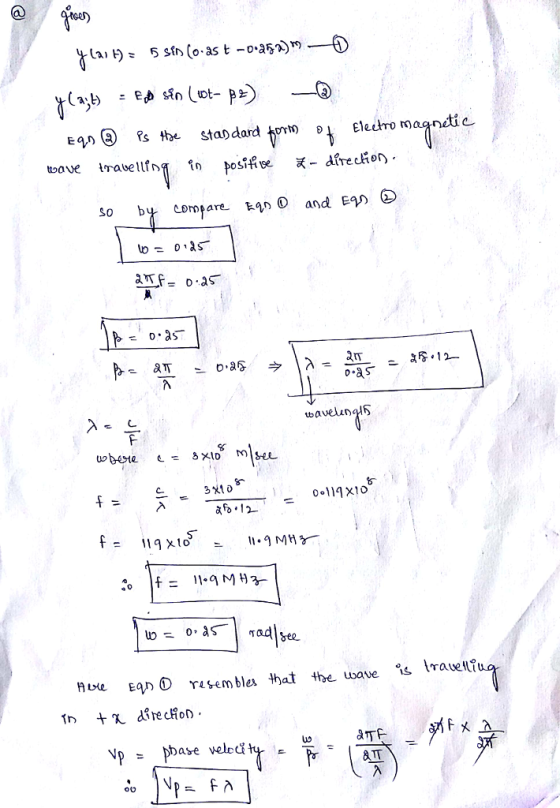
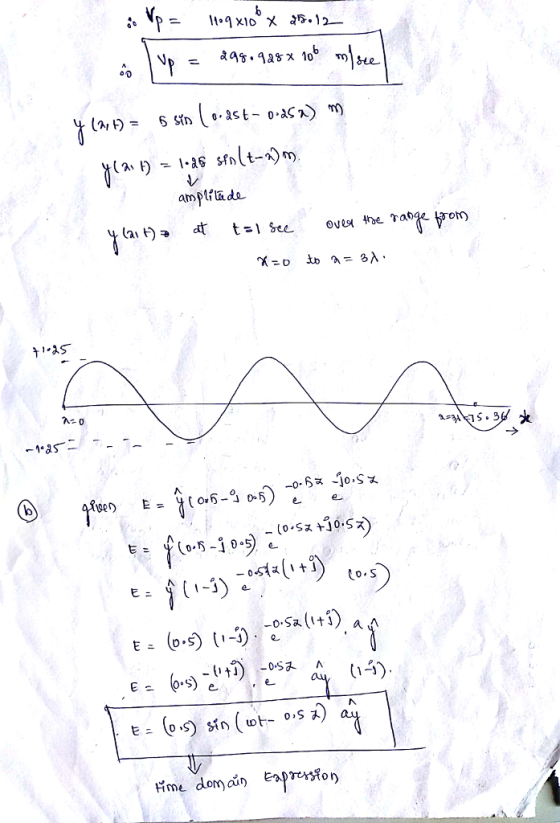
Problem 1 (a) The height of an (m). Determine the phase velocity and the wavelength, and...
(1) A wave is traveling in the positive y direction with wavelength λ = 12 m...
(1) A wave is traveling in the positive y direction with wavelength λ = 12 m and frequency f = 1/6 Hz. At t = 0, there is no displacement of the medium at the origin, but its amplitude is 6m. (a) Write the equation for the displacement of this wave as a function of position and time. (b) Draw a quantitatively accurate history graph (at y = 3m) and snapshot graph (at t = 2s). (c) What is the...
(1) A wave is traveling in the positive-y direction with wavelength λ “ 12 m and...
(1) A wave is traveling in the positive-y direction with wavelength λ “ 12 m and frequency f “ 1 6 Hz. At t “ 0, there is no displacement of the medium at the origin, but its amplitude is 6m. (a) Write the equation for the displacement of this wave as a function of position and time. (b) Draw a quantitatively accurate history graph (at y “ 3m) and snapshot graph (at t “ 2s). (c) What is the...
Calculate the wavelength λ in steel of longitudinal harmonic waves that correspond to the commonly-used UT...
Calculate the wavelength λ in steel of longitudinal harmonic waves that correspond to the commonly-used UT frequency of = 5 Mhz. Longitudinal wave velocity in steel = 5940 m/s and ρ=7800 kg/m3. Then use the use the answer to write the expression for longitudinal traveling waves that are excited by a piezoelectric crystal at the end of a thin semi-infinite steel rod extending in the x direction with a 5Mhz frequency and ± 1 nm vibration amplitude (also in the...
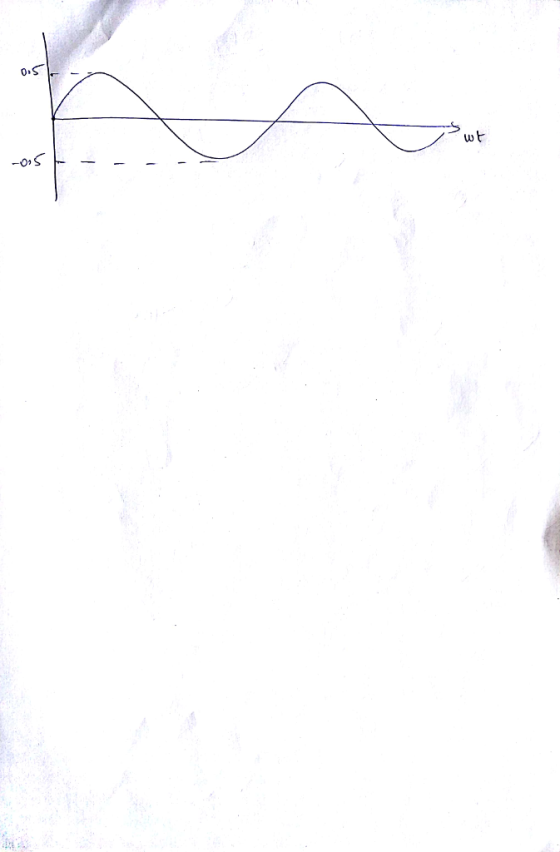
In a medium characterised by a = 0,4 = Ho,€, an electromagnetic wave is described by;...
 In a medium characterised by a = 0,4 = Ho,€, an electromagnetic wave is described by; E = Em sin(wt -ky) a, V/m a) find an expression for; (1 marks) ii. B (5 marks) b) Sketch E and Hatt=0. (3 marks) c) The electromagnetic wave enters a region and propagates such that; i. D Em = 50 V /m, do = 2mx10? rad/s, k = 5 i. State the direction of wave propagation ii. Compute the period T, velocity v...
(1) A wave is traveling in the positive-y direction with wavelength λ f Hz. At t...
 (1) A wave is traveling in the positive-y direction with wavelength λ f Hz. At t is 6m 12 m and frequency 0, there is no displacement of the medium at the origin, but its amplitude a) Write the equation for the displacement of this wave as a function of position and (b) Draw a quantitatively accurate history graph (at y 3m) and snapshot graph (at t 2s) (c) What is the speed of the wave?
Light, radiant heat (infrared radiation), X rays, and radio waves are all examples of traveling electromagnetic...
 Light, radiant heat (infrared radiation), X rays, and radio waves are all examples of traveling electromagnetic waves. Electromagnetic waves comprise combinations of electric and magnetic fields that are mutually compatible in the sense that the changes in one generate the other. The simplest form of a traveling electromagnetic wave is a plane wave. For a wave traveling in the x direction whose electric field is in the y direction, the electric and magnetic fields are given by Ē = E,...
Timer Evalt The components of the electric field in an electromagnetic wave traveling in vacuum are...
 Timer Evalt The components of the electric field in an electromagnetic wave traveling in vacuum are described by Ex = 0, y = 0, and Ez = 4.69 sin(3.81x - wt) V/m, where x is measured in meters and t in seconds. Calculate the frequency of the wave. E Tries 0/12 Calculate the wavelength of the wave. ** Tries 0/12 Calculate the amplitude of the magnetic field of the wave. SK Tries 0/12 Calculate the intensity of the wave. Tries...
3.A uniform electromagnetic plane wave is normally incident from the air region ( medium #1 with+ η = η。= 120π ) upon the planar interface separating air from a lossy dielectric medium (medium #...
 3.A uniform electromagnetic plane wave is normally incident from the air region ( medium #1 with+ η = η。= 120π ) upon the planar interface separating air from a lossy dielectric medium (medium #2 with intrinsic impedance 20π + jlOr ). The incident plane wave in air has a phasor electric field given by E(x)-le, x<0 Find: (a) the frequency f (Hertz) (b) the magnitude and the phase of the reflected phasor electric field E as a function of coordinates...
Electromagnetic Waves 2 1 2 3 4 A plane monochromatic electromagnetic wave with wavelength 1 =...
 Electromagnetic Waves 2 1 2 3 4 A plane monochromatic electromagnetic wave with wavelength 1 = 2.6 cm, propagates through a vacuum. Its magnetic field is described by B = (B,i+Byj) cos(kx + wt) where B, = 2.7 x 10⁻⁶ T, B, - 5.9 X 10⁶T, and i-hat and j-hat are the unit vectors in the +x and +y directions, respectively. 1) What is f, the frequency of this wave? 0 GHz Submit 2) What is I, the intensity of...
A plane monochromatic electromagnetic wave with wavelength 1 = 4.1 cm, propagates through a vacuum. Its...
 A plane monochromatic electromagnetic wave with wavelength 1 = 4.1 cm, propagates through a vacuum. Its magnetic field is described by B = (Bxi+Byj) cos(kz + wt) where Bx = 2 x 10⁻⁶ T, By = 3.4 x 10⁻⁶ T, and i-hat and j-hat are the unit vectors in the +x and +y directions, respectively. 3) What is Sy, the z-component of the Poynting vector at (x = 0, y = 0, z = 0) at t = 0? W/m2...
 In a medium characterised by a = 0,4 = Ho,€, an electromagnetic wave is described by; E = Em sin(wt -ky) a, V/m a) find an expression for; (1 marks) ii. B (5 marks) b) Sketch E and Hatt=0. (3 marks) c) The electromagnetic wave enters a region and propagates such that; i. D Em = 50 V /m, do = 2mx10? rad/s, k = 5 i. State the direction of wave propagation ii. Compute the period T, velocity v...
 (1) A wave is traveling in the positive-y direction with wavelength λ f Hz. At t is 6m 12 m and frequency 0, there is no displacement of the medium at the origin, but its amplitude a) Write the equation for the displacement of this wave as a function of position and (b) Draw a quantitatively accurate history graph (at y 3m) and snapshot graph (at t 2s) (c) What is the speed of the wave?
 Light, radiant heat (infrared radiation), X rays, and radio waves are all examples of traveling electromagnetic waves. Electromagnetic waves comprise combinations of electric and magnetic fields that are mutually compatible in the sense that the changes in one generate the other. The simplest form of a traveling electromagnetic wave is a plane wave. For a wave traveling in the x direction whose electric field is in the y direction, the electric and magnetic fields are given by Ē = E,...
 Timer Evalt The components of the electric field in an electromagnetic wave traveling in vacuum are described by Ex = 0, y = 0, and Ez = 4.69 sin(3.81x - wt) V/m, where x is measured in meters and t in seconds. Calculate the frequency of the wave. E Tries 0/12 Calculate the wavelength of the wave. ** Tries 0/12 Calculate the amplitude of the magnetic field of the wave. SK Tries 0/12 Calculate the intensity of the wave. Tries...
 3.A uniform electromagnetic plane wave is normally incident from the air region ( medium #1 with+ η = η。= 120π ) upon the planar interface separating air from a lossy dielectric medium (medium #2 with intrinsic impedance 20π + jlOr ). The incident plane wave in air has a phasor electric field given by E(x)-le, x<0 Find: (a) the frequency f (Hertz) (b) the magnitude and the phase of the reflected phasor electric field E as a function of coordinates...
 Electromagnetic Waves 2 1 2 3 4 A plane monochromatic electromagnetic wave with wavelength 1 = 2.6 cm, propagates through a vacuum. Its magnetic field is described by B = (B,i+Byj) cos(kx + wt) where B, = 2.7 x 10⁻⁶ T, B, - 5.9 X 10⁶T, and i-hat and j-hat are the unit vectors in the +x and +y directions, respectively. 1) What is f, the frequency of this wave? 0 GHz Submit 2) What is I, the intensity of...
 A plane monochromatic electromagnetic wave with wavelength 1 = 4.1 cm, propagates through a vacuum. Its magnetic field is described by B = (Bxi+Byj) cos(kz + wt) where Bx = 2 x 10⁻⁶ T, By = 3.4 x 10⁻⁶ T, and i-hat and j-hat are the unit vectors in the +x and +y directions, respectively. 3) What is Sy, the z-component of the Poynting vector at (x = 0, y = 0, z = 0) at t = 0? W/m2...
Most questions answered within 3 hours.
-
Where is the error in this code sequence?
String s1 = "Hello";
String s2 = "ello";...
asked 10 months ago -
Financial data for Joel de Paris, Inc., for last year
follow:
Joel de Paris, Inc.
Balance...
asked 10 months ago -
Consider this reaction:
Al2(SO4)3 (aq)+ BaCl3
(aq) Al2Cl6 (aq)- +
3BaSO4(s) . What is the...
asked 10 months ago -
Suppose that Savneet is considering increasing her
recent random sample from 20 car rentals to 40...
asked 10 months ago -
Trucks arrive at an unloading terminal at an average rate of 120
per hour.
Trucks arrive...
asked 10 months ago -
Why are methanol and ethanol completely soluble in water while
octanol is not very little soluble....
asked 10 months ago -
A facilities manager at a university reads in a research report
that the mean amount of...
asked 10 months ago -
When the CuSO4 is rehydrated by adding water to the anhydrous
compound, is this an endothermic...
asked 10 months ago -
A ray of sunlight is passing from diamond into crown glass; the
angle of incidence is...
asked 10 months ago -
A block of mass 0.249 kg is placed on top of a light, vertical
spring of...
asked 10 months ago -
how do the kidneys compensate in the presences of acidosis
a) trigger hyperventilate
b) reserve acid...
asked 10 months ago -
Question 501 pts
The rental rate of capital to the firm increases. Which of the
following...
asked 10 months ago