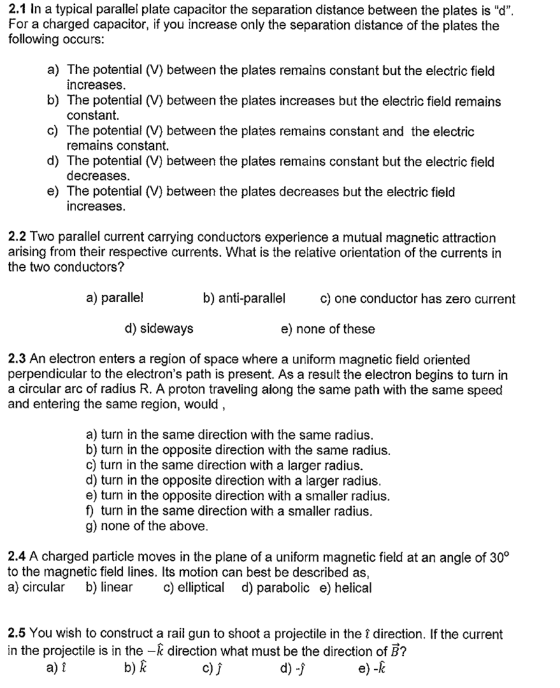
I mostly just need to confirm my answers thanks!
Homework Answers
2.1 For a parallel plate capacitor, C = Ae/d and Q = CV
so, when d is increased, C decreases
and Q is constasnt
so, V increases
so, b) V increasesm but E = V/d = constant
2.2 wo wires carrying current in same direction always attract each
other. SO the current is a) parallel
2.3 The proton will have the force acting on the opposite
direction, due to opposite charge
also, F = qVB
and F = mv^2/r
so mv/r = qB
r = mv/qB
so mass of proton is more, so more radius
hence
d) the proton turns in opposite irection with larger radius
2.4 The component of the velocity parallel to field remains
constant, the component perpendicular to the fiedld causes a force
ont he particvel causing it to move in circular direction
hence the net motion is a helix
Add Answer to:
I mostly just need to confirm my answers thanks!
In a typical parallel plate capacitor the...
Suppose that, instead of forming a complete ring, the two ends of the wire are connected to the electrodes of a parallel-plate capacitor. The capacitor plates are circular with radius 1.0 cm and sepa...
 Suppose that, instead of forming a complete ring, the two ends of the wire are connected to the electrodes of a parallel-plate capacitor. The capacitor plates are circular with radius 1.0 cm and separation 1.0 mm. Again, the magnetic field strength is initially B 0.750 T and subsequently decreases in time at the constant rate -0.035 T/s (a) Sketch a charge diagram illustrating the final charge distribution on the capacitor plates When this final distribution is obtained, what is the...
A parallel plate capacitor is constructed with circular plates of radius 0.750 cm and plate separation...
A parallel plate capacitor is constructed with circular plates of radius 0.750 cm and plate separation 0.0500 mm. If the capacitor is connected across a 37.2 V source, find: a) the capacitance b) the surface charge on each plate c) The energy stored in the capacitor d) the electric field between the plates e) the energy density between the plates
A parallel plate capacitor with circular plates has a radius of 25cm and a plate spacing or 0.2mm...
 A parallel plate capacitor with circular plates has a radius of 25cm and a plate spacing or 0.2mm. The plates are charged to 90.0V. a) What is the electric field between the plates? The plates are discharged in 0.25ms. b) What is the induced magnetic field 15cm from the axis? c What is the induced magnetic field 30cm from the axis?
A parallel plate capacitor with circular plates has a radius of 25cm and a plate spacing or 0.2mm. The...
A parallel plate capacitor with circular plates has a radius of 25cm and a plate spacing or 0.2mm. The plates are charged to 90.0V. a) What is the electric field between the plates? The plates are discharged in 0.25ms. b) What is the induced magnetic field 15cm from the axis? c What is the induced magnetic field 30cm from the axis?
A parallel plate capacitor with circular plates has a radius of 25cm and a plate spacing or 0.2mm. The...
An electric field 7*10^4 V/m exist between the plates of a circular parallel-plate capacitor that has...
 An
electric field 7*10^4 V/m exist between the plates of a circular
parallel-plate capacitor that has a plate separation of 3mm
5 -1 points Tipler6 24.P040 An electric field of 7. × 104 V/m exists between the plates of a circular parallel-plate capacitor that has a plate separation of 3 mm. (a) What is the voltage across the capacitor? (b) What plate radius is required if the stored charge is 10 ycC? eBook
An
electric field 7*10^4 V/m exist between the plates of a circular
parallel-plate capacitor that has a plate separation of 3mm
5 -1 points Tipler6 24.P040 An electric field of 7. × 104 V/m exists between the plates of a circular parallel-plate capacitor that has a plate separation of 3 mm. (a) What is the voltage across the capacitor? (b) What plate radius is required if the stored charge is 10 ycC? eBook
The figure shows a parallel-plate capacitor of plate area A and plate separation d. A potential differenceV0 is applied between the plates.
 The figure shows a parallel-plate capacitor of plate area A and plate separation d. A potential differenceV0 is applied between the plates. While the
battery remains connected, a dielectric slab of thickness b and dielectric constant κ is placed between the plates
as shown. Assume A = 130 cm2, d = 1.94
cm, V0 = 72.6 V, b = 0.735 cm, and κ =
3.15. Calculate (a) the capacitance,(b) the charge on the capacitor plates,(c) the electric field in the gap, and(d)...
The figure shows a parallel-plate capacitor of plate area A and plate separation d. A potential differenceV0 is applied between the plates. While the
battery remains connected, a dielectric slab of thickness b and dielectric constant κ is placed between the plates
as shown. Assume A = 130 cm2, d = 1.94
cm, V0 = 72.6 V, b = 0.735 cm, and κ =
3.15. Calculate (a) the capacitance,(b) the charge on the capacitor plates,(c) the electric field in the gap, and(d)...
i need help please A 1.24-pF, parallel-plate, air-filled capacitor with circular plates is to be used...
 i need help please
A 1.24-pF, parallel-plate, air-filled capacitor with circular plates is to be used in a circuit in which it will be subjected to potentials of up to 2.00 times 10^2 V. The electric field between the plates is to be no greater than 6.00 x 10^4 N/C. As a budding electrical engineer for Live-Wire Electronics, your tasks are the following. Design the capacitor by finding what its physical dimensions and separation must be. radius 1.528 cm plate...
i need help please
A 1.24-pF, parallel-plate, air-filled capacitor with circular plates is to be used in a circuit in which it will be subjected to potentials of up to 2.00 times 10^2 V. The electric field between the plates is to be no greater than 6.00 x 10^4 N/C. As a budding electrical engineer for Live-Wire Electronics, your tasks are the following. Design the capacitor by finding what its physical dimensions and separation must be. radius 1.528 cm plate...
A parallel plate capacitor with circular plates of radius R = 16.0 cm and plate separation...
A parallel plate capacitor with circular plates of radius R = 16.0 cm and plate separation d = 9.00 mm is being charged at the rate of 8.00 C/s. What is the displacement current through a circular loop of radius r = 21.00 cm centered on the axis of the capacitor? 8.00 You are correct. What is the displacement current through a circular loop of radius r = 3.00 cm centered on the axis of the capacitor? What is the...
Suppose that a parallel-plate capacitor has circular plates with radius R = 23 mm and a...
Suppose that a parallel-plate capacitor has circular plates with radius R = 23 mm and a plate separation of 3.8 mm. Suppose also that a sinusoidal potential difference with a maximum value of 110 V and a frequency of 85 Hz is applied across the plates; that is, V = (110 V) sin[2π(85 Hz)t]. Find Bmax(R), the maximum value of the induced magnetic field that occurs at r = R.
Suppose that a parallel-plate capacitor has circular plates with radius R = 26 mm and a...
Suppose that a parallel-plate capacitor has circular plates with radius R = 26 mm and a plate separation of 4.1 mm. Suppose also that a sinusoidal potential difference with a maximum value of 170 V and a frequency of 82 Hz is applied across the plates; that is, V = (170 V) sin[2π(82 Hz)t]. Find Bmax(R), the maximum value of the induced magnetic field that occurs at r = R.
Suppose that a parallel-plate capacitor has circular plates with radius R = 37 mm and a...
Suppose that a parallel-plate capacitor has circular plates with radius R = 37 mm and a plate separation of 6.8 mm. Suppose also that a sinusoidal potential difference with a maximum value of 120 V and a frequency of 47 Hz is applied across the plates; that is, V = (120 V) sin[2π(47 Hz)t]. Find Bmax(R), the maximum value of the induced magnetic field that occurs at r = R.
 Suppose that, instead of forming a complete ring, the two ends of the wire are connected to the electrodes of a parallel-plate capacitor. The capacitor plates are circular with radius 1.0 cm and separation 1.0 mm. Again, the magnetic field strength is initially B 0.750 T and subsequently decreases in time at the constant rate -0.035 T/s (a) Sketch a charge diagram illustrating the final charge distribution on the capacitor plates When this final distribution is obtained, what is the...
 A parallel plate capacitor with circular plates has a radius of 25cm and a plate spacing or 0.2mm. The plates are charged to 90.0V. a) What is the electric field between the plates? The plates are discharged in 0.25ms. b) What is the induced magnetic field 15cm from the axis? c What is the induced magnetic field 30cm from the axis?
A parallel plate capacitor with circular plates has a radius of 25cm and a plate spacing or 0.2mm. The...
A parallel plate capacitor with circular plates has a radius of 25cm and a plate spacing or 0.2mm. The plates are charged to 90.0V. a) What is the electric field between the plates? The plates are discharged in 0.25ms. b) What is the induced magnetic field 15cm from the axis? c What is the induced magnetic field 30cm from the axis?
A parallel plate capacitor with circular plates has a radius of 25cm and a plate spacing or 0.2mm. The...
 An
electric field 7*10^4 V/m exist between the plates of a circular
parallel-plate capacitor that has a plate separation of 3mm
5 -1 points Tipler6 24.P040 An electric field of 7. × 104 V/m exists between the plates of a circular parallel-plate capacitor that has a plate separation of 3 mm. (a) What is the voltage across the capacitor? (b) What plate radius is required if the stored charge is 10 ycC? eBook
An
electric field 7*10^4 V/m exist between the plates of a circular
parallel-plate capacitor that has a plate separation of 3mm
5 -1 points Tipler6 24.P040 An electric field of 7. × 104 V/m exists between the plates of a circular parallel-plate capacitor that has a plate separation of 3 mm. (a) What is the voltage across the capacitor? (b) What plate radius is required if the stored charge is 10 ycC? eBook
 i need help please
A 1.24-pF, parallel-plate, air-filled capacitor with circular plates is to be used in a circuit in which it will be subjected to potentials of up to 2.00 times 10^2 V. The electric field between the plates is to be no greater than 6.00 x 10^4 N/C. As a budding electrical engineer for Live-Wire Electronics, your tasks are the following. Design the capacitor by finding what its physical dimensions and separation must be. radius 1.528 cm plate...
i need help please
A 1.24-pF, parallel-plate, air-filled capacitor with circular plates is to be used in a circuit in which it will be subjected to potentials of up to 2.00 times 10^2 V. The electric field between the plates is to be no greater than 6.00 x 10^4 N/C. As a budding electrical engineer for Live-Wire Electronics, your tasks are the following. Design the capacitor by finding what its physical dimensions and separation must be. radius 1.528 cm plate...
Most questions answered within 3 hours.
-
Where is the error in this code sequence?
String s1 = "Hello";
String s2 = "ello";...
asked 11 months ago -
Financial data for Joel de Paris, Inc., for last year
follow:
Joel de Paris, Inc.
Balance...
asked 11 months ago -
Consider this reaction:
Al2(SO4)3 (aq)+ BaCl3
(aq) Al2Cl6 (aq)- +
3BaSO4(s) . What is the...
asked 11 months ago -
Suppose that Savneet is considering increasing her
recent random sample from 20 car rentals to 40...
asked 11 months ago -
Trucks arrive at an unloading terminal at an average rate of 120
per hour.
Trucks arrive...
asked 11 months ago -
Why are methanol and ethanol completely soluble in water while
octanol is not very little soluble....
asked 11 months ago -
A facilities manager at a university reads in a research report
that the mean amount of...
asked 11 months ago -
When the CuSO4 is rehydrated by adding water to the anhydrous
compound, is this an endothermic...
asked 11 months ago -
A ray of sunlight is passing from diamond into crown glass; the
angle of incidence is...
asked 11 months ago -
A block of mass 0.249 kg is placed on top of a light, vertical
spring of...
asked 11 months ago -
how do the kidneys compensate in the presences of acidosis
a) trigger hyperventilate
b) reserve acid...
asked 11 months ago -
Question 501 pts
The rental rate of capital to the firm increases. Which of the
following...
asked 11 months ago