
Homework Answers
Request Answer!
We need at least 10 more requests to produce the answer.
0 / 10 have requested this problem solution
The more requests, the faster the answer.
Add Answer to:
2) In carbonated pop, the bubbles come from carbonic acid, H2CO3 (aq), in the liquid decomposing...
Carbonated drinks contain carbonic acid. The carbonic acid is formed when excess CO2 gas is added...
 Carbonated drinks contain carbonic acid. The carbonic acid is formed when excess CO2 gas is added to the drink and then the container is quickly capped to capture the excess gas. The CO2 gas reacts with the water to form carbonic acid. The equilibrium is easily disturbed by shaking the bottle. a. Observe an unopened carbonated drink container. Describe if the bottle can be squeezed or if it is hard. Are the bubbles present on the top of the liquid?...
Carbonic acid present in the blood comes mainly from dissolved carbon dioxide (CO2). Dissolved carbon dioxide,...
Carbonic acid present in the blood comes mainly from dissolved carbon dioxide (CO2). Dissolved carbon dioxide, CO2(aq), reacts with water to produce H2CO3. a) Write the equilibrium expression for this process. b) The equilibrium constant for this reaction is the hydration constant for CO2, Kh = [H2CO3]/[CO2(aq)] = 3.0 x 10⁻³ . Combine this equation with the expression you derived in 1.a) for the equilibrium expressions for the first ionization (controlled by Ka1) and rearrange to obtain the apparent equilibrium...
a) The consecutive equilibria: CO2(g) <=>CO2(aq) + H2O(l) <=>H2CO3(aq) <=>H+(aq) + HCO3-(aq), explain why: A. carbonated...
a) The consecutive equilibria: CO2(g) <=>CO2(aq) + H2O(l) <=>H2CO3(aq) <=>H+(aq) + HCO3-(aq), explain why: A. carbonated beverages are less acidic than pure water. B. carbonated beverages contain measurably less water than the same volume of pure water. C. rainwater is slightly acidic b) A 1.0 M solution of a weak monoprotic acid with Ka = 1.0 10-6 would have a pH of: A. 1 B. 2 C. 3 D. 6 c) Ascorbic acid is a diprotic acid with Ka1 =...
a) The consecutive equilibria: CO2(g) <=>CO2(aq) + H2O(l) <=>H2CO3(aq) <=>H+(aq) + HCO3-(aq), explain why: A. carbonated beverages are less acidic than pure water. B. carbonated beve...
a) The consecutive equilibria: CO2(g) <=>CO2(aq) + H2O(l) <=>H2CO3(aq) <=>H+(aq) + HCO3-(aq), explain why: A. carbonated beverages are less acidic than pure water. B. carbonated beverages contain measurably less water than the same volume of pure water. C. rainwater is slightly acidic b) A 1.0 M solution of a weak monoprotic acid with Ka = 1.0 10-6 would have a pH of: A. 1 B. 2 C. 3 D. 6 c) Ascorbic acid is a diprotic acid with Ka1 =...
Part A Carbonic acid can form water and carbon dioxide upon heating. How much carbon dioxide is formed from 3.10 g...
 Part A Carbonic acid can form water and carbon dioxide upon heating. How much carbon dioxide is formed from 3.10 g of carbonic acid? H2CO3 + H2O + CO2 4.379 2.20 g 10.7 g 3.10 9 0.900 g Submit Request Answer Provide Feedback
Carbon dioxide dissolves in water to form carbonic acid, which is primarily dissolved CO2. Dissolved CO2...
 Carbon dioxide dissolves in water to form carbonic acid, which
is primarily dissolved CO2. Dissolved CO2 satisfies the equilibrium
equation The acid dissociation constants listed in most standard
reference texts for carbonic acid actually apply to dissolved CO2.
For a CO2 partial pressure of 1.8×10⁻⁴ bar in the atmosphere, what
is the pH of water in equilibrium with the atmosphere? (For
carbonic acid Ka1 = 4.46× 10⁻⁷ and Ka2 = 4.69× 10⁻¹¹).
Carbon dioxide dissolves in water to form carbonic...
Carbon dioxide dissolves in water to form carbonic acid, which
is primarily dissolved CO2. Dissolved CO2 satisfies the equilibrium
equation The acid dissociation constants listed in most standard
reference texts for carbonic acid actually apply to dissolved CO2.
For a CO2 partial pressure of 1.8×10⁻⁴ bar in the atmosphere, what
is the pH of water in equilibrium with the atmosphere? (For
carbonic acid Ka1 = 4.46× 10⁻⁷ and Ka2 = 4.69× 10⁻¹¹).
Carbon dioxide dissolves in water to form carbonic...
Carbon dioxide dissolves in water to form carbonic acid, which is primarily dissolved CO2. Dissolved CO2...
Carbon dioxide dissolves in water to form carbonic acid, which is primarily dissolved CO2. Dissolved CO2 satisfies the equilibrium equation CO2(gas)<------>CO2(aq) K=0.032 M*atm-1 The acid dissociation constants listed in most standard reference texts for carbonic acid actually apply to dissolved CO2. For a CO2 partial pressure of 3.1×10⁻⁴ atm in the atmosphere, what is the pH of water in equilibrium with the atmosphere?
Carbon dioxide dissolves in water to form carbonic acid, which is primarily dissolved CO2. Dissol...
Carbon dioxide dissolves in water to form carbonic acid, which is primarily dissolved CO2. Dissolved CO2 satisfies the equilibrium equation. CO2 (g) <--> CO2 (aq) K= 0.032 M atm-1 The acid dissociation constants listed in most standard reference texts for carbonic acid actually apply to dissolved CO2. For a CO2 partial pressure of 8.8×10⁻⁴ atm in the atmosphere, what is the pH of water in equilibrium with the atmosphere?
Carbon dioxide dissolves in water to form carbonic acid, which is primarily dissolved CO2 . Dissolved...
Carbon dioxide dissolves in water to form carbonic acid, which is primarily dissolved CO2 . Dissolved CO2 satisfies the equilibrium equation CO2(g)↽−−⇀CO2(aq)?=0.032 CO 2 ( g ) ↽ − − ⇀ CO 2 ( aq ) K = 0.032 The acid dissociation constants listed in most standard reference texts for carbonic acid actually apply to dissolved CO2 CO 2 . For a CO2 CO 2 partial pressure of 2.6×10⁻⁴ bar 2.6 × 10 − 4 bar in the atmosphere, what...
10.39 The first-order rate constant for the dehydration of carbonic acid, H2CO3(aq) = CO2(g) + H2O(1) is about 1 x 1...
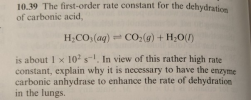 10.39 The first-order rate constant for the dehydration of carbonic acid, H2CO3(aq) = CO2(g) + H2O(1) is about 1 x 10² s-. In view of this rather high rate constant, explain why it is necessary to have the enzyme carbonic anhydrase to enhance the rate of dehydration in the lungs.
 Carbonated drinks contain carbonic acid. The carbonic acid is formed when excess CO2 gas is added to the drink and then the container is quickly capped to capture the excess gas. The CO2 gas reacts with the water to form carbonic acid. The equilibrium is easily disturbed by shaking the bottle. a. Observe an unopened carbonated drink container. Describe if the bottle can be squeezed or if it is hard. Are the bubbles present on the top of the liquid?...
 Part A Carbonic acid can form water and carbon dioxide upon heating. How much carbon dioxide is formed from 3.10 g of carbonic acid? H2CO3 + H2O + CO2 4.379 2.20 g 10.7 g 3.10 9 0.900 g Submit Request Answer Provide Feedback
 Carbon dioxide dissolves in water to form carbonic acid, which
is primarily dissolved CO2. Dissolved CO2 satisfies the equilibrium
equation The acid dissociation constants listed in most standard
reference texts for carbonic acid actually apply to dissolved CO2.
For a CO2 partial pressure of 1.8×10⁻⁴ bar in the atmosphere, what
is the pH of water in equilibrium with the atmosphere? (For
carbonic acid Ka1 = 4.46× 10⁻⁷ and Ka2 = 4.69× 10⁻¹¹).
Carbon dioxide dissolves in water to form carbonic...
Carbon dioxide dissolves in water to form carbonic acid, which
is primarily dissolved CO2. Dissolved CO2 satisfies the equilibrium
equation The acid dissociation constants listed in most standard
reference texts for carbonic acid actually apply to dissolved CO2.
For a CO2 partial pressure of 1.8×10⁻⁴ bar in the atmosphere, what
is the pH of water in equilibrium with the atmosphere? (For
carbonic acid Ka1 = 4.46× 10⁻⁷ and Ka2 = 4.69× 10⁻¹¹).
Carbon dioxide dissolves in water to form carbonic...
 10.39 The first-order rate constant for the dehydration of carbonic acid, H2CO3(aq) = CO2(g) + H2O(1) is about 1 x 10² s-. In view of this rather high rate constant, explain why it is necessary to have the enzyme carbonic anhydrase to enhance the rate of dehydration in the lungs.
Most questions answered within 3 hours.
-
Where is the error in this code sequence?
String s1 = "Hello";
String s2 = "ello";...
asked 10 months ago -
Financial data for Joel de Paris, Inc., for last year
follow:
Joel de Paris, Inc.
Balance...
asked 10 months ago -
Consider this reaction:
Al2(SO4)3 (aq)+ BaCl3
(aq) Al2Cl6 (aq)- +
3BaSO4(s) . What is the...
asked 10 months ago -
Suppose that Savneet is considering increasing her
recent random sample from 20 car rentals to 40...
asked 10 months ago -
Trucks arrive at an unloading terminal at an average rate of 120
per hour.
Trucks arrive...
asked 10 months ago -
Why are methanol and ethanol completely soluble in water while
octanol is not very little soluble....
asked 10 months ago -
A facilities manager at a university reads in a research report
that the mean amount of...
asked 10 months ago -
When the CuSO4 is rehydrated by adding water to the anhydrous
compound, is this an endothermic...
asked 10 months ago -
A ray of sunlight is passing from diamond into crown glass; the
angle of incidence is...
asked 10 months ago -
A block of mass 0.249 kg is placed on top of a light, vertical
spring of...
asked 10 months ago -
how do the kidneys compensate in the presences of acidosis
a) trigger hyperventilate
b) reserve acid...
asked 10 months ago -
Question 501 pts
The rental rate of capital to the firm increases. Which of the
following...
asked 10 months ago