
Homework Answers
Find the solution attached.
Add Answer to:
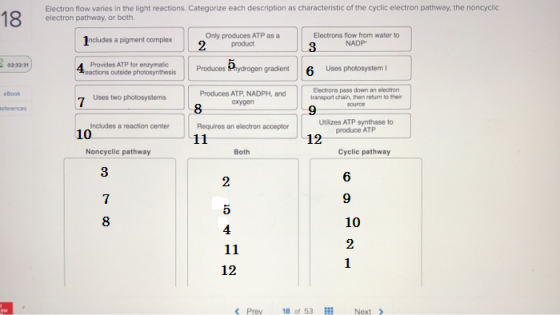
18 Electron flow varies in the light reactions. Categorize each description as characteristic of the cyclic...
place the correct words in each sentence to asses your understanding of the cyclic and noncyclic...
 place the correct words in each sentence to asses your
understanding of the cyclic and noncyclic electron pathways of
photosynthesis
z Chapter 8 G z Chapter 8 https/ Seved ATP synthase Two types of light reactions occur in called noncyclic, because electron flow can be traced from water to a molecule of of the chloroplast. One is The second type is called cyclic because energized electrons are cyclic passed down an electron transport chain and then returned to their source...
place the correct words in each sentence to asses your
understanding of the cyclic and noncyclic electron pathways of
photosynthesis
z Chapter 8 G z Chapter 8 https/ Seved ATP synthase Two types of light reactions occur in called noncyclic, because electron flow can be traced from water to a molecule of of the chloroplast. One is The second type is called cyclic because energized electrons are cyclic passed down an electron transport chain and then returned to their source...
QUESTION 8 Put the following statements about the light dependent reactions in order (1-4) Electrons that...
 QUESTION 8 Put the following statements about the light dependent reactions in order (1-4) Electrons that leave PSI travel through a transport chain, which allows H+ to be actively transported to high concentration Light energy excites electrons of antenna pigment molecules at PSII (and PSI) Electrons are ultimately accepted by NADP+ (forming NADPH) and the H+ gradient pass through ATP synthase, allowing ATP to be produced Energy from excited electrons of antenna pigments is passed to the reaction center of...
Put the following steps of the light reactions in the correct order: Light excites an electron...
Put the following steps of the light reactions in the correct order: Light excites an electron from photosystem I. Light excites an electron from photosystem II. Electrons reduce NADP+ to NADPH. Electrons pass through an electron transport chain, which generates a H+ gradient used to make ATP.
1. which of the following are produced during the light reactions of photosynthesis? a) ADP,NADP+,O2 b)glucose,...
1. which of the following are produced during the light reactions of photosynthesis? a) ADP,NADP+,O2 b)glucose, ADP,NAD+ c)ATP,NADPH,CO2 d)glucose,ADP,NADP+,CO2 e)ATP,NADPH,O3 2. Which type of light energy is not used by plants during photosynthesis? a)blue b)yellow c)violet d)red E)none of the above=identofy 3. Photosystem II a)does not have a reaction center b)is reduced by NADPH c)passes electrons to photosystem I d)has P700 at its reaction e)all the choices are correct 4. The photolysis of water a)combines with carbon dioxide b)produces NADPH...
que photosynthetic pigment instead of chlorophyll. The leaves of this plant always appear to be green....
 que photosynthetic pigment instead of chlorophyll. The leaves of this plant always appear to be green. What colors of light would be least effective for photosynthesis for this plant? A plant has a unique photo yellow, not green. What co A. green B. white C. red D. blue E yellow 25. Which of the following is NOT a product of the light reactions? A. NADPH В. АТР C. oxygen D. carbon dioxide 26. Which of the following are products of...
24) What are the products of cyclic electron flow during the light reactions of photosynthesis? A)...
 24) What are the products of cyclic electron flow during the light reactions of photosynthesis? A) hent and fluorescence B) ATP C) ATP and NADPH D) ADP and NADP+ 25) What is the relationship between the wavelength of light and the quantity of energy per photon? A) They have a direct, linear relationship. B) They are inversely related C) They are logarithmically related D) They are separate phenomena. OPEN QUESTIONS (VARIOUS POINT VALUES): 26) In the space below, draw an...
does anyone know D? Lab 8 Spring 2020 The Light Reactions The light reactions begin with...
 does anyone know D?
Lab 8 Spring 2020 The Light Reactions The light reactions begin with the photolysis of water. Photolysis refers to the process by which, in the Intact thylakoid membranes and light. water is split into oxygen protons and electrons. Therefore, was primary electron donor in photosynthesis. Conversion of water, a very stable molecule, to oxygen is er unfavorable and would not occur to any significant extent without input of light energy in photosystem e process by which,...
does anyone know D?
Lab 8 Spring 2020 The Light Reactions The light reactions begin with the photolysis of water. Photolysis refers to the process by which, in the Intact thylakoid membranes and light. water is split into oxygen protons and electrons. Therefore, was primary electron donor in photosynthesis. Conversion of water, a very stable molecule, to oxygen is er unfavorable and would not occur to any significant extent without input of light energy in photosystem e process by which,...
PHOTOSYSTEM II Choose... THYLAKOID SPACE WATER STOMATA NADPH WHAT THE LIGHT REACTIONS REDUCE PHOTOSYSTEMI THYLAKOID MEMBRANE...
 PHOTOSYSTEM II Choose... THYLAKOID SPACE WATER STOMATA NADPH WHAT THE LIGHT REACTIONS REDUCE PHOTOSYSTEMI THYLAKOID MEMBRANE Choose... HOUSES PHOTOSYSTEM I AND II PROVIDES HIGH ENERGY ELECTRONS FOR THE CHEMIOSMOTIC HYDROGEN PUMPS GENERATED BY THE DIFFUSION OF HYDROGEN ATOMS THE DARK REACTIONS OXIDIZE ALLOWS THE REQUIRED GAS EXCHANGE FOR PHOTOSYNTHESIS BOOSTS THE ELECTRONS UP AND INTO FINAL NADP+ REDUCTION WASTE PRODUCT RELEASED FROM LIGHT REACTIONS RESPONDS TO LIGHT FREQUENCIES OF 400ish AND 680ish LOCATION OF HYDROGEN ACCUMULATION DURING LIGHT REACTIONS OXIDIZED...
Please answer ALL of the questions below! They are all on the same page and related!...
 Please answer ALL of the questions below! They are all on the
same page and related!
I will rate the answer immediately after getting the answer!
Thank you! 7
In the reaction, 6CO2 + 6H20 --C6H12O6 + 602, carbon dioxide is being — oxidized Ophosphorylated hydrolyzed reduced condensed Which portion of the photosynthetic apparatus absorbs light? O NADP reductase O photosystem 1 both photosystem I and NADP reductase O photosystem II both photosystem I and photosystem II The image here...
Please answer ALL of the questions below! They are all on the
same page and related!
I will rate the answer immediately after getting the answer!
Thank you! 7
In the reaction, 6CO2 + 6H20 --C6H12O6 + 602, carbon dioxide is being — oxidized Ophosphorylated hydrolyzed reduced condensed Which portion of the photosynthetic apparatus absorbs light? O NADP reductase O photosystem 1 both photosystem I and NADP reductase O photosystem II both photosystem I and photosystem II The image here...
QUESTION 9 During fixation (carboxylation), carbon dioxide combines with RuBP. True False QUESTION 10 Electrons that...
 QUESTION 9 During fixation (carboxylation), carbon dioxide combines with RuBP. True False QUESTION 10 Electrons that leave PSI flow through an electron transport chain and then into PSII True False QUESTION 11 During the Calvin Cycle, 3PGA is phosphorylated, resulting in the formation of BPG. True False - CULTILOCONCIL - FOOUJOU QUESTION 12 H+ are actively moved from the thylakoid lumen to the stroma True False QUESTION 13 Which of the following does NOT occur during the light dependent reactions?...
 place the correct words in each sentence to asses your
understanding of the cyclic and noncyclic electron pathways of
photosynthesis
z Chapter 8 G z Chapter 8 https/ Seved ATP synthase Two types of light reactions occur in called noncyclic, because electron flow can be traced from water to a molecule of of the chloroplast. One is The second type is called cyclic because energized electrons are cyclic passed down an electron transport chain and then returned to their source...
place the correct words in each sentence to asses your
understanding of the cyclic and noncyclic electron pathways of
photosynthesis
z Chapter 8 G z Chapter 8 https/ Seved ATP synthase Two types of light reactions occur in called noncyclic, because electron flow can be traced from water to a molecule of of the chloroplast. One is The second type is called cyclic because energized electrons are cyclic passed down an electron transport chain and then returned to their source...
 QUESTION 8 Put the following statements about the light dependent reactions in order (1-4) Electrons that leave PSI travel through a transport chain, which allows H+ to be actively transported to high concentration Light energy excites electrons of antenna pigment molecules at PSII (and PSI) Electrons are ultimately accepted by NADP+ (forming NADPH) and the H+ gradient pass through ATP synthase, allowing ATP to be produced Energy from excited electrons of antenna pigments is passed to the reaction center of...
 que photosynthetic pigment instead of chlorophyll. The leaves of this plant always appear to be green. What colors of light would be least effective for photosynthesis for this plant? A plant has a unique photo yellow, not green. What co A. green B. white C. red D. blue E yellow 25. Which of the following is NOT a product of the light reactions? A. NADPH В. АТР C. oxygen D. carbon dioxide 26. Which of the following are products of...
 24) What are the products of cyclic electron flow during the light reactions of photosynthesis? A) hent and fluorescence B) ATP C) ATP and NADPH D) ADP and NADP+ 25) What is the relationship between the wavelength of light and the quantity of energy per photon? A) They have a direct, linear relationship. B) They are inversely related C) They are logarithmically related D) They are separate phenomena. OPEN QUESTIONS (VARIOUS POINT VALUES): 26) In the space below, draw an...
 does anyone know D?
Lab 8 Spring 2020 The Light Reactions The light reactions begin with the photolysis of water. Photolysis refers to the process by which, in the Intact thylakoid membranes and light. water is split into oxygen protons and electrons. Therefore, was primary electron donor in photosynthesis. Conversion of water, a very stable molecule, to oxygen is er unfavorable and would not occur to any significant extent without input of light energy in photosystem e process by which,...
does anyone know D?
Lab 8 Spring 2020 The Light Reactions The light reactions begin with the photolysis of water. Photolysis refers to the process by which, in the Intact thylakoid membranes and light. water is split into oxygen protons and electrons. Therefore, was primary electron donor in photosynthesis. Conversion of water, a very stable molecule, to oxygen is er unfavorable and would not occur to any significant extent without input of light energy in photosystem e process by which,...
 PHOTOSYSTEM II Choose... THYLAKOID SPACE WATER STOMATA NADPH WHAT THE LIGHT REACTIONS REDUCE PHOTOSYSTEMI THYLAKOID MEMBRANE Choose... HOUSES PHOTOSYSTEM I AND II PROVIDES HIGH ENERGY ELECTRONS FOR THE CHEMIOSMOTIC HYDROGEN PUMPS GENERATED BY THE DIFFUSION OF HYDROGEN ATOMS THE DARK REACTIONS OXIDIZE ALLOWS THE REQUIRED GAS EXCHANGE FOR PHOTOSYNTHESIS BOOSTS THE ELECTRONS UP AND INTO FINAL NADP+ REDUCTION WASTE PRODUCT RELEASED FROM LIGHT REACTIONS RESPONDS TO LIGHT FREQUENCIES OF 400ish AND 680ish LOCATION OF HYDROGEN ACCUMULATION DURING LIGHT REACTIONS OXIDIZED...
 Please answer ALL of the questions below! They are all on the
same page and related!
I will rate the answer immediately after getting the answer!
Thank you! 7
In the reaction, 6CO2 + 6H20 --C6H12O6 + 602, carbon dioxide is being — oxidized Ophosphorylated hydrolyzed reduced condensed Which portion of the photosynthetic apparatus absorbs light? O NADP reductase O photosystem 1 both photosystem I and NADP reductase O photosystem II both photosystem I and photosystem II The image here...
Please answer ALL of the questions below! They are all on the
same page and related!
I will rate the answer immediately after getting the answer!
Thank you! 7
In the reaction, 6CO2 + 6H20 --C6H12O6 + 602, carbon dioxide is being — oxidized Ophosphorylated hydrolyzed reduced condensed Which portion of the photosynthetic apparatus absorbs light? O NADP reductase O photosystem 1 both photosystem I and NADP reductase O photosystem II both photosystem I and photosystem II The image here...
 QUESTION 9 During fixation (carboxylation), carbon dioxide combines with RuBP. True False QUESTION 10 Electrons that leave PSI flow through an electron transport chain and then into PSII True False QUESTION 11 During the Calvin Cycle, 3PGA is phosphorylated, resulting in the formation of BPG. True False - CULTILOCONCIL - FOOUJOU QUESTION 12 H+ are actively moved from the thylakoid lumen to the stroma True False QUESTION 13 Which of the following does NOT occur during the light dependent reactions?...
Most questions answered within 3 hours.
-
Where is the error in this code sequence?
String s1 = "Hello";
String s2 = "ello";...
asked 11 months ago -
Financial data for Joel de Paris, Inc., for last year
follow:
Joel de Paris, Inc.
Balance...
asked 11 months ago -
Consider this reaction:
Al2(SO4)3 (aq)+ BaCl3
(aq) Al2Cl6 (aq)- +
3BaSO4(s) . What is the...
asked 11 months ago -
Suppose that Savneet is considering increasing her
recent random sample from 20 car rentals to 40...
asked 11 months ago -
Trucks arrive at an unloading terminal at an average rate of 120
per hour.
Trucks arrive...
asked 11 months ago -
Why are methanol and ethanol completely soluble in water while
octanol is not very little soluble....
asked 11 months ago -
A facilities manager at a university reads in a research report
that the mean amount of...
asked 11 months ago -
When the CuSO4 is rehydrated by adding water to the anhydrous
compound, is this an endothermic...
asked 11 months ago -
A ray of sunlight is passing from diamond into crown glass; the
angle of incidence is...
asked 11 months ago -
A block of mass 0.249 kg is placed on top of a light, vertical
spring of...
asked 11 months ago -
how do the kidneys compensate in the presences of acidosis
a) trigger hyperventilate
b) reserve acid...
asked 11 months ago -
Question 501 pts
The rental rate of capital to the firm increases. Which of the
following...
asked 11 months ago