Which of the following is generally NOT an example of a first-order reaction? There may be...
Which of the following is generally NOT an example of a first-order reaction? There may be more than one correct answer - select all that apply.
Chain reactions
Radioactive decay reactions
Reactions involving explosions
Reactions involving spontaneous combustion
Homework Answers

Add Answer to:
Which of the following is generally NOT an example of a
first-order reaction? There may be...
Which of the following are correct for first-order reactions? Select all that apply. ? The reaction...
 Which of the following are correct for first-order reactions? Select all that apply. ? The reaction slows down as the reaction proceeds. ? A higher concentration of reactants will speed up the reaction. ? The concentration of the reactants changes nonlinearly. The half-life of the reaction stays constant as the reaction proceeds The units for the rate constant and the rate of reaction are the same.
Which of the following is true regarding ᐃG? (mark all that apply) Group of answer choices...
Which of the following is true regarding ᐃG? (mark all that apply) Group of answer choices When Keq is >> 1, ᐃG is large and negative When Keq is << 1, ᐃG is large and positive When Keq is << 1, ᐃG is small and positive When Keq is << 1, ᐃG is large and negative When Keq is >> 1, ᐃG is small and positive 2-Why is coupling of reactions an important biochemical mechanism to allow non-spontaneous reactions to...
Describe spontaneous and nonspontaneous processes Question Which process is spontaneous? Select the correct answer below: the...
 Describe spontaneous and nonspontaneous processes Question Which process is spontaneous? Select the correct answer below: the radioactive decay of Tc-99 the radioactive decay of U-238 O the radioactive decay of C-14 all of the above Content attribution
Which of the following describe(s) the following reaction? Choose all that apply. 200U + in Ba...
 Which of the following describe(s) the following reaction? Choose all that apply. 200U + in Ba + Kr + 3 n bombardment reaction potential chain reaction beta decay reaction fission reaction alpha decay reaction Submit Answer Retry Entire Group 5 more group attempts remaining
Select every statement that is true about radioactivity (more than one may be selected): a. Gamma...
Select every statement that is true about radioactivity (more than one may be selected): a. Gamma decay is a helium nucleus being emitted from the nucleus of a larger atom. b. Beta decay is a neutron in the nucleus of an atom splitting into a proton, which stays in the nucleus, and an electron, which is ejected. c. The products of a decay reaction are often themselves radioactive. d. Different isotopes of the same element often react differently in radioactive...
1) A certain first order reaction has a rate constant of 0.038 min-1. How much of...
1) A certain first order reaction has a rate constant of 0.038 min-1. How much of the reactant will remain if the reaction is run for 2.5 hours and the initial concentration of the reactant is 0.35 M? 2)Which of the following correctly represents a first order integrated rate law? (Select all that are correct, there may be more than one.) A. [A]0 = [A]te-kt B. [A]t = [A]0ekt C. ln [A]t = ln [A]0 - kt D. [A]t =...
If AG < 0 for a reaction, which of the following is/are true? Select all that...
 If AG < 0 for a reaction, which of the following is/are true? Select all that apply. There will be no net change in the amounts of reactants or products. The reaction is spontaneous in the forward direction. The reaction is spontaneous in the reverse direction. The reaction is at equilibrium. The reaction will proceed to form more products. The reaction will proceed to form more reactants.
Answer the correct answer/answers below: Which of the following is not an action-reaction pair of forces?...
 Answer the correct answer/answers below:
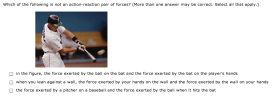
Which of the following is not an action-reaction pair of forces? (More than one answer may be correct. Select all that apply.) in the figure, the force exerted by the ball on the bat and the force exerted by the bat on the player's hands when you lean against a wall, the force exerted by your hands on the wall and the force exerted by the wall on your hands the force exerted by a...
Answer the correct answer/answers below:
Which of the following is not an action-reaction pair of forces? (More than one answer may be correct. Select all that apply.) in the figure, the force exerted by the ball on the bat and the force exerted by the bat on the player's hands when you lean against a wall, the force exerted by your hands on the wall and the force exerted by the wall on your hands the force exerted by a...
kjk Which of the following describe(s) the following reaction? Choose all that apply. N + He...
 kjk
Which of the following describe(s) the following reaction? Choose all that apply. N + He — 10 + 1H bombardment reaction potential chain reaction alpha decay reaction beta decay reaction fission reaction
kjk
Which of the following describe(s) the following reaction? Choose all that apply. N + He — 10 + 1H bombardment reaction potential chain reaction alpha decay reaction beta decay reaction fission reaction
Answer the following questions regarding decay of Iridium-192 which is a first order reaction with a...
Answer the following questions regarding decay of Iridium-192 which is a first order reaction with a half life of 74 days Write the balanced equation representing Ir-192 undergoing beta decay and it accompanying rate law Determine the rate constant k for this reaction How many grams of a 50.0g sample of Iridium-192 remain after 5 years
 Which of the following are correct for first-order reactions? Select all that apply. ? The reaction slows down as the reaction proceeds. ? A higher concentration of reactants will speed up the reaction. ? The concentration of the reactants changes nonlinearly. The half-life of the reaction stays constant as the reaction proceeds The units for the rate constant and the rate of reaction are the same.
 Describe spontaneous and nonspontaneous processes Question Which process is spontaneous? Select the correct answer below: the radioactive decay of Tc-99 the radioactive decay of U-238 O the radioactive decay of C-14 all of the above Content attribution
 Which of the following describe(s) the following reaction? Choose all that apply. 200U + in Ba + Kr + 3 n bombardment reaction potential chain reaction beta decay reaction fission reaction alpha decay reaction Submit Answer Retry Entire Group 5 more group attempts remaining
 If AG < 0 for a reaction, which of the following is/are true? Select all that apply. There will be no net change in the amounts of reactants or products. The reaction is spontaneous in the forward direction. The reaction is spontaneous in the reverse direction. The reaction is at equilibrium. The reaction will proceed to form more products. The reaction will proceed to form more reactants.
 Answer the correct answer/answers below:
Which of the following is not an action-reaction pair of forces? (More than one answer may be correct. Select all that apply.) in the figure, the force exerted by the ball on the bat and the force exerted by the bat on the player's hands when you lean against a wall, the force exerted by your hands on the wall and the force exerted by the wall on your hands the force exerted by a...
Answer the correct answer/answers below:
Which of the following is not an action-reaction pair of forces? (More than one answer may be correct. Select all that apply.) in the figure, the force exerted by the ball on the bat and the force exerted by the bat on the player's hands when you lean against a wall, the force exerted by your hands on the wall and the force exerted by the wall on your hands the force exerted by a...
 kjk
Which of the following describe(s) the following reaction? Choose all that apply. N + He — 10 + 1H bombardment reaction potential chain reaction alpha decay reaction beta decay reaction fission reaction
kjk
Which of the following describe(s) the following reaction? Choose all that apply. N + He — 10 + 1H bombardment reaction potential chain reaction alpha decay reaction beta decay reaction fission reaction
Most questions answered within 3 hours.
-
Where is the error in this code sequence?
String s1 = "Hello";
String s2 = "ello";...
asked 11 months ago -
Financial data for Joel de Paris, Inc., for last year
follow:
Joel de Paris, Inc.
Balance...
asked 11 months ago -
Consider this reaction:
Al2(SO4)3 (aq)+ BaCl3
(aq) Al2Cl6 (aq)- +
3BaSO4(s) . What is the...
asked 11 months ago -
Suppose that Savneet is considering increasing her
recent random sample from 20 car rentals to 40...
asked 11 months ago -
Trucks arrive at an unloading terminal at an average rate of 120
per hour.
Trucks arrive...
asked 11 months ago -
Why are methanol and ethanol completely soluble in water while
octanol is not very little soluble....
asked 11 months ago -
A facilities manager at a university reads in a research report
that the mean amount of...
asked 11 months ago -
When the CuSO4 is rehydrated by adding water to the anhydrous
compound, is this an endothermic...
asked 11 months ago -
A ray of sunlight is passing from diamond into crown glass; the
angle of incidence is...
asked 11 months ago -
A block of mass 0.249 kg is placed on top of a light, vertical
spring of...
asked 11 months ago -
how do the kidneys compensate in the presences of acidosis
a) trigger hyperventilate
b) reserve acid...
asked 11 months ago -
Question 501 pts
The rental rate of capital to the firm increases. Which of the
following...
asked 11 months ago