
Homework Answers
Add Answer to:
Discrete Math
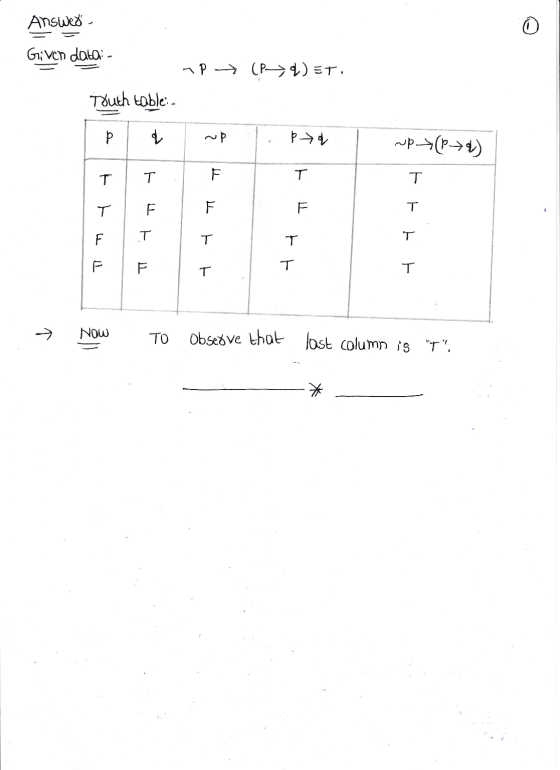
(7) (bonus) Give a proof of the following equivalence following the pattern of proof...
Discrete Math: Consider the following theorem: If p is even then p+1 is odd. Can someone...
Discrete Math: Consider the following theorem: If p is even then p+1 is odd. Can someone explain or show how do to these examples? Write a proof by contraposition. (Assume ~q, show ~p) Write a direct proof (Assume p, show ~p) Write a proof by mathematical induction. (Show basis step, assume k^th step, show k+1 step)
Discrete Math- Check my work and explain if I got anything wrong 7. Prove that the...
 Discrete Math- Check my work and explain if I got anything
wrong
7. Prove that the following formulas Fi and F2 are equivalent: F1:-(3x (p(x) (Fy (g(y) 1-r(x, y))))) F2: Vx (p(x) → (Vy (q(y) +r(x, y)))) Clearly label each equivalence used in your proof. 7. = x + 7 (pc) n/7ylfly) 170 (x,y)))) 7J x PC) = HX7 P05 = YG pux) v 7 (7y (q (y) 17 r(x, y))) 1 paq=1p uq = kx (7 p.) v (Vy...
Discrete Math- Check my work and explain if I got anything
wrong
7. Prove that the following formulas Fi and F2 are equivalent: F1:-(3x (p(x) (Fy (g(y) 1-r(x, y))))) F2: Vx (p(x) → (Vy (q(y) +r(x, y)))) Clearly label each equivalence used in your proof. 7. = x + 7 (pc) n/7ylfly) 170 (x,y)))) 7J x PC) = HX7 P05 = YG pux) v 7 (7y (q (y) 17 r(x, y))) 1 paq=1p uq = kx (7 p.) v (Vy...
Discrete Math Consider the following directed graph. Give the indegree of each vertex.
 Discrete Math
Consider the following directed graph. Give the indegree of each vertex.
Discrete Math
Consider the following directed graph. Give the indegree of each vertex.
please answer the question using 0 & 1 instead of T & F 7. (10) Give a direct proof and an indirect proof...
 please answer the question using 0 & 1 instead of T &
F
7. (10) Give a direct proof and an indirect proof of the following:
7. (10) Give a direct proof and an indirect proof of the following:
please answer the question using 0 & 1 instead of T &
F
7. (10) Give a direct proof and an indirect proof of the following:
7. (10) Give a direct proof and an indirect proof of the following:
(Discrete Math) Read the following combinatorial proof, and write a theorem that we proved. Explain it...
(Discrete Math) Read the following combinatorial proof, and write a theorem that we proved. Explain it in details. We count the number of k+1 element subsets of [n+1]. On one hand, it is clearly C(n+1,k+1). On the other hand, we can count these subsets in two steps. First we count the subsets that contain the number n+1. Since have to choose another k elements from {1,2,...,n} for it to make a k+1-element set, the number of these is C(n,k). Then...
discrete math Need 7c 9ab 10 15 16 17 (7) Consider the following matrices. Compute the...
 discrete math
Need 7c 9ab 10 15 16 17
(7) Consider the following matrices. Compute the following matrices A=[ ]B=[ 1 c-[! (a) CA (b) BAA (c) AOC (9) Determine if the following statements are True or False. If the statement is False, explain why. (a) Consider A={1,2,3,4,5). Do A1 = {1,3,5}, A2 = {2,4}. (i) Show that P ={A1, A2} forms a partition of A. (ii) Construct the matrix of the relation R corresponding to P (b) Consider A...
discrete math
Need 7c 9ab 10 15 16 17
(7) Consider the following matrices. Compute the following matrices A=[ ]B=[ 1 c-[! (a) CA (b) BAA (c) AOC (9) Determine if the following statements are True or False. If the statement is False, explain why. (a) Consider A={1,2,3,4,5). Do A1 = {1,3,5}, A2 = {2,4}. (i) Show that P ={A1, A2} forms a partition of A. (ii) Construct the matrix of the relation R corresponding to P (b) Consider A...
Question 7 Classify each of the following sets as finite, countable infinite, or uncountable (no proof...
 Question 7 Classify each of the following sets as finite, countable infinite, or uncountable (no proof is necessary): A=0 B = {2 ER: 0 < x < 0.0001} C=0 D=N E = {R} F= {n EN:n <9000} G=Z/5Z H = P(N) I= {n €Z:n > 50 J=Z Bonus: Give an example of a set with larger cardinality then any of the above sets.
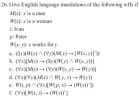
Discrete Math Question (Q26, P55, Textbook: Mathematical Structures for Computer Science 7e): Give English language translations...
 Discrete Math Question (Q26, P55,
Textbook: Mathematical Structures for Computer Science
7e):
Give English language translations of the following wffs if:
Discrete Math Question (Q26, P55,
Textbook: Mathematical Structures for Computer Science
7e):
Give English language translations of the following wffs if:
How to do this problem for discrete math. Use the rules of inference to show that...
 How to do this problem for
discrete math.
Use the rules of inference to show that if V x (Ax) v α刈and V xứcAx) Λ α where the domains of all quantifiers are the same. Construct your argument by rearranging the following building blocks. ) → Rx)) are true, then V x("A(x) → A is also tr 1. We will show that if the premises are true, then (1A(a) → Pla) for every a. 2. Suppose -R(a) is true for...
How to do this problem for
discrete math.
Use the rules of inference to show that if V x (Ax) v α刈and V xứcAx) Λ α where the domains of all quantifiers are the same. Construct your argument by rearranging the following building blocks. ) → Rx)) are true, then V x("A(x) → A is also tr 1. We will show that if the premises are true, then (1A(a) → Pla) for every a. 2. Suppose -R(a) is true for...
Give an epsilon delta proof for the following limit: as x—>3 lim(6x-7)=11
Give an epsilon delta proof for the following limit: as x—>3 lim(6x-7)=11
 Discrete Math- Check my work and explain if I got anything
wrong
7. Prove that the following formulas Fi and F2 are equivalent: F1:-(3x (p(x) (Fy (g(y) 1-r(x, y))))) F2: Vx (p(x) → (Vy (q(y) +r(x, y)))) Clearly label each equivalence used in your proof. 7. = x + 7 (pc) n/7ylfly) 170 (x,y)))) 7J x PC) = HX7 P05 = YG pux) v 7 (7y (q (y) 17 r(x, y))) 1 paq=1p uq = kx (7 p.) v (Vy...
Discrete Math- Check my work and explain if I got anything
wrong
7. Prove that the following formulas Fi and F2 are equivalent: F1:-(3x (p(x) (Fy (g(y) 1-r(x, y))))) F2: Vx (p(x) → (Vy (q(y) +r(x, y)))) Clearly label each equivalence used in your proof. 7. = x + 7 (pc) n/7ylfly) 170 (x,y)))) 7J x PC) = HX7 P05 = YG pux) v 7 (7y (q (y) 17 r(x, y))) 1 paq=1p uq = kx (7 p.) v (Vy...
 Discrete Math
Consider the following directed graph. Give the indegree of each vertex.
Discrete Math
Consider the following directed graph. Give the indegree of each vertex.
 please answer the question using 0 & 1 instead of T &
F
7. (10) Give a direct proof and an indirect proof of the following:
7. (10) Give a direct proof and an indirect proof of the following:
please answer the question using 0 & 1 instead of T &
F
7. (10) Give a direct proof and an indirect proof of the following:
7. (10) Give a direct proof and an indirect proof of the following:
 discrete math
Need 7c 9ab 10 15 16 17
(7) Consider the following matrices. Compute the following matrices A=[ ]B=[ 1 c-[! (a) CA (b) BAA (c) AOC (9) Determine if the following statements are True or False. If the statement is False, explain why. (a) Consider A={1,2,3,4,5). Do A1 = {1,3,5}, A2 = {2,4}. (i) Show that P ={A1, A2} forms a partition of A. (ii) Construct the matrix of the relation R corresponding to P (b) Consider A...
discrete math
Need 7c 9ab 10 15 16 17
(7) Consider the following matrices. Compute the following matrices A=[ ]B=[ 1 c-[! (a) CA (b) BAA (c) AOC (9) Determine if the following statements are True or False. If the statement is False, explain why. (a) Consider A={1,2,3,4,5). Do A1 = {1,3,5}, A2 = {2,4}. (i) Show that P ={A1, A2} forms a partition of A. (ii) Construct the matrix of the relation R corresponding to P (b) Consider A...
 Question 7 Classify each of the following sets as finite, countable infinite, or uncountable (no proof is necessary): A=0 B = {2 ER: 0 < x < 0.0001} C=0 D=N E = {R} F= {n EN:n <9000} G=Z/5Z H = P(N) I= {n €Z:n > 50 J=Z Bonus: Give an example of a set with larger cardinality then any of the above sets.
 Discrete Math Question (Q26, P55,
Textbook: Mathematical Structures for Computer Science
7e):
Give English language translations of the following wffs if:
Discrete Math Question (Q26, P55,
Textbook: Mathematical Structures for Computer Science
7e):
Give English language translations of the following wffs if:
 How to do this problem for
discrete math.
Use the rules of inference to show that if V x (Ax) v α刈and V xứcAx) Λ α where the domains of all quantifiers are the same. Construct your argument by rearranging the following building blocks. ) → Rx)) are true, then V x("A(x) → A is also tr 1. We will show that if the premises are true, then (1A(a) → Pla) for every a. 2. Suppose -R(a) is true for...
How to do this problem for
discrete math.
Use the rules of inference to show that if V x (Ax) v α刈and V xứcAx) Λ α where the domains of all quantifiers are the same. Construct your argument by rearranging the following building blocks. ) → Rx)) are true, then V x("A(x) → A is also tr 1. We will show that if the premises are true, then (1A(a) → Pla) for every a. 2. Suppose -R(a) is true for...
Most questions answered within 3 hours.
-
Where is the error in this code sequence?
String s1 = "Hello";
String s2 = "ello";...
asked 11 months ago -
Financial data for Joel de Paris, Inc., for last year
follow:
Joel de Paris, Inc.
Balance...
asked 11 months ago -
Consider this reaction:
Al2(SO4)3 (aq)+ BaCl3
(aq) Al2Cl6 (aq)- +
3BaSO4(s) . What is the...
asked 11 months ago -
Suppose that Savneet is considering increasing her
recent random sample from 20 car rentals to 40...
asked 11 months ago -
Trucks arrive at an unloading terminal at an average rate of 120
per hour.
Trucks arrive...
asked 11 months ago -
Why are methanol and ethanol completely soluble in water while
octanol is not very little soluble....
asked 11 months ago -
A facilities manager at a university reads in a research report
that the mean amount of...
asked 11 months ago -
When the CuSO4 is rehydrated by adding water to the anhydrous
compound, is this an endothermic...
asked 11 months ago -
A ray of sunlight is passing from diamond into crown glass; the
angle of incidence is...
asked 11 months ago -
A block of mass 0.249 kg is placed on top of a light, vertical
spring of...
asked 11 months ago -
how do the kidneys compensate in the presences of acidosis
a) trigger hyperventilate
b) reserve acid...
asked 11 months ago -
Question 501 pts
The rental rate of capital to the firm increases. Which of the
following...
asked 11 months ago