Reproduce sexually via conidia? A. Ascomycota B. Basidiomycota C. Zygomycota
Reproduce sexually via conidia?
A. Ascomycota
B. Basidiomycota
C. Zygomycota
Homework Answers
Solution-
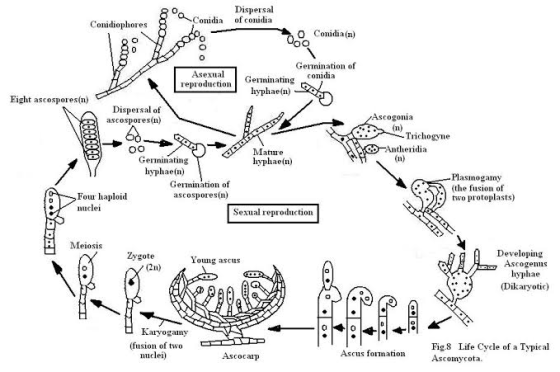
Ascomycota reproduce sexualy by conidiaospore.
Basidiomycota reproduce by basidiospores.
Zygomycota reproduce by zygospore
- In ascomycota condia are asexual spore produced on veg body.
- This spore get germinated in to two different hyphal sex organs antherida and ascogonia.
- Which mate to produce ascogoium to produce ascospore.
- Ascospore germinated into fungal hypha to produce veg body of ascomycetes.
Add Answer to:
Reproduce sexually via conidia?
A. Ascomycota
B. Basidiomycota
C. Zygomycota
Which of the following statements is TRUE? (a) Diploid organisms reproduce only sexually. (b) All sexually...
Which of the following statements is TRUE? (a) Diploid organisms reproduce only sexually. (b) All sexually reproducing organisms have at least two copies of each gene at some stage in their life cycle. (c) Gametes have only one chromosome. (d) Another name for the unfertilized egg cell is the zygote. (e) Mutations in somatic cells are passed on to individuals of the next generation.
number 2,4, and 5 please 2 What is the significance of the kingdom Fungi to the...
 number 2,4, and 5 please
2 What is the significance of the kingdom Fungi to the environment? 3 Identify which phylum each of the examples belongs to, using the following key: Rusts and smuts Batrachochytrium dendrobatidis A = Ascomycota B - Basidiomycota C = Chytridiomycota G - Glomeromycota Z = Zygomycota Pilobolus sp. Penicillium sp. and Aspergillus sp. Morels and Peziza sp. Earth stars, puffballs, and bracket fungi Mucor sp. and Rhizopus sp. Candida albicans and Saccharomyces cerevisiae Mycorrhizae Which...
number 2,4, and 5 please
2 What is the significance of the kingdom Fungi to the environment? 3 Identify which phylum each of the examples belongs to, using the following key: Rusts and smuts Batrachochytrium dendrobatidis A = Ascomycota B - Basidiomycota C = Chytridiomycota G - Glomeromycota Z = Zygomycota Pilobolus sp. Penicillium sp. and Aspergillus sp. Morels and Peziza sp. Earth stars, puffballs, and bracket fungi Mucor sp. and Rhizopus sp. Candida albicans and Saccharomyces cerevisiae Mycorrhizae Which...
30. Fungi reproduce asexually sexually asexually and sexually by conjuction conjugation 3. A single species of...
 30. Fungi reproduce asexually sexually asexually and sexually by conjuction conjugation 3. A single species of freshwater lineage. gave rise to the entire terrestrial plant A B. red algae brown algae green algae fungus prokaryote D. E. 4. Green algae split into 2 clades: A. B. C. D. (E.) chromalveolata and stramenopila rhizaria and cercozoa alveolata and stramenopila excavata and opisthokonta chlorophytes and charophytes The green algae clade that remained aquatic is A. chromalveolata B. cercozoa charophytes D. excavata E....
a) Why do species that reproduce sexually have more genetic variation than species that reproduce asexually?...
a) Why do species that reproduce sexually have more genetic variation than species that reproduce asexually? b) Why is it difficult to use genetics to predict exactly how tall someone will be? c) Many prokaryotes reproduce asexually using binary fission. Why is it impossible for a prokaryote to use the process of meiosis for reproduction? d) Monosomy is a genetic disorder. In this disorder, a person receives one gamete that has is missing a chromosome. This gives the person one...
Plants can reproduce both sexually and asexually. a. Explain the difference between sexual and asexual reproduction...
Plants can reproduce both sexually and asexually. a. Explain the difference between sexual and asexual reproduction in plants (not in other organisms). b. Explain the different ways in which a plant can reproduce asexually. c. Include examples of the different types of asexual reproduction. ( I expect you to have more than one example as your textbook devotes an entire section to this topic.)
Match the correct fungal phylum to the distinguishing feature of morphology of their life cycle i....
Match the correct fungal phylum to the distinguishing feature of morphology of their life cycle i. Chytridiomycota ii. Zygomycota iii) Ascomycota iv) Basidiomycota a) flagellate spores b) basidia c) ascospores d) zygosporangium A) i= a, ii= b, iii= c, iv= d, B) i= a, ii= c, iii= b, iv= d, C) i= a, ii= d, iii= c, iv= b, D) i= b, ii= a, iii= c, iv= d,
Most animals and plants reproduce sexually. This means that DNA is passed down to new organisms...
Most animals and plants reproduce sexually. This means that DNA is passed down to new organisms from two parental organisms. Which of the following is a key advantage of sexual reproduction? A. Increased genetic diversity for changing environments B. The elimination of genetic mutations from a parent organism C. The receipt of the strongest genes from both parents for survival D. The creation of new genes to improve survival
need help on these questions. bio 11b Use the image below for question 1-3 1. To...
 need help on these questions. bio 11b
Use the image below for question 1-3 1. To what clades (groups) does the above belong (select all that apply) a. Zygomycota b. Ascomycota C. Basidiomycota d. Eukaryote e. Archaea 2. What is the name of the structure in the image? a. Zygosporangium b. Ascomyspore C. Basidioangium d. Basidiospore e. Basidia 3. In regards to the structure in the image (select all that apply) a. Rough thick-walled coating b. Resistant to freezing and...
need help on these questions. bio 11b
Use the image below for question 1-3 1. To what clades (groups) does the above belong (select all that apply) a. Zygomycota b. Ascomycota C. Basidiomycota d. Eukaryote e. Archaea 2. What is the name of the structure in the image? a. Zygosporangium b. Ascomyspore C. Basidioangium d. Basidiospore e. Basidia 3. In regards to the structure in the image (select all that apply) a. Rough thick-walled coating b. Resistant to freezing and...
4) Which of the following is an exception to Koch's postulates? A) bacteria reproduce via binary...
 4) Which of the following is an exception to Koch's postulates? A) bacteria reproduce via binary fission B) some bacteria cannot be grown on artificial media C) the same microorganism is present in every case of the disease D) now we have antibiotics which didn't exist during Koch's experiments E) Koch's postulates only work with Bacillus anthracis
What tissue type is found in the area labeled below? Select one: a. Simple squamous epithelial...
 What tissue type is found in the area labeled below? Select one: a. Simple squamous epithelial tissue b. Pseudostratified cuboidal epithelial tissue c. Stratifies columnar epithelial tissue d. Simple cuboidal epithelial tissue e. Stratifies cuboidal epithelial tissue f. Pseudostratified columnar epithelial tissue g. Simple columnar epithelial tissue To which phylum of fungi kingdom does yeast organism belong to? Select one: a. Zygomycota b. Chytridiomycota c. Ascomycota d. Glomeomycota e. Basidiomycota Identify the phyllotaxy and venation of the plant leaves shown...
 number 2,4, and 5 please
2 What is the significance of the kingdom Fungi to the environment? 3 Identify which phylum each of the examples belongs to, using the following key: Rusts and smuts Batrachochytrium dendrobatidis A = Ascomycota B - Basidiomycota C = Chytridiomycota G - Glomeromycota Z = Zygomycota Pilobolus sp. Penicillium sp. and Aspergillus sp. Morels and Peziza sp. Earth stars, puffballs, and bracket fungi Mucor sp. and Rhizopus sp. Candida albicans and Saccharomyces cerevisiae Mycorrhizae Which...
number 2,4, and 5 please
2 What is the significance of the kingdom Fungi to the environment? 3 Identify which phylum each of the examples belongs to, using the following key: Rusts and smuts Batrachochytrium dendrobatidis A = Ascomycota B - Basidiomycota C = Chytridiomycota G - Glomeromycota Z = Zygomycota Pilobolus sp. Penicillium sp. and Aspergillus sp. Morels and Peziza sp. Earth stars, puffballs, and bracket fungi Mucor sp. and Rhizopus sp. Candida albicans and Saccharomyces cerevisiae Mycorrhizae Which...
 30. Fungi reproduce asexually sexually asexually and sexually by conjuction conjugation 3. A single species of freshwater lineage. gave rise to the entire terrestrial plant A B. red algae brown algae green algae fungus prokaryote D. E. 4. Green algae split into 2 clades: A. B. C. D. (E.) chromalveolata and stramenopila rhizaria and cercozoa alveolata and stramenopila excavata and opisthokonta chlorophytes and charophytes The green algae clade that remained aquatic is A. chromalveolata B. cercozoa charophytes D. excavata E....
 need help on these questions. bio 11b
Use the image below for question 1-3 1. To what clades (groups) does the above belong (select all that apply) a. Zygomycota b. Ascomycota C. Basidiomycota d. Eukaryote e. Archaea 2. What is the name of the structure in the image? a. Zygosporangium b. Ascomyspore C. Basidioangium d. Basidiospore e. Basidia 3. In regards to the structure in the image (select all that apply) a. Rough thick-walled coating b. Resistant to freezing and...
need help on these questions. bio 11b
Use the image below for question 1-3 1. To what clades (groups) does the above belong (select all that apply) a. Zygomycota b. Ascomycota C. Basidiomycota d. Eukaryote e. Archaea 2. What is the name of the structure in the image? a. Zygosporangium b. Ascomyspore C. Basidioangium d. Basidiospore e. Basidia 3. In regards to the structure in the image (select all that apply) a. Rough thick-walled coating b. Resistant to freezing and...
 4) Which of the following is an exception to Koch's postulates? A) bacteria reproduce via binary fission B) some bacteria cannot be grown on artificial media C) the same microorganism is present in every case of the disease D) now we have antibiotics which didn't exist during Koch's experiments E) Koch's postulates only work with Bacillus anthracis
 What tissue type is found in the area labeled below? Select one: a. Simple squamous epithelial tissue b. Pseudostratified cuboidal epithelial tissue c. Stratifies columnar epithelial tissue d. Simple cuboidal epithelial tissue e. Stratifies cuboidal epithelial tissue f. Pseudostratified columnar epithelial tissue g. Simple columnar epithelial tissue To which phylum of fungi kingdom does yeast organism belong to? Select one: a. Zygomycota b. Chytridiomycota c. Ascomycota d. Glomeomycota e. Basidiomycota Identify the phyllotaxy and venation of the plant leaves shown...
Most questions answered within 3 hours.
-
Where is the error in this code sequence?
String s1 = "Hello";
String s2 = "ello";...
asked 11 months ago -
Financial data for Joel de Paris, Inc., for last year
follow:
Joel de Paris, Inc.
Balance...
asked 11 months ago -
Consider this reaction:
Al2(SO4)3 (aq)+ BaCl3
(aq) Al2Cl6 (aq)- +
3BaSO4(s) . What is the...
asked 11 months ago -
Suppose that Savneet is considering increasing her
recent random sample from 20 car rentals to 40...
asked 11 months ago -
Trucks arrive at an unloading terminal at an average rate of 120
per hour.
Trucks arrive...
asked 11 months ago -
Why are methanol and ethanol completely soluble in water while
octanol is not very little soluble....
asked 11 months ago -
A facilities manager at a university reads in a research report
that the mean amount of...
asked 11 months ago -
When the CuSO4 is rehydrated by adding water to the anhydrous
compound, is this an endothermic...
asked 11 months ago -
A ray of sunlight is passing from diamond into crown glass; the
angle of incidence is...
asked 11 months ago -
A block of mass 0.249 kg is placed on top of a light, vertical
spring of...
asked 11 months ago -
how do the kidneys compensate in the presences of acidosis
a) trigger hyperventilate
b) reserve acid...
asked 11 months ago -
Question 501 pts
The rental rate of capital to the firm increases. Which of the
following...
asked 11 months ago