
Homework Answers
Add Answer to:
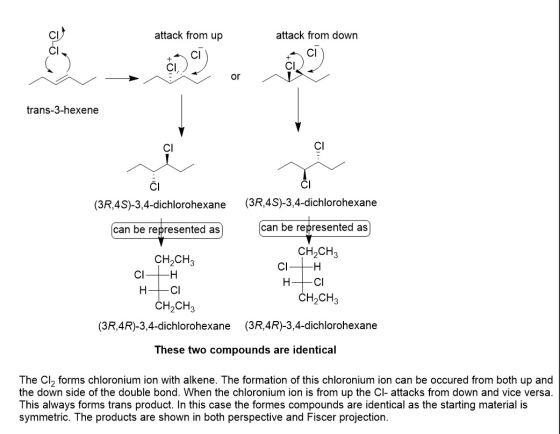
1) a) Using Fischer projections or perspective formulas, draw the stereoisomers obtained from the following reaction:...
For the compound 3-bromo-4-methylhexane, there are two chiral centers. Draw all stereoisomers in both perspective formulas...
For the compound 3-bromo-4-methylhexane, there are two chiral centers. Draw all stereoisomers in both perspective formulas (3D) and Fischer projections. Indicate R or S on the formulas (you don’t need to name them). List the relationships among the stereoisomers as Enantiomers and/or Diastereomers.
TRATEGY PROBLEM 18 Draw enantiomers for each of the following using a. perspective formulas. b. Fischer...
 TRATEGY PROBLEM 18 Draw enantiomers for each of the following using a. perspective formulas. b. Fischer projections. CH, 1. CH3CHCH,OH 2. CICH,CH,CHCH,CH, Br CH, 3. CH3CHCHCH; OH
1. Draw all stereoisomers of 1,2-dibromo-2-chloro-1-ethanol (fischer projections). How many isomers exist? Which are superimposable on...
1. Draw all stereoisomers of 1,2-dibromo-2-chloro-1-ethanol (fischer projections). How many isomers exist? Which are superimposable on each other? Which are non superimposable? Which are enantiomers? Which are diastereomers? 2. Draw all stereoisomers of 1,2-dichloro-1,2-dibromoethane (fischer projections). How many isomers exist? Which are superimposable on each other? Which are non-superimposable? Which are enantiomers? Which are diastereomers? Is there a mesocompound?
Draw all stereoisomers associated with 2-Bromo-3-methypentane. Draw the Fischer projections for all stereoisomers associated with 2-Bromo-3-methypentane....
 Draw all stereoisomers associated with 2-Bromo-3-methypentane.
Draw the Fischer projections for all stereoisomers associated with
2-Bromo-3-methypentane. Clearly label all stereoisomers as either
enantiomers, diastereomers, or meso. Place the lowest priority
groups in two vertical positions in final display. SHOW ALL WORK
CLEARLY. Thank you!
Draw all stereoisomers associated with 2-Bromo-3-methypentane.
Draw the Fischer projections for all stereoisomers associated with
2-Bromo-3-methypentane. Clearly label all stereoisomers as either
enantiomers, diastereomers, or meso. Place the lowest priority
groups in two vertical positions in final display. SHOW ALL WORK
CLEARLY. Thank you!
For 2-chloro-3-hexanol: Draw the structure of all the possible stereoisomers with Fischer Projection and Perspective Formulas...
 For 2-chloro-3-hexanol: Draw the structure of all the possible stereoisomers with Fischer Projection and Perspective Formulas showing both eclipsed and staggered conformations). 2) Assign the configuration of all chiral centers with R or S. (3) Give the complete IUPAC name for each stereoisomers. (4) Indicate the relationship among the structures, indicating which are the threo or erythro enantiomer, and diastereoisomer pairs.
Draw all the stereoisomers (redraw the first with the proper 3-D representation) of the compounds below....
 Draw all the stereoisomers (redraw the first with the proper 3-D
representation) of the compounds below. The configuration for the
first isomer you should draw is provided. Assign R or S
configuration to each chirality center in the additional isomers.
Indicate the stereochemical relationship (diastereomers,
enantiomers, meso compounds) between the first isomer and each of
the others. The configuration for the Fischer Projection has been
omitted, since stereochemistry can be determined from a 2-D
structure. You do not need to...
Draw all the stereoisomers (redraw the first with the proper 3-D
representation) of the compounds below. The configuration for the
first isomer you should draw is provided. Assign R or S
configuration to each chirality center in the additional isomers.
Indicate the stereochemical relationship (diastereomers,
enantiomers, meso compounds) between the first isomer and each of
the others. The configuration for the Fischer Projection has been
omitted, since stereochemistry can be determined from a 2-D
structure. You do not need to...
5. For the following set of Fischer projections answer each of the questions below by circling...
 5. For the following set of Fischer projections answer each of the questions below by circling the appropriate letter(s) or letter combination(s). Hint: Redraw the Fischer projections with the longest carbon chain in the vertical direction and having similar atoms in the top and bottom portion. Classify all chiral centers in the first structure as R or S absolute configuration. (X pts) a. Which are optically active? b. Which are meso? c. Which is not an isomer with the others?...
IX. (12 pts) Draw Fischer projections of all possible stereoisomers of 3-bromo-2-chlorobutanoic acid: CHaCH(Br)CH(CI)CO2H. Determine the...
 IX. (12 pts) Draw Fischer projections of all possible stereoisomers of 3-bromo-2-chlorobutanoic acid: CHaCH(Br)CH(CI)CO2H. Determine the R/S configuration of each stereocenter. Indicate the relationship between each pair of stereoisomers.
1.) Name the following compounds including stereochemistry. + Br 2.) Assign configurations to each of the...
 1.) Name the following compounds including stereochemistry. + Br 2.) Assign configurations to each of the chiral centers and circle the stereochemical relationship of the two compounds shown below in Fischer notation? CH3 C2H5 Br- H CH HCI Brt CzH5 A) enantiomers. B) diastereomers - C) constitutional isomers- D) cis/trans - isomers E) meso - same structure CH3 3.) Draw the structure of the meso form of 1,3-dichlorocyclopentane. Take particular care to indicate three-dimensional stereochemical detail properly. -
1. Consider the following Fischer projection formulas of 3-amino-2-butanol. Decide which pairs of the formulas are...
 1. Consider the following Fischer projection formulas of 3-amino-2-butanol. Decide which pairs of the formulas are related as enantiomers, which are related as diastereomers, and which represent identical molecules. Assign R or S absolute configuration to C2 and C3 for each structure, and then decide. List your results by letters in the spaces provided below. (5 pts) CH2CH3 O CH3CH2 - NH căH HS CH2CH3 H. NH2 SH CH3CH2CH CH,CH2 C- NH, SH Enantiomeric pairs: Diastereomeric pairs: Identical molecules:
 TRATEGY PROBLEM 18 Draw enantiomers for each of the following using a. perspective formulas. b. Fischer projections. CH, 1. CH3CHCH,OH 2. CICH,CH,CHCH,CH, Br CH, 3. CH3CHCHCH; OH
 Draw all stereoisomers associated with 2-Bromo-3-methypentane.
Draw the Fischer projections for all stereoisomers associated with
2-Bromo-3-methypentane. Clearly label all stereoisomers as either
enantiomers, diastereomers, or meso. Place the lowest priority
groups in two vertical positions in final display. SHOW ALL WORK
CLEARLY. Thank you!
Draw all stereoisomers associated with 2-Bromo-3-methypentane.
Draw the Fischer projections for all stereoisomers associated with
2-Bromo-3-methypentane. Clearly label all stereoisomers as either
enantiomers, diastereomers, or meso. Place the lowest priority
groups in two vertical positions in final display. SHOW ALL WORK
CLEARLY. Thank you!
 For 2-chloro-3-hexanol: Draw the structure of all the possible stereoisomers with Fischer Projection and Perspective Formulas showing both eclipsed and staggered conformations). 2) Assign the configuration of all chiral centers with R or S. (3) Give the complete IUPAC name for each stereoisomers. (4) Indicate the relationship among the structures, indicating which are the threo or erythro enantiomer, and diastereoisomer pairs.
 Draw all the stereoisomers (redraw the first with the proper 3-D
representation) of the compounds below. The configuration for the
first isomer you should draw is provided. Assign R or S
configuration to each chirality center in the additional isomers.
Indicate the stereochemical relationship (diastereomers,
enantiomers, meso compounds) between the first isomer and each of
the others. The configuration for the Fischer Projection has been
omitted, since stereochemistry can be determined from a 2-D
structure. You do not need to...
Draw all the stereoisomers (redraw the first with the proper 3-D
representation) of the compounds below. The configuration for the
first isomer you should draw is provided. Assign R or S
configuration to each chirality center in the additional isomers.
Indicate the stereochemical relationship (diastereomers,
enantiomers, meso compounds) between the first isomer and each of
the others. The configuration for the Fischer Projection has been
omitted, since stereochemistry can be determined from a 2-D
structure. You do not need to...
 5. For the following set of Fischer projections answer each of the questions below by circling the appropriate letter(s) or letter combination(s). Hint: Redraw the Fischer projections with the longest carbon chain in the vertical direction and having similar atoms in the top and bottom portion. Classify all chiral centers in the first structure as R or S absolute configuration. (X pts) a. Which are optically active? b. Which are meso? c. Which is not an isomer with the others?...
 IX. (12 pts) Draw Fischer projections of all possible stereoisomers of 3-bromo-2-chlorobutanoic acid: CHaCH(Br)CH(CI)CO2H. Determine the R/S configuration of each stereocenter. Indicate the relationship between each pair of stereoisomers.
 1.) Name the following compounds including stereochemistry. + Br 2.) Assign configurations to each of the chiral centers and circle the stereochemical relationship of the two compounds shown below in Fischer notation? CH3 C2H5 Br- H CH HCI Brt CzH5 A) enantiomers. B) diastereomers - C) constitutional isomers- D) cis/trans - isomers E) meso - same structure CH3 3.) Draw the structure of the meso form of 1,3-dichlorocyclopentane. Take particular care to indicate three-dimensional stereochemical detail properly. -
 1. Consider the following Fischer projection formulas of 3-amino-2-butanol. Decide which pairs of the formulas are related as enantiomers, which are related as diastereomers, and which represent identical molecules. Assign R or S absolute configuration to C2 and C3 for each structure, and then decide. List your results by letters in the spaces provided below. (5 pts) CH2CH3 O CH3CH2 - NH căH HS CH2CH3 H. NH2 SH CH3CH2CH CH,CH2 C- NH, SH Enantiomeric pairs: Diastereomeric pairs: Identical molecules:
Most questions answered within 3 hours.
-
Where is the error in this code sequence?
String s1 = "Hello";
String s2 = "ello";...
asked 10 months ago -
Financial data for Joel de Paris, Inc., for last year
follow:
Joel de Paris, Inc.
Balance...
asked 10 months ago -
Consider this reaction:
Al2(SO4)3 (aq)+ BaCl3
(aq) Al2Cl6 (aq)- +
3BaSO4(s) . What is the...
asked 10 months ago -
Suppose that Savneet is considering increasing her
recent random sample from 20 car rentals to 40...
asked 10 months ago -
Trucks arrive at an unloading terminal at an average rate of 120
per hour.
Trucks arrive...
asked 10 months ago -
Why are methanol and ethanol completely soluble in water while
octanol is not very little soluble....
asked 10 months ago -
A facilities manager at a university reads in a research report
that the mean amount of...
asked 10 months ago -
When the CuSO4 is rehydrated by adding water to the anhydrous
compound, is this an endothermic...
asked 10 months ago -
A ray of sunlight is passing from diamond into crown glass; the
angle of incidence is...
asked 10 months ago -
A block of mass 0.249 kg is placed on top of a light, vertical
spring of...
asked 10 months ago -
how do the kidneys compensate in the presences of acidosis
a) trigger hyperventilate
b) reserve acid...
asked 10 months ago -
Question 501 pts
The rental rate of capital to the firm increases. Which of the
following...
asked 10 months ago