London dispersión forces are only significant factor affecting boiling point for all of the following except...
London dispersión forces are only significant factor affecting boiling point for all of the following except Kr,H2SO4,C4, CL2,CH4
Homework Answers
if molecule or atoms are non-polar londen sidpersion forces are significantly effect on boiling point.
if molecule is polar then dipole-dipole interactions effects the boiling point.
among all H2SO4 is polar so dipole -dipole interactions are significant.
answer = HSO4
Add Answer to:
London dispersión forces are only significant factor
affecting boiling point for all of the following except...
London dispersion forces are the only significant factor affecting boiling point for all the following except?...
London dispersion forces are the only significant factor affecting boiling point for all the following except? a. CHF3 b. CH4 c. SO3 d. Ar e. Br2
h of the following statements is NOT true? London dispersion forces are present in all substances but are the only significant intermolecular forces in nonpolar substances. ) The density of the l...
 h of the following statements is NOT true? London dispersion forces are present in all substances but are the only significant intermolecular forces in nonpolar substances. ) The density of the liquid state of a substance is greater than the density of its gaseous state. The thermal energy in a liquid allows the atoms within molecules to completely overcome the attractions between them so they flow. Most liquids can be converted to a gas by reducing pressure and/or heating. The...
Which compound(s) exhibit only London dispersion intermolecular forces?
Which compound(s) exhibit only London dispersion intermolecular forces? (Select all that apply.) NH2OH SO2 CH4 SF4 PF5 NH3
Question 6 (1 point) Water has a relatively high boiling point due to London dispersion forces. True O False
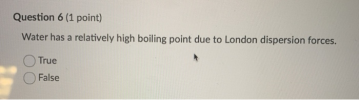 Question 6 (1 point) Water has a relatively high boiling point due to London dispersion forces. True O False
1.Which of the following is expected to have the higher boiling point? fluorine gas chlorine gas...
1.Which of the following is expected to have the higher boiling point? fluorine gas chlorine gas bromine gas iodine gas 2.Which of the following statements are true about Intermolecular Forces (IMFs)? (Select all that apply.) Hydrogen bonds occur between hydrogens on two neighboring molecules. All molecules exhibit Dipole-Dipole forces. Hydrogen bonds are generally stronger than London Dispersion Forces. Intermolecular forces are weaker than bonds. Intermolecular forces are attractive forces between two atoms in the same molecule. Only polar molecules exhibit...
1. Check off (V) all the forces that apply to each of the following compounds Compound...
 1. Check off (V) all the forces that apply to each of the following compounds Compound Intermolecular Force London Forces Hydrogen Bonding Dipole - Dipole BrF Cl2 H.S 2. In the liquid state, disruptive forces are a. roughly of the same magnitude as cohesive forces b. very weak compared to cohesive forces c. dominant over cohesive forces d. None of these 3. Between CIF and ClBr which compound would have a large boiling point? Explain the reason for your choice....
Please show steps (17) Which intermolecular forces are present in a sample of SF4? (A) London...
 Please show steps
(17) Which intermolecular forces are present in a sample of SF4? (A) London dispersion forces (B) Covalent Bonds (C) Dipole-dipole forces (D) Two of these (E) All of these (18) Which of the following does not increase with the strength of the intermolecular forces? (A) Melting Point (B) Boiling Point (C) Viscosity (D) Surface Tension (E) Ideal gas behavior
Please show steps
(17) Which intermolecular forces are present in a sample of SF4? (A) London dispersion forces (B) Covalent Bonds (C) Dipole-dipole forces (D) Two of these (E) All of these (18) Which of the following does not increase with the strength of the intermolecular forces? (A) Melting Point (B) Boiling Point (C) Viscosity (D) Surface Tension (E) Ideal gas behavior
Arrange each of the following sets of compounds in order of increasing boiling point temperature: (a)...
Arrange each of the following sets of compounds in order of increasing boiling point temperature: (a) HCl, H2O, SiH4 (b) F2, Cl2, Br2 (c) CH4, C2H6, C3H8 (d) O2, NO, N2
My answers: Not sure if they are correct. 1. a. London dispersion b. H-bonding, dipole-dipole,...
 My answers: Not sure if they are correct.
1. a. London dispersion
b. H-bonding, dipole-dipole, london dispersion
c. London dispersion
d. Ionic, london disperson
2. The second one because not a lot of H+ and less acidic. Need
help understanding the meaning of the question.
3. Diethyl cannot h-bond because it does not provide intermolecular
bonding engery while 1-b. can form h-bond making strong
intermolecular bonds to take up greater engery to break
molecules.
4. Not sure...
My answers: Not sure if they are correct.
1. a. London dispersion
b. H-bonding, dipole-dipole, london dispersion
c. London dispersion
d. Ionic, london disperson
2. The second one because not a lot of H+ and less acidic. Need
help understanding the meaning of the question.
3. Diethyl cannot h-bond because it does not provide intermolecular
bonding engery while 1-b. can form h-bond making strong
intermolecular bonds to take up greater engery to break
molecules.
4. Not sure...
Rank the following compounds in terms of increasing boiling point and provide a brief justification for...
Rank the following compounds in terms of increasing boiling point and provide a brief justification for your answer (Hint: consider intermolecular forces). CH3(CH2)3CH3 CH3CH2COOCH3 CH3CH2OH CH4
 h of the following statements is NOT true? London dispersion forces are present in all substances but are the only significant intermolecular forces in nonpolar substances. ) The density of the liquid state of a substance is greater than the density of its gaseous state. The thermal energy in a liquid allows the atoms within molecules to completely overcome the attractions between them so they flow. Most liquids can be converted to a gas by reducing pressure and/or heating. The...
 Question 6 (1 point) Water has a relatively high boiling point due to London dispersion forces. True O False
 1. Check off (V) all the forces that apply to each of the following compounds Compound Intermolecular Force London Forces Hydrogen Bonding Dipole - Dipole BrF Cl2 H.S 2. In the liquid state, disruptive forces are a. roughly of the same magnitude as cohesive forces b. very weak compared to cohesive forces c. dominant over cohesive forces d. None of these 3. Between CIF and ClBr which compound would have a large boiling point? Explain the reason for your choice....
 Please show steps
(17) Which intermolecular forces are present in a sample of SF4? (A) London dispersion forces (B) Covalent Bonds (C) Dipole-dipole forces (D) Two of these (E) All of these (18) Which of the following does not increase with the strength of the intermolecular forces? (A) Melting Point (B) Boiling Point (C) Viscosity (D) Surface Tension (E) Ideal gas behavior
Please show steps
(17) Which intermolecular forces are present in a sample of SF4? (A) London dispersion forces (B) Covalent Bonds (C) Dipole-dipole forces (D) Two of these (E) All of these (18) Which of the following does not increase with the strength of the intermolecular forces? (A) Melting Point (B) Boiling Point (C) Viscosity (D) Surface Tension (E) Ideal gas behavior
 My answers: Not sure if they are correct.
1. a. London dispersion
b. H-bonding, dipole-dipole, london dispersion
c. London dispersion
d. Ionic, london disperson
2. The second one because not a lot of H+ and less acidic. Need
help understanding the meaning of the question.
3. Diethyl cannot h-bond because it does not provide intermolecular
bonding engery while 1-b. can form h-bond making strong
intermolecular bonds to take up greater engery to break
molecules.
4. Not sure...
My answers: Not sure if they are correct.
1. a. London dispersion
b. H-bonding, dipole-dipole, london dispersion
c. London dispersion
d. Ionic, london disperson
2. The second one because not a lot of H+ and less acidic. Need
help understanding the meaning of the question.
3. Diethyl cannot h-bond because it does not provide intermolecular
bonding engery while 1-b. can form h-bond making strong
intermolecular bonds to take up greater engery to break
molecules.
4. Not sure...
Most questions answered within 3 hours.
-
Where is the error in this code sequence?
String s1 = "Hello";
String s2 = "ello";...
asked 10 months ago -
Financial data for Joel de Paris, Inc., for last year
follow:
Joel de Paris, Inc.
Balance...
asked 10 months ago -
Consider this reaction:
Al2(SO4)3 (aq)+ BaCl3
(aq) Al2Cl6 (aq)- +
3BaSO4(s) . What is the...
asked 10 months ago -
Suppose that Savneet is considering increasing her
recent random sample from 20 car rentals to 40...
asked 10 months ago -
Trucks arrive at an unloading terminal at an average rate of 120
per hour.
Trucks arrive...
asked 10 months ago -
Why are methanol and ethanol completely soluble in water while
octanol is not very little soluble....
asked 10 months ago -
A facilities manager at a university reads in a research report
that the mean amount of...
asked 10 months ago -
When the CuSO4 is rehydrated by adding water to the anhydrous
compound, is this an endothermic...
asked 10 months ago -
A ray of sunlight is passing from diamond into crown glass; the
angle of incidence is...
asked 10 months ago -
A block of mass 0.249 kg is placed on top of a light, vertical
spring of...
asked 10 months ago -
how do the kidneys compensate in the presences of acidosis
a) trigger hyperventilate
b) reserve acid...
asked 10 months ago -
Question 501 pts
The rental rate of capital to the firm increases. Which of the
following...
asked 10 months ago