
Homework Answers
Add Answer to:
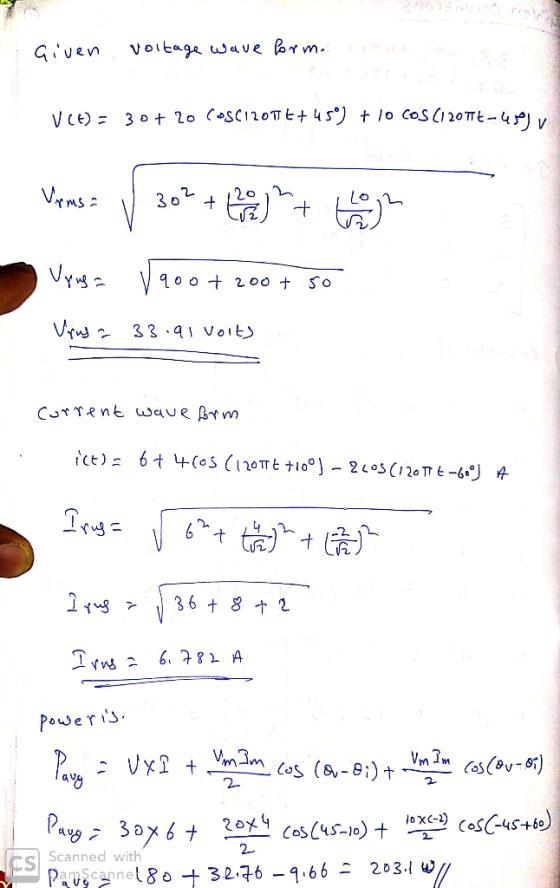
P.3 The voltage across the terminals of a circuit is: v(t) = 30+ 20 cos(1207t +45°)+10...
3. (30% ) The voltage and current at the terminals of a load circuit are given...
 3. (30% ) The voltage and current at the terminals of a load circuit are given by: )=1202 sin(ar) V i ()=812 sin(ar-60)+6/2 sin(Bax -120) A (V) and (A). (a) Find (b) Find the real (average) power P delivered to the load. (c) The distortion factor of the current waveform. (e) Find the displacement power factor DPF for this circuit. (f) Find the power factor of the load. (g) Is the load linear? 3. (30% ) The voltage and current...
For the circuit shown, find the steady-state voltage across the inductor v (t), when us 1 (t) = 2...
 For the circuit shown, find the steady-state voltage across the inductor v (t), when us 1 (t) = 20 cos(1000t) V, vs2(t) = 30 cos(1000t-90') V, using: (a) The mesh-current method (b) The node-voltage method. (c) The Source transformation Method (d) The superposition Principle (e The Thevenin's equivalent at the terminals a-b. 200μF VL 15mH Vs2 10Ω
For the circuit shown, find the steady-state voltage across the inductor v (t), when us 1 (t) = 20 cos(1000t) V, vs2(t) =...
For the circuit shown, find the steady-state voltage across the inductor v (t), when us 1 (t) = 20 cos(1000t) V, vs2(t) = 30 cos(1000t-90') V, using: (a) The mesh-current method (b) The node-voltage method. (c) The Source transformation Method (d) The superposition Principle (e The Thevenin's equivalent at the terminals a-b. 200μF VL 15mH Vs2 10Ω
For the circuit shown, find the steady-state voltage across the inductor v (t), when us 1 (t) = 20 cos(1000t) V, vs2(t) =...
For the circuit shown, find the steady-state voltage across the inductor v (t), when us 1 (t) = 2...
 For the circuit shown, find the steady-state voltage across the inductor v (t), when us 1 (t) = 20 cos(1000t) V, vs2(t) = 30 cos(1000t-90') V, using: (a) The mesh-current method (b) The node-voltage method. (c) The Source transformation Method (d) The superposition Principle (e The Thevenin's equivalent at the terminals a-b. 200μF VL 15mH Vs2 10Ω
For the circuit shown, find the steady-state voltage across the inductor v (t), when us 1 (t) = 20 cos(1000t) V, vs2(t) =...
For the circuit shown, find the steady-state voltage across the inductor v (t), when us 1 (t) = 20 cos(1000t) V, vs2(t) = 30 cos(1000t-90') V, using: (a) The mesh-current method (b) The node-voltage method. (c) The Source transformation Method (d) The superposition Principle (e The Thevenin's equivalent at the terminals a-b. 200μF VL 15mH Vs2 10Ω
For the circuit shown, find the steady-state voltage across the inductor v (t), when us 1 (t) = 20 cos(1000t) V, vs2(t) =...
2- A circuit across the terminals of a sinusoidal voltage source, as shown in Figure 2....
 2- A circuit across the terminals of a sinusoidal voltage source, as shown in Figure 2. The steady-state expression for the source voltage is v;=50.cos(1000t+20). (40 points) 12 mH 100 MF 10 Figure 2 a) Construct the frequency-domain equivalent circuit. b) Calculate the steady-state current i by the phasor method.
Problem 04: A voltage source is expressed by the following Fourier series: v(t) = -2 +...
 Problem 04: A voltage source is expressed by the following Fourier series: v(t) = -2 + 5* sin(t) – 5*cos(t) – 3* sin(2*t) + 4*cos(2*t) – sin(3*t) – 6*cos(3*t) + 4*sin(4*t) + 6*cos(4*t). Now, (a) Express v(t) in amplitude-phase form. (b) Draw the amplitude and phase spectra of v(t) (c) Determine the effective value (rms value) of the voltage v(t) (d) If the voltage is applied across an impedance block as shown in the circuit below, determine the average power...
The voltage and current at the input of a circuit are given by the expressions v(t)...
The voltage and current at the input of a circuit are given by the expressions v(t) = 120 cos (ω t + 30o) V i(t) = 40 cos (ω t + 45o) A Determine the average power absorbed by the circuit.
A 0.044-H inductor is wired across the terminals of a generator that has a voltage of...
A 0.044-H inductor is wired across the terminals of a generator that has a voltage of 2.4 V and supplies a current of 0.033 A. Find the frequency of the generator. Note: The ac current and voltage are rms values and power is an average value unless indicated otherwise.
Example 1 The voltage across the load is v(t) = 60 cos(wt - 10°) V and...
 Example 1 The voltage across the load is v(t) = 60 cos(wt - 10°) V and the current through the element in the direction of I voltage drop is i(t) = 1.5 sin(wt + 50°) A. Find a) The complex and apparent powers b) The real and the reactive powers c) The power factor and the load impedance.
Very clear explanation therotically and mathematically using trignometric formulaes. The voltage v across a load and...
 Very clear explanation therotically and mathematically using
trignometric formulaes.
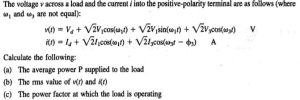
The voltage v across a load and the current i into the positive-polarity terminal are as follows (where , and ω3 are not equal): v(1) Va + V2Vicos@y) + V2V1sin(ωι) + V2V3Cos(W) Calculate the following: (a) The average power P supplied to the load (b) The rms value of v(t) and i(t) (c) The power factor at which the load is operating
Very clear explanation therotically and mathematically using
trignometric formulaes.
The voltage v across a load and the current i into the positive-polarity terminal are as follows (where , and ω3 are not equal): v(1) Va + V2Vicos@y) + V2V1sin(ωι) + V2V3Cos(W) Calculate the following: (a) The average power P supplied to the load (b) The rms value of v(t) and i(t) (c) The power factor at which the load is operating
20. The voltage and current in an electrical load is given by v(t) = 100 cos(wt...
 20. The voltage and current in an electrical load is given by v(t) = 100 cos(wt + 15°) and i(t) = 2 cos(wt – 15°). The reactive power Q in the load is 21. An electrical load absorbs an average power of 8kW at a leading power factor of 0.8. The reactive power in the load is 22. A balanced Y-connected load with an impedance of 104–30°N? per phase is supplied by a balanced A-connected source with Va = 208/30°V...
 3. (30% ) The voltage and current at the terminals of a load circuit are given by: )=1202 sin(ar) V i ()=812 sin(ar-60)+6/2 sin(Bax -120) A (V) and (A). (a) Find (b) Find the real (average) power P delivered to the load. (c) The distortion factor of the current waveform. (e) Find the displacement power factor DPF for this circuit. (f) Find the power factor of the load. (g) Is the load linear? 3. (30% ) The voltage and current...
 For the circuit shown, find the steady-state voltage across the inductor v (t), when us 1 (t) = 20 cos(1000t) V, vs2(t) = 30 cos(1000t-90') V, using: (a) The mesh-current method (b) The node-voltage method. (c) The Source transformation Method (d) The superposition Principle (e The Thevenin's equivalent at the terminals a-b. 200μF VL 15mH Vs2 10Ω
For the circuit shown, find the steady-state voltage across the inductor v (t), when us 1 (t) = 20 cos(1000t) V, vs2(t) =...
For the circuit shown, find the steady-state voltage across the inductor v (t), when us 1 (t) = 20 cos(1000t) V, vs2(t) = 30 cos(1000t-90') V, using: (a) The mesh-current method (b) The node-voltage method. (c) The Source transformation Method (d) The superposition Principle (e The Thevenin's equivalent at the terminals a-b. 200μF VL 15mH Vs2 10Ω
For the circuit shown, find the steady-state voltage across the inductor v (t), when us 1 (t) = 20 cos(1000t) V, vs2(t) =...
 For the circuit shown, find the steady-state voltage across the inductor v (t), when us 1 (t) = 20 cos(1000t) V, vs2(t) = 30 cos(1000t-90') V, using: (a) The mesh-current method (b) The node-voltage method. (c) The Source transformation Method (d) The superposition Principle (e The Thevenin's equivalent at the terminals a-b. 200μF VL 15mH Vs2 10Ω
For the circuit shown, find the steady-state voltage across the inductor v (t), when us 1 (t) = 20 cos(1000t) V, vs2(t) =...
For the circuit shown, find the steady-state voltage across the inductor v (t), when us 1 (t) = 20 cos(1000t) V, vs2(t) = 30 cos(1000t-90') V, using: (a) The mesh-current method (b) The node-voltage method. (c) The Source transformation Method (d) The superposition Principle (e The Thevenin's equivalent at the terminals a-b. 200μF VL 15mH Vs2 10Ω
For the circuit shown, find the steady-state voltage across the inductor v (t), when us 1 (t) = 20 cos(1000t) V, vs2(t) =...
 2- A circuit across the terminals of a sinusoidal voltage source, as shown in Figure 2. The steady-state expression for the source voltage is v;=50.cos(1000t+20). (40 points) 12 mH 100 MF 10 Figure 2 a) Construct the frequency-domain equivalent circuit. b) Calculate the steady-state current i by the phasor method.
 Problem 04: A voltage source is expressed by the following Fourier series: v(t) = -2 + 5* sin(t) – 5*cos(t) – 3* sin(2*t) + 4*cos(2*t) – sin(3*t) – 6*cos(3*t) + 4*sin(4*t) + 6*cos(4*t). Now, (a) Express v(t) in amplitude-phase form. (b) Draw the amplitude and phase spectra of v(t) (c) Determine the effective value (rms value) of the voltage v(t) (d) If the voltage is applied across an impedance block as shown in the circuit below, determine the average power...
 Example 1 The voltage across the load is v(t) = 60 cos(wt - 10°) V and the current through the element in the direction of I voltage drop is i(t) = 1.5 sin(wt + 50°) A. Find a) The complex and apparent powers b) The real and the reactive powers c) The power factor and the load impedance.
 Very clear explanation therotically and mathematically using
trignometric formulaes.
The voltage v across a load and the current i into the positive-polarity terminal are as follows (where , and ω3 are not equal): v(1) Va + V2Vicos@y) + V2V1sin(ωι) + V2V3Cos(W) Calculate the following: (a) The average power P supplied to the load (b) The rms value of v(t) and i(t) (c) The power factor at which the load is operating
Very clear explanation therotically and mathematically using
trignometric formulaes.
The voltage v across a load and the current i into the positive-polarity terminal are as follows (where , and ω3 are not equal): v(1) Va + V2Vicos@y) + V2V1sin(ωι) + V2V3Cos(W) Calculate the following: (a) The average power P supplied to the load (b) The rms value of v(t) and i(t) (c) The power factor at which the load is operating
 20. The voltage and current in an electrical load is given by v(t) = 100 cos(wt + 15°) and i(t) = 2 cos(wt – 15°). The reactive power Q in the load is 21. An electrical load absorbs an average power of 8kW at a leading power factor of 0.8. The reactive power in the load is 22. A balanced Y-connected load with an impedance of 104–30°N? per phase is supplied by a balanced A-connected source with Va = 208/30°V...
Most questions answered within 3 hours.
-
Where is the error in this code sequence?
String s1 = "Hello";
String s2 = "ello";...
asked 11 months ago -
Financial data for Joel de Paris, Inc., for last year
follow:
Joel de Paris, Inc.
Balance...
asked 11 months ago -
Consider this reaction:
Al2(SO4)3 (aq)+ BaCl3
(aq) Al2Cl6 (aq)- +
3BaSO4(s) . What is the...
asked 11 months ago -
Suppose that Savneet is considering increasing her
recent random sample from 20 car rentals to 40...
asked 11 months ago -
Trucks arrive at an unloading terminal at an average rate of 120
per hour.
Trucks arrive...
asked 11 months ago -
Why are methanol and ethanol completely soluble in water while
octanol is not very little soluble....
asked 11 months ago -
A facilities manager at a university reads in a research report
that the mean amount of...
asked 11 months ago -
When the CuSO4 is rehydrated by adding water to the anhydrous
compound, is this an endothermic...
asked 11 months ago -
A ray of sunlight is passing from diamond into crown glass; the
angle of incidence is...
asked 11 months ago -
A block of mass 0.249 kg is placed on top of a light, vertical
spring of...
asked 11 months ago -
how do the kidneys compensate in the presences of acidosis
a) trigger hyperventilate
b) reserve acid...
asked 11 months ago -
Question 501 pts
The rental rate of capital to the firm increases. Which of the
following...
asked 11 months ago