
Homework Answers
Answer is as follows :
As we see x is global variable, so it is set as Program Stack initially. So Currently stack contains variable x.
Now we start from main function.
Two variables a1 and a2 are declare there. So memory is reserved for these two also.
Currently stack contains variable x , a1 , a2.
Than there is function call to method b().
Where at first int b is declared.
After that b is operated and variable c is declared and given a function call to method a().
So now stack contains variable x , a1 , a2 , b , c .
At method a() variable a is declared and return the value . So memory is also reserved for this.
So now stack contains variable x , a1 , a2 , b , c , a.
The compiler will not see variable d, so it can't get any memory in stack according to question. Only method a() is running so we can't proceed further to method b(), to initialize the memory to variable d.
So stack contains following variables :
x , a1 , a2 , b , c , a
if there is any query please ask in comments..
Add Answer to:
8. Given the following code part, when methodA) is running, list ALL variables that are on...
please answer all 5 questions, thanks. 1. What are the two memory pools for programs running...
 please answer all 5 questions, thanks.
1. What are the two memory pools for programs running a modern operating system? 2. Given the following program: #includec iostream» using namespace std; void func1(int); int main( int a 5, b 10; func1(a): return e; void func1 (int a) int z[2]; int y a. What is on the stack before the first function call (assume a memory starting address of 0x1018)? b. What is on the stack after the function call is executed...
please answer all 5 questions, thanks.
1. What are the two memory pools for programs running a modern operating system? 2. Given the following program: #includec iostream» using namespace std; void func1(int); int main( int a 5, b 10; func1(a): return e; void func1 (int a) int z[2]; int y a. What is on the stack before the first function call (assume a memory starting address of 0x1018)? b. What is on the stack after the function call is executed...
problem 2 and 3 1. For each variable (a-g) describe whether the variable itself is global...
 problem
2 and 3
1. For each variable (a-g) describe whether the variable itself is global or local, static or not static, and initialized or uninitialized. (Hints: Global variables are always static. Local variables become static when declared with 'static'. For pointers, consider the pointer itself, not anything the pointer might point to.) 2. For each variable (a-g), describe where it is located when DoFunctionB is running. That is, for each variable, describe whether it is on the stack, in...
problem
2 and 3
1. For each variable (a-g) describe whether the variable itself is global or local, static or not static, and initialized or uninitialized. (Hints: Global variables are always static. Local variables become static when declared with 'static'. For pointers, consider the pointer itself, not anything the pointer might point to.) 2. For each variable (a-g), describe where it is located when DoFunctionB is running. That is, for each variable, describe whether it is on the stack, in...
Question 5 (1 point) Suppose you were debugging the following C code. Which of the following...
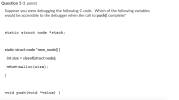 Question 5 (1 point) Suppose you were debugging the following C code. Which of the following variables would be accessible to the debugger when the call to push() complete? static struct node *stack; static struct node *new_node() { int size = sizeof(struct node); return malloc(size); بب void push (void *value) { void push (void *value) { struct node *n = new_node(); n->value = value; n->next = stack; stack = n; } stack, value. n, size stack stack, n, value stack,...
1. What is output by the following code: ArrayList< Integer > a = new ArrayList< Integer...
1. What is output by the following code: ArrayList< Integer > a = new ArrayList< Integer >(); ArrayList b = a; a.add(new Integer(4)); b.add(new Integer(5)); a.add(new Integer(6)); a.add(new Integer(7)); System.out.println(b.size()); A)1 B)2 C)3 D)4 E)5 2. Assume the Student and Employee classes each extend the Person class. The Student class overrides the getMoney method in the Person class. Consider the following code: Person p1, p2, p3; int m1, m2, m3; p1 = new Person(); m1 = p1.getMoney(); // assignment 1...
b) Consider the following code. public static int f(int n) if (n == 1) return 0;...
 b) Consider the following code. public static int f(int n) if (n == 1) return 0; else if (n % 2 == 0). return g(n/2); else return g(n+1); public static int g(int n) int r = n % 3; if (r == 0) return f(n/3); else if (r == 1) return f(n+2); else return f(2 * n); // (HERE) public static void main(String[] args) { int x = 3; System.out.println(f(x)); (1) (5 points) Draw the call stack as it would...
What is wrong with my code, when I pass in 4 It will not run, without...
What is wrong with my code, when I pass in 4 It will not run, without the 4 it will run, but throw and error. I am getting the error required: no arguments found: int reason: actual and formal argument lists differ in length where T is a type-variable: T extends Object declared in class LinkedDropOutStack public class Help { /** * Program entry point for drop-out stack testing. * @param args Argument list. */ public static void main(String[] args)...
in c++ please include all of the following " template class, template function, singly linked list,...
in c++ please include all of the following " template class, template function, singly linked list, the ADT stack, copy constructor, operator overloading, "try catch"and pointers Modify the code named "Stack using a Singly Linked List" to make the ADT Stack that is a template class has the code of the destructor in which each node is directly deleted without using any member function. As each node is deleted, the destructor displays the address of the node that is being...
#1. Operators and values, expressions Please correct the following code to make it print the given...
#1. Operators and values, expressions Please correct the following code to make it print the given expressions and their answers well (3pts). public class DataTypes { public static void main(String[] args) { System.out.println("5*8/6 = " + 5*8/6); System.out.println("(2*6)+(4*4)+10 = " + (2*6)+(4*4)+10); System.out.println("6 / 2 + 7 / 3 = " + 6 / 2 + 7 / 3); System.out.println("6 * 7 % 4 = " + 6 * 7 % 4 ); System.out.println("22 + 4 * 2 = "...
PART A - STACKS To complete this assignment: Please study the code posted below. Please rewrite...
PART A - STACKS To complete this assignment: Please study the code posted below. Please rewrite the code implementing a template class using a linked list instead of an array. Note: The functionality should remain the same *************************************************************************************************************** /** * Stack implementation using array in C/procedural language. */ #include <iostream> #include <cstdio> #include <cstdlib> //#include <climits> // For INT_MIN #define SIZE 100 using namespace std; /// Create a stack with capacity of 100 elements int stack[SIZE]; /// Initially stack is...
Given the following code, determine the amount of memory required to store all of the variables...
Given the following code, determine the amount of memory required to store all of the variables after the program has been executed (Hint: sum the variables) show your work. Then, tabulate your results in the form of the table below (a separate table ffor each part) then add to your report. Variable datatype Memory for datatype (bits) # of elements Memory (bits) a logical 8 1 8*1 = 8 . . . . . . . . . ....
 please answer all 5 questions, thanks.
1. What are the two memory pools for programs running a modern operating system? 2. Given the following program: #includec iostream» using namespace std; void func1(int); int main( int a 5, b 10; func1(a): return e; void func1 (int a) int z[2]; int y a. What is on the stack before the first function call (assume a memory starting address of 0x1018)? b. What is on the stack after the function call is executed...
please answer all 5 questions, thanks.
1. What are the two memory pools for programs running a modern operating system? 2. Given the following program: #includec iostream» using namespace std; void func1(int); int main( int a 5, b 10; func1(a): return e; void func1 (int a) int z[2]; int y a. What is on the stack before the first function call (assume a memory starting address of 0x1018)? b. What is on the stack after the function call is executed...
 problem
2 and 3
1. For each variable (a-g) describe whether the variable itself is global or local, static or not static, and initialized or uninitialized. (Hints: Global variables are always static. Local variables become static when declared with 'static'. For pointers, consider the pointer itself, not anything the pointer might point to.) 2. For each variable (a-g), describe where it is located when DoFunctionB is running. That is, for each variable, describe whether it is on the stack, in...
problem
2 and 3
1. For each variable (a-g) describe whether the variable itself is global or local, static or not static, and initialized or uninitialized. (Hints: Global variables are always static. Local variables become static when declared with 'static'. For pointers, consider the pointer itself, not anything the pointer might point to.) 2. For each variable (a-g), describe where it is located when DoFunctionB is running. That is, for each variable, describe whether it is on the stack, in...
 Question 5 (1 point) Suppose you were debugging the following C code. Which of the following variables would be accessible to the debugger when the call to push() complete? static struct node *stack; static struct node *new_node() { int size = sizeof(struct node); return malloc(size); بب void push (void *value) { void push (void *value) { struct node *n = new_node(); n->value = value; n->next = stack; stack = n; } stack, value. n, size stack stack, n, value stack,...
 b) Consider the following code. public static int f(int n) if (n == 1) return 0; else if (n % 2 == 0). return g(n/2); else return g(n+1); public static int g(int n) int r = n % 3; if (r == 0) return f(n/3); else if (r == 1) return f(n+2); else return f(2 * n); // (HERE) public static void main(String[] args) { int x = 3; System.out.println(f(x)); (1) (5 points) Draw the call stack as it would...
Most questions answered within 3 hours.
-
Where is the error in this code sequence?
String s1 = "Hello";
String s2 = "ello";...
asked 11 months ago -
Financial data for Joel de Paris, Inc., for last year
follow:
Joel de Paris, Inc.
Balance...
asked 11 months ago -
Consider this reaction:
Al2(SO4)3 (aq)+ BaCl3
(aq) Al2Cl6 (aq)- +
3BaSO4(s) . What is the...
asked 11 months ago -
Suppose that Savneet is considering increasing her
recent random sample from 20 car rentals to 40...
asked 11 months ago -
Trucks arrive at an unloading terminal at an average rate of 120
per hour.
Trucks arrive...
asked 11 months ago -
Why are methanol and ethanol completely soluble in water while
octanol is not very little soluble....
asked 11 months ago -
A facilities manager at a university reads in a research report
that the mean amount of...
asked 11 months ago -
When the CuSO4 is rehydrated by adding water to the anhydrous
compound, is this an endothermic...
asked 11 months ago -
A ray of sunlight is passing from diamond into crown glass; the
angle of incidence is...
asked 11 months ago -
A block of mass 0.249 kg is placed on top of a light, vertical
spring of...
asked 11 months ago -
how do the kidneys compensate in the presences of acidosis
a) trigger hyperventilate
b) reserve acid...
asked 11 months ago -
Question 501 pts
The rental rate of capital to the firm increases. Which of the
following...
asked 11 months ago