Given the following code, determine the amount of memory required to store all of the variables...
Given the following code, determine the amount of memory
required to store all of the variables after the program has been
executed (Hint: sum the variables) show your work. Then, tabulate
your results in the form of the table below (a separate table ffor
each part) then add to your report.
Variable datatype Memory for datatype (bits) # of
elements Memory (bits) a logical 8 1 8*1 = 8 . . . . . . . . . . .
. . . . sum (bytes)
(a)
clear all clc
a=2; b=[5 1];
c = ~(a > b);
d = uint16(c);
e = [ b b a a];
f=single(a);
(b)
clear all clc
d=[1 2 3; 4 5 6; 7 8 9]; s=0;
[nr,nc]=size(d);
for ir=1:nr
for ic=1:nc
s = s + d(ir,ic);
end
end
m = s/(nr*nc);
(c)
clear all
clc
c = uint8(0);
happy=true;
out=[];
while(happy)
c = c + uint8(1);
out = [out double(c) ];
if(c>4)
happy = false;
end
end
q =10:-2:0;
r = single(q(1:3));
s = rand(3,1);
Homework Answers
[Edited]
The amount of memory required to store each variable and the total amount of storage required to store all of the variables after the execution of the program is given below in Tabular Form.
Code a
| Variable Name | Datatype | Dimension |
Effective number of element |
Bytes allocated per element | Total Bytes allocated to the variable |
| a | double | 1 1 1 |
1 | 8 | 8 |
| b | double | 12 |
2 | 8 | 16 |
| c | logical | 12 |
2 | 1 | 2 |
| d | unit16 | 12 |
2 | 2 | 4 |
| e | double | 16 |
6 | 8 | 48 |
| f | single | 11 |
1 | 4 | 4 |
| Total | 78 |
Code b)
| Variable Name | Datatype | Dimension |
Effective number of element |
Bytes allocated per element | Total Bytes allocated to the variable |
| d | double | 33 |
9 | 8 | 9*8 = 72 |
| ic | double | 11 |
1 | 8 | 8 |
| it | double | 11 |
1 | 8 | 8 |
| m | double | 11 |
1 | 8 | 8 |
| nc | double | 11 |
1 | 8 | 8 |
| nr | double | 11 |
1 | 8 | 8 |
| s | double | 11 |
1 | 8 | 8 |
| Total | 15 | 8 | 15*8 = 120 |
Code c:
| Variable Name | Datatype | Dimension |
Effective number of element |
Bytes allocated per element | Total Bytes allocated to the variable |
| c | unit8 | 11 |
1 | 1 | 1 |
| happy | logical | 11 |
1 | 2 | 1 |
| out | double | 15 |
5 | 8 | 40 |
| q | double | 16 |
6 | 8 | 48 |
| r | single | 13 |
3 | 4 | 12 |
| s | double | 31 |
3 | 8 | 24 |
| Total | 126 |
Refer to the command "help double" to know how many bytes of memory is allocated when we assign a variable of datatype double.
Add Answer to:
Given the following code, determine the amount of memory
required to store all of the variables...
8. Given the following code part, when methodA) is running, list ALL variables that are on...
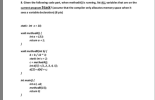 8. Given the following code part, when methodA) is running, list ALL variables that are on the current program Stack? (assume that the compiler only allocates memory space when it sees a variable declaration) (8 pts) static int 10 void methodA) inta -123 return a1; void methodB(int b) t b b/12 3 static int c 2 c methodAl) int d[5]-(1,2, 3,4, 5 2-4G int main0 inta1, a2; methodB(15 return 0
A. What is the output of the following C++ code fragment? (all variables are of type...
 A. What is the output of the following C++ code fragment? (all variables are of type int) int count-1; int y-100; while (count 3) y=y-1 ; count+t cout << y << endl; cout<< count <<endl What is the value of x after control leaves the following while loop? (all variables are of type int) B. int x0 while (x < 20) sum- sum+x cout << sum<< endl;
Write out the memory map for the following code, providing all values at the end of...
 Write out the memory map for the following code, providing all
values at the end of execution.
How many total bytes does this code declare for variables?
double testd; struct frog h: int testi; double .xy: struct frog turtle, apple, tv[3] testi-2; apple-kturtle; apple->x-ktestd; *(turtle.x)-7.3; apple).y-3.6 turtle.y-1.5 for (testi-o ; te8tjc3 ; test i++) tv [testi] .x-a(tv [ (test1+1 )%3] . y) ;
Write out the memory map for the following code, providing all
values at the end of execution.
How many total bytes does this code declare for variables?
double testd; struct frog h: int testi; double .xy: struct frog turtle, apple, tv[3] testi-2; apple-kturtle; apple->x-ktestd; *(turtle.x)-7.3; apple).y-3.6 turtle.y-1.5 for (testi-o ; te8tjc3 ; test i++) tv [testi] .x-a(tv [ (test1+1 )%3] . y) ;
4. If the memory bus has 24 bits, and there are 8 words in a block...
4. If the memory bus has 24 bits, and there are 8 words in a block in RAM, To design a 4 set-associative cache with 8K sets in cache, answer the following questions: (a). RAM size (b). How many blocks in RAM? (c). How many bits are w? (d). How many bits are d? (e). How many bits are s? (f). cache size in words? (g). How many lines in cache? (h). If we increase the cache size to 32K...
3. (15 Pts.) In this problem you are given a microprocessor with 24-bit address bus and...
 3. (15 Pts.) In this problem you are given a microprocessor with 24-bit address bus and 8-bit data bus. a. What is the addressing space of this microprocessor? 113 16 MB b. how many bytes are contained in the sub-space starting at address C00 000h and ending at address DFF FFFH? Express your answer in KB and MB. DFFFEE CoO DOU - TFFFFF in ke 20 4SKe c. You would like to interface a single 4 MB memory IC to...
Hi, please help and write clearly. Thanks. uestion 2 (30 marks (a) A memory system of...
 Hi, please help and write clearly. Thanks.
uestion 2 (30 marks (a) A memory system of 64 bit is arranged into 4096 rows and 128 columns Calculatee (i)The data length in bytes (ii)The number of bits stored in the memory (iii)The number of row and column addresse:s [2 marks] [4 marks] [4 marks] (b)A Programmable Read Only Memory (PROM) based Programmable logic device (PLD) has the following characteristics When C-0, output is A. When C-1, output is B (i)Determine the...
Hi, please help and write clearly. Thanks.
uestion 2 (30 marks (a) A memory system of 64 bit is arranged into 4096 rows and 128 columns Calculatee (i)The data length in bytes (ii)The number of bits stored in the memory (iii)The number of row and column addresse:s [2 marks] [4 marks] [4 marks] (b)A Programmable Read Only Memory (PROM) based Programmable logic device (PLD) has the following characteristics When C-0, output is A. When C-1, output is B (i)Determine the...
Problem #1 (25 points) Address Space, Memory Consider a hypothetical 18-bit processor called HYP18 with all...
 Problem #1 (25 points) Address Space, Memory Consider a hypothetical 18-bit processor called HYP18 with all registers, including PC and SP, being 18 bits long. The smallest addressable unit in memory is an 8-bit byte. A. (4 points) What is the size of HYP18's address space in bytes and KB? How many address lines does HYP18 require? Address space: Bytes Address space: KB (KiloBytes). Address bus lines: B. (6 points) Assume that first quarter of the address space is dedicated...
Question 4] All variables and headers properly defined for the C functional program. char st 80...
 Question 4] All variables and headers properly defined for the C functional program. char st 80 1: unsigned *ptri-s .a) What is the size of the array 's' in bytes? .b) ptr1 has a hex-decimal value of 28FE60 referring to the first element of st 1 array. What is the decimal value? c) Following this functional software; a Ans size- b Ans-- for (i 0; sl i0:+i) printf( "in %c: It %dVt",toupper(s[i] . (i.2), toupper( st i l . (i.2)));...
1. Select all that are true for the following code. #include <stdio.h> #include <stdlib.h> void range(int...
1. Select all that are true for the following code. #include <stdio.h> #include <stdlib.h> void range(int start, int end, int *results) { int length = end - start; results = malloc(sizeof(int) * length); for (int i=start; i<end; i++) { *results = i; results++; } } void printArray(int *arr, int length) { for (int i=0; i<length; i++) { printf("%d ", arr[i]); } } int main() { int *x; int s = 2; int e = 11; range(s, e, x); printArray(x, e...
For each part, do or answer the following: - Show how you would add the two...
 For each part, do or
answer the following:
-
Show how you would add the two 8-bit binary numbers by filling
in each of the blank boxes with a 0 or 1.
NOTE1: Addition of 2's complement numbers is done just like the
addition of unsigned whole numbers, so you only need to show each
addition once.
NOTE2: There are 9 blank boxes for the Carry bits and 8 blank boxes
for the Sum bits.
CAUTION: Every blank box should...
For each part, do or
answer the following:
-
Show how you would add the two 8-bit binary numbers by filling
in each of the blank boxes with a 0 or 1.
NOTE1: Addition of 2's complement numbers is done just like the
addition of unsigned whole numbers, so you only need to show each
addition once.
NOTE2: There are 9 blank boxes for the Carry bits and 8 blank boxes
for the Sum bits.
CAUTION: Every blank box should...
 8. Given the following code part, when methodA) is running, list ALL variables that are on the current program Stack? (assume that the compiler only allocates memory space when it sees a variable declaration) (8 pts) static int 10 void methodA) inta -123 return a1; void methodB(int b) t b b/12 3 static int c 2 c methodAl) int d[5]-(1,2, 3,4, 5 2-4G int main0 inta1, a2; methodB(15 return 0
 A. What is the output of the following C++ code fragment? (all variables are of type int) int count-1; int y-100; while (count 3) y=y-1 ; count+t cout << y << endl; cout<< count <<endl What is the value of x after control leaves the following while loop? (all variables are of type int) B. int x0 while (x < 20) sum- sum+x cout << sum<< endl;
 Write out the memory map for the following code, providing all
values at the end of execution.
How many total bytes does this code declare for variables?
double testd; struct frog h: int testi; double .xy: struct frog turtle, apple, tv[3] testi-2; apple-kturtle; apple->x-ktestd; *(turtle.x)-7.3; apple).y-3.6 turtle.y-1.5 for (testi-o ; te8tjc3 ; test i++) tv [testi] .x-a(tv [ (test1+1 )%3] . y) ;
Write out the memory map for the following code, providing all
values at the end of execution.
How many total bytes does this code declare for variables?
double testd; struct frog h: int testi; double .xy: struct frog turtle, apple, tv[3] testi-2; apple-kturtle; apple->x-ktestd; *(turtle.x)-7.3; apple).y-3.6 turtle.y-1.5 for (testi-o ; te8tjc3 ; test i++) tv [testi] .x-a(tv [ (test1+1 )%3] . y) ;
 3. (15 Pts.) In this problem you are given a microprocessor with 24-bit address bus and 8-bit data bus. a. What is the addressing space of this microprocessor? 113 16 MB b. how many bytes are contained in the sub-space starting at address C00 000h and ending at address DFF FFFH? Express your answer in KB and MB. DFFFEE CoO DOU - TFFFFF in ke 20 4SKe c. You would like to interface a single 4 MB memory IC to...
 Hi, please help and write clearly. Thanks.
uestion 2 (30 marks (a) A memory system of 64 bit is arranged into 4096 rows and 128 columns Calculatee (i)The data length in bytes (ii)The number of bits stored in the memory (iii)The number of row and column addresse:s [2 marks] [4 marks] [4 marks] (b)A Programmable Read Only Memory (PROM) based Programmable logic device (PLD) has the following characteristics When C-0, output is A. When C-1, output is B (i)Determine the...
Hi, please help and write clearly. Thanks.
uestion 2 (30 marks (a) A memory system of 64 bit is arranged into 4096 rows and 128 columns Calculatee (i)The data length in bytes (ii)The number of bits stored in the memory (iii)The number of row and column addresse:s [2 marks] [4 marks] [4 marks] (b)A Programmable Read Only Memory (PROM) based Programmable logic device (PLD) has the following characteristics When C-0, output is A. When C-1, output is B (i)Determine the...
 Problem #1 (25 points) Address Space, Memory Consider a hypothetical 18-bit processor called HYP18 with all registers, including PC and SP, being 18 bits long. The smallest addressable unit in memory is an 8-bit byte. A. (4 points) What is the size of HYP18's address space in bytes and KB? How many address lines does HYP18 require? Address space: Bytes Address space: KB (KiloBytes). Address bus lines: B. (6 points) Assume that first quarter of the address space is dedicated...
 Question 4] All variables and headers properly defined for the C functional program. char st 80 1: unsigned *ptri-s .a) What is the size of the array 's' in bytes? .b) ptr1 has a hex-decimal value of 28FE60 referring to the first element of st 1 array. What is the decimal value? c) Following this functional software; a Ans size- b Ans-- for (i 0; sl i0:+i) printf( "in %c: It %dVt",toupper(s[i] . (i.2), toupper( st i l . (i.2)));...
 For each part, do or
answer the following:
-
Show how you would add the two 8-bit binary numbers by filling
in each of the blank boxes with a 0 or 1.
NOTE1: Addition of 2's complement numbers is done just like the
addition of unsigned whole numbers, so you only need to show each
addition once.
NOTE2: There are 9 blank boxes for the Carry bits and 8 blank boxes
for the Sum bits.
CAUTION: Every blank box should...
For each part, do or
answer the following:
-
Show how you would add the two 8-bit binary numbers by filling
in each of the blank boxes with a 0 or 1.
NOTE1: Addition of 2's complement numbers is done just like the
addition of unsigned whole numbers, so you only need to show each
addition once.
NOTE2: There are 9 blank boxes for the Carry bits and 8 blank boxes
for the Sum bits.
CAUTION: Every blank box should...
Most questions answered within 3 hours.
-
Where is the error in this code sequence?
String s1 = "Hello";
String s2 = "ello";...
asked 11 months ago -
Financial data for Joel de Paris, Inc., for last year
follow:
Joel de Paris, Inc.
Balance...
asked 11 months ago -
Consider this reaction:
Al2(SO4)3 (aq)+ BaCl3
(aq) Al2Cl6 (aq)- +
3BaSO4(s) . What is the...
asked 11 months ago -
Suppose that Savneet is considering increasing her
recent random sample from 20 car rentals to 40...
asked 11 months ago -
Trucks arrive at an unloading terminal at an average rate of 120
per hour.
Trucks arrive...
asked 11 months ago -
Why are methanol and ethanol completely soluble in water while
octanol is not very little soluble....
asked 11 months ago -
A facilities manager at a university reads in a research report
that the mean amount of...
asked 11 months ago -
When the CuSO4 is rehydrated by adding water to the anhydrous
compound, is this an endothermic...
asked 11 months ago -
A ray of sunlight is passing from diamond into crown glass; the
angle of incidence is...
asked 11 months ago -
A block of mass 0.249 kg is placed on top of a light, vertical
spring of...
asked 11 months ago -
how do the kidneys compensate in the presences of acidosis
a) trigger hyperventilate
b) reserve acid...
asked 11 months ago -
Question 501 pts
The rental rate of capital to the firm increases. Which of the
following...
asked 11 months ago