A ladder of length L = 2.5 m and mass m = 20 kg rests on...
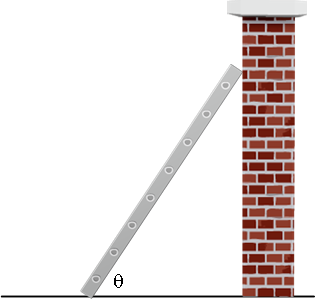
A ladder of length L = 2.5 m and mass m = 20 kg rests on a floor with coefficient of static friction μs = 0.52. Assume the wall is frictionless.
1)What is the normal force the floor exerts on the ladder? 196.2N
2) What is the minimum angle the ladder must make with the floor to not slip?
3)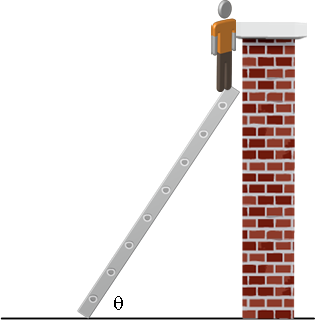
A person with mass M = 63 kg now stands at the very top of the ladder.
What is the normal force the floor exerts on the ladder?
4)What is the minimum angle to keep the ladder from sliding?
Homework Answers
given data
length of the ladder L=2.5m
mass m=20
μs = 0.52
1)What is the normal force the floor exerts on the ladder?
Since the wall is frictionless, the normal force on the floor supports the full weight of the ladder.
Therefore Fn = 20kg * 9.8m/s² = 196 N
2) What is the minimum angle the ladder must make with the floor to not slip?
At the threshold, Fw = Ff = µmg = 0.52 * 196N = 196 N
where Ff is the friction force at the floor and Fw is the opposing
force at the wall.
Sum the moments about the base of the ladder:
196N * 2.5m/2 * cosΘ = 102N * 2.5m * sinΘ
245N·m = 255N·m * tanΘ
Θ = 43.85º
3.A person with mass M = 63 kg now stands at the very top of the ladder.
What is the normal force the floor exerts on the ladder?
Fn = 196N + 63kg * 9.8m/s² = 813.4 N
4)What is the minimum angle to keep the ladder from sliding?
Ff = 813.4N * 0.52 = 423 N = Fw
196N * 2.5m/2 * cosΘ + 63kg * 9.8m/s² * 2.5m * cosΘ = 423N * 2.5m *
sinΘ
(196/2)+63*9.8 = 423 *tan(Θ )
Θ = 59.4º
A ladder of length L = 2.8 m and mass m = 22 kg rests on...
A ladder of length L = 2.8 m and mass m = 22 kg rests on a floor with coefficient of static friction μs = 0.57. Assume the wall is frictionless. *What is the minimum angle the ladder must make with the floor to not slip? A person with mass M = 60 kg now stands at the very top of the ladder. *What is the normal force the floor exerts on the ladder? *What is the minimum angle to...
Question: A ladder of length L = 2.4 m and mass m = 19.0 kg rests...
Question: A ladder of length L = 2.4 m and mass m = 19.0 kg rests on a floor with coefficient of static friction ?s = 0.50. Assume the wall is frictionless. a) What is the normal force the floor exerts on the ladder? = 187.4 N b) What is the minimum angle the ladder must make with the floor to not slip? = 45 degrees c) A person with mass M = 61.0 kg now stands at the very...
A ladder of mass M and length 3.00 m rests against a frictionless wall at an...
 A ladder of mass M and length 3.00 m rests against a
frictionless wall at an angle ? = 50° to the horizontal as in the
figure below. The coefficient of static friction at the floor is
0.600. What is the maximum distance along the ladder a person of
mass 12M can climb before the ladder starts to slip?
A ladder of mass M and length 3.00 m rests against a
frictionless wall at an angle ? = 50° to the horizontal as in the
figure below. The coefficient of static friction at the floor is
0.600. What is the maximum distance along the ladder a person of
mass 12M can climb before the ladder starts to slip?
A uniform ladder of length L and mass 5 kg rests against a smooth, frictionless, vertical...
A uniform ladder of length L and mass 5 kg rests against a smooth, frictionless, vertical wall. The coefficient of static friction between the ladder and ground is 0.4. a.) Draw a force diagram indicating all the forces acting on the ladder and where they are applied. b.) Find the minimum angle,between the ladder and the ground at which the ladder will not slip.
A uniform ladder of mass (m = 14.0 kg) and length (L) leans against a frictionless...
A uniform ladder of mass (m = 14.0 kg) and length (L) leans against a frictionless wall, see figure. If the angle θ = 60.0°, find the static friction force between the ladder and the floor when a 60.0-kg person stands two-third of the way up the ladder?
A uniform ladder of mass (m = 15.0 kg) and length (L) leans against a frictionless...
A uniform ladder of mass (m = 15.0 kg) and length (L) leans against a frictionless wall, see figure. If the angle θ = 52.0°, find the static friction force between the ladder and the floor when a 95.0-kg person stands two-third of the way up the ladder?
8. A uniform ladder of mass (m = 14.5 kg) and length (L) leans against a...
 8. A uniform ladder of mass (m = 14.5 kg) and
length (L) leans against a frictionless wall, see figure.
If the angle θ = 70.0°, find the static friction force between the
ladder and the floor when a 80.0-kg person stands half way up the
ladder?
N
8. A uniform ladder of mass (m = 14.5 kg) and
length (L) leans against a frictionless wall, see figure.
If the angle θ = 70.0°, find the static friction force between the
ladder and the floor when a 80.0-kg person stands half way up the
ladder?
N
013 10.0 points A 25.6 kg person climbs up a uniform ladder with negligible mass. The...
 013 10.0 points A 25.6 kg person climbs up a uniform ladder with negligible mass. The upper end of the ladder rests on a frictionless wall. The bottom of the ladder rests on a floor with a rough surface where the coefficient of static friction is 0.25. The angle between the horizontal and the ladder is . The person wants to climb up the ladder a distance of 2.5 m along the ladder from the ladder's foot. 3.8 m 125.6...
QUESTION 7 A person having a mass, m= 75.0 kg, stands on a ladder of mass...
 QUESTION 7 A person having a mass, m= 75.0 kg, stands on a ladder of mass mi=9.20 kg and length 1=5.50 m. The bottom end of the ladder rests on the floor at a point 3.50 m from the wall. Assume the wall is frictionless but the floor is not and has a 0.435 coefficient of static friction with the ladder's feet. At what critical distance from the bottom end of the ladder would the person stand to cause the...
 A ladder of mass M and length 3.00 m rests against a
frictionless wall at an angle ? = 50° to the horizontal as in the
figure below. The coefficient of static friction at the floor is
0.600. What is the maximum distance along the ladder a person of
mass 12M can climb before the ladder starts to slip?
A ladder of mass M and length 3.00 m rests against a
frictionless wall at an angle ? = 50° to the horizontal as in the
figure below. The coefficient of static friction at the floor is
0.600. What is the maximum distance along the ladder a person of
mass 12M can climb before the ladder starts to slip?
 8. A uniform ladder of mass (m = 14.5 kg) and
length (L) leans against a frictionless wall, see figure.
If the angle θ = 70.0°, find the static friction force between the
ladder and the floor when a 80.0-kg person stands half way up the
ladder?
N
8. A uniform ladder of mass (m = 14.5 kg) and
length (L) leans against a frictionless wall, see figure.
If the angle θ = 70.0°, find the static friction force between the
ladder and the floor when a 80.0-kg person stands half way up the
ladder?
N
 013 10.0 points A 25.6 kg person climbs up a uniform ladder with negligible mass. The upper end of the ladder rests on a frictionless wall. The bottom of the ladder rests on a floor with a rough surface where the coefficient of static friction is 0.25. The angle between the horizontal and the ladder is . The person wants to climb up the ladder a distance of 2.5 m along the ladder from the ladder's foot. 3.8 m 125.6...
 QUESTION 7 A person having a mass, m= 75.0 kg, stands on a ladder of mass mi=9.20 kg and length 1=5.50 m. The bottom end of the ladder rests on the floor at a point 3.50 m from the wall. Assume the wall is frictionless but the floor is not and has a 0.435 coefficient of static friction with the ladder's feet. At what critical distance from the bottom end of the ladder would the person stand to cause the...
Most questions answered within 3 hours.
-
Where is the error in this code sequence?
String s1 = "Hello";
String s2 = "ello";...
asked 11 months ago -
Financial data for Joel de Paris, Inc., for last year
follow:
Joel de Paris, Inc.
Balance...
asked 11 months ago -
Consider this reaction:
Al2(SO4)3 (aq)+ BaCl3
(aq) Al2Cl6 (aq)- +
3BaSO4(s) . What is the...
asked 11 months ago -
Suppose that Savneet is considering increasing her
recent random sample from 20 car rentals to 40...
asked 11 months ago -
Trucks arrive at an unloading terminal at an average rate of 120
per hour.
Trucks arrive...
asked 11 months ago -
Why are methanol and ethanol completely soluble in water while
octanol is not very little soluble....
asked 11 months ago -
A facilities manager at a university reads in a research report
that the mean amount of...
asked 11 months ago -
When the CuSO4 is rehydrated by adding water to the anhydrous
compound, is this an endothermic...
asked 11 months ago -
A ray of sunlight is passing from diamond into crown glass; the
angle of incidence is...
asked 11 months ago -
A block of mass 0.249 kg is placed on top of a light, vertical
spring of...
asked 11 months ago -
how do the kidneys compensate in the presences of acidosis
a) trigger hyperventilate
b) reserve acid...
asked 11 months ago -
Question 501 pts
The rental rate of capital to the firm increases. Which of the
following...
asked 11 months ago