![P3-8 A spherical distribution of charge p po[1 (R2/b2)] exists in the ón 0 E R < b. This charge distribution is concentricall](http://img.homeworklib.com/questions/d6e47f80-8ba6-11eb-87cb-0d0eb7e12911.png?x-oss-process=image/resize,w_560)
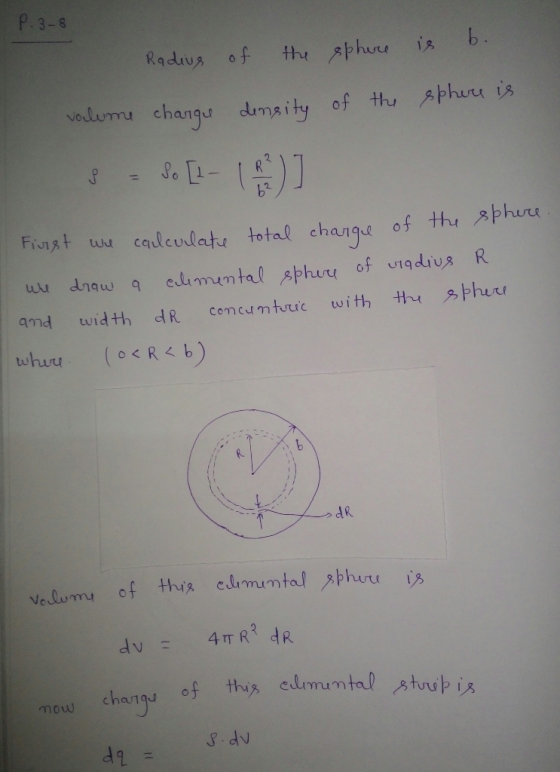
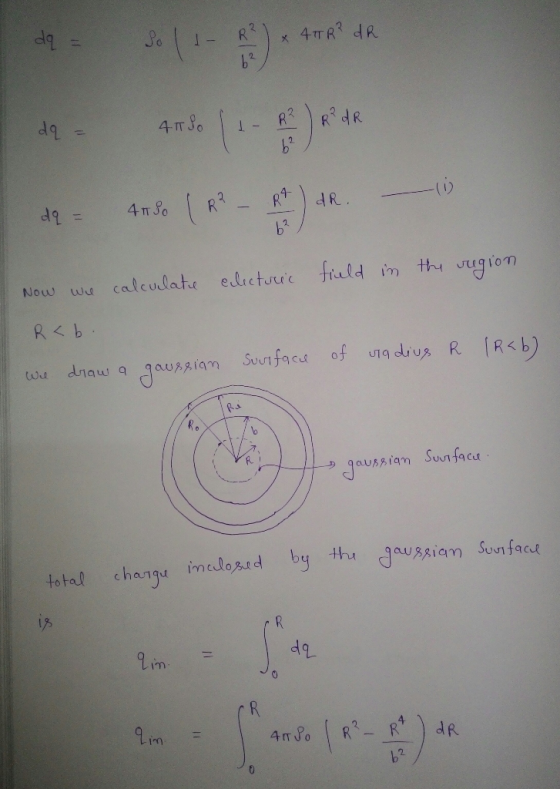
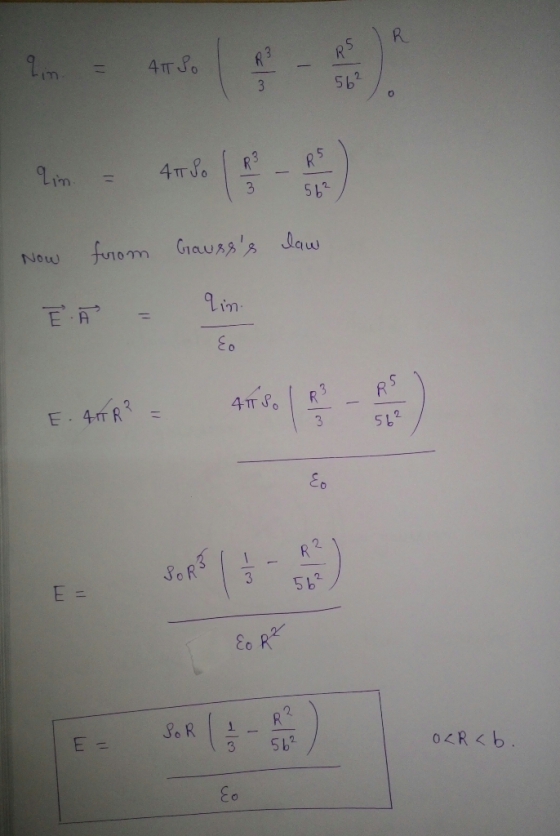
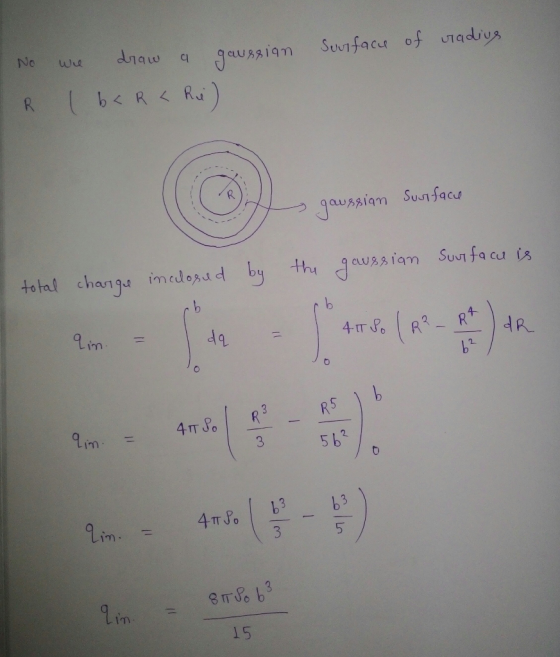
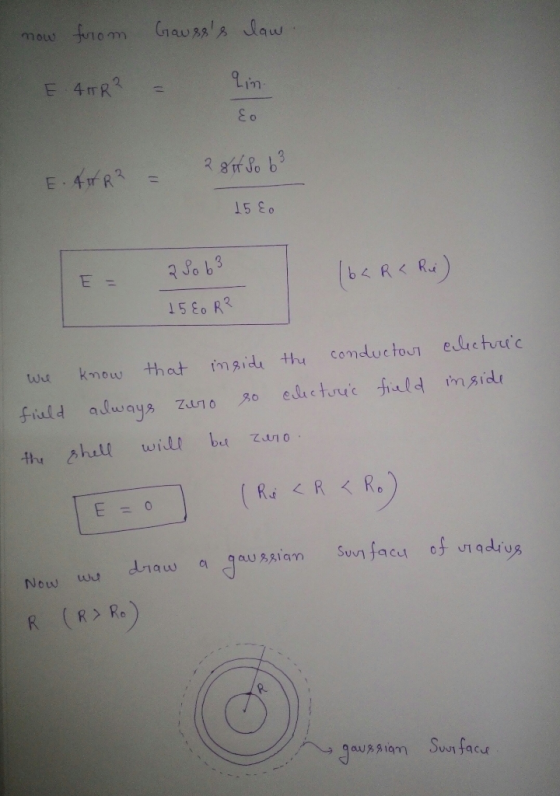
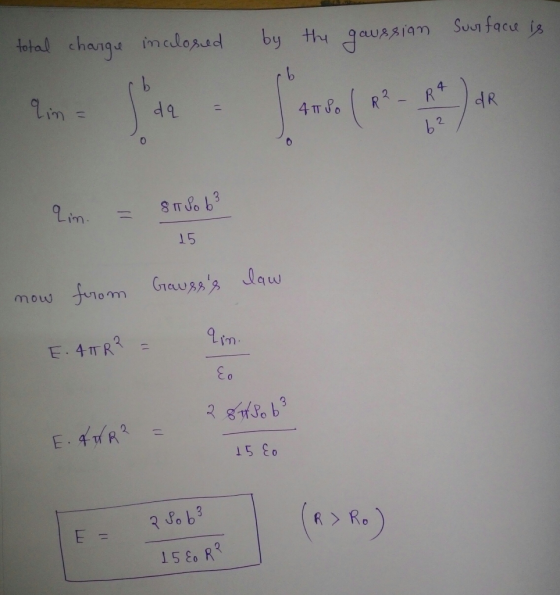
P.3-8 A spherical distribution of charge \(\rho=\rho_{0}\left[1-\left(R^{2} / b^{2}\right)\right]\) exists in the region \(0 \leqslant R \leqslant b\). This charge distribution is concentrically surrounded by a conducting shell with inner radius \(R_{i}(>b)\) and outer radius \(R_{o} .\) Determine \(\mathbf{E}\) everywhere.
P.3-9) Two infinitely long coaxial cylindrical surfaces, \(r=a\) and \(r=b(b>a)\), carry surface charge densities \(\rho_{s a}\) and \(\rho_{s b},\) respectively.
a) Determine \(\mathbf{E}\) everywhere.
b) What must be the relation between \(a\) and \(b\) in order that \(\mathbf{E}\) vanishes for \(r>b ?\)
Homework Answers
A dielectric sphere of radius a has a ”frozen in” polarization given by P (r) = krrˆ in standard ...
 A dielectric sphere of radius a has a ”frozen in” polarization
given by P (r) = krrˆ in standard spherical coordinates, with the
origin of the coordinate system at the center of the sphere. (A)
The sphere is surrounded by a conducting shell of inner radius a
and outer radius b > a. The total charge on the conducting shell
is zero. Is there an induced charge on the inner and outer surfaces
of the conducting shell? If so, what...
A dielectric sphere of radius a has a ”frozen in” polarization
given by P (r) = krrˆ in standard spherical coordinates, with the
origin of the coordinate system at the center of the sphere. (A)
The sphere is surrounded by a conducting shell of inner radius a
and outer radius b > a. The total charge on the conducting shell
is zero. Is there an induced charge on the inner and outer surfaces
of the conducting shell? If so, what...
A positive point charge of magnitude 2.6 HC is at the center of an uncharged spherical...
 A positive point charge of magnitude 2.6 HC is at the center of an uncharged spherical conducting shell of inner radius 65 cm and outer radius 110 cm (a) Find the charge densities on the inner and outer surfaces of the shel -0.49 0.17 μC/m2 (inner) μC ', /m2 (outer) Find the total charge on each surface 2.6 2.6 HC (inner) IC (outer) (b) Find the electric field everywhere Er 65 cm 23374 E65 < r< 110 cm0 r2 Er110...
A 3-µC point charge is inside a metal spherical shell of inner radius 2.0 cm and...
A 3-µC point charge is inside a metal spherical shell of inner radius 2.0 cm and outer radius 4.0 cm that has a net charge of 2-µC on it. Determine the electric field everywhere as a function of r, as well as the surface charge densities on the shell.
5. Total: 5 pts] A spherical conducting ball of radius a carries a net charge of...
 5. Total: 5 pts] A spherical conducting ball of radius a carries a net charge of Q, and it is surrounded by a concentric spherical conducting shell with zero net charge. The shell has inner radius b and outer radius c (see Fig. 1 a) 2 points] Find the total surface charge on the surfaces at r = a, r = b, and r = c. b) [3 points Find E and V as a function of radius from zero...
9.5) Coaxial cable An infinitely long wire carries a uniform linear charge density of −λ. The...
9.5) Coaxial cable An infinitely long wire carries a uniform linear charge density of −λ. The wire is surrounded by a cylindrical sheath of radius a coaxial with the wire. The sheath carries a uniform surface charge density of η = +λ/(2πa). (a) Consider a cylindrical Gaussian surface of radius R and length `coaxial with the cables. How much charge is enclosed in the Gaussian surface for R < a and R > a? (b) What does symmetry dictate about...
2. Given a spherical dielectric shell (inner radius a, outer radius b, dielectric constant K) and...
 2. Given a spherical dielectric shell (inner radius a, outer radius b, dielectric constant K) and a point charge Q, which is infinitely separated from the shell. Now let Q be placed at the center of the shell. Determine the change in the energy of the system (Hint: the induced charge densities σα and ơb due to the centered Q on the inner and outer surfaces are-(Q/4 a 2)(K-1)/K] and +(Q/4 b2)(K-1)/ki, respectively.)
2. Given a spherical dielectric shell (inner...
2. Given a spherical dielectric shell (inner radius a, outer radius b, dielectric constant K) and a point charge Q, which is infinitely separated from the shell. Now let Q be placed at the center of the shell. Determine the change in the energy of the system (Hint: the induced charge densities σα and ơb due to the centered Q on the inner and outer surfaces are-(Q/4 a 2)(K-1)/K] and +(Q/4 b2)(K-1)/ki, respectively.)
2. Given a spherical dielectric shell (inner...
A spherical conducting shell with no net charge on it has a point charge q on...
A spherical conducting shell with no net charge on it has a point charge q on its center. a.) What is the surface charge density on its inner surface (r=a), and what's the surface charge density on its outer surface (r=b)? b.) If charge Q' is added to the conducting shell, what are the new charge densities on the inner and outer surfaces? Please show all work!!!
G1. What is E for a spherical shell of charge p=0 for r < R1, p...
 G1. What is E for a spherical shell of charge p=0 for r < R1, p = po for R; <r < R2 and • P=0 for r > R2? R2 R1 Po What is the electric field for an infinitely long cylindrical pipe, inner radius Ry, outer radius R, and with p=Ar2 in the pipe wall between R, and R,? R2 R1 For problem G1 what is V in each region of space?
A perfectly conducting spherical shell has an inner radius a and an outer radius b as...
 A perfectly conducting spherical shell has an inner radius a and an outer radius b as shown below. The region r< a is hollow. The entire shell has a net charge of Q IC] on it because it has been stuck by lightning. Determine the electric field vector in all three regions: r<a, a< r b, and r > b. Determine the surface charge densities po and po on the two metal surfaces. Explain how this problem illustrates the Faraday...
The vertical axis scale is set by Es = -4.8x 10³ N/C. What is the linear charge density of the shell?
 Figure (a) shows a narrow charged solid cylinder that is coaxial with a larger charged cylindrical shell. Both are nonconducting and thin and have uniform surface charge densities on their outer surfaces. Figure (b) gives the radial component E of the electric field versus radial distance r from the common axis. The vertical axis scale is set by Es = -4.8x 10³ N/C. What is the linear charge density of the shell?
 A dielectric sphere of radius a has a ”frozen in” polarization
given by P (r) = krrˆ in standard spherical coordinates, with the
origin of the coordinate system at the center of the sphere. (A)
The sphere is surrounded by a conducting shell of inner radius a
and outer radius b > a. The total charge on the conducting shell
is zero. Is there an induced charge on the inner and outer surfaces
of the conducting shell? If so, what...
A dielectric sphere of radius a has a ”frozen in” polarization
given by P (r) = krrˆ in standard spherical coordinates, with the
origin of the coordinate system at the center of the sphere. (A)
The sphere is surrounded by a conducting shell of inner radius a
and outer radius b > a. The total charge on the conducting shell
is zero. Is there an induced charge on the inner and outer surfaces
of the conducting shell? If so, what...
 A positive point charge of magnitude 2.6 HC is at the center of an uncharged spherical conducting shell of inner radius 65 cm and outer radius 110 cm (a) Find the charge densities on the inner and outer surfaces of the shel -0.49 0.17 μC/m2 (inner) μC ', /m2 (outer) Find the total charge on each surface 2.6 2.6 HC (inner) IC (outer) (b) Find the electric field everywhere Er 65 cm 23374 E65 < r< 110 cm0 r2 Er110...
 5. Total: 5 pts] A spherical conducting ball of radius a carries a net charge of Q, and it is surrounded by a concentric spherical conducting shell with zero net charge. The shell has inner radius b and outer radius c (see Fig. 1 a) 2 points] Find the total surface charge on the surfaces at r = a, r = b, and r = c. b) [3 points Find E and V as a function of radius from zero...
 2. Given a spherical dielectric shell (inner radius a, outer radius b, dielectric constant K) and a point charge Q, which is infinitely separated from the shell. Now let Q be placed at the center of the shell. Determine the change in the energy of the system (Hint: the induced charge densities σα and ơb due to the centered Q on the inner and outer surfaces are-(Q/4 a 2)(K-1)/K] and +(Q/4 b2)(K-1)/ki, respectively.)
2. Given a spherical dielectric shell (inner...
2. Given a spherical dielectric shell (inner radius a, outer radius b, dielectric constant K) and a point charge Q, which is infinitely separated from the shell. Now let Q be placed at the center of the shell. Determine the change in the energy of the system (Hint: the induced charge densities σα and ơb due to the centered Q on the inner and outer surfaces are-(Q/4 a 2)(K-1)/K] and +(Q/4 b2)(K-1)/ki, respectively.)
2. Given a spherical dielectric shell (inner...
 G1. What is E for a spherical shell of charge p=0 for r < R1, p = po for R; <r < R2 and • P=0 for r > R2? R2 R1 Po What is the electric field for an infinitely long cylindrical pipe, inner radius Ry, outer radius R, and with p=Ar2 in the pipe wall between R, and R,? R2 R1 For problem G1 what is V in each region of space?
 A perfectly conducting spherical shell has an inner radius a and an outer radius b as shown below. The region r< a is hollow. The entire shell has a net charge of Q IC] on it because it has been stuck by lightning. Determine the electric field vector in all three regions: r<a, a< r b, and r > b. Determine the surface charge densities po and po on the two metal surfaces. Explain how this problem illustrates the Faraday...
Most questions answered within 3 hours.
-
Where is the error in this code sequence?
String s1 = "Hello";
String s2 = "ello";...
asked 10 months ago -
Financial data for Joel de Paris, Inc., for last year
follow:
Joel de Paris, Inc.
Balance...
asked 10 months ago -
Consider this reaction:
Al2(SO4)3 (aq)+ BaCl3
(aq) Al2Cl6 (aq)- +
3BaSO4(s) . What is the...
asked 10 months ago -
Suppose that Savneet is considering increasing her
recent random sample from 20 car rentals to 40...
asked 10 months ago -
Trucks arrive at an unloading terminal at an average rate of 120
per hour.
Trucks arrive...
asked 10 months ago -
Why are methanol and ethanol completely soluble in water while
octanol is not very little soluble....
asked 10 months ago -
A facilities manager at a university reads in a research report
that the mean amount of...
asked 10 months ago -
When the CuSO4 is rehydrated by adding water to the anhydrous
compound, is this an endothermic...
asked 10 months ago -
A ray of sunlight is passing from diamond into crown glass; the
angle of incidence is...
asked 10 months ago -
A block of mass 0.249 kg is placed on top of a light, vertical
spring of...
asked 10 months ago -
how do the kidneys compensate in the presences of acidosis
a) trigger hyperventilate
b) reserve acid...
asked 10 months ago -
Question 501 pts
The rental rate of capital to the firm increases. Which of the
following...
asked 10 months ago