
Homework Answers
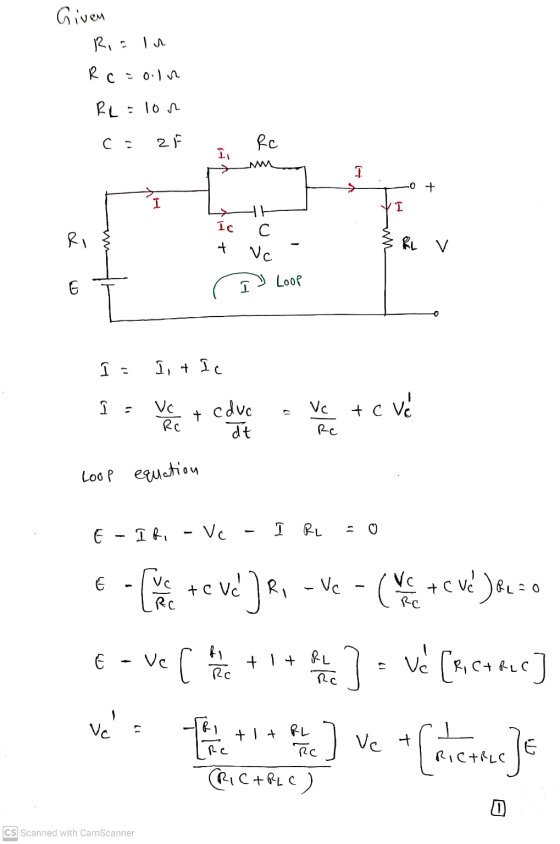
![t Vc CA] Ve [B] where 11 - RI RC +1+ RL Re Ric+ REC 11 1 0 :) + 1 + 10 0 1 1(2) +10(2) 11 10+1 +100 2 + 20 22 11 I -5.ous B](http://img.homeworklib.com/questions/e5943360-8bfa-11eb-bc0d-5bc8b41da591.png?x-oss-process=image/resize,w_560)
![Now at out put side VE E E-IR-VC V - E V RL ) R-Vc v{1+ & E-Vc RL V Vc t E ) I+ RI (It love) V (c] ve + [D] C Y С 1 + х so C](http://img.homeworklib.com/questions/e6698740-8bfa-11eb-b701-01989c52548d.png?x-oss-process=image/resize,w_560)
![11 [It it ri ) RL it to 11 0.909 So state seace model of this circuit is х А х + BU Y Сх DU 11 Vc [5.045] Ve + [0.045] e V [-](http://img.homeworklib.com/questions/e6de2240-8bfa-11eb-8c72-ebdab26bb37e.png?x-oss-process=image/resize,w_560)
![(2) Trams for function from Eto u is Scution! Transfer function [C] (s.1-258+) Hore [SI-A st [s+ 5.045 [ 5+ 5.045 so Traust](http://img.homeworklib.com/questions/e76462f0-8bfa-11eb-ac3c-738c1f9711ab.png?x-oss-process=image/resize,w_560)
Problem 1 (Problem Solving Workshop 1) For a parallel RL circuit R-10, L 1H Determine 1)...
 Problem 1 (Problem Solving Workshop 1) For a parallel RL circuit R-10, L 1H Determine 1) 21 3) 4) The transfer function H(s) = (s), the pole-zero map, and the step response. Let L(0) - OA The state and output equations. Let Lt) be the state variable The block diagram of this system. Let (O) = -1 The response (t) due to a step input (t) = (t) A) using a known software. Problem #2 (Problem Solving Workshop 1) For...
solve Problem #4 VCE = 8 +0.7=6 8.7V Rsig RL=0 VA 150 + 10 (1+12 170...
 solve
Problem #4 VCE = 8 +0.7=6 8.7V Rsig RL=0 VA 150 + 10 (1+12 170 V ſo=100 15V o www 0.1 uF NCE Vi No & skr ਫੀਸਦ · e) End Avo Ri Ro Perid by fond R c) fund small signal small signal circuit. parameters
solve
Problem #4 VCE = 8 +0.7=6 8.7V Rsig RL=0 VA 150 + 10 (1+12 170 V ſo=100 15V o www 0.1 uF NCE Vi No & skr ਫੀਸਦ · e) End Avo Ri Ro Perid by fond R c) fund small signal small signal circuit. parameters
o a Ro RL Q6a Given: V. 30 Volts a) Find the value of R that...
 o a Ro RL Q6a Given: V. 30 Volts a) Find the value of R that results in maximum power being transferred to R R 35 (Ohm) R2 140 (Ohm) 2 (Ohms) ?,max power b) Find the maximum power that can be delivered to R RL,max power Watts
Find the transfer function H(jω) for the circuit above as a function of jω. (Leave R...
 Find the transfer function H(jω) for the
circuit above as a function of jω. (Leave R and L as variables).
Assume V R to be the output and V S to be the input.
С L RVR(t) vs (t) A. Find the transfer function H(jo) for the circuit above as a function of jaw. (Leave R and L as variables). Assume V to be the output and V to be the input. S R B. Find the Magnitude and Phase...
Find the transfer function H(jω) for the
circuit above as a function of jω. (Leave R and L as variables).
Assume V R to be the output and V S to be the input.
С L RVR(t) vs (t) A. Find the transfer function H(jo) for the circuit above as a function of jaw. (Leave R and L as variables). Assume V to be the output and V to be the input. S R B. Find the Magnitude and Phase...
PROBLEM 1 (35 %) The mechanical system in the figure below consists of a disk of radius r, a block of mass m, a spr...
 PROBLEM 1 (35 %) The mechanical system in the figure below consists of a disk of radius r, a block of mass m, a spring of stiffness (spring constant) k, and a damper with damping ratio b. The disk has moment of inertia Jabout its center of mass (pivot point O), and the block is subjected to an external force t) as shown in the figure. The spring is unstressed when x 0= 0. Assume small 0. (a) (10 points)...
Consider the RC circuit shown below. Assume that R=(0.1)2 and C=(0.1)F 3. R i(t) y (t)...
 Consider the RC circuit shown below. Assume that R=(0.1)2 and C=(0.1)F 3. R i(t) y (t) x(t) The input to this circuit is given as x(t) s(t)+ny (t), where the noise component of input, n(t), is a sample function realization of white noise process with an autocorrelation function given by Rpx(t) 8(T), and s (t) cos(6Tt) is the signal component of input. IS(fOI df, where S( a. Find the power of the signal component of input, Ps is the Fourier...
Consider the RC circuit shown below. Assume that R=(0.1)2 and C=(0.1)F 3. R i(t) y (t)...
 Consider the RC circuit shown below. Assume that R=(0.1)2 and C=(0.1)F 3. R i(t) y (t) x(t) The input to this circuit is given as x(t) s(t)+ny (t), where the noise component of input, n(t), is a sample function realization of white noise process with an autocorrelation function given by Rpx(t) 8(T), and s (t) cos(6Tt) is the signal component of input. IS(fOI df, where S( a. Find the power of the signal component of input, Ps is the Fourier...
Problem # 1 For each system Derive the differential equation which describes the system. Use Laplace Trans form to...
 Problem # 1 For each system Derive the differential equation which describes the system. Use Laplace Trans form to find the Transfer Function. Specify the number of the Poles and Zeros and the value of the Gain. Determine the system's order both based on the Transfer Function and the number of the energy storage elements. Draw the Block Diagram with Input and Output C. Liquid Level System; assume q is the input and h3 is the output ! Ay Ry...
Given a RL circuit as in Figure Q2 (a) with input for the circuit is vi(t)...
 Given a RL circuit as in Figure Q2 (a) with input for the circuit is vi(t) and output is vo(t). L1 il(t) R1 il(t) + + vi(t) L2 R2 v.(t) Figure Q2 (a) Show that the RL circuit in Figure Q2 (a) can be represented by the following state-space representation: di,, (t) -(R+R) L dt di,, (t) dt R₂ R L, 1.t -R, L. (1) L2 8-6 L, V. (t) L v.(t)=[R, R)
Problem 24: (18 points) 1. (6 points) Figure 2 shows an RC circuit with input f(t)...
 Problem 24: (18 points) 1. (6 points) Figure 2 shows an RC circuit with input f(t) and output y(t) Function Generator R, v, (r) y1) Figure 2: RC circuit. (a) (1 point) Sketch the circuit in the phasor domain by replacing the capacitor with its impedance represen- (b) (3 points) Using circuit analysis techniques, show that the frequency response function is Specify the DC gain, K, and the time constant, T, in terms of the parameters R, R, and C...
 Problem 1 (Problem Solving Workshop 1) For a parallel RL circuit R-10, L 1H Determine 1) 21 3) 4) The transfer function H(s) = (s), the pole-zero map, and the step response. Let L(0) - OA The state and output equations. Let Lt) be the state variable The block diagram of this system. Let (O) = -1 The response (t) due to a step input (t) = (t) A) using a known software. Problem #2 (Problem Solving Workshop 1) For...
 solve
Problem #4 VCE = 8 +0.7=6 8.7V Rsig RL=0 VA 150 + 10 (1+12 170 V ſo=100 15V o www 0.1 uF NCE Vi No & skr ਫੀਸਦ · e) End Avo Ri Ro Perid by fond R c) fund small signal small signal circuit. parameters
solve
Problem #4 VCE = 8 +0.7=6 8.7V Rsig RL=0 VA 150 + 10 (1+12 170 V ſo=100 15V o www 0.1 uF NCE Vi No & skr ਫੀਸਦ · e) End Avo Ri Ro Perid by fond R c) fund small signal small signal circuit. parameters
 o a Ro RL Q6a Given: V. 30 Volts a) Find the value of R that results in maximum power being transferred to R R 35 (Ohm) R2 140 (Ohm) 2 (Ohms) ?,max power b) Find the maximum power that can be delivered to R RL,max power Watts
 Find the transfer function H(jω) for the
circuit above as a function of jω. (Leave R and L as variables).
Assume V R to be the output and V S to be the input.
С L RVR(t) vs (t) A. Find the transfer function H(jo) for the circuit above as a function of jaw. (Leave R and L as variables). Assume V to be the output and V to be the input. S R B. Find the Magnitude and Phase...
Find the transfer function H(jω) for the
circuit above as a function of jω. (Leave R and L as variables).
Assume V R to be the output and V S to be the input.
С L RVR(t) vs (t) A. Find the transfer function H(jo) for the circuit above as a function of jaw. (Leave R and L as variables). Assume V to be the output and V to be the input. S R B. Find the Magnitude and Phase...
 PROBLEM 1 (35 %) The mechanical system in the figure below consists of a disk of radius r, a block of mass m, a spring of stiffness (spring constant) k, and a damper with damping ratio b. The disk has moment of inertia Jabout its center of mass (pivot point O), and the block is subjected to an external force t) as shown in the figure. The spring is unstressed when x 0= 0. Assume small 0. (a) (10 points)...
 Consider the RC circuit shown below. Assume that R=(0.1)2 and C=(0.1)F 3. R i(t) y (t) x(t) The input to this circuit is given as x(t) s(t)+ny (t), where the noise component of input, n(t), is a sample function realization of white noise process with an autocorrelation function given by Rpx(t) 8(T), and s (t) cos(6Tt) is the signal component of input. IS(fOI df, where S( a. Find the power of the signal component of input, Ps is the Fourier...
 Consider the RC circuit shown below. Assume that R=(0.1)2 and C=(0.1)F 3. R i(t) y (t) x(t) The input to this circuit is given as x(t) s(t)+ny (t), where the noise component of input, n(t), is a sample function realization of white noise process with an autocorrelation function given by Rpx(t) 8(T), and s (t) cos(6Tt) is the signal component of input. IS(fOI df, where S( a. Find the power of the signal component of input, Ps is the Fourier...
 Problem # 1 For each system Derive the differential equation which describes the system. Use Laplace Trans form to find the Transfer Function. Specify the number of the Poles and Zeros and the value of the Gain. Determine the system's order both based on the Transfer Function and the number of the energy storage elements. Draw the Block Diagram with Input and Output C. Liquid Level System; assume q is the input and h3 is the output ! Ay Ry...
 Given a RL circuit as in Figure Q2 (a) with input for the circuit is vi(t) and output is vo(t). L1 il(t) R1 il(t) + + vi(t) L2 R2 v.(t) Figure Q2 (a) Show that the RL circuit in Figure Q2 (a) can be represented by the following state-space representation: di,, (t) -(R+R) L dt di,, (t) dt R₂ R L, 1.t -R, L. (1) L2 8-6 L, V. (t) L v.(t)=[R, R)
 Problem 24: (18 points) 1. (6 points) Figure 2 shows an RC circuit with input f(t) and output y(t) Function Generator R, v, (r) y1) Figure 2: RC circuit. (a) (1 point) Sketch the circuit in the phasor domain by replacing the capacitor with its impedance represen- (b) (3 points) Using circuit analysis techniques, show that the frequency response function is Specify the DC gain, K, and the time constant, T, in terms of the parameters R, R, and C...
Most questions answered within 3 hours.
-
Where is the error in this code sequence?
String s1 = "Hello";
String s2 = "ello";...
asked 10 months ago -
Financial data for Joel de Paris, Inc., for last year
follow:
Joel de Paris, Inc.
Balance...
asked 10 months ago -
Consider this reaction:
Al2(SO4)3 (aq)+ BaCl3
(aq) Al2Cl6 (aq)- +
3BaSO4(s) . What is the...
asked 10 months ago -
Suppose that Savneet is considering increasing her
recent random sample from 20 car rentals to 40...
asked 10 months ago -
Trucks arrive at an unloading terminal at an average rate of 120
per hour.
Trucks arrive...
asked 10 months ago -
Why are methanol and ethanol completely soluble in water while
octanol is not very little soluble....
asked 10 months ago -
A facilities manager at a university reads in a research report
that the mean amount of...
asked 10 months ago -
When the CuSO4 is rehydrated by adding water to the anhydrous
compound, is this an endothermic...
asked 10 months ago -
A ray of sunlight is passing from diamond into crown glass; the
angle of incidence is...
asked 10 months ago -
A block of mass 0.249 kg is placed on top of a light, vertical
spring of...
asked 10 months ago -
how do the kidneys compensate in the presences of acidosis
a) trigger hyperventilate
b) reserve acid...
asked 10 months ago -
Question 501 pts
The rental rate of capital to the firm increases. Which of the
following...
asked 10 months ago