
Homework Answers


Add Answer to:
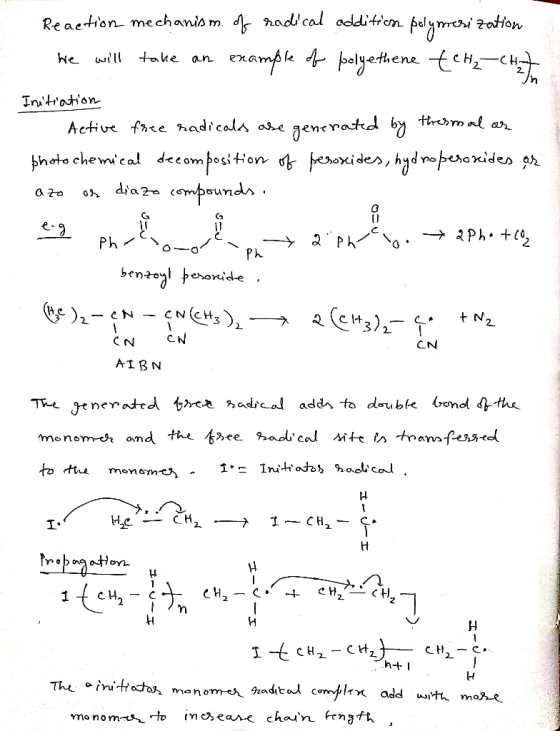
Describe, by using an example, the reaction mechanisms of radical addition polymerisation. Comment on how the...
Consider the preparation of an addition polymer by a radical chain reaction Q. 2 (a) Give...
 Consider the preparation of an addition polymer by a radical chain reaction Q. 2 (a) Give the polymers that can be formed from each of the following monomers and show the repeating unit in each case CI OMe (b) Describe the key steps in a radical chain growth polymerisation. What is "head to tail" addition and explain why it preferentially occurs (c) (d) Show the resonance stabilisation for the radical formed where possible for each of the monomers given in...
Mechanisms Question 1 (22 marks) (a) Consider the radical chain reactions of the alkane shown below with Br, in the...
 Mechanisms Question 1 (22 marks) (a) Consider the radical chain reactions of the alkane shown below with Br, in the presence of light. H3C HH H C-CCHS CH3 Br2 hv 2 Different mono- bromo products 25 °C + (you will need to look up the bond dissociation energy (BDE) for the types of bonds formed and broken in this reactions) (i) Give the structures of the products from the reaction and using standard arrow conventions show the series of mechanistic...
Determine the anticipated addition mechanisms for the reactions below. Using correct mechanistic arrows provide the step-by-step...
 Determine the anticipated addition mechanisms for the reactions below. Using correct mechanistic arrows provide the step-by-step mechanism that shows how the following addition reaction proceeds. You do not need to show stereochemistry while providing the mechanism, but show correct stereochemistry in the final product(s).
Cp2Ni undergoes oxidative addition of PhI. How does this reaction happen? Be sure to clearly sket...
Cp2Ni undergoes oxidative addition of PhI. How does this reaction happen? Be sure to clearly sketch the product and describe the steps between the reactants and products.
2.a. Explain Ethics in research 2.b. Using practical examples, describe the ethical principles you will observe...
 2.a. Explain Ethics in research
2.b. Using practical examples, describe the ethical
principles you will observe conducting research that involves
children at the early childhood level of education
4.a. Use practical example to distinguish a cross
sectional survey and a longitudinal survey.
4.
b. Use practical example to distinguish between an
experimental research and a quasi-experimental research
DBE431 RESEARCH METHODS IN EDUCATION LEVEL: 300 INSTRUCTIONS: Answer question one (1) and any other two questions 1. Illustrate how you will critically...
2.a. Explain Ethics in research
2.b. Using practical examples, describe the ethical
principles you will observe conducting research that involves
children at the early childhood level of education
4.a. Use practical example to distinguish a cross
sectional survey and a longitudinal survey.
4.
b. Use practical example to distinguish between an
experimental research and a quasi-experimental research
DBE431 RESEARCH METHODS IN EDUCATION LEVEL: 300 INSTRUCTIONS: Answer question one (1) and any other two questions 1. Illustrate how you will critically...
What are the products of the reaction between Hexamethylenediamine and Adipic acid? Is this an addition...
What are the products of the reaction between Hexamethylenediamine and Adipic acid? Is this an addition or a condensation polymerization reaction? What is the molecular weight of the repeating unit (formula unit) of Nylon 6,10? Write Rx 1 (p.2) for n = 1 and consider the amounts of reagents used in the lab to determine LR and theoretical yield of Nylon 6,10 for this reaction. (a) What is the by-product of the condensation reaction to produce Nylon 6,10 (using Hexamethylenediamine...
Question 2 (a) Show how the Wittig reaction might be used to prepare the following alkene....
 Question 2 (a) Show how the Wittig reaction might be used to prepare the following alkene. Mechanisms are not required, however your answer should identify what carbonyl component would be used, and show all steps and reagents required to prepare the necessary phosphorus ylide from the appropriate alkyl halide. You should also justify the resultant stereochemistry observed. HH [6 marks] c) wine celor de (b) What product would you expect from the halohydrin reaction shown below? Provide a mechanism for...
I need help please: Reaction Mechanisms and Catalysis 1. The rate constant in an elementary reaction's...
 I
need help please: Reaction Mechanisms and Catalysis
1. The rate constant in an elementary reaction's rate equation can be modeled by the Arrhenius equation: & Ae a. The coefficient A is the frequency factor. What are the units of A for a first-order reaction? Justify your answer mathematically. (2 points) b. Describe how the value of A is affected by molecular collisions. (1 point) c. Is the effect of the reaction temperature on A high, low, or moderate? Explain....
I
need help please: Reaction Mechanisms and Catalysis
1. The rate constant in an elementary reaction's rate equation can be modeled by the Arrhenius equation: & Ae a. The coefficient A is the frequency factor. What are the units of A for a first-order reaction? Justify your answer mathematically. (2 points) b. Describe how the value of A is affected by molecular collisions. (1 point) c. Is the effect of the reaction temperature on A high, low, or moderate? Explain....
1. Draw an electrophilic addition that illustrates 1,2-versus 1,4-addition. Using this reaction, explain Kinetic versus Thermodynamic...
1. Draw an electrophilic addition that illustrates 1,2-versus 1,4-addition. Using this reaction, explain Kinetic versus Thermodynamic products. 2. Explain resonance hybrid and draw an example that has at least 3 reasonance forms. 3. Draw a typical Diel-Alder reaction. Show the mechanism for your reaction 4. Use the inscribed polygon techiques to illustrate why benzene is aromatic and cyclopentadiene is not 5. Draw the general mechanism for electrophilic aromatic substitution 6. Explain how substituents on the aromatic ring activate or slow...
[01] Give all three termination steps (using structures) for a radical chain reaction monochlorination (Clh/hv) of...
 [01] Give all three termination steps (using structures) for a radical chain reaction monochlorination (Clh/hv) of cyclopropane to give chlorocyclopropane 1. 2. [01] a. Give the resulting structure from the following electron flow. b. Give the curved arrows on structure at left to indicate the electron flow in going to the resonance structure on the right. Be precise. 3. [O1] Give the structure of the major product for the following reaction as well as the two allylic resonance structures from...
 Consider the preparation of an addition polymer by a radical chain reaction Q. 2 (a) Give the polymers that can be formed from each of the following monomers and show the repeating unit in each case CI OMe (b) Describe the key steps in a radical chain growth polymerisation. What is "head to tail" addition and explain why it preferentially occurs (c) (d) Show the resonance stabilisation for the radical formed where possible for each of the monomers given in...
 Mechanisms Question 1 (22 marks) (a) Consider the radical chain reactions of the alkane shown below with Br, in the presence of light. H3C HH H C-CCHS CH3 Br2 hv 2 Different mono- bromo products 25 °C + (you will need to look up the bond dissociation energy (BDE) for the types of bonds formed and broken in this reactions) (i) Give the structures of the products from the reaction and using standard arrow conventions show the series of mechanistic...
 Determine the anticipated addition mechanisms for the reactions below. Using correct mechanistic arrows provide the step-by-step mechanism that shows how the following addition reaction proceeds. You do not need to show stereochemistry while providing the mechanism, but show correct stereochemistry in the final product(s).
 2.a. Explain Ethics in research
2.b. Using practical examples, describe the ethical
principles you will observe conducting research that involves
children at the early childhood level of education
4.a. Use practical example to distinguish a cross
sectional survey and a longitudinal survey.
4.
b. Use practical example to distinguish between an
experimental research and a quasi-experimental research
DBE431 RESEARCH METHODS IN EDUCATION LEVEL: 300 INSTRUCTIONS: Answer question one (1) and any other two questions 1. Illustrate how you will critically...
2.a. Explain Ethics in research
2.b. Using practical examples, describe the ethical
principles you will observe conducting research that involves
children at the early childhood level of education
4.a. Use practical example to distinguish a cross
sectional survey and a longitudinal survey.
4.
b. Use practical example to distinguish between an
experimental research and a quasi-experimental research
DBE431 RESEARCH METHODS IN EDUCATION LEVEL: 300 INSTRUCTIONS: Answer question one (1) and any other two questions 1. Illustrate how you will critically...
 Question 2 (a) Show how the Wittig reaction might be used to prepare the following alkene. Mechanisms are not required, however your answer should identify what carbonyl component would be used, and show all steps and reagents required to prepare the necessary phosphorus ylide from the appropriate alkyl halide. You should also justify the resultant stereochemistry observed. HH [6 marks] c) wine celor de (b) What product would you expect from the halohydrin reaction shown below? Provide a mechanism for...
 I
need help please: Reaction Mechanisms and Catalysis
1. The rate constant in an elementary reaction's rate equation can be modeled by the Arrhenius equation: & Ae a. The coefficient A is the frequency factor. What are the units of A for a first-order reaction? Justify your answer mathematically. (2 points) b. Describe how the value of A is affected by molecular collisions. (1 point) c. Is the effect of the reaction temperature on A high, low, or moderate? Explain....
I
need help please: Reaction Mechanisms and Catalysis
1. The rate constant in an elementary reaction's rate equation can be modeled by the Arrhenius equation: & Ae a. The coefficient A is the frequency factor. What are the units of A for a first-order reaction? Justify your answer mathematically. (2 points) b. Describe how the value of A is affected by molecular collisions. (1 point) c. Is the effect of the reaction temperature on A high, low, or moderate? Explain....
 [01] Give all three termination steps (using structures) for a radical chain reaction monochlorination (Clh/hv) of cyclopropane to give chlorocyclopropane 1. 2. [01] a. Give the resulting structure from the following electron flow. b. Give the curved arrows on structure at left to indicate the electron flow in going to the resonance structure on the right. Be precise. 3. [O1] Give the structure of the major product for the following reaction as well as the two allylic resonance structures from...
Most questions answered within 3 hours.
-
Where is the error in this code sequence?
String s1 = "Hello";
String s2 = "ello";...
asked 10 months ago -
Financial data for Joel de Paris, Inc., for last year
follow:
Joel de Paris, Inc.
Balance...
asked 10 months ago -
Consider this reaction:
Al2(SO4)3 (aq)+ BaCl3
(aq) Al2Cl6 (aq)- +
3BaSO4(s) . What is the...
asked 10 months ago -
Suppose that Savneet is considering increasing her
recent random sample from 20 car rentals to 40...
asked 10 months ago -
Trucks arrive at an unloading terminal at an average rate of 120
per hour.
Trucks arrive...
asked 10 months ago -
Why are methanol and ethanol completely soluble in water while
octanol is not very little soluble....
asked 10 months ago -
A facilities manager at a university reads in a research report
that the mean amount of...
asked 10 months ago -
When the CuSO4 is rehydrated by adding water to the anhydrous
compound, is this an endothermic...
asked 10 months ago -
A ray of sunlight is passing from diamond into crown glass; the
angle of incidence is...
asked 10 months ago -
A block of mass 0.249 kg is placed on top of a light, vertical
spring of...
asked 10 months ago -
how do the kidneys compensate in the presences of acidosis
a) trigger hyperventilate
b) reserve acid...
asked 10 months ago -
Question 501 pts
The rental rate of capital to the firm increases. Which of the
following...
asked 10 months ago