Manufacturers Inc. (MI) currently has a labor force of 10, which can produce 600 units per...
Manufacturers Inc. (MI) currently has a labor force of 10, which can produce 600 units per period. The labor cost is now $5000 per period per employee. The company has a long-standing rule that does not allow it to make use of any overtime. In addition, the product cannot be subcontracted, due to the specialized nature of the machinery that MI uses to produce it. As a result, MI can only increase/decrease production by hiring or laying off employees. The cost is $10000 to hire or lay off an employee. Inventory carrying costs are $200 per unit for any unsold items at the end of the period. The inventory level at the beginning of period 1 is 400 units. The forecast demand is 700 in period 1, 600 in period 2, 450 in period 3, 250 in period 4, 500 in period 5, and 550 in period 6.
a.) Compute the costs of the Chase Demand Strategy.
b.) Compute the costs of the Level Strategy
c.) Compare the costs of the two strategies. Which one is superior?
Homework Answers
| a) Chase demand strategy | ||||||
| With Chase strategy, hiring and layoff is flexible to meet demand and inventory carried forward is minimum | ||||||
| Initial Labor force | 10 | Labor cost | $5,000 | |||
| Initial production | 600 | Hire/ layoff cost | $10,000 | |||
| Units produced per labor | 60 | Inventory carrying cost | $200 | |||
| Period 1 | Period 2 | Period 3 | Period 4 | Period 5 | Period 6 | |
| Forecast Demand | 700 | 600 | 450 | 250 | 500 | 550 |
| Regular Production | 300 | 600 | 480 | 240 | 480 | 600 |
| Projected Inventory on hand: 400 | 300+400-700=0 | 600-600=0 | 480-450=30 | 240+30-250=20 | 480+20-500=0 | 600-550=50 |
| Regular Labor Force | 5 | 10 | 8 | 4 | 8 | 10 |
| Hire | 5 | 4 | 2 | |||
| Layoff | 10-5=5 | 2 | 4 | |||
| Cost | ||||||
| Period 1 | Period 2 | Period 3 | Period 4 | Period 5 | Period 6 | |
| Regular Labor Cost | 5*5000=$25000 | $50,000 | $40,000 | $20,000 | $40,000 | $50,000 |
| Inventory cost | 0 | 0 | 30*200=$6000 | 20*200=$4000 | 0 | 50*200=$10000 |
| Hire cost | 0 | 5*10000=$50000 | $0 | $0 | $40,000 | $20,000 |
| Layoff cost | 5*10000=$50000 | $20,000 | $40,000 | $0 | $0 | |
| Total | $75,000 | $100,000 | $66,000 | $64,000 | $80,000 | $80,000 |
| $465,000 | ||||||
| b) Level Strategy | |||||||
| With level strategy, hiring and layoff is only allowed at beginning and there is level regular production which is constant for all periods. | |||||||
| Level production = (Total demand for 6 periods- Beg. Inventory)/ 6 | Level production =(700+600+450+250+500+550-400)/6 =441, so we produce 480 as multiple of labour output per period | ||||||
| Initial Labor force | 10 | Labor cost | $5,000 | ||||
| Initial production | 600 | Hire/ layoff cost | $10,000 | ||||
| Units produced per labor | 60 | Inventory carrying cost | $200 | ||||
| Period 1 | Period 2 | Period 3 | Period 4 | Period 5 | Period 6 | ||
| Forecast Demand | 700 | 600 | 450 | 250 | 500 | 550 | |
| Regular Production | 480 | 480 | 480 | 480 | 480 | 480 | |
| Projected Inventory on hand: 400 | 480+400-700=180 | 180+480-600=60 | 60+480-450=90 | 90+480-250=320 | 320+480-500=300 | 300+480-550=230 | |
| Regular Labor Force | 8 | 8 | 8 | 8 | 8 | 8 | |
| Hire | |||||||
| Layoff | 10-8=2 | ||||||
| Cost | |||||||
| Period 1 | Period 2 | Period 3 | Period 4 | Period 5 | Period 6 | ||
| Regular Labor Cost | 8*5000=$40000 | $40,000 | $40,000 | $40,000 | $40,000 | $40,000 | |
| Inventory cost | 180*200=$36000 | 60*200=$12000 | 90*200=$18000 | 320*200=$64000 | 300*200=$60000 | 230*200=$46000 | |
| Hire cost | |||||||
| Layoff cost | 2*10000=$20000 | ||||||
| Total | $96,000 | $52,000 | $58,000 | $104,000 | $100,000 | $86,000 | |
| $496,000 | |||||||
c)
Clearly cost of Chase strategy ($465,000) is lower than level strategy ($496,000). Hence, Chase strategy is superior.
Please give thumbs up/ likes if you find this answer helpful. Thank
you!
Add Answer to:
Manufacturers Inc. (MI) currently has a labor force of 10, which
can produce 600 units per...
Management at the Kerby Corporation has determined the following aggregated demand schedule (in units): Month 1...
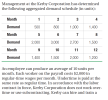 Management at the Kerby Corporation has determined the following aggregated demand schedule (in units): Month 1 2 3 4 Demand 500 800 1,000 1,400 Month 5 6 7 8 Demand 2,000 3,000 2,700 1,500 Month 9 10 11 12 Demand 1,400 1,500 2,000 1,200 An employee can produce an average of 10 units per month. Each worker on the payroll costs $2,000 in regular-time wages per month. Undertime is paid at the same rate as regular time. In accordance with...
The Cut-Rite Company is a major producer of industrial lawn mowers. The cost to Cut-Rite for...
The Cut-Rite Company is a major producer of industrial lawn mowers. The cost to Cut-Rite for hiring a semi-skilled worker for its assembly plant is $3000, and the cost for laying off one worker is $2000. With its current work force of 720 workers, the plant can produce 36,000 lawn mowers per quarter. Regular-time capacity in any quarter is directly proportional to the number of employees. Overtime is limited to a maximum of 5,000 mowers per quarter. The costs to...
USE LEVEL AGGREGATE PLAN: Cost data Regular time labor cost per hour $10 Overtime time labor...
USE LEVEL AGGREGATE PLAN: Cost data Regular time labor cost per hour $10 Overtime time labor cost per hour $15 Subcontracting cost per unit $80 Back order cost per unit per period $20 Inventory holding cost per unit per period $10 Hiring cost per employee $400 Firing cost per employee $500 Capacity data Beginning workforce 40 employees Beginning inventory 0 units Beginning backorders 0 units Production standard per unit (hours) 2 hours of labor per unit Regular time available per...
Each certified instructor puts in 480 hours per quarter regular time and can work an additional 1...
 Each certified instructor puts in 480 hours per quarter regular time and can work an additional 120 hours overtime. Regular-time wages and benefits cost Carlton $7,200 per employee per quarter for regular time worked up to 480 hours, with an overtime cost of $20 per hour. Unused regular time for certified instructors is paid at $15 per hour. There is no cost for unused overtime capacity The cost of hiring, training, and certifying a new employee is $10,000. Layoff costs...
The beginning workforce is 335 employees. The monthly output per employee is 400 units. The cost...
The beginning workforce is 335 employees. The monthly output per employee is 400 units. The cost to hire and lay off a worker are $1,000 and $2,000, respectively. The cost to carry an item in inventory for one month is estimated at $11, and the stockout cost is $30 per unit. Show the production schedule, the inventory levels, and the changes in workforce from period to period. Compute the plan's cost. Construct the chase sales and operations plan (enter your...
Here is an operations planning case analysis. You are expected to do the following questions and...
 Here is an operations planning case analysis. You are expected to do the following questions and submit them for marking at the end of the semester via utsonline and in hard copy to your tutor in week 10. A company has the following demand forecast next year, expressed in six bimonthly periods: Forecast Demand: Period 1 = 4,500 units Period 4 = 6,500 units Period 2 = 3,000 units Period 5 = 5,100 units Period 3 = 4,800 units Period...
Problem 2 D small manufacturing company is manufact has prring company is planing production requirements requ...
 Problem 2 D small manufacturing company is manufact has prring company is planing production requirements requ ected demand bplanning production requirements for next year. The Sales by quarter as shown below: Winter Average quarterly demand 3500 units 3800 units 4200 units 4500 units Suppose the company had 50 workers and 1.600 units in inventory at the beginning of the winter The company wishes to finish the year with an inventory of 1,000 units on hand. The average pay per worker...
The Barberton Municipal division of Road Maintenance is charged with road repair in the city of...
The Barberton Municipal division of Road Maintenance is charged with road repair in the city of Barberton and the surrounding area. Cindy Kramer, road maintenance director, must submit a staffing plan for the next year based on a set schedule for repairs and on the city budget. Kramer estimates that the labor hours required for the next four quarters are 7,000, 13,000, 19,000, and 10,000, respectively. Each of the 11 workers on the workforce can contribute 500 hours per quarter....
A company believes that its demand for the next six months is as follows ota ont eman The output per worker per month is 100 units. The per worker hiring and lay off costs are $1,500 and $3,500, resp...
 A company believes that its demand for the next six months is as follows ota ont eman The output per worker per month is 100 units. The per worker hiring and lay off costs are $1,500 and $3,500, respectively. There is no beginning inventory, and the starting workforce is 135. It cost the company $25 to carry an item in inventory each month, and the stockout costs is estimated to be $25 per unit. Develop a level sales and operations...
Plan production for a four-month period: February through May. For February and March, you should produce...
Plan production for a four-month period: February through May. For February and March, you should produce to exact demand forecast. For April and May, you should use overtime and inventory with a stable workforce; stable means that the number of workers needed for March will be held constant through May. However, government constraints put a maximum of 5,000 hours of overtime labor per month in April and May (zero overtime in February and March). If demand exceeds supply, then backorders...
 Management at the Kerby Corporation has determined the following aggregated demand schedule (in units): Month 1 2 3 4 Demand 500 800 1,000 1,400 Month 5 6 7 8 Demand 2,000 3,000 2,700 1,500 Month 9 10 11 12 Demand 1,400 1,500 2,000 1,200 An employee can produce an average of 10 units per month. Each worker on the payroll costs $2,000 in regular-time wages per month. Undertime is paid at the same rate as regular time. In accordance with...
 Each certified instructor puts in 480 hours per quarter regular time and can work an additional 120 hours overtime. Regular-time wages and benefits cost Carlton $7,200 per employee per quarter for regular time worked up to 480 hours, with an overtime cost of $20 per hour. Unused regular time for certified instructors is paid at $15 per hour. There is no cost for unused overtime capacity The cost of hiring, training, and certifying a new employee is $10,000. Layoff costs...
 Here is an operations planning case analysis. You are expected to do the following questions and submit them for marking at the end of the semester via utsonline and in hard copy to your tutor in week 10. A company has the following demand forecast next year, expressed in six bimonthly periods: Forecast Demand: Period 1 = 4,500 units Period 4 = 6,500 units Period 2 = 3,000 units Period 5 = 5,100 units Period 3 = 4,800 units Period...
 Problem 2 D small manufacturing company is manufact has prring company is planing production requirements requ ected demand bplanning production requirements for next year. The Sales by quarter as shown below: Winter Average quarterly demand 3500 units 3800 units 4200 units 4500 units Suppose the company had 50 workers and 1.600 units in inventory at the beginning of the winter The company wishes to finish the year with an inventory of 1,000 units on hand. The average pay per worker...
 A company believes that its demand for the next six months is as follows ota ont eman The output per worker per month is 100 units. The per worker hiring and lay off costs are $1,500 and $3,500, respectively. There is no beginning inventory, and the starting workforce is 135. It cost the company $25 to carry an item in inventory each month, and the stockout costs is estimated to be $25 per unit. Develop a level sales and operations...
Most questions answered within 3 hours.
-
Where is the error in this code sequence?
String s1 = "Hello";
String s2 = "ello";...
asked 10 months ago -
Financial data for Joel de Paris, Inc., for last year
follow:
Joel de Paris, Inc.
Balance...
asked 10 months ago -
Consider this reaction:
Al2(SO4)3 (aq)+ BaCl3
(aq) Al2Cl6 (aq)- +
3BaSO4(s) . What is the...
asked 10 months ago -
Suppose that Savneet is considering increasing her
recent random sample from 20 car rentals to 40...
asked 10 months ago -
Trucks arrive at an unloading terminal at an average rate of 120
per hour.
Trucks arrive...
asked 10 months ago -
Why are methanol and ethanol completely soluble in water while
octanol is not very little soluble....
asked 10 months ago -
A facilities manager at a university reads in a research report
that the mean amount of...
asked 10 months ago -
When the CuSO4 is rehydrated by adding water to the anhydrous
compound, is this an endothermic...
asked 10 months ago -
A ray of sunlight is passing from diamond into crown glass; the
angle of incidence is...
asked 10 months ago -
A block of mass 0.249 kg is placed on top of a light, vertical
spring of...
asked 10 months ago -
how do the kidneys compensate in the presences of acidosis
a) trigger hyperventilate
b) reserve acid...
asked 10 months ago -
Question 501 pts
The rental rate of capital to the firm increases. Which of the
following...
asked 10 months ago