The demand for widgets (X) is given by the following equation: QX = A PX-0 .5...
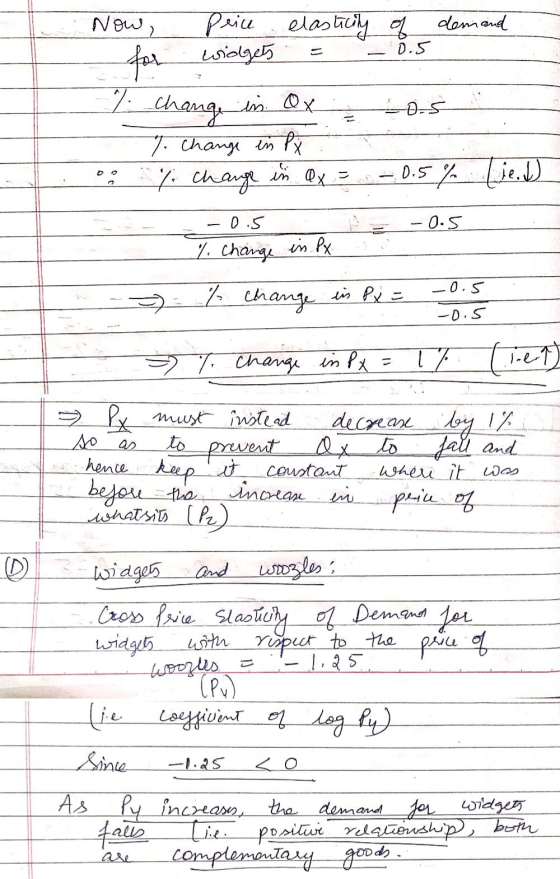
The demand for widgets (X) is given by the following
equation:
QX = A PX-0 .5 PW
PY-1.25 PZ-0.25 I
where PX is the price of widgets,
PY, PW and PZ are the prices of
woozles, gadgets, and whatsits respectively, and I is income.
(A) The manufacturer of widgets is contemplating
an increase in its price. Is it possible to know whether revenue
will increase or decrease given that the initial price of widgets
is not known? (2)
(B) By how much must the price of widgets change
if income decreases by 4% and the goal is to keep QX constant?
(2)
(C) By how much PX must change if the price of
whatsits (PZ) increases by 2% and the goal is to keep QX
constant? (2)
(D) How are widgets and woozles related in
consumption? (2)
(E) How are goods woozles and whatsits related in
consumption? (2)
Homework Answers

Add Answer to:
The demand for widgets (X) is given by the following
equation:
QX = A PX-0 .5...
The demand for Widgets (QX) is a function of the price of widgets (PX), the price...
The demand for Widgets (QX) is a function of the price of widgets (PX), the price of woozles (PY), and per capita income (I): QX = 1950 - 10 PX + 5 PY - 0.1I Currently, PX = 25, PY = 10, and I = 15,000. (a) Calculate the elasticity of demand for widgets with respect to its own price, the price of woozles, and income. (b) Over what range of prices is the demand for widgets elastic? (c) If...
The demand for your product X has been estimated to be Qx = 7, 880 −...
The demand for your product X has been estimated to be Qx = 7, 880 − 4Px − 2Py + Pz − 0.1M where Y and Z are other (related) products. The relevant price and income data are as follows: Px = 10, Py = 15, Pz = 50, M = 40, 000 (Please show work and answers to questions a-e) a. Which goods are substitutes for X? Which are complements? b. Is X an inferior or a normal good?...
The inverse demand curve for product x is given by px=20−4·qx+2·py where px represents the price...
The inverse demand curve for product x is given by px=20−4·qx+2·py where px represents the price in dollars per unit, qx represents the rate of sales in pounds per week, and py represents the selling price of another product y in dollars per unit. The inverse supply curve of product x is given by px=10+2·qx Determine the equilibrium price and sales of X Let py=$10. Determine whether x and y are substitutes or complements
please calculate carefully The demand for good (Qx) is given by the following equation: Qx =...
 please calculate carefully
The demand for good (Qx) is given by the following equation: Qx = 20,200 - 12.5 Px + 5 Py-M + 1.5 Ax Suppose the firm spends $3,000 per week on advertising (Ax), Px is $80, Py is $60, and income per capita (M) in the market area is $22,000. (a) Calculate the elasticity of demand for good X with respect to its own price, the price of good Y, and Income per capita. (3) (b) Calculate...
please calculate carefully
The demand for good (Qx) is given by the following equation: Qx = 20,200 - 12.5 Px + 5 Py-M + 1.5 Ax Suppose the firm spends $3,000 per week on advertising (Ax), Px is $80, Py is $60, and income per capita (M) in the market area is $22,000. (a) Calculate the elasticity of demand for good X with respect to its own price, the price of good Y, and Income per capita. (3) (b) Calculate...
The demand for good X is given by QXd = 6,000 - (1/2)PX - PY +...
The demand for good X is given by QXd = 6,000 - (1/2)PX - PY + 9PZ + (1/10)M Research shows that the prices of related goods are given by Py = $6,500 and Pz = $100, while the average income of individuals consuming this product is M = $70,000. a. Indicate whether goods Y and Z are substitutes or complements for good X. Good Y is: (Click to select) a substitute neither complement nor substitute a complement . Good Z is: (Click to select) a complement a...
suppose demand for good X is given by QX = –5PX + 10PY + 1.25I. Suppose...
suppose demand for good X is given by QX = –5PX + 10PY + 1.25I. Suppose PY=$1 and I=$12. What is the equation for the own-price demand curve? What is the slope of the own-price demand curve? Calculate the price elasticity of demand if PX = $2. Interpret your result
The demand equation for widgets has been estimated as: QW = 3200 - 4 PW +...
The demand equation for widgets has been estimated as: QW = 3200 - 4 PW + 0.160 I - 1.8 PR where QW is the quantity demanded of widgets, PW is the price of widgets, I is the average income of dollars of consumers in the market, and PR is the price of radgets. Holding other factors constant, an increase in average consumer incomes of $300 would produce a change in the quantity demanded of widgets of: ...
The demand for good X is given by QXd = 6,000 - (1/2)PX - PY +...
The demand for good X is given by QXd = 6,000 - (1/2)PX - PY + 9PZ + (1/10)M Research shows that the prices of related goods are given by Py = $6,500 and Pz = $100, while the average income of individuals consuming this product is M = $70,000. a. Indicate whether goods Y and Z are substitutes or complements for good X b. Is X an inferior or a normal good? c. How many units of good X...
1. Given the above demand curve, how many of good X will consumer purchase when PX...
1. Given the above demand curve, how many of good X will consumer purchase when PX is $100 a unit, PY is $50 a unit, and M is $25,000? 2. Your research department estimates that the supply function for televisions is given by: QXS = 5,000 + 5PX -10PR – 2PW When PX is $800, PR is $200, and PW is $2500, how many television sets are produced? 3. Suppose the cross-price elasticity of demand between Coke and...
suppose demand for good X is given by QX = –5PX + 10PY + 1.25I Suppose...
suppose demand for good X is given by QX = –5PX + 10PY + 1.25I Suppose PX=$3 and I=$20 What is the equation for the cross-price demand curve? What is the slope of the cross-price demand curve? Calculate the cross-price elasticity of demand if PY = $1. Interpret your result.
 please calculate carefully
The demand for good (Qx) is given by the following equation: Qx = 20,200 - 12.5 Px + 5 Py-M + 1.5 Ax Suppose the firm spends $3,000 per week on advertising (Ax), Px is $80, Py is $60, and income per capita (M) in the market area is $22,000. (a) Calculate the elasticity of demand for good X with respect to its own price, the price of good Y, and Income per capita. (3) (b) Calculate...
please calculate carefully
The demand for good (Qx) is given by the following equation: Qx = 20,200 - 12.5 Px + 5 Py-M + 1.5 Ax Suppose the firm spends $3,000 per week on advertising (Ax), Px is $80, Py is $60, and income per capita (M) in the market area is $22,000. (a) Calculate the elasticity of demand for good X with respect to its own price, the price of good Y, and Income per capita. (3) (b) Calculate...
Most questions answered within 3 hours.
-
Where is the error in this code sequence?
String s1 = "Hello";
String s2 = "ello";...
asked 11 months ago -
Financial data for Joel de Paris, Inc., for last year
follow:
Joel de Paris, Inc.
Balance...
asked 11 months ago -
Consider this reaction:
Al2(SO4)3 (aq)+ BaCl3
(aq) Al2Cl6 (aq)- +
3BaSO4(s) . What is the...
asked 11 months ago -
Suppose that Savneet is considering increasing her
recent random sample from 20 car rentals to 40...
asked 11 months ago -
Trucks arrive at an unloading terminal at an average rate of 120
per hour.
Trucks arrive...
asked 11 months ago -
Why are methanol and ethanol completely soluble in water while
octanol is not very little soluble....
asked 11 months ago -
A facilities manager at a university reads in a research report
that the mean amount of...
asked 11 months ago -
When the CuSO4 is rehydrated by adding water to the anhydrous
compound, is this an endothermic...
asked 11 months ago -
A ray of sunlight is passing from diamond into crown glass; the
angle of incidence is...
asked 11 months ago -
A block of mass 0.249 kg is placed on top of a light, vertical
spring of...
asked 11 months ago -
how do the kidneys compensate in the presences of acidosis
a) trigger hyperventilate
b) reserve acid...
asked 11 months ago -
Question 501 pts
The rental rate of capital to the firm increases. Which of the
following...
asked 11 months ago