physics
Show that the wavefunction ψ(x) =N sin kx+iN cos kx is an eigen function of the
momentum operator and determine its eigen value.
Homework Answers
Request Answer!
We need at least 10 more requests to produce the answer.
0 / 10 have requested this problem solution
The more requests, the faster the answer.
Physics 51A Spring 2017 May 31, 2017 Week 9 As shown in Example 7.2, the expectation...
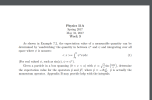 Physics 51A Spring 2017 May 31, 2017 Week 9
As shown in Example 7.2, the
expectation value of a measurable quantity can be determined by
’sandwiching’ the quantity in between ψ ∗ and ψ and integrating
over all space where ψ is nonzero: < x >= Z a 0 ψ ∗xψdx (1)
(For real valued ψ, such as sin(x), ψ = ψ ∗ ). Given a particle in
a box spanning (0 < x < a) with ψ = q2...
Physics 51A Spring 2017 May 31, 2017 Week 9
As shown in Example 7.2, the
expectation value of a measurable quantity can be determined by
’sandwiching’ the quantity in between ψ ∗ and ψ and integrating
over all space where ψ is nonzero: < x >= Z a 0 ψ ∗xψdx (1)
(For real valued ψ, such as sin(x), ψ = ψ ∗ ). Given a particle in
a box spanning (0 < x < a) with ψ = q2...
5. Part 1. (6 pt) An electron moves around a 2D ring with ring radius 0.50 nm in the state m --20...
 5. Part 1. (6 pt) An electron moves around a 2D ring with ring radius 0.50 nm in the state m --20. Determine the wavelength (in nm) of the particle wave induced by this electron. (similar to a question in Exam 1) Part 2. (a) (7pt) A wavefunction is given by y, (e, 4-B sin cos(6). Can this function be an eigenfunction of Legendrían operator (A2.sunagatsineaesin暘for a quantum particle moving around a spherical surface)? If so, determine the eigenvalue and...
A free proton has a wave function Psi (x) = A sin (kx), where k =...
 A free proton has a wave function Psi (x) = A sin (kx), where k = 1.2 times 10^10 m^-1 What is the proton's lambda? What is the proton's momentum? What is the proton's speed? Normalize Psi (x) if the wave only exists inside an infinite square well with width a = 2.1 m, (so that Psi (x) = A sin (kx) between 0 < x < a and Psi (x) = 0 otherwise).
The function ψ2px-1(ψ2,1,1+ψ2,1-1) describes an electron in the 2px state of a hydrogen-like atom (with unspecified...
 The function ψ2px-1(ψ2,1,1+ψ2,1-1) describes an electron in the 2px state of a hydrogen-like atom (with unspecified spin). Functions ψη..my are normalized egenfuntions of the energy operator (A), the square of angular momentum operator (12), and the z-component of angular momentum operator (Lz), that is 4. E1 a) Show that the function ψ2px is an eigen function of both the energy operator and the square of angular momentum operator. Find the corresponding eigenvalues. b) Determine the expected value and the uncertainty...
described 1.24(a) An electron in a one-dimensional metal of length L is by the wavefunction ψ(x)-sin(nx/L)....
 described 1.24(a) An electron in a one-dimensional metal of length L is by the wavefunction ψ(x)-sin(nx/L). Compute the expectation value of the momentum of the electron.
(( 8)) In each case show that F(x) is an eigen-function of the operator and find...
 (( 8)) In each case show that F(x) is an eigen-function of the operator and find the eigen-value F(x) Eigen-value i) d/dx? cos ax ii) d/dt elat iii) d/dx2 + 2d/dx + 3 ex iv) d/dy xey v) V2 - d/dx2 + d´/dy2 + d´/dz2 cos ax cos by cos cz
Show that the angular momentum operator, Îz = (ħ/i) d/dφ, is hermitian. Hint: consider the wavefunction...
Show that the angular momentum operator, Îz = (ħ/i) d/dφ, is hermitian. Hint: consider the wavefunction ψ(φ), where φ varies from 0 to 2π
The question is 1.3 but the Psi(x,0) and phi(k) are given in the previous two parts...
 The question is 1.3 but the Psi(x,0) and phi(k) are given in the
previous two parts
1.1 Consider a free particle in one-dimension with a wavefunction at t-0 Show that Ψ is normalized. 1.2 Show that the momentum wavefunction is Notice that lin (k-ak-k) 1.3 we can find Ψ(r) at any time t by: (ie. Ψ(x,t) is given by the Schrodinger' egn and the initial condition Ψ(x Show that iht 2mA イAr /2 2mA
The question is 1.3 but the Psi(x,0) and phi(k) are given in the
previous two parts
1.1 Consider a free particle in one-dimension with a wavefunction at t-0 Show that Ψ is normalized. 1.2 Show that the momentum wavefunction is Notice that lin (k-ak-k) 1.3 we can find Ψ(r) at any time t by: (ie. Ψ(x,t) is given by the Schrodinger' egn and the initial condition Ψ(x Show that iht 2mA イAr /2 2mA
9. 1.66 points Show that the wave function ψ-A ei(kx-at) is a solution to the Schrödinger equation, given below, where k-2π / λ and U-0. 2m dz2 Accomplish by calculating the following quantities. (Us...
 9. 1.66 points Show that the wave function ψ-A ei(kx-at) is a solution to the Schrödinger equation, given below, where k-2π / λ and U-0. 2m dz2 Accomplish by calculating the following quantities. (Use the following as necessary: A, K, x, ,t, h, and m.) momentum Need Help?Read ItTalk to a Tutor
9. 1.66 points Show that the wave function ψ-A ei(kx-at) is a solution to the Schrödinger equation, given below, where k-2π / λ and U-0. 2m dz2 Accomplish...
9. 1.66 points Show that the wave function ψ-A ei(kx-at) is a solution to the Schrödinger equation, given below, where k-2π / λ and U-0. 2m dz2 Accomplish by calculating the following quantities. (Use the following as necessary: A, K, x, ,t, h, and m.) momentum Need Help?Read ItTalk to a Tutor
9. 1.66 points Show that the wave function ψ-A ei(kx-at) is a solution to the Schrödinger equation, given below, where k-2π / λ and U-0. 2m dz2 Accomplish...
2) In each case below show (in the space provided directly) that F(y) is an eigen-...
 2) In each case below show (in the space provided directly) that F(y) is an eigen- function of the operator A and find the eigen-value a (Hint: Å F(y) = a F(y) ) F(y) Eigen-value d/dy2 Sin ay ii) d/dy elay
 Physics 51A Spring 2017 May 31, 2017 Week 9
As shown in Example 7.2, the
expectation value of a measurable quantity can be determined by
’sandwiching’ the quantity in between ψ ∗ and ψ and integrating
over all space where ψ is nonzero: < x >= Z a 0 ψ ∗xψdx (1)
(For real valued ψ, such as sin(x), ψ = ψ ∗ ). Given a particle in
a box spanning (0 < x < a) with ψ = q2...
Physics 51A Spring 2017 May 31, 2017 Week 9
As shown in Example 7.2, the
expectation value of a measurable quantity can be determined by
’sandwiching’ the quantity in between ψ ∗ and ψ and integrating
over all space where ψ is nonzero: < x >= Z a 0 ψ ∗xψdx (1)
(For real valued ψ, such as sin(x), ψ = ψ ∗ ). Given a particle in
a box spanning (0 < x < a) with ψ = q2...
 5. Part 1. (6 pt) An electron moves around a 2D ring with ring radius 0.50 nm in the state m --20. Determine the wavelength (in nm) of the particle wave induced by this electron. (similar to a question in Exam 1) Part 2. (a) (7pt) A wavefunction is given by y, (e, 4-B sin cos(6). Can this function be an eigenfunction of Legendrían operator (A2.sunagatsineaesin暘for a quantum particle moving around a spherical surface)? If so, determine the eigenvalue and...
 A free proton has a wave function Psi (x) = A sin (kx), where k = 1.2 times 10^10 m^-1 What is the proton's lambda? What is the proton's momentum? What is the proton's speed? Normalize Psi (x) if the wave only exists inside an infinite square well with width a = 2.1 m, (so that Psi (x) = A sin (kx) between 0 < x < a and Psi (x) = 0 otherwise).
 The function ψ2px-1(ψ2,1,1+ψ2,1-1) describes an electron in the 2px state of a hydrogen-like atom (with unspecified spin). Functions ψη..my are normalized egenfuntions of the energy operator (A), the square of angular momentum operator (12), and the z-component of angular momentum operator (Lz), that is 4. E1 a) Show that the function ψ2px is an eigen function of both the energy operator and the square of angular momentum operator. Find the corresponding eigenvalues. b) Determine the expected value and the uncertainty...
 described 1.24(a) An electron in a one-dimensional metal of length L is by the wavefunction ψ(x)-sin(nx/L). Compute the expectation value of the momentum of the electron.
 (( 8)) In each case show that F(x) is an eigen-function of the operator and find the eigen-value F(x) Eigen-value i) d/dx? cos ax ii) d/dt elat iii) d/dx2 + 2d/dx + 3 ex iv) d/dy xey v) V2 - d/dx2 + d´/dy2 + d´/dz2 cos ax cos by cos cz
 The question is 1.3 but the Psi(x,0) and phi(k) are given in the
previous two parts
1.1 Consider a free particle in one-dimension with a wavefunction at t-0 Show that Ψ is normalized. 1.2 Show that the momentum wavefunction is Notice that lin (k-ak-k) 1.3 we can find Ψ(r) at any time t by: (ie. Ψ(x,t) is given by the Schrodinger' egn and the initial condition Ψ(x Show that iht 2mA イAr /2 2mA
The question is 1.3 but the Psi(x,0) and phi(k) are given in the
previous two parts
1.1 Consider a free particle in one-dimension with a wavefunction at t-0 Show that Ψ is normalized. 1.2 Show that the momentum wavefunction is Notice that lin (k-ak-k) 1.3 we can find Ψ(r) at any time t by: (ie. Ψ(x,t) is given by the Schrodinger' egn and the initial condition Ψ(x Show that iht 2mA イAr /2 2mA
 9. 1.66 points Show that the wave function ψ-A ei(kx-at) is a solution to the Schrödinger equation, given below, where k-2π / λ and U-0. 2m dz2 Accomplish by calculating the following quantities. (Use the following as necessary: A, K, x, ,t, h, and m.) momentum Need Help?Read ItTalk to a Tutor
9. 1.66 points Show that the wave function ψ-A ei(kx-at) is a solution to the Schrödinger equation, given below, where k-2π / λ and U-0. 2m dz2 Accomplish...
9. 1.66 points Show that the wave function ψ-A ei(kx-at) is a solution to the Schrödinger equation, given below, where k-2π / λ and U-0. 2m dz2 Accomplish by calculating the following quantities. (Use the following as necessary: A, K, x, ,t, h, and m.) momentum Need Help?Read ItTalk to a Tutor
9. 1.66 points Show that the wave function ψ-A ei(kx-at) is a solution to the Schrödinger equation, given below, where k-2π / λ and U-0. 2m dz2 Accomplish...
 2) In each case below show (in the space provided directly) that F(y) is an eigen- function of the operator A and find the eigen-value a (Hint: Å F(y) = a F(y) ) F(y) Eigen-value d/dy2 Sin ay ii) d/dy elay
Most questions answered within 3 hours.
-
Where is the error in this code sequence?
String s1 = "Hello";
String s2 = "ello";...
asked 10 months ago -
Financial data for Joel de Paris, Inc., for last year
follow:
Joel de Paris, Inc.
Balance...
asked 10 months ago -
Consider this reaction:
Al2(SO4)3 (aq)+ BaCl3
(aq) Al2Cl6 (aq)- +
3BaSO4(s) . What is the...
asked 10 months ago -
Suppose that Savneet is considering increasing her
recent random sample from 20 car rentals to 40...
asked 10 months ago -
Trucks arrive at an unloading terminal at an average rate of 120
per hour.
Trucks arrive...
asked 10 months ago -
Why are methanol and ethanol completely soluble in water while
octanol is not very little soluble....
asked 10 months ago -
A facilities manager at a university reads in a research report
that the mean amount of...
asked 10 months ago -
When the CuSO4 is rehydrated by adding water to the anhydrous
compound, is this an endothermic...
asked 10 months ago -
A ray of sunlight is passing from diamond into crown glass; the
angle of incidence is...
asked 10 months ago -
A block of mass 0.249 kg is placed on top of a light, vertical
spring of...
asked 10 months ago -
how do the kidneys compensate in the presences of acidosis
a) trigger hyperventilate
b) reserve acid...
asked 10 months ago -
Question 501 pts
The rental rate of capital to the firm increases. Which of the
following...
asked 10 months ago