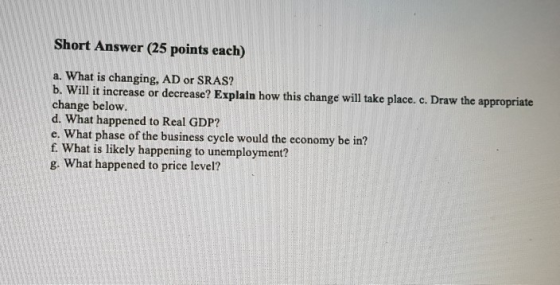
Aggregate Demand Aggregate Supply Questions

Homework Answers
Government passed tax reduction on Income:
a) Aggregate demand = Consumption + Investment + Government spending = Exports - Imports
Tax reduction will raise disposable income with consumers to spend on goods. It will change aggregate demand.
b) It will increase aggregate demand as consumption and aggregate demand have positive relationship with each other.
c)
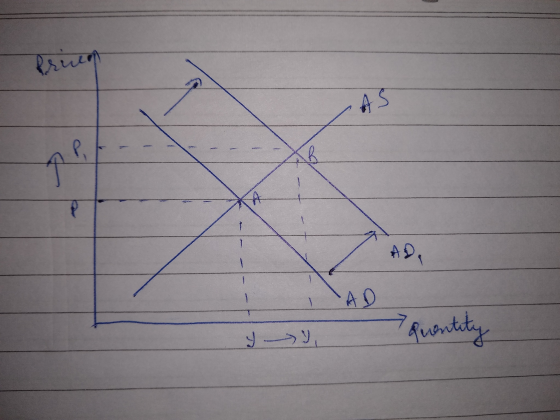
d) Real GDP increases from Y to Y1 as depicted in the diagram above.
e) Economy must be in expansionary phase where real GDP rises.
f) Unemployment will level as producers will need more labor to produce more output level.
g) It will raise price level from P to P1 as depicted in the diagram above.
Add Answer to:
Aggregate Demand Aggregate Supply Questions
Short Answer (25 points each) a. What is changing, AD or...
The graph depicts a dynamic aggregate demand (AD) and aggregate supply (AS) model of the economy....
 The graph depicts a dynamic aggregate demand (AD) and aggregate supply (AS) model of the economy. Suppose that in 2003, the economy is in macroeconomic equilibrium, with GDP at GDP (year 1). The Fed projects that in 2004, the aggregate demand curve will be AD (year 2), that potential real GDP will be $12.45 trillion (GDP (year 2), and that actual real GDP will be $12.39 trillion LRAS (year 1) LRAS (year 2) SRAS (ycar1) SRAS (year 2 ear Year...
drawing the graph of AD (Aggregate Demand), SRAS (Short- run aggregate supply curve) and LRAS (...
drawing the graph of AD (Aggregate Demand), SRAS (Short- run aggregate supply curve) and LRAS ( long run aggregate supply curve) and writing down what would happen under the two conditions "increase personal income taxes" and "decrease personal income taxes". You need to write down everything happens by following the seven steps: 1. What would happen under the condition? (Whether AD, SRAS, or LRAS would change? And in which direction the curve would shift?) 2. Where is the new short-run...
The graph below depicts the aggregate demand, Irrun aggregate supply, and short-run aggregate supply curves for...
 The graph below depicts the aggregate demand, Irrun aggregate supply, and short-run aggregate supply curves for the United States at an initial long-run macroeconomic equilibrium Price level] (P) LRAS SRAS Real GDP Consider a situation in which two things happen simultaneously: there is a deterioration of institutions, and the federal government massively increases spending. Which of the graphs below illustrates the shifts in this model given this situation? Price level Price level (P) (P) URAS LRAS, LRAS SRAS SRAS SRAS...
in output WHAT SHIFTS THE SHORT-RUN AGGREGATE SUPPLY CURVE? SRAS, SRAS, BRAS, 1. Determine whether each...
 in output WHAT SHIFTS THE SHORT-RUN AGGREGATE SUPPLY CURVE? SRAS, SRAS, BRAS, 1. Determine whether each change listed in the table below will cause an increase, decreased or no change in Aggregate Supply (AS). Always start with SEASO. 2. IN column 1, list which component of AS is affected: input prices or productivity 3. IN column 2, draw an up arrow if the change will cause an increase in AS, a down arrow if it will cause a decrease in...
Consider an economy with the following aggregate demand (AD) and aggregate supply (AS) schedules. These schedules...
Consider an economy with the following aggregate demand (AD) and aggregate supply (AS) schedules. These schedules reflect the fact that, prior to the period we’re examining, decision makers entered into contracts and made choices anticipating that the price level would be P105. AD105 Price Level SRAS105 (trillion dollars) (trillion dollars) 5.1 95 3.5 4.9 100 3.8 4.7 105 4.2 4.5 110 4.5 4.3 115 4.8 The quantity of GDP that will be produced will be _____ trillion and the price...
Using the aggregate demand (AD), the short-run aggregate supply (SRAS), and the long-run aggregate supply (LRAS)...
Using the aggregate demand (AD), the short-run aggregate supply (SRAS), and the long-run aggregate supply (LRAS) curves, briefly explain how an open market purchase will affect the equilibrium price level (P) and real output (Y) in the short run. Assume the economy is initially in a recession?
Given a downward-sloping aggregate demand (AD) curve and an upward-sloping short-run aggregate supply curve (SRAS), equilibrium...
Given a downward-sloping aggregate demand (AD) curve and an upward-sloping short-run aggregate supply curve (SRAS), equilibrium occurs where the two intersect. The value on the vertical axis is the equilibrium price level and the value on the horizontal axis is the equilibrium value of real GDP or output. What happens to the economy when AD shifts? It is useful to sketch a graph and show the shift. Suppose, for example, interest rates fall or wealth increases due to a stock...
Update the graph below to show an increase in short run aggregate supply and show what...
 Update the graph below to show an increase in short run aggregate supply and show what effect this increase in increase short run aggregate supply will have on price levels and real GDP. 1. Price level SRAS AD Real GDF 2. Assume that a recessionary gap currently exists. If long-run supply (aka, potential output) increases and there is no change to aggregate demand or short run aggregate supply what happens to real GDP and to the recessionary gap?
Using aggregate demand (AD), short-run aggregate supply (SRAS) and long-run aggregate supply (LRAS) curves
Question 1: AD-SRAS-LRAS Model Using aggregate demand (AD), short-run aggregate supply (SRAS) and long-run aggregate supply (LRAS) curves, graphically illustrate the effect of an increase in the money supply on output and prices in the short and long run. Assume that the economy is initially in long run equilibrium at the potential output level and prices are fixed in the short-run. In your graph, label "A" for the initial equilibrium, "B' for the short-run equilibrium, and "C" for the long-run equilibrium.
()-run equilibrium occurs at the intersection of the aggregate demand curve, AD, and the short-run aggregate...
()-run equilibrium occurs at the intersection of the aggregate demand curve, AD, and the short-run aggregate supply curve, SRAS.() ▼ Long Short -run equilibrium occurs at the intersection of AD and the long-run aggregate supply curve, LRAS. Any unanticipated shifts in aggregate demand or supply are called aggregate demand or aggregate supply() ▼ shocks externalities . When aggregate demand decreases while aggregate supply is stable,() ▼ a recessionary an inflationary gap can occur, defined as the difference between how much...
 The graph depicts a dynamic aggregate demand (AD) and aggregate supply (AS) model of the economy. Suppose that in 2003, the economy is in macroeconomic equilibrium, with GDP at GDP (year 1). The Fed projects that in 2004, the aggregate demand curve will be AD (year 2), that potential real GDP will be $12.45 trillion (GDP (year 2), and that actual real GDP will be $12.39 trillion LRAS (year 1) LRAS (year 2) SRAS (ycar1) SRAS (year 2 ear Year...
 The graph below depicts the aggregate demand, Irrun aggregate supply, and short-run aggregate supply curves for the United States at an initial long-run macroeconomic equilibrium Price level] (P) LRAS SRAS Real GDP Consider a situation in which two things happen simultaneously: there is a deterioration of institutions, and the federal government massively increases spending. Which of the graphs below illustrates the shifts in this model given this situation? Price level Price level (P) (P) URAS LRAS, LRAS SRAS SRAS SRAS...
 in output WHAT SHIFTS THE SHORT-RUN AGGREGATE SUPPLY CURVE? SRAS, SRAS, BRAS, 1. Determine whether each change listed in the table below will cause an increase, decreased or no change in Aggregate Supply (AS). Always start with SEASO. 2. IN column 1, list which component of AS is affected: input prices or productivity 3. IN column 2, draw an up arrow if the change will cause an increase in AS, a down arrow if it will cause a decrease in...
 Update the graph below to show an increase in short run aggregate supply and show what effect this increase in increase short run aggregate supply will have on price levels and real GDP. 1. Price level SRAS AD Real GDF 2. Assume that a recessionary gap currently exists. If long-run supply (aka, potential output) increases and there is no change to aggregate demand or short run aggregate supply what happens to real GDP and to the recessionary gap?
Most questions answered within 3 hours.
-
Where is the error in this code sequence?
String s1 = "Hello";
String s2 = "ello";...
asked 10 months ago -
Financial data for Joel de Paris, Inc., for last year
follow:
Joel de Paris, Inc.
Balance...
asked 10 months ago -
Consider this reaction:
Al2(SO4)3 (aq)+ BaCl3
(aq) Al2Cl6 (aq)- +
3BaSO4(s) . What is the...
asked 10 months ago -
Suppose that Savneet is considering increasing her
recent random sample from 20 car rentals to 40...
asked 10 months ago -
Trucks arrive at an unloading terminal at an average rate of 120
per hour.
Trucks arrive...
asked 10 months ago -
Why are methanol and ethanol completely soluble in water while
octanol is not very little soluble....
asked 10 months ago -
A facilities manager at a university reads in a research report
that the mean amount of...
asked 10 months ago -
When the CuSO4 is rehydrated by adding water to the anhydrous
compound, is this an endothermic...
asked 10 months ago -
A ray of sunlight is passing from diamond into crown glass; the
angle of incidence is...
asked 10 months ago -
A block of mass 0.249 kg is placed on top of a light, vertical
spring of...
asked 10 months ago -
how do the kidneys compensate in the presences of acidosis
a) trigger hyperventilate
b) reserve acid...
asked 10 months ago -
Question 501 pts
The rental rate of capital to the firm increases. Which of the
following...
asked 10 months ago