What are the 3 primer pair combinations that are considered standard when setting up a genotyping...
What are the 3 primer pair combinations that are considered standard when setting up a genotyping reaction to test for a mutation in an organism that is represented by a putative insertion?
Homework Answers
Primer pairs consist of the upper and lower primers. Although two different primers may make up the primer pairs, it is important that the primers both have similar melting temperatures in order to facilitate a successful PCR reaction. Software is available which identifies potential primer pairs, providing their melting and annealing temperatures, along with other details, and also suggesting alternative options of various primer pairs.
Primers are always specified 5' to 3', left to right.
Primers for PCR and sequencing should be between 18 to 25
nucleotides in length.
Primers for PCR and sequencing should have a GC content between 40
and 60%, with the 3′ of a primer ending in C or G to promote
binding.
The 3' end of the primer should be an exact match to the template
DNA, because extension by DNA polymerase, during PCR, depends on a
good match at the 3' end.
In the last 5 bases at the 3′ end of the primer, make sure that
there are at least 2 G or C bases (GC clamp). G-C base pairs have a
stronger bond than A-T base pairs (3 hydrogen bonds versus
2).
Where a restriction site has been added onto the end of a primer,
typically, 5-6 nucleotides are added 5’ of the restriction enzyme
site (aka a “leader sequence”) in the primer to allow for efficient
cutting.
widely used strategy for detecting DNA sequence variants is allele-specific PCR in which one or both primers are designed to anneal at sites of sequence variation. Ideally, a primer whose sequence matches a specific variant should selectively amplify only that variant; however, in practice, significant mismatched amplification typically occurs. It is common practice to anchor the 3′ end of the allele-specific primer at the mutant base in order to selectively amplify the mutant template. This strategy reduces but does not eliminate amplification of the wild-type allele. The amount of this non-specific amplification has been found to vary widely depending on the particular base mismatch between the allele-specific primer and the wild-type sequence .The variability of non-specific amplification typically requires a process of trial and error when designing highly selective mutation assay.The assay method reported here utilizes a combination of allele-specific PCR primers, a blocker oligonucleotide to suppress amplification of the wild type allele, and a set of reagent design rules that consistently produce highly selective assays for a wide variety of single point substitutions, insertions, or deletions.
Modified assay by the acronym ASB-PCR (Allele-Specific Blocker PCR). Features of the method include the ability to detect mutations in either DNA or RNA with a high level of sensitivity and selectivity.
Add Answer to:
What are the 3 primer pair combinations that are considered
standard when setting up a genotyping...
When pricing a product for export, what factors are to be considered when setting the price?...
When pricing a product for export, what factors are to be considered when setting the price? Should it be higher, lower or the same. Finally, when quoting a price, what needs to be considered?
In setting up the tubes for the standard curve in the Biuret reaction, which of the...
In setting up the tubes for the standard curve in the Biuret reaction, which of the 3 components (BSA, water, Biuret reagent) must be pippeted as accurately as possible and which could vary slightly in volume (e.g use of an unwiped blowout pipe) provided that the same error is made throughout?
You obtained the following raw data when setting up a Bradford standard curve: BSA (mg/ml) Absorbancy...
You obtained the following raw data when setting up a Bradford standard curve: BSA (mg/ml) Absorbancy 595nm 0 0.225 1 0.310 2 0.420 3 0.510 4 0.610 5 0.720 6 0.810 7 0.915 8 0.950 9 0.980 10 0.990 Set up a standard curve. What would the quality of the line-fit (R2 value) be if you exclude experimental outliers? (Give you answer to 4 decimal places)
When a standard pair of six sided dice are rolled, what is the probability of getting...
 When a standard pair of six sided dice are rolled, what is the probability of getting a 6? Express your answer as a decimal rounded to the thousandsth place.)
1. When setting up a microscope in Köhler illumination, when the condenser lens is correctly focused what should the edge of the field diaphragm ring look like? 2. What happens to a microscop...
1. When setting up a microscope in Köhler illumination, when the condenser lens is correctly focused what should the edge of the field diaphragm ring look like? 2. What happens to a microscope image if the condenser lens is a long way out of focus? 3. What happens to a microscope image if the aperture of the condenser diaphragm is closed so that it transmits less light? 1. When setting up a microscope in Köhler illumination, when the condenser lens...
I'm having trouble setting up the problems for questions 3-4, please help when the formation of...
 I'm having trouble setting up the problems for
questions 3-4, please help
when the formation of ca sult of a strung neid a What is the pH of the solution obtained by mixing 50.00 mL of 0.250M HCl and 50.00 mL of 0.500M NaOH? pOH = -log(. 500). 301 3. What is the pH of a solution that is 0.20M in sodium acetate and 0.40M in acetic acid? (K, for acetic acid is 1.85 x 10.) 4. What is the...
I'm having trouble setting up the problems for
questions 3-4, please help
when the formation of ca sult of a strung neid a What is the pH of the solution obtained by mixing 50.00 mL of 0.250M HCl and 50.00 mL of 0.500M NaOH? pOH = -log(. 500). 301 3. What is the pH of a solution that is 0.20M in sodium acetate and 0.40M in acetic acid? (K, for acetic acid is 1.85 x 10.) 4. What is the...
what is considered a restrained a. 2 side rails up b. 4 side rail up c.3...
what is considered a restrained a. 2 side rails up b. 4 side rail up c.3 side rail up d. bed in the chair position
Problem 3. In the setting of Problem 1, what is the expected value and the variance of the first ...
Problem 3. In the setting of Problem 1, what is the expected value and the variance of the first day when the stock price goes up? What is the MGF of this day? What is the probability that this day happens on the sixth day? Problem 1. An investment analyst found that a certain stock price goes up or down a point every day with probabilities 0.75 and 0.25, respectively. Daily fluctuations are independent. Find the probability that after four...
3. Iwould suggest setting up the equations for this multiple steady state problem in Excel. The...
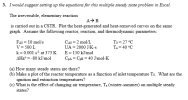 3. Iwould suggest setting up the equations for this multiple steady state problem in Excel. The irreversible, elementary reaction is carried out in a CSTR. Plot the heat-generated and heat-removed curves on the same graph. Assume the following reactor, reaction, and thermodynamic parameters To 27 °C Ta = 40 °C FAo 10 mol/s V 500I k 0.001 s 1 at 373 K E 150 kJ/mol AHRO-80 kJ/mol UA 2000 J/K-s CpA CpB 40 J/mol-K (a) How many steady states are...
a) When setting up the reflux condenser, does it matter if the water flows into the...
 a) When setting up the reflux condenser, does it matter
if the water flows into the bottom or the top of the condenser? If
so, does it have to flow into the bottom or the top, and why? If
not, why does it not matter?
Question pertains to the following reactions:
Reaction 2: Reduction NO2 NH4HCO2 NH2 + NO2 Pd/C NO2 NH2 NH2 m-methylaniline p-methylaniline 0-methylaniline ortho meta para Procedure for Reaction 2: 1) The mixture of ortho, meta, and...
a) When setting up the reflux condenser, does it matter
if the water flows into the bottom or the top of the condenser? If
so, does it have to flow into the bottom or the top, and why? If
not, why does it not matter?
Question pertains to the following reactions:
Reaction 2: Reduction NO2 NH4HCO2 NH2 + NO2 Pd/C NO2 NH2 NH2 m-methylaniline p-methylaniline 0-methylaniline ortho meta para Procedure for Reaction 2: 1) The mixture of ortho, meta, and...
 When a standard pair of six sided dice are rolled, what is the probability of getting a 6? Express your answer as a decimal rounded to the thousandsth place.)
 I'm having trouble setting up the problems for
questions 3-4, please help
when the formation of ca sult of a strung neid a What is the pH of the solution obtained by mixing 50.00 mL of 0.250M HCl and 50.00 mL of 0.500M NaOH? pOH = -log(. 500). 301 3. What is the pH of a solution that is 0.20M in sodium acetate and 0.40M in acetic acid? (K, for acetic acid is 1.85 x 10.) 4. What is the...
I'm having trouble setting up the problems for
questions 3-4, please help
when the formation of ca sult of a strung neid a What is the pH of the solution obtained by mixing 50.00 mL of 0.250M HCl and 50.00 mL of 0.500M NaOH? pOH = -log(. 500). 301 3. What is the pH of a solution that is 0.20M in sodium acetate and 0.40M in acetic acid? (K, for acetic acid is 1.85 x 10.) 4. What is the...
 3. Iwould suggest setting up the equations for this multiple steady state problem in Excel. The irreversible, elementary reaction is carried out in a CSTR. Plot the heat-generated and heat-removed curves on the same graph. Assume the following reactor, reaction, and thermodynamic parameters To 27 °C Ta = 40 °C FAo 10 mol/s V 500I k 0.001 s 1 at 373 K E 150 kJ/mol AHRO-80 kJ/mol UA 2000 J/K-s CpA CpB 40 J/mol-K (a) How many steady states are...
 a) When setting up the reflux condenser, does it matter
if the water flows into the bottom or the top of the condenser? If
so, does it have to flow into the bottom or the top, and why? If
not, why does it not matter?
Question pertains to the following reactions:
Reaction 2: Reduction NO2 NH4HCO2 NH2 + NO2 Pd/C NO2 NH2 NH2 m-methylaniline p-methylaniline 0-methylaniline ortho meta para Procedure for Reaction 2: 1) The mixture of ortho, meta, and...
a) When setting up the reflux condenser, does it matter
if the water flows into the bottom or the top of the condenser? If
so, does it have to flow into the bottom or the top, and why? If
not, why does it not matter?
Question pertains to the following reactions:
Reaction 2: Reduction NO2 NH4HCO2 NH2 + NO2 Pd/C NO2 NH2 NH2 m-methylaniline p-methylaniline 0-methylaniline ortho meta para Procedure for Reaction 2: 1) The mixture of ortho, meta, and...
Most questions answered within 3 hours.
-
Where is the error in this code sequence?
String s1 = "Hello";
String s2 = "ello";...
asked 10 months ago -
Financial data for Joel de Paris, Inc., for last year
follow:
Joel de Paris, Inc.
Balance...
asked 10 months ago -
Consider this reaction:
Al2(SO4)3 (aq)+ BaCl3
(aq) Al2Cl6 (aq)- +
3BaSO4(s) . What is the...
asked 10 months ago -
Suppose that Savneet is considering increasing her
recent random sample from 20 car rentals to 40...
asked 10 months ago -
Trucks arrive at an unloading terminal at an average rate of 120
per hour.
Trucks arrive...
asked 10 months ago -
Why are methanol and ethanol completely soluble in water while
octanol is not very little soluble....
asked 10 months ago -
A facilities manager at a university reads in a research report
that the mean amount of...
asked 10 months ago -
When the CuSO4 is rehydrated by adding water to the anhydrous
compound, is this an endothermic...
asked 10 months ago -
A ray of sunlight is passing from diamond into crown glass; the
angle of incidence is...
asked 10 months ago -
A block of mass 0.249 kg is placed on top of a light, vertical
spring of...
asked 10 months ago -
how do the kidneys compensate in the presences of acidosis
a) trigger hyperventilate
b) reserve acid...
asked 10 months ago -
Question 501 pts
The rental rate of capital to the firm increases. Which of the
following...
asked 10 months ago