Consumer choice with gift certificate
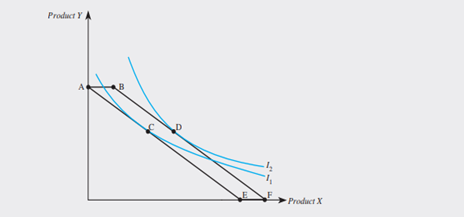
In the following figure, a consumer is initially in equilibrium at point C. The consumer’s income is $400, and the budget line through point C is given by $400 = $100X + $200Y. When the consumer is given a $100 gift certificate that is good only at store X, she moves to a new equilibrium at point D. (LO1, LO3, LO6)
a. Determine the prices of goods X and Y.
b. How many units of product Y could be purchased at point A?
c. How many units of product X could be purchased at point E?
d. How many units of product X could be purchased at point B?
e. How many units of product X could be purchased at point F?
f. Based on this consumer’s preferences, rank bundles A, B, C, and D in order from most preferred to least preferred.
g. Is product X a normal or an inferior good?
Homework Answers
A consumer has the following budget line:

(a) Price of good X is $100 and price of good Y is $200.
(b) The maximum units of good Y that can be purchased with given income is calculated as income divided by price of good.

(c) The maximum units of good X that can be purchased with $400 income is 4 units.

(d) With $100 certificate of good X, 1 unit more of good X can be purchased even if all $400 income is spent on good Y.

Therefore total of 5 units can be purchased with $500.
(e) With income of $500, 5 units of good X can be purchased if all income is spent on good X.
(f) The higher the indifference curve, the more preferred is the consumption bundle. The consumer will give first preference to point D since it lies at higher indifference curve. Then comes point B which lies below D but above point C and A. The third preference would be point C since it is the optimal point of lower indifference curve. The last is point A. The preference would be D, B, C and A.
(g) Product X is normal good since the consumer is better off with higher consumption of good X as income increases. Had it been inferior, the consumption of good X would have decreased with certificate of $100.
Help Save & Exit Submit Check my work In the below figure, a consumer is initially...
 Help Save & Exit Submit Check my work In the below figure, a consumer is initially in equilibrium at point C. The consumer's income is $250, and the point C is given by $250 $50X+$125 Y. When moves to a new equilbrium at point D budget line through the consumer is given a $100 gift certificate that is good only at store X, she Product Y Product X MacBook Ai F5 #6 F7 ch4 Hw Help Save & a. Determine...
Managerial Economics: A consumer is in equilibrium at point A in the accompanying figure. The price of good X is $5.
 A consumer is in equilibrium at point A in the accompanying figure. The
price of good X is $5. a) What is the price of good Y? b) What is the consumer’s income? c) At point A, how many units of good X does the consumer purchase? d) Suppose the budget line changes so that the consumer achieves a new
equilibrium at point B. What change in the economic environment led to this
new equilibrium? Is the consumer better off or worse off as...
A consumer is in equilibrium at point A in the accompanying figure. The
price of good X is $5. a) What is the price of good Y? b) What is the consumer’s income? c) At point A, how many units of good X does the consumer purchase? d) Suppose the budget line changes so that the consumer achieves a new
equilibrium at point B. What change in the economic environment led to this
new equilibrium? Is the consumer better off or worse off as...
8.If bundle A is weakly preferred to bundle B, bundle B is strictly preferred to bundle...
8.If bundle A is weakly preferred to bundle B, bundle B is strictly preferred to bundle C, and bundle C is weakly preferred to bundle A, what can we conclude? a. The consumer is indifferent between bundles A and B b. The consumer violates monotonicity c. The consumer violates transitivity. d.The consumer prefers C to B e. None of the above 11. Consider a consumer who can buy good 1 or 2. The price of good 1 is $5 and...
A consumer has the utility function U(X, Y) = (X + 2)(Y + 4). Her income is...
A consumer has the utility function U(X, Y) = (X + 2)(Y + 4). Her income is $100, the price of X is $4, and the price of Y is $5. In order to maximize utility subject to her budget constraint, how many units of X and Y will our consumer choose to purchase? Sketch a budget line – indifference curve diagram illustrating this optimum. Label this optimum A. Suppose the price of X increases to $8, while income and the price...
A consumer must divide $600 between the consumption of product X and product Y. The relevant...
A consumer must divide $600 between the consumption of product X and product Y. The relevant market prices are Px = $10 and Py = $40. (LO2) a. Write the equation for the consumer’s budget line. b. Illustrate the consumer’s opportunity set in a carefully labeled diagram. c. Show how the consumer’s opportunity set changes when the price of good X increases to $20. How does this change alter the market rate of substitution between goods X and Y?
A consumer has the utility function over goods X and Y, U(X; Y) = X1/3Y1/2 Let...
A consumer has the utility function over goods X and Y, U(X; Y) = X1/3Y1/2 Let the price of good x be given by Px, let the price of good y be given by Py, and let income be given by I. Derive the consumer’s generalized demand function for good X. Solve for the Marshallian Demand for X and Y using Px, and Py (there are no numbers—use the notation). c. Is good Y normal or inferior? Explain precisely.
1. Show, using a sketch graph, a consumer who prefers a cash gift rather than a...
 1. Show, using a sketch graph, a consumer who prefers a cash gift rather than a larger gift of merchandise. [As a starting point use an optimal choice of a consumption bundle containing an amount of good X and a composite good Y.] 2. Show, using a sketch graph, income and substitution effects of a price decrease for an inferior good. Fully label your diagram.
2. Suppose there are two consumers, A and B, and two goods, X and Y. Consumer...
2. Suppose there are two consumers, A and B, and two goods, X and Y. Consumer A is given an initial endowment of 2 units of good X and 3 units of good Y. Consumer B is given an initial endowment of 6 units of good X and 5 units of good Y. Consumer A’s utility function is given by: UA(X,Y) = X1/2*Y1/2, And consumer B’s utility function is given by UB(X,Y) = X1/4*Y3/4. Therefore, consumer A’s marginal utilities for...
An exchange economy consists of two individuals---consumer A and consumer B with preferences over two goods---goods...
 An exchange economy consists of two individuals---consumer A and consumer B with preferences over two goods---goods X and Y. Suppose consumer A is initially endowed with 9 units of good X and 6 units of good Y and consumer B is initially endowed with 91 units of good X and 14 units of good Y. Both consumer A and consumer B have identical preferences with the following marginal rates of substitution: MUX - 1 YA MRS, = MUX - and...
The weekly utility function of a consumer is: U = 2AB where A and B are...
The weekly utility function of a consumer is: U = 2AB where A and B are two goods in the consumer’s consumption bundle. Based on this utility function the marginal utility of good A is: MUA = 2B and the marginal utility of good B is: MUB = 2A, where A and B represent the quantities of good A and good B, respectively. The price of good A is $5 whereas the price good B is $10. a. Write the...
 Help Save & Exit Submit Check my work In the below figure, a consumer is initially in equilibrium at point C. The consumer's income is $250, and the point C is given by $250 $50X+$125 Y. When moves to a new equilbrium at point D budget line through the consumer is given a $100 gift certificate that is good only at store X, she Product Y Product X MacBook Ai F5 #6 F7 ch4 Hw Help Save & a. Determine...
 1. Show, using a sketch graph, a consumer who prefers a cash gift rather than a larger gift of merchandise. [As a starting point use an optimal choice of a consumption bundle containing an amount of good X and a composite good Y.] 2. Show, using a sketch graph, income and substitution effects of a price decrease for an inferior good. Fully label your diagram.
 An exchange economy consists of two individuals---consumer A and consumer B with preferences over two goods---goods X and Y. Suppose consumer A is initially endowed with 9 units of good X and 6 units of good Y and consumer B is initially endowed with 91 units of good X and 14 units of good Y. Both consumer A and consumer B have identical preferences with the following marginal rates of substitution: MUX - 1 YA MRS, = MUX - and...
Most questions answered within 3 hours.
-
Where is the error in this code sequence?
String s1 = "Hello";
String s2 = "ello";...
asked 10 months ago -
Financial data for Joel de Paris, Inc., for last year
follow:
Joel de Paris, Inc.
Balance...
asked 10 months ago -
Consider this reaction:
Al2(SO4)3 (aq)+ BaCl3
(aq) Al2Cl6 (aq)- +
3BaSO4(s) . What is the...
asked 10 months ago -
Suppose that Savneet is considering increasing her
recent random sample from 20 car rentals to 40...
asked 10 months ago -
Trucks arrive at an unloading terminal at an average rate of 120
per hour.
Trucks arrive...
asked 10 months ago -
Why are methanol and ethanol completely soluble in water while
octanol is not very little soluble....
asked 10 months ago -
A facilities manager at a university reads in a research report
that the mean amount of...
asked 10 months ago -
When the CuSO4 is rehydrated by adding water to the anhydrous
compound, is this an endothermic...
asked 10 months ago -
A ray of sunlight is passing from diamond into crown glass; the
angle of incidence is...
asked 10 months ago -
A block of mass 0.249 kg is placed on top of a light, vertical
spring of...
asked 10 months ago -
how do the kidneys compensate in the presences of acidosis
a) trigger hyperventilate
b) reserve acid...
asked 10 months ago -
Question 501 pts
The rental rate of capital to the firm increases. Which of the
following...
asked 10 months ago