Two moles of ideal monoatomic gas go through a cyclic transformation DABCD staring at the point...
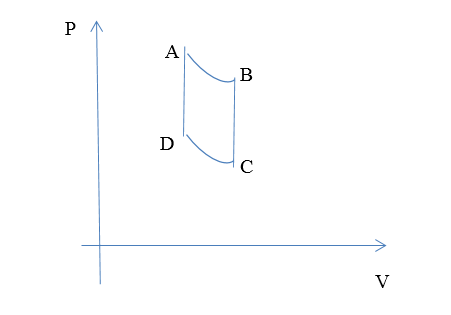
Two moles of ideal monoatomic gas go through a cyclic transformation DABCD staring at the point D in the diagram below at a pressure of 2 atmospheres and a temperature of 360K and returning at point D. The volume at B is three times that of point D. The gas pressure at B is twice the gas pressure at C. Paths AB and CD represent isothermal processes.
a) Calculate the net work done by the gas during one cycle.
Homework Answers
As given in the question,
Pressure at point D: PD = 2 atm = 2*101325 Pa = 202650 Pa
Temperature at point D: TD = 360 K, no of moles: n = 2 mol
Volume ratio: VB = 3*VD and Pressure ratio: PB = 2*PC
Using ideal gas equation, PD*VD = n*R*TD
=> VD = n*R*TD / PD
= 2*8.314*360 / 202650 = 0.0295 m^3
VA = VD = 0.0295 m^3
So, the volume at point B: VB = 3*VD = 0.0886 m^3
VC = VB = 0.0886 m^3
Now, the work done by gas can be calculated using below formula:
Isothermal process: W = - n*R*T*ln(Vfinal / Vinitial)
Temperatures, TC = TD = 360 K
Ideal gas equation between points B and C,
n*R*TB / PB*VB = n*R*TC / PC*VC
Since, VC = VB and PB = 2*PC => TB = 2*TC = 2*360 = 720 K
TA = TB = 720 K
The work done in (D -> A) and (B -> C) are zero because these are at constant volume.
So, the net work done in the whole cyclic process,
WTotal = W(A -> B) + W(C -> D)
= {- n*R*TA*ln(VB / VA)} + {- n*R*TC*ln(VD / VC)}
= {- 2*8.314*720*ln(0.0886 / 0.0295)} + {- 2*8.314*360*ln(0.0295 / 0.0886)}
= - 13166.28 J + 6583.14 J = - 6583.14 J = - 6.583*10^3 kJ
Add Answer to:
Two moles of ideal monoatomic gas go through a cyclic
transformation DABCD staring at the point...
At point D in the figure below, the pressure and temperature of 2.00 mol of an...
 At point D in the figure below, the pressure and temperature of 2.00 mol of an ideal monatomic gas are 2.00 atm and 360 K, respectively. The volume of the gas at point B on the PV diagram is three times that at point D and its pressure is twice that at point C. Paths AB and CD represent isothermal processes. The gas is carried through a complete cycle along the path DABCD. Determine the total amount of work done...
TB4 The PV diagram in the figure is for n moles of an ideal monatomic gas. The gas is initially at point A. The paths AD and BC represent isothermal changes. R is the universal gas constant. Let the...
 TB4 The PV diagram in the figure is for n moles of an ideal monatomic gas. The gas is initially at point A. The paths AD and BC represent isothermal changes. R is the universal gas constant. Let the pressures, volumes, and temperatures at the labeled points be denoted as PA , PB, etc., and VA , VB, etc., and TA, TB, etc., respectively. If the system is brought to point C along th<e path A-»E->C, what is the heat...
7.5) A 1.15 -mol quantity of monatomic ideal gas undergoes the following cyclic process. The gas...
 7.5) A 1.15 -mol quantity of monatomic ideal gas undergoes the
following cyclic process. The gas starts at point a at STP. It
expands isothermally to point b, where the volume is 2.2 times its
original volume. Next, heat is removed while keeping the volume
constant and reducing the pressure. Finally, the gas undergoes
adiabatic compression, returning to point a.
a. Calculate the pressures at b and c. (answers in Pa)
**Find the volumes at a and b first.
**Use...
7.5) A 1.15 -mol quantity of monatomic ideal gas undergoes the
following cyclic process. The gas starts at point a at STP. It
expands isothermally to point b, where the volume is 2.2 times its
original volume. Next, heat is removed while keeping the volume
constant and reducing the pressure. Finally, the gas undergoes
adiabatic compression, returning to point a.
a. Calculate the pressures at b and c. (answers in Pa)
**Find the volumes at a and b first.
**Use...
1.08 mol of a monatomic ideal gas undergoes a cyclic process in a reversible engine, as...
 1.08 mol of a monatomic ideal gas undergoes a cyclic process in
a reversible engine, as shown in the PV diagram. The gas is
initially at STP at point a. The curved path is an isotherm at T =
411 K, and the straight paths represent processes at constant
pressure or constant volume. Determine the heat added in process
c-a.
1.08 mol of a monatomic ideal gas undergoes a cyclic process in
a reversible engine, as shown in the PV diagram. The gas is
initially at STP at point a. The curved path is an isotherm at T =
411 K, and the straight paths represent processes at constant
pressure or constant volume. Determine the heat added in process
c-a.
An ideal gas is brought through an isothermal compression process. The 5.00 moles of gas go...
 An ideal gas is brought through an isothermal compression process. The 5.00 moles of gas go from having an initial volume of 268.2 times 10^-6 m^3 to 139.7 times 10^-6 m^3. If 7820 J are released by the gas during this process, what are the temperature T of the gas and the final pressure Pf?
0.25 moles ofa monatomic ideal gas starts from point a (400Pa and Im3) in the diagram as shown. It undergoes a constant...
 0.25 moles ofa monatomic ideal gas starts from point a (400Pa and Im3) in the diagram as shown. It undergoes a constant pressure expansion from a to b (2m3); an isothermal process from b to c (3.2m3); a constant volume process c to d (125Pa); and an isothermal compression from d back to a. Problems 2-5 400 b a 300 2a. Find the temperature values Ta, Tb, Te and Td. 200 100 3 4 1 2 volume (m3) 2b. Find...
The PV diagram below represents 2.79 mol of an ideal monatomic gas. The gas is initially at point A. The paths AD and B...
 The PV diagram below represents 2.79 mol of an ideal monatomic gas. The gas is initially at point A. The paths AD and BC represent isothermal changes. If the system is brought to point C along the path ABC, find the following: P atm 4.0 1.0 4.01 20.0 V.L (a) the initial and final temperatures of the gas initia final b) the work done by the gas (c) the heat absorbed by the gas eBook
The PV diagram below represents...
The PV diagram below represents 2.79 mol of an ideal monatomic gas. The gas is initially at point A. The paths AD and BC represent isothermal changes. If the system is brought to point C along the path ABC, find the following: P atm 4.0 1.0 4.01 20.0 V.L (a) the initial and final temperatures of the gas initia final b) the work done by the gas (c) the heat absorbed by the gas eBook
The PV diagram below represents...
An ideal gas is brought through an isothermal compression process. The 2.00 moles of gas go...
 An ideal gas is brought through an isothermal compression process. The 2.00 moles of gas go from having an initial volume of 202.2 106 m3 to 116.9 10 m3. f 8290 J are released by the gas during this process, what are the temperature T of the gas and the final pressure p? Number Number Pa
An ideal gas is brought through an isothermal compression process. The 2.00 moles of gas go...
 An ideal gas is brought through an isothermal compression process. The 2.00 moles of gas go from havin an initial volume of 214.3 x10⁶ m3 to 128.0 x10⁶ m3. If 8270 J are released by the gas during this process, what are the temperature T of the gas and the final pressure p? Number T- Number Pa
An ideal gas is brought through an isothermal compression process. The 3.00 moles of gas go...
 An ideal gas is brought through an isothermal compression process. The 3.00 moles of gas go from having an initial volume of 255.0x 10⁶ m3 to 112.1 x10⁶ m3. If 7520 J are released by the gas during this process, what are the temperature Tof the gas and the final pressure pr? Number T-367 Number Pa
 At point D in the figure below, the pressure and temperature of 2.00 mol of an ideal monatomic gas are 2.00 atm and 360 K, respectively. The volume of the gas at point B on the PV diagram is three times that at point D and its pressure is twice that at point C. Paths AB and CD represent isothermal processes. The gas is carried through a complete cycle along the path DABCD. Determine the total amount of work done...
 TB4 The PV diagram in the figure is for n moles of an ideal monatomic gas. The gas is initially at point A. The paths AD and BC represent isothermal changes. R is the universal gas constant. Let the pressures, volumes, and temperatures at the labeled points be denoted as PA , PB, etc., and VA , VB, etc., and TA, TB, etc., respectively. If the system is brought to point C along th<e path A-»E->C, what is the heat...
 1.08 mol of a monatomic ideal gas undergoes a cyclic process in
a reversible engine, as shown in the PV diagram. The gas is
initially at STP at point a. The curved path is an isotherm at T =
411 K, and the straight paths represent processes at constant
pressure or constant volume. Determine the heat added in process
c-a.
1.08 mol of a monatomic ideal gas undergoes a cyclic process in
a reversible engine, as shown in the PV diagram. The gas is
initially at STP at point a. The curved path is an isotherm at T =
411 K, and the straight paths represent processes at constant
pressure or constant volume. Determine the heat added in process
c-a.
 An ideal gas is brought through an isothermal compression process. The 5.00 moles of gas go from having an initial volume of 268.2 times 10^-6 m^3 to 139.7 times 10^-6 m^3. If 7820 J are released by the gas during this process, what are the temperature T of the gas and the final pressure Pf?
 0.25 moles ofa monatomic ideal gas starts from point a (400Pa and Im3) in the diagram as shown. It undergoes a constant pressure expansion from a to b (2m3); an isothermal process from b to c (3.2m3); a constant volume process c to d (125Pa); and an isothermal compression from d back to a. Problems 2-5 400 b a 300 2a. Find the temperature values Ta, Tb, Te and Td. 200 100 3 4 1 2 volume (m3) 2b. Find...
 The PV diagram below represents 2.79 mol of an ideal monatomic gas. The gas is initially at point A. The paths AD and BC represent isothermal changes. If the system is brought to point C along the path ABC, find the following: P atm 4.0 1.0 4.01 20.0 V.L (a) the initial and final temperatures of the gas initia final b) the work done by the gas (c) the heat absorbed by the gas eBook
The PV diagram below represents...
The PV diagram below represents 2.79 mol of an ideal monatomic gas. The gas is initially at point A. The paths AD and BC represent isothermal changes. If the system is brought to point C along the path ABC, find the following: P atm 4.0 1.0 4.01 20.0 V.L (a) the initial and final temperatures of the gas initia final b) the work done by the gas (c) the heat absorbed by the gas eBook
The PV diagram below represents...
 An ideal gas is brought through an isothermal compression process. The 2.00 moles of gas go from having an initial volume of 202.2 106 m3 to 116.9 10 m3. f 8290 J are released by the gas during this process, what are the temperature T of the gas and the final pressure p? Number Number Pa
 An ideal gas is brought through an isothermal compression process. The 2.00 moles of gas go from havin an initial volume of 214.3 x10⁶ m3 to 128.0 x10⁶ m3. If 8270 J are released by the gas during this process, what are the temperature T of the gas and the final pressure p? Number T- Number Pa
 An ideal gas is brought through an isothermal compression process. The 3.00 moles of gas go from having an initial volume of 255.0x 10⁶ m3 to 112.1 x10⁶ m3. If 7520 J are released by the gas during this process, what are the temperature Tof the gas and the final pressure pr? Number T-367 Number Pa
Most questions answered within 3 hours.
-
Where is the error in this code sequence?
String s1 = "Hello";
String s2 = "ello";...
asked 11 months ago -
Financial data for Joel de Paris, Inc., for last year
follow:
Joel de Paris, Inc.
Balance...
asked 11 months ago -
Consider this reaction:
Al2(SO4)3 (aq)+ BaCl3
(aq) Al2Cl6 (aq)- +
3BaSO4(s) . What is the...
asked 11 months ago -
Suppose that Savneet is considering increasing her
recent random sample from 20 car rentals to 40...
asked 11 months ago -
Trucks arrive at an unloading terminal at an average rate of 120
per hour.
Trucks arrive...
asked 11 months ago -
Why are methanol and ethanol completely soluble in water while
octanol is not very little soluble....
asked 11 months ago -
A facilities manager at a university reads in a research report
that the mean amount of...
asked 11 months ago -
When the CuSO4 is rehydrated by adding water to the anhydrous
compound, is this an endothermic...
asked 11 months ago -
A ray of sunlight is passing from diamond into crown glass; the
angle of incidence is...
asked 11 months ago -
A block of mass 0.249 kg is placed on top of a light, vertical
spring of...
asked 11 months ago -
how do the kidneys compensate in the presences of acidosis
a) trigger hyperventilate
b) reserve acid...
asked 11 months ago -
Question 501 pts
The rental rate of capital to the firm increases. Which of the
following...
asked 11 months ago