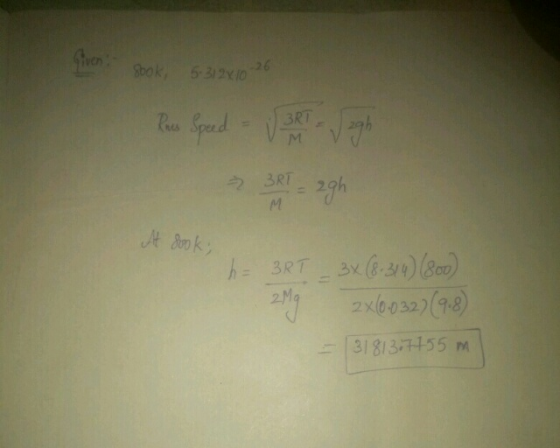
An oxygen molecule falls in a vacuum. From what height must it fall so that its...
An oxygen molecule falls in a vacuum. From what height must it fall so that its kinetic energy at the bottom equals the average energy of an oxygen molecule at 800 K? The mass of one O2 molecule is 5.312 × 10⁻²⁶ kg.
Homework Answers
Add Answer to:
An oxygen molecule falls in a vacuum. From what height must it
fall so that its...
From what height must an oxygen molecule fall in a vacuum so that its kinetic energy...
From what height must an oxygen molecule fall in a vacuum so that its kinetic energy at the bottom equals the average energy of an oxygen molecule at 350 K ?
At what temperature would the root-mean-square speed (thermal speed) of oxygen molecules be 116 m/s? Assume...
At what temperature would the root-mean-square speed (thermal speed) of oxygen molecules be 116 m/s? Assume that oxygen approximates an ideal gas. The mass of one O2 molecule is 5.312 x 10⁻²⁶ kg. The Boltzmann constant is 1.38 × 10⁻²³ J/K.
The highest waterfall in the world is the Salto Angel Falls in Venezuela. Its longest fall...
 The highest waterfall in the world is the Salto Angel Falls in
Venezuela. Its longest fall has a height of 807 meters. If water at
the top of the falls is at rest and at 15°C, what is the maximum
temperature of the water at the bottom of the falls? Assume all the
kinetic energy of the water as it reaches the bottom goes into
raising its temperature. The specific heat capacity for water is
4186 J/kg°C.
3. The highest...
The highest waterfall in the world is the Salto Angel Falls in
Venezuela. Its longest fall has a height of 807 meters. If water at
the top of the falls is at rest and at 15°C, what is the maximum
temperature of the water at the bottom of the falls? Assume all the
kinetic energy of the water as it reaches the bottom goes into
raising its temperature. The specific heat capacity for water is
4186 J/kg°C.
3. The highest...
Q) What is the kinetic energy, in joules, of a molecule of oxygen moving at a...
Q) What is the kinetic energy, in joules, of a molecule of oxygen moving at a speed of 255 m/s(use the appropriate prefix to avoid exponential notation) a) The equation for kinetic energy is ½mv2, and is in units of joules. What are the component units for joules in terms of mass and velocity? kg m^2/s^2 b) From the previous part, we know that the mass needs to be in units of kg. What is the mass of an oxygen...
Oxygen (O2, 32 amu) is confined to a cubic container 15 cm on a side at...
Oxygen (O2, 32 amu) is confined to a cubic container 15 cm on a side at a temperature of 300 K. Compare the average kinetic energy of a molecule of the gas to the change in its gravitational potential energy if it falls from the top of the container to the bottom.
The oxygen molecule, O2, has a total mass of 5.30×10⁻²⁶ kg and a rotational inertia of...
The oxygen molecule, O2, has a total mass of 5.30×10⁻²⁶ kg and a rotational inertia of 1.94×10-46kg-m2 about an axis perpendicular to the center of the line joining the atoms. Suppose that such a molecule in a gas has a speed of 1.48×10²m/s and that its rotational kinetic energy is two-thirds (2/3) of its translational kinetic energy. Find its angular velocity.
Consider the diatomic oxygen molecule, O_2, which is rotating in the xy plane about the z...
 Consider the diatomic oxygen molecule, O_2, which is rotating in the xy plane about the z axis passing through its center, perpendicular to its length. At room temperature, the "average" separation between the two oxygen atoms is 1.21 times 10^-10 m (the atoms are treated as point masses, each with 2.66 times 10^-26 kg.) (a) Calculate the moment of inertia of the molecule about the z-axis. (b) If the angular velocity of the molecule about the z axis is 2.0...
Oxygen (O2) has a molar mass of 32.0g/mol . What is the root-mean-square speed of an...
Oxygen (O2) has a molar mass of 32.0g/mol . What is the root-mean-square speed of an oxygen molecule at a temperature of 297K ? What is its average translational kinetic energy at that speed?
Oxygen (O2, with molar mass 32.0 g/mol) gas at 282 K and 1.37 atm is confined...
Oxygen (O2, with molar mass 32.0 g/mol) gas at 282 K and 1.37 atm is confined to a cubical container 12.0 cm on a side. Calculate ΔUg/Kavg, where ΔUg is the change in the gravitational potential energy of an oxygen molecule falling the height of the box and Kavg is the molecule's average translational kinetic energy.
What is the average kinetic energy of a molecule of oxygen at a temperature of 330...
What is the average kinetic energy of a molecule of oxygen at a temperature of 330 K?
 The highest waterfall in the world is the Salto Angel Falls in
Venezuela. Its longest fall has a height of 807 meters. If water at
the top of the falls is at rest and at 15°C, what is the maximum
temperature of the water at the bottom of the falls? Assume all the
kinetic energy of the water as it reaches the bottom goes into
raising its temperature. The specific heat capacity for water is
4186 J/kg°C.
3. The highest...
The highest waterfall in the world is the Salto Angel Falls in
Venezuela. Its longest fall has a height of 807 meters. If water at
the top of the falls is at rest and at 15°C, what is the maximum
temperature of the water at the bottom of the falls? Assume all the
kinetic energy of the water as it reaches the bottom goes into
raising its temperature. The specific heat capacity for water is
4186 J/kg°C.
3. The highest...
 Consider the diatomic oxygen molecule, O_2, which is rotating in the xy plane about the z axis passing through its center, perpendicular to its length. At room temperature, the "average" separation between the two oxygen atoms is 1.21 times 10^-10 m (the atoms are treated as point masses, each with 2.66 times 10^-26 kg.) (a) Calculate the moment of inertia of the molecule about the z-axis. (b) If the angular velocity of the molecule about the z axis is 2.0...
Most questions answered within 3 hours.
-
Where is the error in this code sequence?
String s1 = "Hello";
String s2 = "ello";...
asked 10 months ago -
Financial data for Joel de Paris, Inc., for last year
follow:
Joel de Paris, Inc.
Balance...
asked 10 months ago -
Consider this reaction:
Al2(SO4)3 (aq)+ BaCl3
(aq) Al2Cl6 (aq)- +
3BaSO4(s) . What is the...
asked 10 months ago -
Suppose that Savneet is considering increasing her
recent random sample from 20 car rentals to 40...
asked 10 months ago -
Trucks arrive at an unloading terminal at an average rate of 120
per hour.
Trucks arrive...
asked 10 months ago -
Why are methanol and ethanol completely soluble in water while
octanol is not very little soluble....
asked 10 months ago -
A facilities manager at a university reads in a research report
that the mean amount of...
asked 10 months ago -
When the CuSO4 is rehydrated by adding water to the anhydrous
compound, is this an endothermic...
asked 10 months ago -
A ray of sunlight is passing from diamond into crown glass; the
angle of incidence is...
asked 10 months ago -
A block of mass 0.249 kg is placed on top of a light, vertical
spring of...
asked 10 months ago -
how do the kidneys compensate in the presences of acidosis
a) trigger hyperventilate
b) reserve acid...
asked 10 months ago -
Question 501 pts
The rental rate of capital to the firm increases. Which of the
following...
asked 10 months ago