LINEAR SYSTEMS
REMOTE POSITION CONTROL SERVOMECHANISM
how to answer bandwidth question


Homework Answers


Add Answer to:
LINEAR SYSTEMS
REMOTE POSITION CONTROL SERVOMECHANISM
how to answer bandwidth question
4. Bandwidth 4.1 Explain how...
Linear Control Systems MCTE4250 Question 4 (5 points) Note: The solution to this question is not...
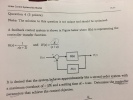 Linear Control Systems MCTE4250 Question 4 (5 points) Note: The solution to this question is not unique and should be optimized. A feedback control system is shown in Figure below where H(s) is representing the FL'17 controller transfer function. and H(s)=(s+a) H(s) It is desired that the system behaves approximately like a second order system with a maximum overshoot of-5% and a settling time of~4 sec. Determine the controller parameters that achieve the control objective.
Automotive cruise control systems are used to hold the vehicle speed steady at a set value...
Automotive cruise control systems are used to hold the vehicle speed steady at a set value especially in long runs to prevent driver fatigue. After switched “ON” by the driver, this system takes the control of the gas throttle using an electronically controlled stepper motor, and keeps the vehicle speed constant. This system requires speed sensors to measure the controlled vehicle speed. a) Identify basic elements of the cruise control system. (Reference input, output, actuator, controller, sensor, plant) b) List...
Question 1 - Analogue Closed Loop Control Systems Many control systems involve processing analogue signals such...
 Question 1 - Analogue Closed Loop Control Systems Many control systems involve processing analogue signals such as heat, light and movement Therefore analogue closed loop control system require walogue processing devices such as the operational amplifier (op-amp). One of the most common control applications involves using the op-amp as a comparator. In it's simplest form a comparator just compares two voltage signals, VI and V2. Ir VI is higher than V2 the output, Ve, is 'low', VI is lower than...
Figure shows three systems. System I is a control system proportional. System II is a position control system with PD control action. System III is a speed feedback position control system. Compare the unit step, unit impulse, and unit ramp responses o
 Figure shows three systems. System I is a control systemproportional. System II is a position control system with PD control action.System III is a speed feedback position control system.Compare the unit step, unit impulse, and unit ramp responses of the threesystems. (Analytically and using Matlab's Simulink, to compare the results)system is better with respect to speed of response and maximum overshoot in thestep answer?
4. (10 pts) Using the Gauss-Jordan elimination process, solve the following systems of linear equations. How many solutions are there? Can we apply Cramer's rule? Explain why (Use the matrix...
 4. (10 pts) Using the Gauss-Jordan elimination process, solve the following systems of linear equations. How many solutions are there? Can we apply Cramer's rule? Explain why (Use the matrix form of linear equations.)
4. (10 pts) Using the Gauss-Jordan elimination process, solve the following systems of linear equations. How many solutions are there? Can we apply Cramer's rule? Explain why (Use the matrix form of linear equations.)
4. (10 pts) Using the Gauss-Jordan elimination process, solve the following systems of linear equations. How many solutions are there? Can we apply Cramer's rule? Explain why (Use the matrix form of linear equations.)
Routh's stability criterion is of limited usefulness in linear control systems analysis mainly because it does...
 Routh's stability criterion is of limited usefulness in linear control systems analysis mainly because it does not suggest how to stabilize an unstable system. Thus, we should evaluate the stability range of a parameter value. Consider the servo system with tachometer feedback as shown in Figure 3(b). Evaluate the ranges of stability for K and Kn. (Note that Kn must be positive). R(s) C(s) 20 (5 + 1) (8 + 4) $ KA
control systems Explain and describe in your own words how knowing the locations of the poles...
control systems Explain and describe in your own words how knowing the locations of the poles in the s-domain of a transfer function lets you know whether a system will be stable or unstable. pleases dont just copy and paste a old anwer.
Question 2: The 0.8-m arm O4 for a remote-control mechanism is p and the entire assembly...
 Question 2: The 0.8-m arm O4 for a remote-control mechanism is p and the entire assembly rotates about the g-axis pivoted the horiza ah tant speed N-60 rev/min. Simultaneously or the position where ? 30, determine ist the arm is being raised at the constant rate B4radis teed N S. F 1. The angular velocity of OA 2. The angular acceleration of OA 3. The velocity of point A 4. The acceleration of point A. described, the vertical shaft and...
1. For the following two systems of linear equations answer the questions 4 + x +...
 1. For the following two systems of linear equations answer the questions 4 + x + 2xy + 2x - 6 3x + 2x + 3x3 + 3x = 11 2x + 2x + 3.5+ 2x- 9 2x + 2x+4x3+5x - 13 3x, +2, +4x3+4x-13 3x+3x+3x2+2x, -11 (1) Solve the above systems of linear equations using naive Gauss elimination (b) solve the above systems of linear equations using Gauss elimination with partial pivoting . Axb 2. For the following matrix...
Signal system question. EEGR 221 Signals and Systems Homework 3 Determine whether the following systems are...
 Signal system question.
EEGR 221 Signals and Systems Homework 3 Determine whether the following systems are (i) Memoryless (ii) Invertible (ii) Casual (iv) Stable (v) Time invariant (vi) Linear (a) y(t)-5x(2t +4) (b) y(t)-7 x(2t 1) +3 (c) y(t)e4x(c) (d) y(t)-sin (x(t + 1)) (e) y(t) x(t)l (1) y() log(x(t)) Your answer must have 3 components for each property 1) Definition of the property 2) Yes or NO 3) Justification and the test that you have done to give the...
Signal system question.
EEGR 221 Signals and Systems Homework 3 Determine whether the following systems are (i) Memoryless (ii) Invertible (ii) Casual (iv) Stable (v) Time invariant (vi) Linear (a) y(t)-5x(2t +4) (b) y(t)-7 x(2t 1) +3 (c) y(t)e4x(c) (d) y(t)-sin (x(t + 1)) (e) y(t) x(t)l (1) y() log(x(t)) Your answer must have 3 components for each property 1) Definition of the property 2) Yes or NO 3) Justification and the test that you have done to give the...
 Linear Control Systems MCTE4250 Question 4 (5 points) Note: The solution to this question is not unique and should be optimized. A feedback control system is shown in Figure below where H(s) is representing the FL'17 controller transfer function. and H(s)=(s+a) H(s) It is desired that the system behaves approximately like a second order system with a maximum overshoot of-5% and a settling time of~4 sec. Determine the controller parameters that achieve the control objective.
 Question 1 - Analogue Closed Loop Control Systems Many control systems involve processing analogue signals such as heat, light and movement Therefore analogue closed loop control system require walogue processing devices such as the operational amplifier (op-amp). One of the most common control applications involves using the op-amp as a comparator. In it's simplest form a comparator just compares two voltage signals, VI and V2. Ir VI is higher than V2 the output, Ve, is 'low', VI is lower than...
 4. (10 pts) Using the Gauss-Jordan elimination process, solve the following systems of linear equations. How many solutions are there? Can we apply Cramer's rule? Explain why (Use the matrix form of linear equations.)
4. (10 pts) Using the Gauss-Jordan elimination process, solve the following systems of linear equations. How many solutions are there? Can we apply Cramer's rule? Explain why (Use the matrix form of linear equations.)
4. (10 pts) Using the Gauss-Jordan elimination process, solve the following systems of linear equations. How many solutions are there? Can we apply Cramer's rule? Explain why (Use the matrix form of linear equations.)
 Routh's stability criterion is of limited usefulness in linear control systems analysis mainly because it does not suggest how to stabilize an unstable system. Thus, we should evaluate the stability range of a parameter value. Consider the servo system with tachometer feedback as shown in Figure 3(b). Evaluate the ranges of stability for K and Kn. (Note that Kn must be positive). R(s) C(s) 20 (5 + 1) (8 + 4) $ KA
 Question 2: The 0.8-m arm O4 for a remote-control mechanism is p and the entire assembly rotates about the g-axis pivoted the horiza ah tant speed N-60 rev/min. Simultaneously or the position where ? 30, determine ist the arm is being raised at the constant rate B4radis teed N S. F 1. The angular velocity of OA 2. The angular acceleration of OA 3. The velocity of point A 4. The acceleration of point A. described, the vertical shaft and...
 1. For the following two systems of linear equations answer the questions 4 + x + 2xy + 2x - 6 3x + 2x + 3x3 + 3x = 11 2x + 2x + 3.5+ 2x- 9 2x + 2x+4x3+5x - 13 3x, +2, +4x3+4x-13 3x+3x+3x2+2x, -11 (1) Solve the above systems of linear equations using naive Gauss elimination (b) solve the above systems of linear equations using Gauss elimination with partial pivoting . Axb 2. For the following matrix...
 Signal system question.
EEGR 221 Signals and Systems Homework 3 Determine whether the following systems are (i) Memoryless (ii) Invertible (ii) Casual (iv) Stable (v) Time invariant (vi) Linear (a) y(t)-5x(2t +4) (b) y(t)-7 x(2t 1) +3 (c) y(t)e4x(c) (d) y(t)-sin (x(t + 1)) (e) y(t) x(t)l (1) y() log(x(t)) Your answer must have 3 components for each property 1) Definition of the property 2) Yes or NO 3) Justification and the test that you have done to give the...
Signal system question.
EEGR 221 Signals and Systems Homework 3 Determine whether the following systems are (i) Memoryless (ii) Invertible (ii) Casual (iv) Stable (v) Time invariant (vi) Linear (a) y(t)-5x(2t +4) (b) y(t)-7 x(2t 1) +3 (c) y(t)e4x(c) (d) y(t)-sin (x(t + 1)) (e) y(t) x(t)l (1) y() log(x(t)) Your answer must have 3 components for each property 1) Definition of the property 2) Yes or NO 3) Justification and the test that you have done to give the...
Most questions answered within 3 hours.
-
Where is the error in this code sequence?
String s1 = "Hello";
String s2 = "ello";...
asked 11 months ago -
Financial data for Joel de Paris, Inc., for last year
follow:
Joel de Paris, Inc.
Balance...
asked 11 months ago -
Consider this reaction:
Al2(SO4)3 (aq)+ BaCl3
(aq) Al2Cl6 (aq)- +
3BaSO4(s) . What is the...
asked 11 months ago -
Suppose that Savneet is considering increasing her
recent random sample from 20 car rentals to 40...
asked 11 months ago -
Trucks arrive at an unloading terminal at an average rate of 120
per hour.
Trucks arrive...
asked 11 months ago -
Why are methanol and ethanol completely soluble in water while
octanol is not very little soluble....
asked 11 months ago -
A facilities manager at a university reads in a research report
that the mean amount of...
asked 11 months ago -
When the CuSO4 is rehydrated by adding water to the anhydrous
compound, is this an endothermic...
asked 11 months ago -
A ray of sunlight is passing from diamond into crown glass; the
angle of incidence is...
asked 11 months ago -
A block of mass 0.249 kg is placed on top of a light, vertical
spring of...
asked 11 months ago -
how do the kidneys compensate in the presences of acidosis
a) trigger hyperventilate
b) reserve acid...
asked 11 months ago -
Question 501 pts
The rental rate of capital to the firm increases. Which of the
following...
asked 11 months ago