Calculate the in kJ/mole given that the following reaction has a = -1219.26 kJ/mol 2 ClF3(g)...
Calculate the in kJ/mole given that the following reaction has a
= -1219.26 kJ/mol
2 ClF3(g) + 2 NH3(g) ----- > N2(g) + 6 HF(g) + Cl2(g)
Use data in appendix III
(b) The military uses FRH’s (Flameless ration heaters) to heat MRE’s (meals ready to eat). (Heat of formation of Mg( OH)2(Aqua) = -926.8 kJ/mole
One of the reactions used in an FRH is
Mg(s) + 2 H2O(l) ------ > Mg(OH)2(aq) + H2(g)
Using data in Appendix III of your textbook, calculate for this reaction
(c) Using results of part (b), determine how many grams of Mg(s) would be needed to heat 80.0 mL of water from 21.0oC to 80.0oC? Data: The specific heat of water is 4.184 J/(g deg C).
(d) Consider two Styrofoam coffee cups. If cup #1 contains 80.0 mL of water at 96.0 oC and cup #2 contains 60.0 mL of water at 11.0 oC, what is the final temperature, in oC, when the contents of cup #1 are poured into cup #2? Ignore the heat capacity of the cup. Assume that the density of water is 1.00 g/mL.
Homework Answers
Ans. 1
(a). For the reaction:

The energy of reaction is = -1219.26 KJ/mol;
Given that the energy involved in the formation of Mg(OH)2 (aq) = -926 KJ/mol.
The remaining amount of energy will be released by flameless ration heaters (FRH).
(b) The energy released for the reaction used in FRH is:

Energy released for this reaction will be = -1219.26 - (-926) = -293.26 KJ /mole.
As 1 mole of Mg (s) is used in FRH reaction, so the energy for the reaction will be = -293.26 KJ/mole of Mg
.........................................................................................................................................................................................................
(c) First we will calculate the amount of energy required to heat 80 ml of water from 21 oC to 80 oC.
Energy required to heat 80 ml of water will be calculated by using following relation:
 ;
;
Here Q = Heat required
C = specific heat of water


Amount of heat required to change the temperature of water is : 19.729 KJ
Since, 1 mole of Mg is required to release the heat = 289.46 KJ
that is, 24 gram of Mg is required to release the heat = 289.46 KJ
Now we need to calculate the amount of Mg required to change the temperature of water:
So, gram of Mg required = 
= 1.63579 grams
 ,
is the Mg required.
,
is the Mg required.
------------------------------------------------------------------------------------------------------------------------------------------------------------------------
(d) Here we have two coffee cups,
Given the content of cup #1 is poured into the content of cup #2, As water in cup #1 was at higher temperature and the water in the cup # 2 was at lower temperature. Upon mixing the temperature of cup #1 will decrease and the temperature of cup #2 increase.
To calculate the final temperature upon mixing, the principle to be applied is:
The Heat released by cup # 1 = The Heat gained by Cup # 2
i.e. Change in Heat of water in cup #1 to the final temperature upon mixing = Change in Heat of water in cup # 2 to the final temperature upon mixing.
Hence :

 ;
;

Here Q = Heat required
C = specific heat of water
Assume final temperature upon mixing is T
Hence:





Hence the final temperature we calculated as: 19.7 oC. When the content of cup #1 is poured into the contents of cup # 2.
-----------------------------------------------------------------------------------------------------------------------------------------------------------------------
Add Answer to:
Calculate the in kJ/mole given that the following reaction has
a
= -1219.26 kJ/mol
2 ClF3(g)...
5. (20 pts) Consider the following reaction OF2(g) + H2O(g) ---> 2 HF(g) + O2(g) AH.(kJ/mole) -318 kJ/mole (a) U...
 5. (20 pts) Consider the following reaction OF2(g) + H2O(g) ---> 2 HF(g) + O2(g) AH.(kJ/mole) -318 kJ/mole (a) Using this information along with data in the appendix of your textbook, calculate AH;(OF,(8)) in kJ/mole at 25°C. (b) If 15.0 g of OF2(g) and 10.0 g of H2Og) react, how much heat, expressed in kJ is released? Hint: First calculate the limiting reagent. 6.(20 pts) Consider two Styrofoam coffee cups. If cup #1 contains 102.0 mL of water at 81.8°C...
5. (20 pts) Consider the following reaction OF:(g)+ H20(g) (a) Using this information along with data...
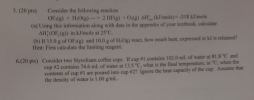 5. (20 pts) Consider the following reaction OF:(g)+ H20(g) (a) Using this information along with data in the appendix of your textbook, calculate AH(OF, (g)) in kJ/mole at 25 C. (b) If 15.0 g of OF (g) and 10.0 g of H2Og) react, how much heat, expressed in kJ is released? Hint: First calculate the limiting reagent. 2 HF(g) + O(g) AH (kJ/mole)--318 kJ/mole Consider two Styrofoam coffee cups. If cup # 1 contains 102.0 mL of water at 81.8...
Calculate the enthalpy change per mole of H2SO4 in the reaction. kJ/mol 05 Question (7 points)...
 Calculate the enthalpy change per mole of H2SO4 in the reaction. kJ/mol 05 Question (7 points) See page 236 A 110.2 mL sample of 1.00 M NaOH is mixed with 55.1 mL of 1,00 M H2SO4 in a large Styrofoam coffee cup; the cup is fitted with a lid through which passes a calibrated thermometer. The temperature of each solution before mixing is 22.25 °C. After adding the NaOH solution to the coffee cup and stirring the mixed solutions with...
5. (20 pts) Consider the following reaction OF2(g) + H2O(g) ---> 2 HF(g) + O2(g) AH.(kJ/mole)=-318 kJ/mole (a) U...
 5. (20 pts) Consider the following reaction OF2(g) + H2O(g) ---> 2 HF(g) + O2(g) AH.(kJ/mole)=-318 kJ/mole (a) Using this information along with data in the appendix of your textbook, calculate AH (OF,(g)) in kJ/mole at 25°C. (b) If 15.0 g of OF2(g) and 10.0 g of H2Og) react, how much heat, expressed in kJ is released? Hint: First calculate the limiting reagent.
Enthalpy Determination for HCI+NaOH Reaction 1. Mass of empty Styrofoam cup, g: 2. Mass of Styrofoam...
 Enthalpy Determination for HCI+NaOH Reaction 1. Mass of empty Styrofoam cup, g: 2. Mass of Styrofoam cup + HCl, g: 3. Initial temperature of HCl solution, "C: Final temperature of solution after mixing, °C 4. 5. Change in temperature, °C: 1215 6. Mass of Styrofoam cup with HCI and NaOH added, g 7. Mass of solution, g: 8. AH of reaction, J: 9. AH of reaction, kJ/mole: 10. AH of reaction based on AH? data, kJ/mole: 11. Percent deviation: Enthalpy...
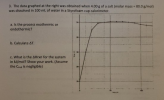
Please show work! 3. The data graphed at the right was obtained when 4.00 g of a salt (molar mass = 80.0 g/mol) was...
 Please show work!
3. The data graphed at the right was obtained when 4.00 g of a salt (molar mass = 80.0 g/mol) was dissolved in 100 mL of water in a Styrofoam cup calorimeter. a. Is the process exothermic or endothermic? b. Calculate AT. c. What is the AHrxn for the system in kJ/mol? Show your work. (Assume the Ccup is negligible)
Please show work!
3. The data graphed at the right was obtained when 4.00 g of a salt (molar mass = 80.0 g/mol) was dissolved in 100 mL of water in a Styrofoam cup calorimeter. a. Is the process exothermic or endothermic? b. Calculate AT. c. What is the AHrxn for the system in kJ/mol? Show your work. (Assume the Ccup is negligible)
2. Calculate AH (expressed in kJ/mol) for the following reaction based on the thermochemical information given:...
 2. Calculate AH (expressed in kJ/mol) for the following reaction based on the thermochemical information given: Na +Crce → NaCl AH ? Nas) + 2Cl2(g) → Nap + Cle AH = 230 kJ/mol Nag) + Cl → Na(+ Cl® AH = 147 kJ/mol Na(s) + Cl2(e) → NaCl) AH = -411 kJ/mol 3. Consider the reaction: 2HCl) + Ba(OH)2(aq) → BaCl(aq) + 2 H200 AH--118 kJ/mol a. Calculate the heat produced when 700.0 mL of 0.500 M HCl is mixed...
#4.(25pts) Consider the reaction AH (kJ/mole) 5 CO2(g) + SizN() ----> 3 SiO(g) + 2 N2O(s)...
 #4.(25pts) Consider the reaction AH (kJ/mole) 5 CO2(g) + SizN() ----> 3 SiO(g) + 2 N2O(s) + 5 CO(g) AH = 2023.75 kJ/mole (1) Use the above information as well as heat of formation data in the appendix of your textbook to calculate AH (Si,N.(s)) in kJ/mole. Additional information: AH (SiO(g)) = 1.94 x 10⁹ kJ/mole 6) How many kJ of heat are absorbed when 1.2 lbs of Si N.(s) react according to the above equation? 1 lb = 453.6...
Calculate the enthalpy (in kJ) per mole of KOH when 3.25 g KOH is added to...
Calculate the enthalpy (in kJ) per mole of KOH when 3.25 g KOH is added to H2SO4 in a coffee cup calorimeter to make 123.2 mL of total solution with density 1.06 g/mL. Assume the specific heat capacity of the solution is 4.184 J/g°C, that no heat is lost to the surroundings and that the final temperature of the solution is 7.52°C higher than the starting temperature.
question 1 & 2 1. Magnesium solid reacts with aqueous hydrochloric acid to form the Mg2+...
 question 1 & 2
1. Magnesium solid reacts with aqueous hydrochloric acid to form the Mg2+ ion in solution. In an experiment, 60.0 mL of aqueous HCI was mixed with 0.1297 g of magnesium solid in a double Styrofoam cup calorimeter. The reaction caused the temperature of the substances in the calorimeter to rise 10.02°C. Assume the density and specific heat of the HCl solution is that of water, 1.00 g/mL and 4.184 J/g °C, respectively. The specific heat of...
question 1 & 2
1. Magnesium solid reacts with aqueous hydrochloric acid to form the Mg2+ ion in solution. In an experiment, 60.0 mL of aqueous HCI was mixed with 0.1297 g of magnesium solid in a double Styrofoam cup calorimeter. The reaction caused the temperature of the substances in the calorimeter to rise 10.02°C. Assume the density and specific heat of the HCl solution is that of water, 1.00 g/mL and 4.184 J/g °C, respectively. The specific heat of...
 5. (20 pts) Consider the following reaction OF2(g) + H2O(g) ---> 2 HF(g) + O2(g) AH.(kJ/mole) -318 kJ/mole (a) Using this information along with data in the appendix of your textbook, calculate AH;(OF,(8)) in kJ/mole at 25°C. (b) If 15.0 g of OF2(g) and 10.0 g of H2Og) react, how much heat, expressed in kJ is released? Hint: First calculate the limiting reagent. 6.(20 pts) Consider two Styrofoam coffee cups. If cup #1 contains 102.0 mL of water at 81.8°C...
 5. (20 pts) Consider the following reaction OF:(g)+ H20(g) (a) Using this information along with data in the appendix of your textbook, calculate AH(OF, (g)) in kJ/mole at 25 C. (b) If 15.0 g of OF (g) and 10.0 g of H2Og) react, how much heat, expressed in kJ is released? Hint: First calculate the limiting reagent. 2 HF(g) + O(g) AH (kJ/mole)--318 kJ/mole Consider two Styrofoam coffee cups. If cup # 1 contains 102.0 mL of water at 81.8...
 Calculate the enthalpy change per mole of H2SO4 in the reaction. kJ/mol 05 Question (7 points) See page 236 A 110.2 mL sample of 1.00 M NaOH is mixed with 55.1 mL of 1,00 M H2SO4 in a large Styrofoam coffee cup; the cup is fitted with a lid through which passes a calibrated thermometer. The temperature of each solution before mixing is 22.25 °C. After adding the NaOH solution to the coffee cup and stirring the mixed solutions with...
 5. (20 pts) Consider the following reaction OF2(g) + H2O(g) ---> 2 HF(g) + O2(g) AH.(kJ/mole)=-318 kJ/mole (a) Using this information along with data in the appendix of your textbook, calculate AH (OF,(g)) in kJ/mole at 25°C. (b) If 15.0 g of OF2(g) and 10.0 g of H2Og) react, how much heat, expressed in kJ is released? Hint: First calculate the limiting reagent.
 Enthalpy Determination for HCI+NaOH Reaction 1. Mass of empty Styrofoam cup, g: 2. Mass of Styrofoam cup + HCl, g: 3. Initial temperature of HCl solution, "C: Final temperature of solution after mixing, °C 4. 5. Change in temperature, °C: 1215 6. Mass of Styrofoam cup with HCI and NaOH added, g 7. Mass of solution, g: 8. AH of reaction, J: 9. AH of reaction, kJ/mole: 10. AH of reaction based on AH? data, kJ/mole: 11. Percent deviation: Enthalpy...
 Please show work!
3. The data graphed at the right was obtained when 4.00 g of a salt (molar mass = 80.0 g/mol) was dissolved in 100 mL of water in a Styrofoam cup calorimeter. a. Is the process exothermic or endothermic? b. Calculate AT. c. What is the AHrxn for the system in kJ/mol? Show your work. (Assume the Ccup is negligible)
Please show work!
3. The data graphed at the right was obtained when 4.00 g of a salt (molar mass = 80.0 g/mol) was dissolved in 100 mL of water in a Styrofoam cup calorimeter. a. Is the process exothermic or endothermic? b. Calculate AT. c. What is the AHrxn for the system in kJ/mol? Show your work. (Assume the Ccup is negligible)
 2. Calculate AH (expressed in kJ/mol) for the following reaction based on the thermochemical information given: Na +Crce → NaCl AH ? Nas) + 2Cl2(g) → Nap + Cle AH = 230 kJ/mol Nag) + Cl → Na(+ Cl® AH = 147 kJ/mol Na(s) + Cl2(e) → NaCl) AH = -411 kJ/mol 3. Consider the reaction: 2HCl) + Ba(OH)2(aq) → BaCl(aq) + 2 H200 AH--118 kJ/mol a. Calculate the heat produced when 700.0 mL of 0.500 M HCl is mixed...
 #4.(25pts) Consider the reaction AH (kJ/mole) 5 CO2(g) + SizN() ----> 3 SiO(g) + 2 N2O(s) + 5 CO(g) AH = 2023.75 kJ/mole (1) Use the above information as well as heat of formation data in the appendix of your textbook to calculate AH (Si,N.(s)) in kJ/mole. Additional information: AH (SiO(g)) = 1.94 x 10⁹ kJ/mole 6) How many kJ of heat are absorbed when 1.2 lbs of Si N.(s) react according to the above equation? 1 lb = 453.6...
 question 1 & 2
1. Magnesium solid reacts with aqueous hydrochloric acid to form the Mg2+ ion in solution. In an experiment, 60.0 mL of aqueous HCI was mixed with 0.1297 g of magnesium solid in a double Styrofoam cup calorimeter. The reaction caused the temperature of the substances in the calorimeter to rise 10.02°C. Assume the density and specific heat of the HCl solution is that of water, 1.00 g/mL and 4.184 J/g °C, respectively. The specific heat of...
question 1 & 2
1. Magnesium solid reacts with aqueous hydrochloric acid to form the Mg2+ ion in solution. In an experiment, 60.0 mL of aqueous HCI was mixed with 0.1297 g of magnesium solid in a double Styrofoam cup calorimeter. The reaction caused the temperature of the substances in the calorimeter to rise 10.02°C. Assume the density and specific heat of the HCl solution is that of water, 1.00 g/mL and 4.184 J/g °C, respectively. The specific heat of...
Most questions answered within 3 hours.
-
Where is the error in this code sequence?
String s1 = "Hello";
String s2 = "ello";...
asked 11 months ago -
Financial data for Joel de Paris, Inc., for last year
follow:
Joel de Paris, Inc.
Balance...
asked 11 months ago -
Consider this reaction:
Al2(SO4)3 (aq)+ BaCl3
(aq) Al2Cl6 (aq)- +
3BaSO4(s) . What is the...
asked 11 months ago -
Suppose that Savneet is considering increasing her
recent random sample from 20 car rentals to 40...
asked 11 months ago -
Trucks arrive at an unloading terminal at an average rate of 120
per hour.
Trucks arrive...
asked 11 months ago -
Why are methanol and ethanol completely soluble in water while
octanol is not very little soluble....
asked 11 months ago -
A facilities manager at a university reads in a research report
that the mean amount of...
asked 11 months ago -
When the CuSO4 is rehydrated by adding water to the anhydrous
compound, is this an endothermic...
asked 11 months ago -
A ray of sunlight is passing from diamond into crown glass; the
angle of incidence is...
asked 11 months ago -
A block of mass 0.249 kg is placed on top of a light, vertical
spring of...
asked 11 months ago -
how do the kidneys compensate in the presences of acidosis
a) trigger hyperventilate
b) reserve acid...
asked 11 months ago -
Question 501 pts
The rental rate of capital to the firm increases. Which of the
following...
asked 11 months ago