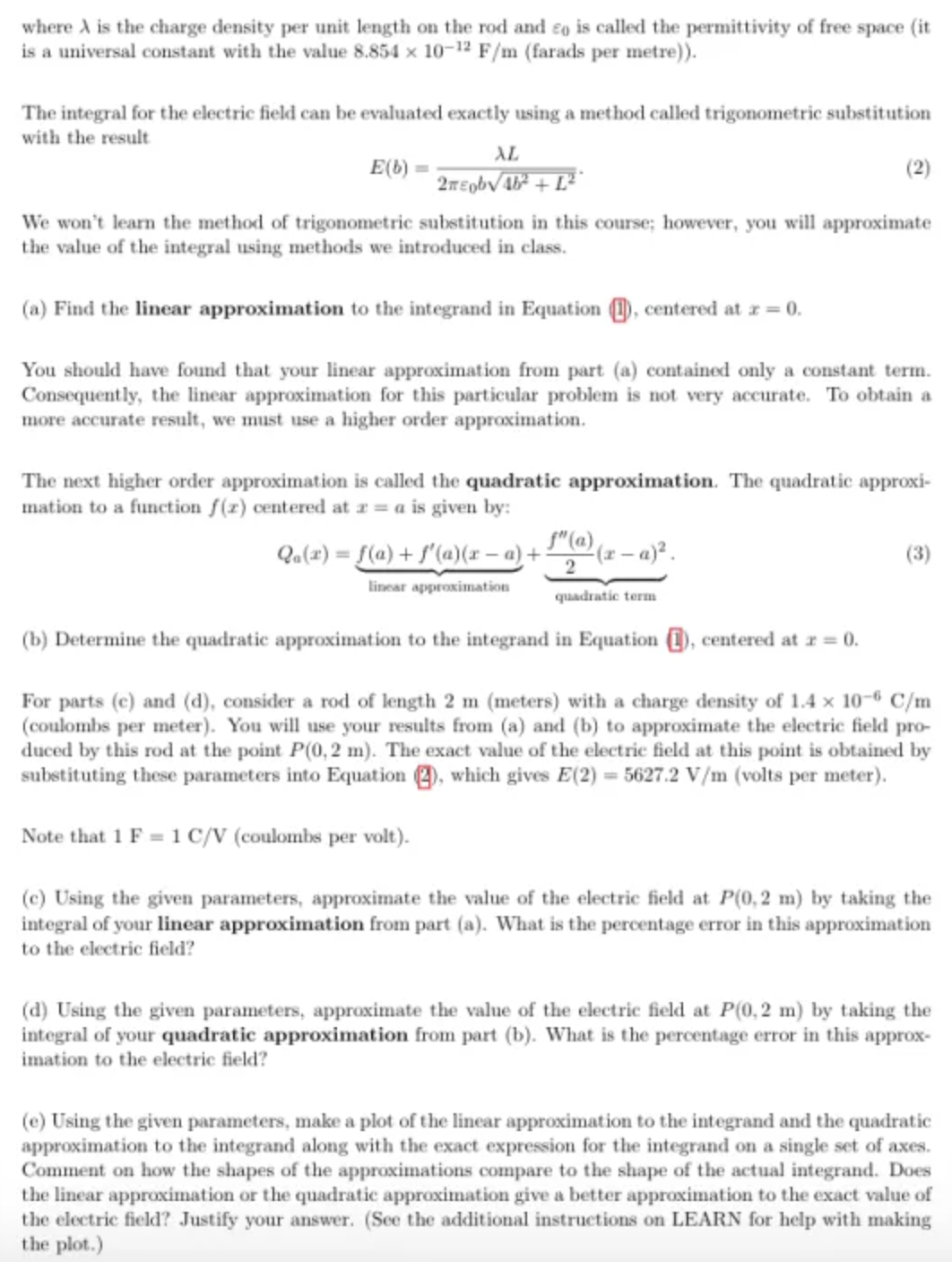
Where λ is the charge density per unit length on the rod and εο is called the permittivity of fre...
 Screen Shot 2021-03-28 at 8.03.16 PM.png
Screen Shot 2021-03-28 at 8.03.30 PM.png
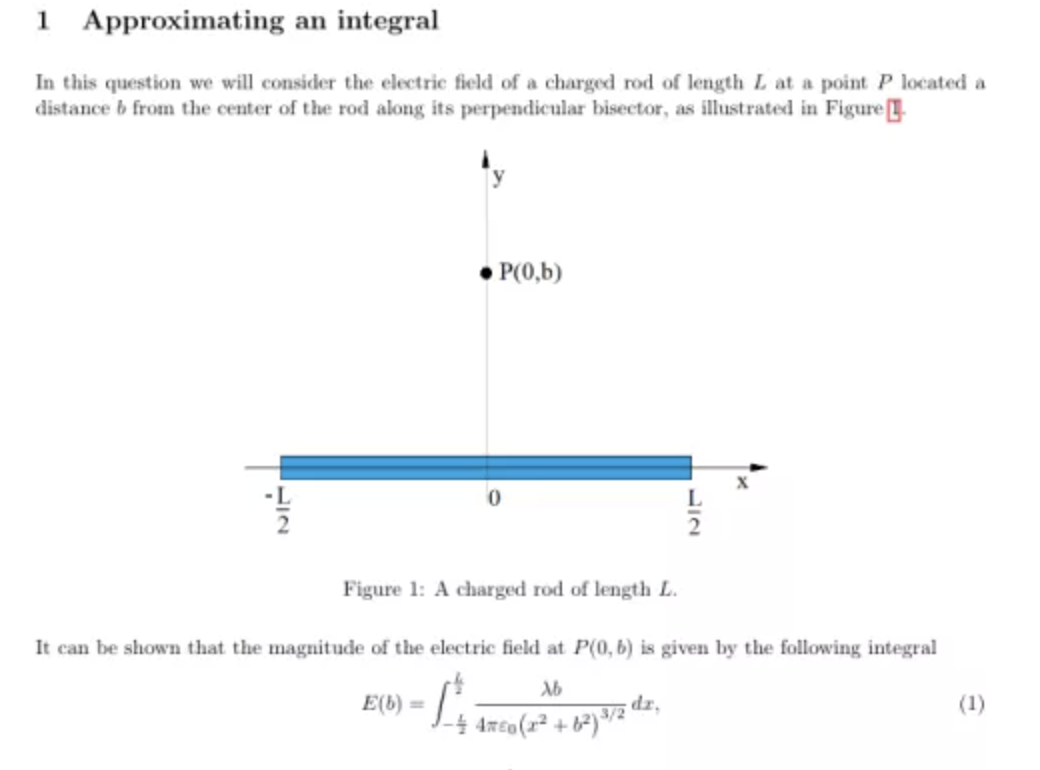
In this question we will consider the electric field of a charged rod of length \(L\) at a point \(P\) located a distance \(b\) from the center of the rod along its perpendicular bisector, as illustrated in Figure \(1 .\)
It can be shown that the magnitude of the electric field at \(P(0, b)\) is given by the following integral
$$ E(b)=\int_{-\frac{L}{2}}^{\frac{L}{2}} \frac{\lambda b}{4 \pi \varepsilon_{0}\left(x^{2}+b^{2}\right)^{3 / 2}} d x $$
where \(\lambda\) is the charge density per unit length on the rod and \(\varepsilon_{0}\) is called the permittivity of free space (it is a universal constant with the value \(8.854 \times 10^{-12} \mathrm{~F} / \mathrm{m}\) (farads per metre)).
Homework Answers
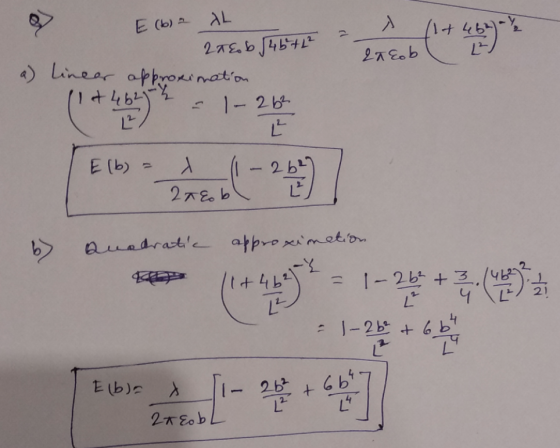
Add Answer to:
Where λ is the charge density per unit length on the rod and εο is called the permittivity of fre...
Where λ is the charge density per unit length on the rod and εο is called the permittivity of fre...
 where λ is the charge density per unit length on the rod and εο is called the permittivity of free space (it is a universal constant with the value 8.854 x 10⁻¹² F/m (farads per metre)) The integral for the electric field can be evaluated exactly using a method called trigonometric substitution with the result AL We won't learn the method of trigonometric substitution in this course; however, you will approximate the value of the integral using methods we introduced...
The charge per unit length on the thin rod of length L shown below is λ...
 The charge per unit length on the thin rod of length L shown below is λ what is the electric field at the point P, distance a away from the right end of the rod? 1. Define a segment of charge: 2. Express the charge of one segment: 3. Express the E field of that one segment. 4. Integral each of the components of that field:
A thin rod, with charge per unit length λ has length L. What is the electric...
 A thin rod, with charge per unit length λ has length L. What is the electric field, in unit vector notation, a distance d away from one of its ends, perpendicular to the axis of the rod? 8.
A rod of length H has uniform charge per length λ. We want to find the...
 A rod of length H has uniform charge per length λ. We want to find the electric field at point P which is a distance L above and distance R to the right of the rod. Use the diagram below for the next three questions. What is the charge dq in the small length du of the rod? du: +x Call the integration variable u with u-0 chosen to be at point A and +u defined as down. What is...
The charge per unit length on the thin rod of length L shown below is A...
 The charge per unit length on the thin rod of length L shown below is A What is the electric field at the point P, distance a away from the right end of the rod? 1. Define a segment of charge: 2. Express the charge of one segment: 3. Express the E field of that one segment. 4. Integral each of the components of that field:
The charge per unit length on the thin rod of length L shown below is λ what is the electric field at the point P, distance a away from the right end of the rod?
 The charge per unit length on the thin rod of length L shown below is λ what is the electric field at the point P, distance a away from the right end of the rod? 1. Define a segment of charge: 2. Express the charge of one segment: 3. Express the E field of that one segment. 4. Integral each of the components of that field:
Charge Q is uniformly distributed along a thin, flexible rod of length L.
 Charge Q is uniformly distributed along a thin, flexible rod of length L. The rod is then bent into the semicircle shown in the figure (Figure 1).Part AFind an expression for the electric field \(\vec{E}\) at the center of the semicircle. Hint: A small piece of arc length \(\Delta s\) spans a small angle \(\Delta \theta=\Delta s / R,\) where R is the radius.Express your answer in terms of the variables Q, L, unit vectors \(\hat{i}, \hat{j},\) and appropriate constants.Part BEvaluate the field...
(a) A thin plastic rod of length L carries a uniform linear charge density, λ-20 trCm,...
 (a) A thin plastic rod of length L carries a uniform linear charge density, λ-20 trCm, along the x-axis, with its left edge at the coordinates (-3,0) and its right edge at (5, 0) m. All distances are measured in meters. Use integral methods to find the x-and y-components of the electric field vector due to the uniformly-charged charged rod at the point, P. with coordinates (0, -4) m. 4, (o, 4 p2212sp2018 tl.doex
A long, straight copper rod has charge per unit length λ = 0.290 μC/m and a...
 A long, straight copper rod has charge per unit length λ = 0.290 μC/m and a diameter of 9.20 cm, what is the electric field at each of the following radial distances from the axis of the rod? (a) 2.30 cm N/C (b) 9.20 cm N/C (c) 2.30 m N/C
The charge per unit length on the thin rod shown below is λ. What is the electric field at the point P?
 The charge per unit length on the thin rod shown below is λ. What is the electric field at the point P?
 where λ is the charge density per unit length on the rod and εο is called the permittivity of free space (it is a universal constant with the value 8.854 x 10⁻¹² F/m (farads per metre)) The integral for the electric field can be evaluated exactly using a method called trigonometric substitution with the result AL We won't learn the method of trigonometric substitution in this course; however, you will approximate the value of the integral using methods we introduced...
 The charge per unit length on the thin rod of length L shown below is λ what is the electric field at the point P, distance a away from the right end of the rod? 1. Define a segment of charge: 2. Express the charge of one segment: 3. Express the E field of that one segment. 4. Integral each of the components of that field:
 A thin rod, with charge per unit length λ has length L. What is the electric field, in unit vector notation, a distance d away from one of its ends, perpendicular to the axis of the rod? 8.
 A rod of length H has uniform charge per length λ. We want to find the electric field at point P which is a distance L above and distance R to the right of the rod. Use the diagram below for the next three questions. What is the charge dq in the small length du of the rod? du: +x Call the integration variable u with u-0 chosen to be at point A and +u defined as down. What is...
 The charge per unit length on the thin rod of length L shown below is A What is the electric field at the point P, distance a away from the right end of the rod? 1. Define a segment of charge: 2. Express the charge of one segment: 3. Express the E field of that one segment. 4. Integral each of the components of that field:
 (a) A thin plastic rod of length L carries a uniform linear charge density, λ-20 trCm, along the x-axis, with its left edge at the coordinates (-3,0) and its right edge at (5, 0) m. All distances are measured in meters. Use integral methods to find the x-and y-components of the electric field vector due to the uniformly-charged charged rod at the point, P. with coordinates (0, -4) m. 4, (o, 4 p2212sp2018 tl.doex
 A long, straight copper rod has charge per unit length λ = 0.290 μC/m and a diameter of 9.20 cm, what is the electric field at each of the following radial distances from the axis of the rod? (a) 2.30 cm N/C (b) 9.20 cm N/C (c) 2.30 m N/C
Most questions answered within 3 hours.
-
Where is the error in this code sequence?
String s1 = "Hello";
String s2 = "ello";...
asked 11 months ago -
Financial data for Joel de Paris, Inc., for last year
follow:
Joel de Paris, Inc.
Balance...
asked 11 months ago -
Consider this reaction:
Al2(SO4)3 (aq)+ BaCl3
(aq) Al2Cl6 (aq)- +
3BaSO4(s) . What is the...
asked 11 months ago -
Suppose that Savneet is considering increasing her
recent random sample from 20 car rentals to 40...
asked 11 months ago -
Trucks arrive at an unloading terminal at an average rate of 120
per hour.
Trucks arrive...
asked 11 months ago -
Why are methanol and ethanol completely soluble in water while
octanol is not very little soluble....
asked 11 months ago -
A facilities manager at a university reads in a research report
that the mean amount of...
asked 11 months ago -
When the CuSO4 is rehydrated by adding water to the anhydrous
compound, is this an endothermic...
asked 11 months ago -
A ray of sunlight is passing from diamond into crown glass; the
angle of incidence is...
asked 11 months ago -
A block of mass 0.249 kg is placed on top of a light, vertical
spring of...
asked 11 months ago -
how do the kidneys compensate in the presences of acidosis
a) trigger hyperventilate
b) reserve acid...
asked 11 months ago -
Question 501 pts
The rental rate of capital to the firm increases. Which of the
following...
asked 11 months ago