
Homework Answers
Answer:
Add Answer to:
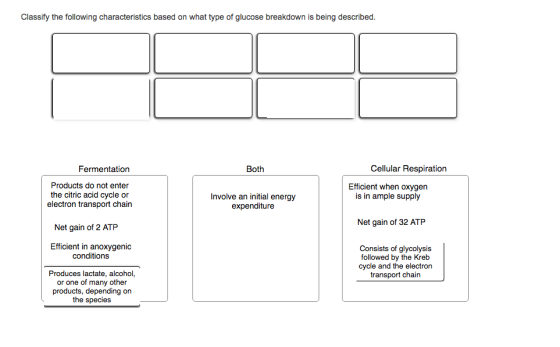
Classify the following characteristics based on what type of glucose breakdown is being described. Products do...
Part A Cellular respiration requires fuel (glucose) and oxygen gas. The main process that produces these...
 Part A Cellular respiration requires fuel (glucose) and oxygen gas. The main process that produces these inputs is photosynthesis glycolysis the Citric Acid cycle electron transport Submit Request Answer Part B Which part(s) of cellular respiration require(s) oxygen gas? the Citric Acid cycle the electron transport chain glycolysis a, b, and c a and b, but not Submit Request Answer Part C What is/are the most important output(s) of glycolysis? MacBook Air Part C What is/are the most important output(s)...
tospan Student Name: Grader Name Instruction: Starting with a single glucose in a yeast cell, please...
 tospan Student Name: Grader Name Instruction: Starting with a single glucose in a yeast cell, please fill in the following table according to what happened during aerobic cellular respiration or fermentation. Make sure that you includes proper numbers of each chemical used or produced from a single glucose molecule 02 Chemicals Used or Produced FAD+/FADH2 NADP+/NADPH X х CO2 Location Cytoplasm H2O Starting Ending ADP/ATP NAD+/NADH 1 Glucose 2 Pyruvate 2ATPs->4ATP 2 NAD+->2NADH х х Pathways Glycolysis Transition Step (Connecting...
is required to accept electron 17. At the very end of the electron transport chain in...
 is required to accept electron 17. At the very end of the electron transport chain in the mitochondria, final electron acceptor. A. carbon dioxide B. ADP C. ATP Synthase Doxygen E. NAD+ 18. Select the correct flow of energy transfer during cellular respiration. A. NADHH gradient glucose → ATP B glucose → NADH H gradient ATP C. glucose H gradient → NADH ATP D. glucose ATPH gradient → NADH 19. If a muscle cell has low levels of oxygen, which...
27) Which one of the following best describes the electron transport chain? A) Electrons are passed...
 27) Which one of the following best describes the electron transport chain? A) Electrons are passed from one carrier to another releasing a little energy at each B) Hydrogen atoms are added to CO2 to make an energy-rich compound. C) Electrons are pumped across a membrane by active transport. D) Glucose is broken down to a three-carbon compound 28) After completion of the citric acid cycle, most of the usable energy from the one molecule is in the form of...
1) Regarding the products and reactants in glycolysis (Choose All) A) although 4 ATPs are synthesized...
1) Regarding the products and reactants in glycolysis (Choose All) A) although 4 ATPs are synthesized for every glucose molecule, there is a net gain of only 2 ATPs/glucose B) ATP is both a reactant and a product C) NAD+ is a product; NADH is a reactant D) glucose is a reactant that is converted to 2 pyruvate products 2) Glycolysis...(Choose All) A) is anaerobic; no oxygen is required B) is probably the most widespread metabolic pathway among organisms C)...
What is the reducing agent (or electron donor) in the following reaction? Pyruvate + NADH +...
 What is the reducing agent (or electron donor) in the following reaction? Pyruvate + NADH + H^+ rightarrow Lactate + NAD^+ A. oxygen B. NADH+H^+ C. NAD^+ D. lactate E. pyruvate Reactants capable of interacting to form products in a chemical reaction must first overcome a thermodynamic barrier known as the reaction's A. entropy B. heat content. C. activation energy. D. endothermic level. E. free-energy content. What does the chemiosmotic process in mitochondria involve? A. establishment of a proton gradient...
QUESTION 1 Which of the following options lists the stages in cellular respiration in the correct...
 QUESTION 1 Which of the following options lists the stages in cellular respiration in the correct order? A. glycolysis, oxidative phosphorylation, pyruvate oxidation, and the citric acid cycle B glycolysis, pyruvate oxidation, the citric acid cycle, and oxidative phosphorylation C. pyruvate oxidation, oxidative phosphorylation, glycolysis, and the citric acid cycle D. the citric acid cycle, oxidative phosphorylation, pyruvate oxidation, and glycolysis QUESTION 2 When a glucose molecule loses a hydrogen atom as the result of an oxidation-reduction reaction, the glucose...
22. Lipids would produce with the carbohydrate of same weight. energy compared (a) more (b) less...
 22. Lipids would produce with the carbohydrate of same weight. energy compared (a) more (b) less c) the same amount 23. Where are the proteins of electron-transport chain located in mitochondria for the cellular respiration? (a) matrix (c) inner membrane (b) outer membrane (d) both membranes 24. The flow of protons during the light reaction of photosynthesis is from thylakoid space to stroma and back to thylakoid space through the ATPase? (a) True (b) False 25. Which of the following...
Ch. 9 11) What are the four steps of cellular respiration? What are the initial reactants...
 Ch. 9 11) What are the four steps of cellular respiration? What are the initial reactants and final products from each of these steps (include NADH and FADH2)? Where do they occur in the cell/mitochondria? 12) Why is the pyruvate processing step necessary? Why not go straight to the citric acid cycle? 13) What is homeostasis? How does cellular respiration play a role in anabolic reactions (think intermediates)? 14) How are the first three steps of cellular respiration regulated? 15)...
Create graphs for Figures 1-4 (circled on pages 111 & 114) based on the data given in Tables ...
 Create graphs for Figures 1-4 (circled on pages 111 & 114)
based on the data given in Tables 2 & 4.
Lab # 8 Cellular Respiration and Fermentation I. Goals and Objectives At the completion of this laboratory exercise, students will be able to: A Differentiate between the intermediates and products of fermentation versus acrobic cellular respiration in yeast. Relate rates of fermentation with sugar availability in yeast. Utilize a reduction-oxidation dye to determine the effect of varying yeast concentration...
Create graphs for Figures 1-4 (circled on pages 111 & 114)
based on the data given in Tables 2 & 4.
Lab # 8 Cellular Respiration and Fermentation I. Goals and Objectives At the completion of this laboratory exercise, students will be able to: A Differentiate between the intermediates and products of fermentation versus acrobic cellular respiration in yeast. Relate rates of fermentation with sugar availability in yeast. Utilize a reduction-oxidation dye to determine the effect of varying yeast concentration...
 Part A Cellular respiration requires fuel (glucose) and oxygen gas. The main process that produces these inputs is photosynthesis glycolysis the Citric Acid cycle electron transport Submit Request Answer Part B Which part(s) of cellular respiration require(s) oxygen gas? the Citric Acid cycle the electron transport chain glycolysis a, b, and c a and b, but not Submit Request Answer Part C What is/are the most important output(s) of glycolysis? MacBook Air Part C What is/are the most important output(s)...
 tospan Student Name: Grader Name Instruction: Starting with a single glucose in a yeast cell, please fill in the following table according to what happened during aerobic cellular respiration or fermentation. Make sure that you includes proper numbers of each chemical used or produced from a single glucose molecule 02 Chemicals Used or Produced FAD+/FADH2 NADP+/NADPH X х CO2 Location Cytoplasm H2O Starting Ending ADP/ATP NAD+/NADH 1 Glucose 2 Pyruvate 2ATPs->4ATP 2 NAD+->2NADH х х Pathways Glycolysis Transition Step (Connecting...
 is required to accept electron 17. At the very end of the electron transport chain in the mitochondria, final electron acceptor. A. carbon dioxide B. ADP C. ATP Synthase Doxygen E. NAD+ 18. Select the correct flow of energy transfer during cellular respiration. A. NADHH gradient glucose → ATP B glucose → NADH H gradient ATP C. glucose H gradient → NADH ATP D. glucose ATPH gradient → NADH 19. If a muscle cell has low levels of oxygen, which...
 27) Which one of the following best describes the electron transport chain? A) Electrons are passed from one carrier to another releasing a little energy at each B) Hydrogen atoms are added to CO2 to make an energy-rich compound. C) Electrons are pumped across a membrane by active transport. D) Glucose is broken down to a three-carbon compound 28) After completion of the citric acid cycle, most of the usable energy from the one molecule is in the form of...
 What is the reducing agent (or electron donor) in the following reaction? Pyruvate + NADH + H^+ rightarrow Lactate + NAD^+ A. oxygen B. NADH+H^+ C. NAD^+ D. lactate E. pyruvate Reactants capable of interacting to form products in a chemical reaction must first overcome a thermodynamic barrier known as the reaction's A. entropy B. heat content. C. activation energy. D. endothermic level. E. free-energy content. What does the chemiosmotic process in mitochondria involve? A. establishment of a proton gradient...
 QUESTION 1 Which of the following options lists the stages in cellular respiration in the correct order? A. glycolysis, oxidative phosphorylation, pyruvate oxidation, and the citric acid cycle B glycolysis, pyruvate oxidation, the citric acid cycle, and oxidative phosphorylation C. pyruvate oxidation, oxidative phosphorylation, glycolysis, and the citric acid cycle D. the citric acid cycle, oxidative phosphorylation, pyruvate oxidation, and glycolysis QUESTION 2 When a glucose molecule loses a hydrogen atom as the result of an oxidation-reduction reaction, the glucose...
 22. Lipids would produce with the carbohydrate of same weight. energy compared (a) more (b) less c) the same amount 23. Where are the proteins of electron-transport chain located in mitochondria for the cellular respiration? (a) matrix (c) inner membrane (b) outer membrane (d) both membranes 24. The flow of protons during the light reaction of photosynthesis is from thylakoid space to stroma and back to thylakoid space through the ATPase? (a) True (b) False 25. Which of the following...
 Ch. 9 11) What are the four steps of cellular respiration? What are the initial reactants and final products from each of these steps (include NADH and FADH2)? Where do they occur in the cell/mitochondria? 12) Why is the pyruvate processing step necessary? Why not go straight to the citric acid cycle? 13) What is homeostasis? How does cellular respiration play a role in anabolic reactions (think intermediates)? 14) How are the first three steps of cellular respiration regulated? 15)...
 Create graphs for Figures 1-4 (circled on pages 111 & 114)
based on the data given in Tables 2 & 4.
Lab # 8 Cellular Respiration and Fermentation I. Goals and Objectives At the completion of this laboratory exercise, students will be able to: A Differentiate between the intermediates and products of fermentation versus acrobic cellular respiration in yeast. Relate rates of fermentation with sugar availability in yeast. Utilize a reduction-oxidation dye to determine the effect of varying yeast concentration...
Create graphs for Figures 1-4 (circled on pages 111 & 114)
based on the data given in Tables 2 & 4.
Lab # 8 Cellular Respiration and Fermentation I. Goals and Objectives At the completion of this laboratory exercise, students will be able to: A Differentiate between the intermediates and products of fermentation versus acrobic cellular respiration in yeast. Relate rates of fermentation with sugar availability in yeast. Utilize a reduction-oxidation dye to determine the effect of varying yeast concentration...
Most questions answered within 3 hours.
-
Where is the error in this code sequence?
String s1 = "Hello";
String s2 = "ello";...
asked 10 months ago -
Financial data for Joel de Paris, Inc., for last year
follow:
Joel de Paris, Inc.
Balance...
asked 10 months ago -
Consider this reaction:
Al2(SO4)3 (aq)+ BaCl3
(aq) Al2Cl6 (aq)- +
3BaSO4(s) . What is the...
asked 10 months ago -
Suppose that Savneet is considering increasing her
recent random sample from 20 car rentals to 40...
asked 10 months ago -
Trucks arrive at an unloading terminal at an average rate of 120
per hour.
Trucks arrive...
asked 10 months ago -
Why are methanol and ethanol completely soluble in water while
octanol is not very little soluble....
asked 10 months ago -
A facilities manager at a university reads in a research report
that the mean amount of...
asked 10 months ago -
When the CuSO4 is rehydrated by adding water to the anhydrous
compound, is this an endothermic...
asked 10 months ago -
A ray of sunlight is passing from diamond into crown glass; the
angle of incidence is...
asked 10 months ago -
A block of mass 0.249 kg is placed on top of a light, vertical
spring of...
asked 10 months ago -
how do the kidneys compensate in the presences of acidosis
a) trigger hyperventilate
b) reserve acid...
asked 10 months ago -
Question 501 pts
The rental rate of capital to the firm increases. Which of the
following...
asked 10 months ago