
Homework Answers
2SO2 + O2 <-------> 2SO3 + heat (exothermic)
a. The equilibrium will shift to the right in order to consume the O2 added
b. You have to use heat as a product or reagent, in these case the reaction is exothermic so it releases heat, it will be a "product". If we add heat the reaction will shift to the left in order to consume the heat.
c. Opposite of b
d. We are taking away a product so the reaction will shift to the left in order to produce the product.
e. I´m not sure about this one. If the H2 doesn´t react with anyone then the equilibrium position won´t change.
--------------------------------------------------------------------------------------------
a. yes, the precipitate will be PbI2
b. yes, the precipitate will be AgCl
c. no precipitate
d. yes, the precipitate will be CaSO4
e. no precipitate
----------------------------------------------------------------------------------
%m/m= mass solute/mass solution x 100
The density of water is 1g/mL so, 325mL are the same as 325g
%m/m= 85.635g/325g+85.635g x100=20.9%
---------------------------------------------------------------------------------
mol NaCl= 36.063g/58g/mol= 0.622 mol
M= mol/V(L)= 0.622mol/1.25L= 0.497M
-----------------------------------------------------------------------------------
V= mol/M= 0.3mol/0.115M= 2.61 L
-----------------------------------------------------------------------------------
Ci x Vi= Cf x Vf
Cf= 12.4M x 8.5x10-3L/0.35L = 0.301M
-------------------------------------------------------------------
3H2SO4 + 2Fe(OH)3 -----> Fe2(SO4)3 + 6H2O
[OH-]x[H+]= 1x10-14M ----> [OH-]= 2.58x10⁻¹²M
pH= -log[H+]= -log 3.88x10⁻³M= 2.41
pOH= -log[OH-]= -log 2.58x10⁻¹²M= 11.59
Add Answer to:
For the following reaction (which is exothermic in the forward determine the effect on the equilibrium...
1. Determine whether each of the following will undergo dissociation, dissolving or ionization. Then write the...
 1. Determine whether each of the following will undergo dissociation, dissolving or ionization. Then write the solvation equation for each substance: a) Lithium oxide - b) Magnesium nitride - Mga Na c) Hydrobromic acid 4. What is the molarity of a 75.0 mL solution that contains 0.225 g of potassium nitrate? 5. Describe how to prepare 750.0 mL of a standard 2.00 M sulfuric acid solution. Be sure to identify any special lab equipment required. Show all calculations. (3 marks...
oi Prelab 11, Equilibrium Control of a Reaction me Consider the following equilibrium reaction Predict which...
 oi Prelab 11, Equilibrium Control of a Reaction me Consider the following equilibrium reaction Predict which direction the equilibrium will shift (left, towards reactants or right, towards products) when you perform the following actions: Shift Right Shift Left Action Add CH4 to the reaction Add CO, to the reaction Add CO to the reaction Add H, to the reaction Remove CH4 from the reaction Remove CO2 from the reaction Remove CO from the reaction Remove H2 from the reaction Increase...
Lab 14 Heat of Reaction Objective: To experimentally determine the heat of reaction for two exothermic...
 Lab 14 Heat of Reaction Objective: To experimentally determine the heat of reaction for two exothermic reactions. Consider the following equations. (1) Mg(s) + 2HCI → MgCl2(aq) + H2(g) Hz(8) AH = ? (2) MgO(s) + 2HCl(aq) → MgCl(aq) + HOH (1) AH2 = ? The reactions represented by equations (1) and (2) will be our experimental work for today. Background: The heat given off or gained in a reaction is commonly called the heat of reaction. A reaction that...
thanks 2. Determine the oxidation number for the indicated element in each of the following substances. a. So, b. Mno, c...
 thanks
2. Determine the oxidation number for the indicated element in each of the following substances. a. So, b. Mno, c. HNO, d. Cr,0,2 4. (a ) Calculate the molarity of a solution made by dissolving 0.75g of Na, so, in water to form exactly 850 mL of solution. (b ) Calculate the volume of 1.50 M Na PO, in liters that contains 2.5 g of solute.
thanks
2. Determine the oxidation number for the indicated element in each of the following substances. a. So, b. Mno, c. HNO, d. Cr,0,2 4. (a ) Calculate the molarity of a solution made by dissolving 0.75g of Na, so, in water to form exactly 850 mL of solution. (b ) Calculate the volume of 1.50 M Na PO, in liters that contains 2.5 g of solute.
U) Indicate if each statement below is true or false (on statement below is true or...
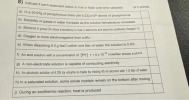 U) Indicate if each statement below is true or false (on statement below is true or false (one error allowed) (4.5 points na 30.97g of phosphorous there are 6.022x10 atoms of phosphorous b) Solubility of gases in Solubility of gases in water increase as the solution temperature increases woments in group 2A show a tendency to lose 2 electrons and become positively charged-2 d) Oxygen is more electronegative than sulfur e) When dissolving 9.0 g NaCl within one liter of...
Question: 1 For the following exothermic reaction system at equilibrium: CO2(g)H2(g) H20(g)CO(g) Choose the changes that...
 Question: 1 For the following exothermic reaction system at equilibrium: CO2(g)H2(g) H20(g)CO(g) Choose the changes that will increase the value of K Add a catalyst (constant T) Remove H2(g) (constant T) Add CO2(g) (constant T) Decrease the temperature Increase the temperature Decrease the volume (constant T) Add H20(g) (constant T) Submit Show Hints MAIN QUESTION
1. Calculate the molarity of the following solutions: a. 318 g Mg Br, in 859 ml...
 1. Calculate the molarity of the following solutions: a. 318 g Mg Br, in 859 ml solution b. 8.28 g Ca(C,H,O,), in 414 ml solution c. 31,1 g Al,(80.), in 766 ml solution d. 59.8 g CaCl, in 100 ml solution e. 313.5 g LICIO, in 250 ml solution | 849 Calculate the moles of solute needed to prepare each of the following: 2. LOL of a 3.0 M NaCl solution b. 0.40 L of a 1.0 M KBr solution...
G. C. 2-7 Studying the Effect of Changes in Conditions on an Equilibrium System 57 System...
 G. C. 2-7 Studying the Effect of Changes in Conditions on an Equilibrium System 57 System No. 4: [Co(H0).J? + 4C 5 [CoCLIC + 6H,0 Solutions Observations Dissolved CoCl-6H,0 - Pink solution Solution plus HCI Blue Solution Heated solution Blue Solution Cooled solution Pink Solutam 9. According to the equilibrium equation, which ion(s) do you have after the solid was diluted? Explain how you know the identity of the ion(s) present. 10. Explain what happened when HCl was added to...
b. Consider the solubility chart displayed below. Then determine whether each of the following mixtures should...
 b. Consider the solubility chart displayed below. Then determine whether each of the following mixtures should be classified as unsaturated, saturated or supersaturated. NaNO3 CaCl2 KNO3 K2Cr2O7 Solubility (g of salt in 100 g H20) Pb(NO3)2 Naci KCIO3 0 10 Ce2(SO4)3 20 30 40 50 60 70 80 90 100 Temperature (°C) Mixture Classification A B 20 g of NaCl mixed with 100 g of water at 30°C 60 g of KCl mixed with 100 g of water at 50...
Convert/Calculate the following: Determine the identity of an elemental gas if 4.55 L weighing 35.4g, under...
Convert/Calculate the following: Determine the identity of an elemental gas if 4.55 L weighing 35.4g, under 5.0 atm is at 40oC What is the pH scale? What is the range? What is an acidic solution? What is a basic solution? How is pH calculated? If the pH is 3.8, what is the pOH? What would be the [H+]? A) Describe the process for preparing 400 mL of a 2.0 M NaOH solution from a 10.0 M bottle of...
 1. Determine whether each of the following will undergo dissociation, dissolving or ionization. Then write the solvation equation for each substance: a) Lithium oxide - b) Magnesium nitride - Mga Na c) Hydrobromic acid 4. What is the molarity of a 75.0 mL solution that contains 0.225 g of potassium nitrate? 5. Describe how to prepare 750.0 mL of a standard 2.00 M sulfuric acid solution. Be sure to identify any special lab equipment required. Show all calculations. (3 marks...
 oi Prelab 11, Equilibrium Control of a Reaction me Consider the following equilibrium reaction Predict which direction the equilibrium will shift (left, towards reactants or right, towards products) when you perform the following actions: Shift Right Shift Left Action Add CH4 to the reaction Add CO, to the reaction Add CO to the reaction Add H, to the reaction Remove CH4 from the reaction Remove CO2 from the reaction Remove CO from the reaction Remove H2 from the reaction Increase...
 Lab 14 Heat of Reaction Objective: To experimentally determine the heat of reaction for two exothermic reactions. Consider the following equations. (1) Mg(s) + 2HCI → MgCl2(aq) + H2(g) Hz(8) AH = ? (2) MgO(s) + 2HCl(aq) → MgCl(aq) + HOH (1) AH2 = ? The reactions represented by equations (1) and (2) will be our experimental work for today. Background: The heat given off or gained in a reaction is commonly called the heat of reaction. A reaction that...
 thanks
2. Determine the oxidation number for the indicated element in each of the following substances. a. So, b. Mno, c. HNO, d. Cr,0,2 4. (a ) Calculate the molarity of a solution made by dissolving 0.75g of Na, so, in water to form exactly 850 mL of solution. (b ) Calculate the volume of 1.50 M Na PO, in liters that contains 2.5 g of solute.
thanks
2. Determine the oxidation number for the indicated element in each of the following substances. a. So, b. Mno, c. HNO, d. Cr,0,2 4. (a ) Calculate the molarity of a solution made by dissolving 0.75g of Na, so, in water to form exactly 850 mL of solution. (b ) Calculate the volume of 1.50 M Na PO, in liters that contains 2.5 g of solute.
 U) Indicate if each statement below is true or false (on statement below is true or false (one error allowed) (4.5 points na 30.97g of phosphorous there are 6.022x10 atoms of phosphorous b) Solubility of gases in Solubility of gases in water increase as the solution temperature increases woments in group 2A show a tendency to lose 2 electrons and become positively charged-2 d) Oxygen is more electronegative than sulfur e) When dissolving 9.0 g NaCl within one liter of...
 Question: 1 For the following exothermic reaction system at equilibrium: CO2(g)H2(g) H20(g)CO(g) Choose the changes that will increase the value of K Add a catalyst (constant T) Remove H2(g) (constant T) Add CO2(g) (constant T) Decrease the temperature Increase the temperature Decrease the volume (constant T) Add H20(g) (constant T) Submit Show Hints MAIN QUESTION
 1. Calculate the molarity of the following solutions: a. 318 g Mg Br, in 859 ml solution b. 8.28 g Ca(C,H,O,), in 414 ml solution c. 31,1 g Al,(80.), in 766 ml solution d. 59.8 g CaCl, in 100 ml solution e. 313.5 g LICIO, in 250 ml solution | 849 Calculate the moles of solute needed to prepare each of the following: 2. LOL of a 3.0 M NaCl solution b. 0.40 L of a 1.0 M KBr solution...
 G. C. 2-7 Studying the Effect of Changes in Conditions on an Equilibrium System 57 System No. 4: [Co(H0).J? + 4C 5 [CoCLIC + 6H,0 Solutions Observations Dissolved CoCl-6H,0 - Pink solution Solution plus HCI Blue Solution Heated solution Blue Solution Cooled solution Pink Solutam 9. According to the equilibrium equation, which ion(s) do you have after the solid was diluted? Explain how you know the identity of the ion(s) present. 10. Explain what happened when HCl was added to...
 b. Consider the solubility chart displayed below. Then determine whether each of the following mixtures should be classified as unsaturated, saturated or supersaturated. NaNO3 CaCl2 KNO3 K2Cr2O7 Solubility (g of salt in 100 g H20) Pb(NO3)2 Naci KCIO3 0 10 Ce2(SO4)3 20 30 40 50 60 70 80 90 100 Temperature (°C) Mixture Classification A B 20 g of NaCl mixed with 100 g of water at 30°C 60 g of KCl mixed with 100 g of water at 50...
Most questions answered within 3 hours.
-
Where is the error in this code sequence?
String s1 = "Hello";
String s2 = "ello";...
asked 10 months ago -
Financial data for Joel de Paris, Inc., for last year
follow:
Joel de Paris, Inc.
Balance...
asked 10 months ago -
Consider this reaction:
Al2(SO4)3 (aq)+ BaCl3
(aq) Al2Cl6 (aq)- +
3BaSO4(s) . What is the...
asked 10 months ago -
Suppose that Savneet is considering increasing her
recent random sample from 20 car rentals to 40...
asked 10 months ago -
Trucks arrive at an unloading terminal at an average rate of 120
per hour.
Trucks arrive...
asked 10 months ago -
Why are methanol and ethanol completely soluble in water while
octanol is not very little soluble....
asked 10 months ago -
A facilities manager at a university reads in a research report
that the mean amount of...
asked 10 months ago -
When the CuSO4 is rehydrated by adding water to the anhydrous
compound, is this an endothermic...
asked 10 months ago -
A ray of sunlight is passing from diamond into crown glass; the
angle of incidence is...
asked 10 months ago -
A block of mass 0.249 kg is placed on top of a light, vertical
spring of...
asked 10 months ago -
how do the kidneys compensate in the presences of acidosis
a) trigger hyperventilate
b) reserve acid...
asked 10 months ago -
Question 501 pts
The rental rate of capital to the firm increases. Which of the
following...
asked 10 months ago