


Homework Answers
Add Answer to:
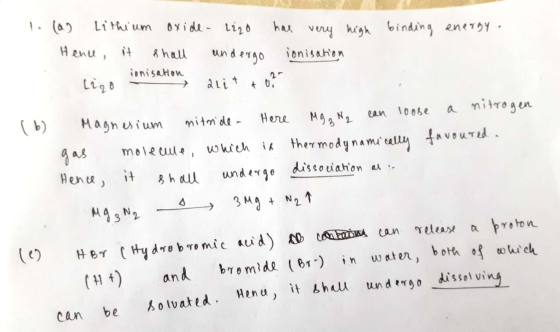
1. Determine whether each of the following will undergo dissociation, dissolving or ionization. Then write the...
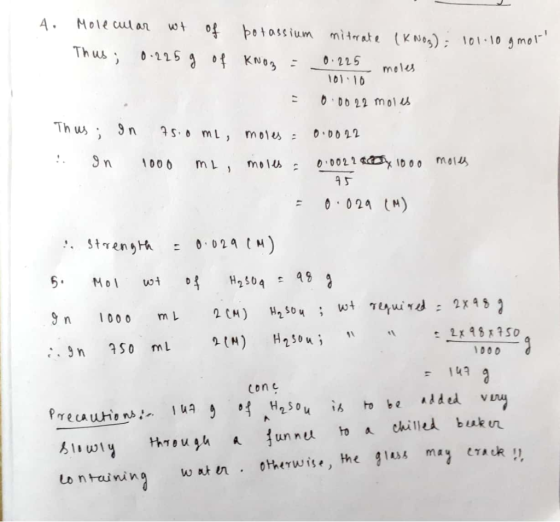
Calculate the volume, in milliliters, for each of the following that provides the given amount of...
 Calculate the volume, in milliliters, for each of the following that provides the given amount of solute: a. 12.5 g of Na2CO, from a 0.120 M Na CO, solution b. 0.850 mol of NaNO, from a 0.500 M NaNO, solution c. 30.0 g of LiOH from a 2.70 M LiOH solution Calculate the final concentration of each of the following: a. 2.0 L of a 6.0 M HCl solution is added to water so that the final volume is 6.0...
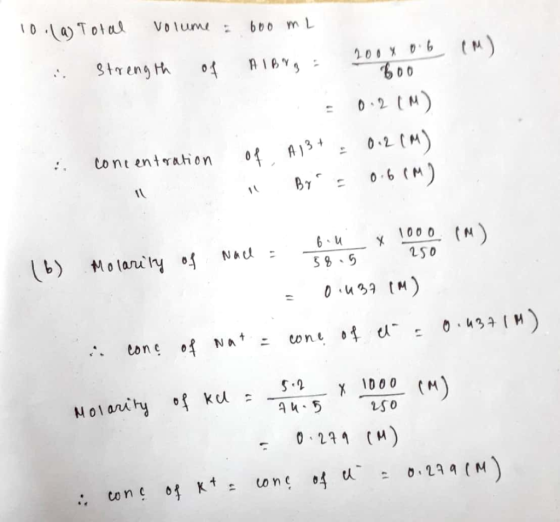
1. Calculate the molarity of the following solutions: a. 318 g Mg Br, in 859 ml...
 1. Calculate the molarity of the following solutions: a. 318 g Mg Br, in 859 ml solution b. 8.28 g Ca(C,H,O,), in 414 ml solution c. 31,1 g Al,(80.), in 766 ml solution d. 59.8 g CaCl, in 100 ml solution e. 313.5 g LICIO, in 250 ml solution | 849 Calculate the moles of solute needed to prepare each of the following: 2. LOL of a 3.0 M NaCl solution b. 0.40 L of a 1.0 M KBr solution...
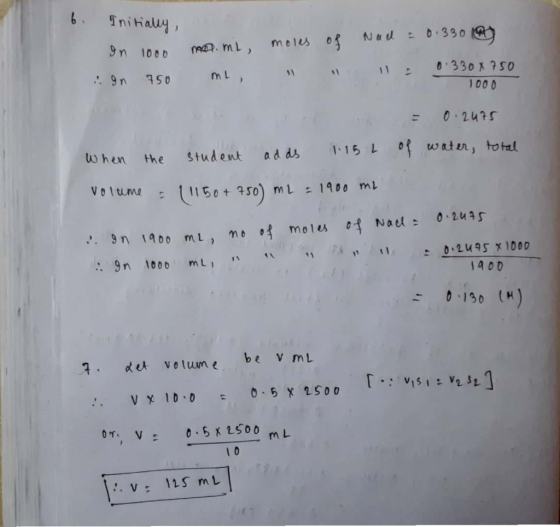
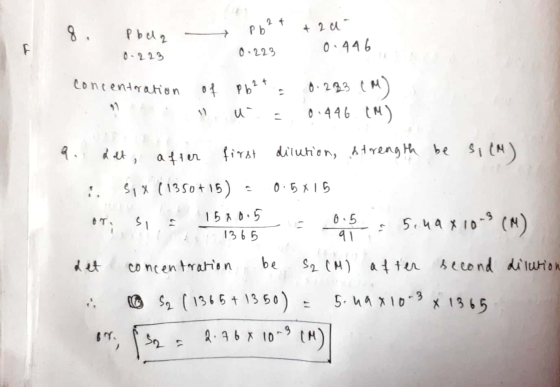
Calculate the final concentration of each of the following. 1) 1.7 L of a 2.50 M...
Calculate the final concentration of each of the following. 1) 1.7 L of a 2.50 M HNO3 solution is added to water so that the final volume is 9.0 L. 2) Water is added to 0.20 L of a 6.2 M NaF solution to make 3.2 L of a diluted NaF solution. 3) A 32.5 mL sample of an 8.2 % (m/v) KBr solution is diluted with water so that the final volume is 209.5 mL. 4) A 6.0 mL...
b. Consider the solubility chart displayed below. Then determine whether each of the following mixtures should...
 b. Consider the solubility chart displayed below. Then determine whether each of the following mixtures should be classified as unsaturated, saturated or supersaturated. NaNO3 CaCl2 KNO3 K2Cr2O7 Solubility (g of salt in 100 g H20) Pb(NO3)2 Naci KCIO3 0 10 Ce2(SO4)3 20 30 40 50 60 70 80 90 100 Temperature (°C) Mixture Classification A B 20 g of NaCl mixed with 100 g of water at 30°C 60 g of KCl mixed with 100 g of water at 50...
6.16 Classify each of the following solutes as an electrolyte or a nonelectrolyte a. NaNO3 b....
6.16 Classify each of the following solutes as an electrolyte or a nonelectrolyte a. NaNO3 b. C6H12O6 c. FeCl3 6.26a Calculate the composition of 20.0 g acetic acid dissolved in 2.50 L in mass/volume% 6.28b Calculate the %m/m composition of 50.0 g KCl in 5.00 x 10² mL solution (d=1.14g/mL) 6.30a How many g of solute are needed to prepare 2.50x10² g of 5.00% (m/m) NH4Cl? 6.34 How many mL of 4.0 mass/volume % Mg(NO3)2 solution would contain 1.2 g...
Exercise #1: (4 marks) Balance each of the following redox reactions in acid condition: a) Mg(s)...
 Exercise #1: (4 marks) Balance each of the following redox reactions in acid condition: a) Mg(s) + H2O(g) → Mg(OH)2(s) + H2(8) b) Cr(NO3)3(aq) + Al(s) + Al(NO3)2(aq) + Cr(s) (6 marks) Exercise #2: In both cases write the balanced formula equation of the reaction and then answer to the question. a) If 25.98 mL of 0.1180 M KOH solution reacts with 52.50 mL of CH,COOH solution, what is the molarity of the acid solution? b) If 26.25 mL of...
Consider the following reaction for Questions 1.3 and answer the questions based upon this GU u...
 Consider the following reaction for Questions 1.3 and answer the questions based upon this GU u IIULS reaction: CÓ (g) + 3 H (g) + CH4 (g) + H2O (G) 1. At 25°C, Keq=4.0. What must be the Co] at equilibrium If the equilibrium concentrations of [H.]= 2.0M. (CH) = 5.0M, and (HO) = 3.OM? Answer: 0.469 M The ICE table is a way to keep track of what is happening in the reaction vessel. The initial concentrations if given...
1) Which one of the following is a Bronsted-Lowry acid? A) (CH3)3NH+ B) CH3COOH C) HNO2...
1) Which one of the following is a Bronsted-Lowry acid? A) (CH3)3NH+ B) CH3COOH C) HNO2 D) all of the above 2) Which one of the following statements regarding Kw is false? A) pKw is 14.00 at 25 °C. B) The value of Kw is always 1.0 × 10⁻¹⁴. C) Kw changes with temperature. D) The value of Kw shows that water is a weak acid. 3) The Ka of benzoic acid is 6.30 × 10⁻⁵. The pH of a...
Write the expressions for Kp for the following reactions: 1. a) 2NH3(g) + Co2(g) N2CH40(s) +...
 Write the expressions for Kp for the following reactions: 1. a) 2NH3(g) + Co2(g) N2CH40(s) + H20 (I) b) CuO (s) + H2(g) Cu(l)+H20 (g) 2. At room temperature, a 1.5 L flask contains 3.0 moles of Cl, 0.5 mole of NOCI, and 4.0x10 mole of NO. Calculate Ke at this temperature for the following reaction: 2NO (g) + Cl2(g) 2NOCİ (g) 0.00245 M, does this represent a system at M, [No] 0.2 M and [Ch] If [NOCI] 2.0x 10...
Titration: Acids and Bases 2. How can you determine which acid is diprotic? 3. using the...
 Titration: Acids and Bases
2. How can you determine which acid is diprotic?
3. using the answers to questions one and two, which acid is
diprotic?
4. Which base has more hydroxide ions per molecule?
Acid Volume Base Base Initial Volume (mL) Base Final Volume (mL) Volume of Base Used (mL) Acid: Base Ratio Acid 1 20 mL Base 1 50 mL 34.5 15.5 4:3 Acid 2 20 mL Base 1 Acid 1 20 mL Base 2 Acid 2 20...
Titration: Acids and Bases
2. How can you determine which acid is diprotic?
3. using the answers to questions one and two, which acid is
diprotic?
4. Which base has more hydroxide ions per molecule?
Acid Volume Base Base Initial Volume (mL) Base Final Volume (mL) Volume of Base Used (mL) Acid: Base Ratio Acid 1 20 mL Base 1 50 mL 34.5 15.5 4:3 Acid 2 20 mL Base 1 Acid 1 20 mL Base 2 Acid 2 20...
 Calculate the volume, in milliliters, for each of the following that provides the given amount of solute: a. 12.5 g of Na2CO, from a 0.120 M Na CO, solution b. 0.850 mol of NaNO, from a 0.500 M NaNO, solution c. 30.0 g of LiOH from a 2.70 M LiOH solution Calculate the final concentration of each of the following: a. 2.0 L of a 6.0 M HCl solution is added to water so that the final volume is 6.0...
 1. Calculate the molarity of the following solutions: a. 318 g Mg Br, in 859 ml solution b. 8.28 g Ca(C,H,O,), in 414 ml solution c. 31,1 g Al,(80.), in 766 ml solution d. 59.8 g CaCl, in 100 ml solution e. 313.5 g LICIO, in 250 ml solution | 849 Calculate the moles of solute needed to prepare each of the following: 2. LOL of a 3.0 M NaCl solution b. 0.40 L of a 1.0 M KBr solution...
 b. Consider the solubility chart displayed below. Then determine whether each of the following mixtures should be classified as unsaturated, saturated or supersaturated. NaNO3 CaCl2 KNO3 K2Cr2O7 Solubility (g of salt in 100 g H20) Pb(NO3)2 Naci KCIO3 0 10 Ce2(SO4)3 20 30 40 50 60 70 80 90 100 Temperature (°C) Mixture Classification A B 20 g of NaCl mixed with 100 g of water at 30°C 60 g of KCl mixed with 100 g of water at 50...
 Exercise #1: (4 marks) Balance each of the following redox reactions in acid condition: a) Mg(s) + H2O(g) → Mg(OH)2(s) + H2(8) b) Cr(NO3)3(aq) + Al(s) + Al(NO3)2(aq) + Cr(s) (6 marks) Exercise #2: In both cases write the balanced formula equation of the reaction and then answer to the question. a) If 25.98 mL of 0.1180 M KOH solution reacts with 52.50 mL of CH,COOH solution, what is the molarity of the acid solution? b) If 26.25 mL of...
 Consider the following reaction for Questions 1.3 and answer the questions based upon this GU u IIULS reaction: CÓ (g) + 3 H (g) + CH4 (g) + H2O (G) 1. At 25°C, Keq=4.0. What must be the Co] at equilibrium If the equilibrium concentrations of [H.]= 2.0M. (CH) = 5.0M, and (HO) = 3.OM? Answer: 0.469 M The ICE table is a way to keep track of what is happening in the reaction vessel. The initial concentrations if given...
 Write the expressions for Kp for the following reactions: 1. a) 2NH3(g) + Co2(g) N2CH40(s) + H20 (I) b) CuO (s) + H2(g) Cu(l)+H20 (g) 2. At room temperature, a 1.5 L flask contains 3.0 moles of Cl, 0.5 mole of NOCI, and 4.0x10 mole of NO. Calculate Ke at this temperature for the following reaction: 2NO (g) + Cl2(g) 2NOCİ (g) 0.00245 M, does this represent a system at M, [No] 0.2 M and [Ch] If [NOCI] 2.0x 10...
 Titration: Acids and Bases
2. How can you determine which acid is diprotic?
3. using the answers to questions one and two, which acid is
diprotic?
4. Which base has more hydroxide ions per molecule?
Acid Volume Base Base Initial Volume (mL) Base Final Volume (mL) Volume of Base Used (mL) Acid: Base Ratio Acid 1 20 mL Base 1 50 mL 34.5 15.5 4:3 Acid 2 20 mL Base 1 Acid 1 20 mL Base 2 Acid 2 20...
Titration: Acids and Bases
2. How can you determine which acid is diprotic?
3. using the answers to questions one and two, which acid is
diprotic?
4. Which base has more hydroxide ions per molecule?
Acid Volume Base Base Initial Volume (mL) Base Final Volume (mL) Volume of Base Used (mL) Acid: Base Ratio Acid 1 20 mL Base 1 50 mL 34.5 15.5 4:3 Acid 2 20 mL Base 1 Acid 1 20 mL Base 2 Acid 2 20...
Most questions answered within 3 hours.
-
Where is the error in this code sequence?
String s1 = "Hello";
String s2 = "ello";...
asked 10 months ago -
Financial data for Joel de Paris, Inc., for last year
follow:
Joel de Paris, Inc.
Balance...
asked 10 months ago -
Consider this reaction:
Al2(SO4)3 (aq)+ BaCl3
(aq) Al2Cl6 (aq)- +
3BaSO4(s) . What is the...
asked 10 months ago -
Suppose that Savneet is considering increasing her
recent random sample from 20 car rentals to 40...
asked 10 months ago -
Trucks arrive at an unloading terminal at an average rate of 120
per hour.
Trucks arrive...
asked 10 months ago -
Why are methanol and ethanol completely soluble in water while
octanol is not very little soluble....
asked 10 months ago -
A facilities manager at a university reads in a research report
that the mean amount of...
asked 10 months ago -
When the CuSO4 is rehydrated by adding water to the anhydrous
compound, is this an endothermic...
asked 10 months ago -
A ray of sunlight is passing from diamond into crown glass; the
angle of incidence is...
asked 10 months ago -
A block of mass 0.249 kg is placed on top of a light, vertical
spring of...
asked 10 months ago -
how do the kidneys compensate in the presences of acidosis
a) trigger hyperventilate
b) reserve acid...
asked 10 months ago -
Question 501 pts
The rental rate of capital to the firm increases. Which of the
following...
asked 10 months ago