
Homework Answers
Add Answer to:
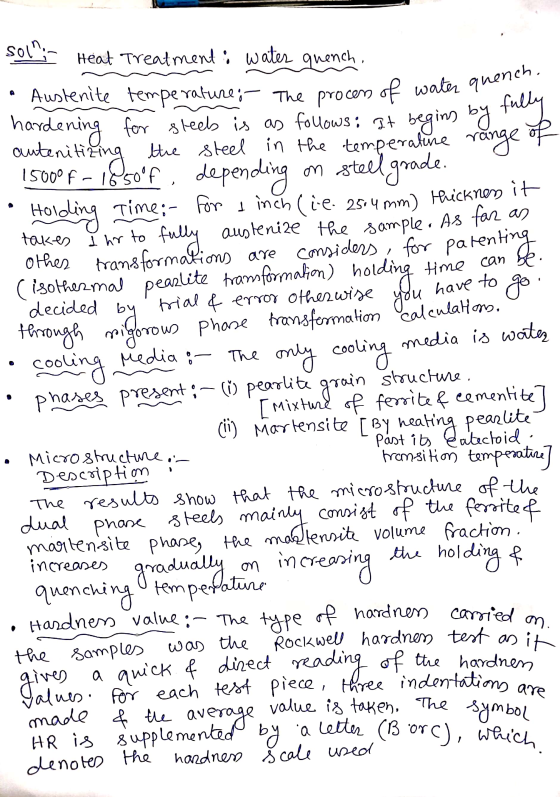
Heat treatment: Water Quench Austenitizing temperature: Holding Time: Cooling Media: Phases Present: Microstouctructure Description: Hardness Value:
Q3: Discuss the effect of all the cooling rates on the microstructure (phases present) and hardne...
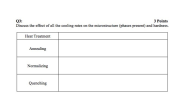 Q3: Discuss the effect of all the cooling rates on the microstructure (phases present) and hardness. 3 Points Heat Treatment Annealing Normalizing Quenching
Q3: Discuss the effect of all the cooling rates on the microstructure (phases present) and hardness. 3 Points Heat Treatment Annealing Normalizing Quenching
Q3: Discuss the effect of all the cooling rates on the microstructure (phases present) and hardness. 3 Points Heat Treatment Annealing Normalizing Quenching
7. Different time-temperature cooling paths for a 1080 steel on an isothermal transformation diagram will produce...
 7. Different time-temperature cooling paths for a 1080 steel on an isothermal transformation diagram will produce different microstructures. Use the IT diagram and other knowledge to determine the microstructure of the steel samples after each heat treatment. In each case assume that the specimen begins at 860ºC and that it has been held at this temperature long enough to have achieved a complete and homogeneous austenitic structure. (10 points) (1) Water-quench Ai 700 (2) Water-quench; reheat 1 h at 200°C,...
I need help to write a nice introduction for experiment 6 please ( no hands write ) typing Thank you HEAT TREATMENT OF STEELS EXPERIMENT 6 EXPERIMENT 6 HEAT TREATMENT OF STEELS THEORY The Ef...
 I need help to write a nice introduction for experiment 6
please ( no hands write ) typing
Thank you
HEAT TREATMENT OF STEELS EXPERIMENT 6 EXPERIMENT 6 HEAT TREATMENT OF STEELS THEORY The Effect of Cooling Rate One of the most convenient methods for controlling the properties of a given steel, i.e., a steel whose composition is already fixed, consists of austenizing the steel and ten cooling to room temperature at some predetermined rate. A variation of cooling rates...
I need help to write a nice introduction for experiment 6
please ( no hands write ) typing
Thank you
HEAT TREATMENT OF STEELS EXPERIMENT 6 EXPERIMENT 6 HEAT TREATMENT OF STEELS THEORY The Effect of Cooling Rate One of the most convenient methods for controlling the properties of a given steel, i.e., a steel whose composition is already fixed, consists of austenizing the steel and ten cooling to room temperature at some predetermined rate. A variation of cooling rates...
6.8. The heat treatments noted below are carried out in 1080 steel. In each case what phases will...
 Phase, TTT, and CCT diagrams provided
6.8. The heat treatments noted below are carried out in 1080 steel. In each case what phases will be present at the end of the treatment? a. Austenitize at 750 deg C; quench to 0 deg C in 1s. b. Austenitize at 750 deg C; rapid quench to 650 deg C; isothermally anneal for 1000 s; quench to 0 deg C in 1s c. Austenitize at 750 deg C; very rapid quench to 250...
Phase, TTT, and CCT diagrams provided
6.8. The heat treatments noted below are carried out in 1080 steel. In each case what phases will be present at the end of the treatment? a. Austenitize at 750 deg C; quench to 0 deg C in 1s. b. Austenitize at 750 deg C; rapid quench to 650 deg C; isothermally anneal for 1000 s; quench to 0 deg C in 1s c. Austenitize at 750 deg C; very rapid quench to 250...
Newton’s Law of Cooling states that the temperature of an object changes in time according to...
Newton’s Law of Cooling states that the temperature of an object changes in time according to the equation dT =k(E−T)dt where T(t) is the temperature of the object, E is the temperature of the environment surrounding the object and k is a constant that is determined by the physical properties of the object. The value k can be expressed as k = hA , ρV cp where h is the heat-transfer coefficient (a measure of how quickly heat escapes the...
Its a thermal treatment of metallic materials from material science questions QUESTION 9 a) Heat treatment...
 Its a thermal treatment of metallic materials from
material science questions
QUESTION 9 a) Heat treatment schedule for three (3) thin samples of plain carbon steel containing different carbon concentration is summarized in Table Q9(a). Determine and sketch the resultant microstructure for each steel. Distinguish steel 1 from steel 3 with reference to their mechanical properties. Table 29(a) Steel wt% C Heating temperature Soaking time (°C) (minutes) Cooling process 1 0.5 950 60 Furnace cooled 2 0.8 800 60 Air...
Its a thermal treatment of metallic materials from
material science questions
QUESTION 9 a) Heat treatment schedule for three (3) thin samples of plain carbon steel containing different carbon concentration is summarized in Table Q9(a). Determine and sketch the resultant microstructure for each steel. Distinguish steel 1 from steel 3 with reference to their mechanical properties. Table 29(a) Steel wt% C Heating temperature Soaking time (°C) (minutes) Cooling process 1 0.5 950 60 Furnace cooled 2 0.8 800 60 Air...
A heat treatment process that is used to harden steel components is examined. The process has...
A heat treatment process that is used to harden steel components is examined. The process has four parameters. Which parameter(s) have the greatest impact on the hardness of steel components? Which parameter(s) have the least impact on the hardness of steel components? Why? (Please show all necessary calculations) Parameter Number Parameters Level 1 Level 2 1 Temperature (C) 750 900 2 Cooling time (s) 50 300 3 Carbon Contents (Wt%c) 1 6 4 CO2 Concentration (%) 7 25 OA is...
Prob. 2: Cooling Curve Circle: Emathermier Exothermis?) Cale, the amount of heat this time in calories...
 Prob. 2: Cooling Curve Circle: Emathermier Exothermis?) Cale, the amount of heat this time in calories (cal) - Ilse I cal 4184 for conversions) lost or removed From 1.75 mol water as steam at a convert it to solid ice chilled in a freezer to a temperature of 47.2°C Cumulative Heat Lost To do this, follow the above drawn curve to determine the amount of heat lost for each of the five steps of this process to convert superheated steam...
a hot stream is cooled by cooling water in a counter current heat exchanger propose a feedback control and sketch a sch...
 a hot stream is cooled by cooling water in a counter current
heat exchanger propose a feedback control and sketch a schematic
diagram
CONSULT APPENDIX WHERE APPROPRIATE shot stream is cooled by cooling water in a counter current heat exchanger ents as shown in Figure Q1. we, Te2 Heat exchanger Figure Q1. Heat exchanger It is desired to control the exit temperature (Tha) of the hot stream. All flow rates can be measured and manipulated. (a) Propose a feedback control...
a hot stream is cooled by cooling water in a counter current
heat exchanger propose a feedback control and sketch a schematic
diagram
CONSULT APPENDIX WHERE APPROPRIATE shot stream is cooled by cooling water in a counter current heat exchanger ents as shown in Figure Q1. we, Te2 Heat exchanger Figure Q1. Heat exchanger It is desired to control the exit temperature (Tha) of the hot stream. All flow rates can be measured and manipulated. (a) Propose a feedback control...
please help me with letter B. Value Ulla ination of Living EXERCISE 3: MICROE b. Holding...
 please help me with letter B.
Value Ulla ination of Living EXERCISE 3: MICROE b. Holding the flask at an angle, remove the stop- per with the fourth and fifth fingers of your oth- er hand. Heat the mouth of the flask by passing it through the flame three times (FIGURE 2a). Why is it necessary to keep the flask at an an- gle through this procedure? (a) Remove theflask. c. Remove the cover from the first dish with the...
please help me with letter B.
Value Ulla ination of Living EXERCISE 3: MICROE b. Holding the flask at an angle, remove the stop- per with the fourth and fifth fingers of your oth- er hand. Heat the mouth of the flask by passing it through the flame three times (FIGURE 2a). Why is it necessary to keep the flask at an an- gle through this procedure? (a) Remove theflask. c. Remove the cover from the first dish with the...
 Q3: Discuss the effect of all the cooling rates on the microstructure (phases present) and hardness. 3 Points Heat Treatment Annealing Normalizing Quenching
Q3: Discuss the effect of all the cooling rates on the microstructure (phases present) and hardness. 3 Points Heat Treatment Annealing Normalizing Quenching
Q3: Discuss the effect of all the cooling rates on the microstructure (phases present) and hardness. 3 Points Heat Treatment Annealing Normalizing Quenching
 7. Different time-temperature cooling paths for a 1080 steel on an isothermal transformation diagram will produce different microstructures. Use the IT diagram and other knowledge to determine the microstructure of the steel samples after each heat treatment. In each case assume that the specimen begins at 860ºC and that it has been held at this temperature long enough to have achieved a complete and homogeneous austenitic structure. (10 points) (1) Water-quench Ai 700 (2) Water-quench; reheat 1 h at 200°C,...
 I need help to write a nice introduction for experiment 6
please ( no hands write ) typing
Thank you
HEAT TREATMENT OF STEELS EXPERIMENT 6 EXPERIMENT 6 HEAT TREATMENT OF STEELS THEORY The Effect of Cooling Rate One of the most convenient methods for controlling the properties of a given steel, i.e., a steel whose composition is already fixed, consists of austenizing the steel and ten cooling to room temperature at some predetermined rate. A variation of cooling rates...
I need help to write a nice introduction for experiment 6
please ( no hands write ) typing
Thank you
HEAT TREATMENT OF STEELS EXPERIMENT 6 EXPERIMENT 6 HEAT TREATMENT OF STEELS THEORY The Effect of Cooling Rate One of the most convenient methods for controlling the properties of a given steel, i.e., a steel whose composition is already fixed, consists of austenizing the steel and ten cooling to room temperature at some predetermined rate. A variation of cooling rates...
 Phase, TTT, and CCT diagrams provided
6.8. The heat treatments noted below are carried out in 1080 steel. In each case what phases will be present at the end of the treatment? a. Austenitize at 750 deg C; quench to 0 deg C in 1s. b. Austenitize at 750 deg C; rapid quench to 650 deg C; isothermally anneal for 1000 s; quench to 0 deg C in 1s c. Austenitize at 750 deg C; very rapid quench to 250...
Phase, TTT, and CCT diagrams provided
6.8. The heat treatments noted below are carried out in 1080 steel. In each case what phases will be present at the end of the treatment? a. Austenitize at 750 deg C; quench to 0 deg C in 1s. b. Austenitize at 750 deg C; rapid quench to 650 deg C; isothermally anneal for 1000 s; quench to 0 deg C in 1s c. Austenitize at 750 deg C; very rapid quench to 250...
 Its a thermal treatment of metallic materials from
material science questions
QUESTION 9 a) Heat treatment schedule for three (3) thin samples of plain carbon steel containing different carbon concentration is summarized in Table Q9(a). Determine and sketch the resultant microstructure for each steel. Distinguish steel 1 from steel 3 with reference to their mechanical properties. Table 29(a) Steel wt% C Heating temperature Soaking time (°C) (minutes) Cooling process 1 0.5 950 60 Furnace cooled 2 0.8 800 60 Air...
Its a thermal treatment of metallic materials from
material science questions
QUESTION 9 a) Heat treatment schedule for three (3) thin samples of plain carbon steel containing different carbon concentration is summarized in Table Q9(a). Determine and sketch the resultant microstructure for each steel. Distinguish steel 1 from steel 3 with reference to their mechanical properties. Table 29(a) Steel wt% C Heating temperature Soaking time (°C) (minutes) Cooling process 1 0.5 950 60 Furnace cooled 2 0.8 800 60 Air...
 Prob. 2: Cooling Curve Circle: Emathermier Exothermis?) Cale, the amount of heat this time in calories (cal) - Ilse I cal 4184 for conversions) lost or removed From 1.75 mol water as steam at a convert it to solid ice chilled in a freezer to a temperature of 47.2°C Cumulative Heat Lost To do this, follow the above drawn curve to determine the amount of heat lost for each of the five steps of this process to convert superheated steam...
 a hot stream is cooled by cooling water in a counter current
heat exchanger propose a feedback control and sketch a schematic
diagram
CONSULT APPENDIX WHERE APPROPRIATE shot stream is cooled by cooling water in a counter current heat exchanger ents as shown in Figure Q1. we, Te2 Heat exchanger Figure Q1. Heat exchanger It is desired to control the exit temperature (Tha) of the hot stream. All flow rates can be measured and manipulated. (a) Propose a feedback control...
a hot stream is cooled by cooling water in a counter current
heat exchanger propose a feedback control and sketch a schematic
diagram
CONSULT APPENDIX WHERE APPROPRIATE shot stream is cooled by cooling water in a counter current heat exchanger ents as shown in Figure Q1. we, Te2 Heat exchanger Figure Q1. Heat exchanger It is desired to control the exit temperature (Tha) of the hot stream. All flow rates can be measured and manipulated. (a) Propose a feedback control...
 please help me with letter B.
Value Ulla ination of Living EXERCISE 3: MICROE b. Holding the flask at an angle, remove the stop- per with the fourth and fifth fingers of your oth- er hand. Heat the mouth of the flask by passing it through the flame three times (FIGURE 2a). Why is it necessary to keep the flask at an an- gle through this procedure? (a) Remove theflask. c. Remove the cover from the first dish with the...
please help me with letter B.
Value Ulla ination of Living EXERCISE 3: MICROE b. Holding the flask at an angle, remove the stop- per with the fourth and fifth fingers of your oth- er hand. Heat the mouth of the flask by passing it through the flame three times (FIGURE 2a). Why is it necessary to keep the flask at an an- gle through this procedure? (a) Remove theflask. c. Remove the cover from the first dish with the...
Most questions answered within 3 hours.
-
Where is the error in this code sequence?
String s1 = "Hello";
String s2 = "ello";...
asked 10 months ago -
Financial data for Joel de Paris, Inc., for last year
follow:
Joel de Paris, Inc.
Balance...
asked 10 months ago -
Consider this reaction:
Al2(SO4)3 (aq)+ BaCl3
(aq) Al2Cl6 (aq)- +
3BaSO4(s) . What is the...
asked 10 months ago -
Suppose that Savneet is considering increasing her
recent random sample from 20 car rentals to 40...
asked 10 months ago -
Trucks arrive at an unloading terminal at an average rate of 120
per hour.
Trucks arrive...
asked 10 months ago -
Why are methanol and ethanol completely soluble in water while
octanol is not very little soluble....
asked 10 months ago -
A facilities manager at a university reads in a research report
that the mean amount of...
asked 10 months ago -
When the CuSO4 is rehydrated by adding water to the anhydrous
compound, is this an endothermic...
asked 10 months ago -
A ray of sunlight is passing from diamond into crown glass; the
angle of incidence is...
asked 10 months ago -
A block of mass 0.249 kg is placed on top of a light, vertical
spring of...
asked 10 months ago -
how do the kidneys compensate in the presences of acidosis
a) trigger hyperventilate
b) reserve acid...
asked 10 months ago -
Question 501 pts
The rental rate of capital to the firm increases. Which of the
following...
asked 10 months ago