At 44 °C, what is the fraction of collisions with energy equal or greater than an...
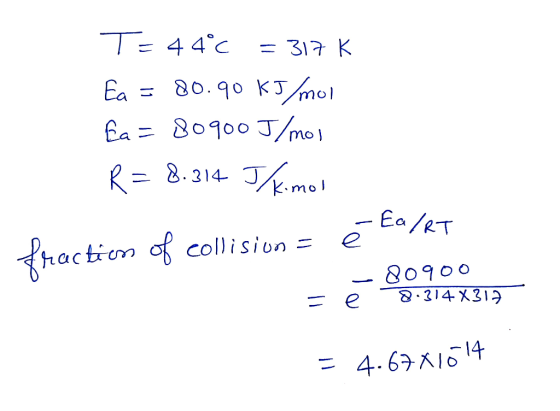
At 44 °C, what is the fraction of collisions with energy equal or greater than an activation energy of 80.90 kJ/mol?
3.13 × 10⁻¹⁴
4.00 × 10⁻¹⁵
4.67 × 10⁻¹⁴
9.37 × 10⁻¹⁵
7.17 × 10⁻¹⁵
1.46 × 10⁻¹⁴
Homework Answers
Add Answer to:
At 44 °C, what is the fraction of collisions with energy equal
or greater than an...
At 27°C, what is the fraction of collisions with energy equal to or greater than an...
At 27°C, what is the fraction of collisions with energy equal to or greater than an activation energy of 88.60 kJ/mol? Give your answer in scientific notation.
Be sure to answer all parts. By what factor does the fraction of collisions with energy...
Be sure to answer all parts. By what factor does the fraction of collisions with energy equal to or greater than activation energy of 100. kJ/mol change if the temperature increases from 21.0 ° C to 59.0 ° C? Give your answer in scientific notation. Be sure to answer all parts. By what factor does the fraction of collisions with energy equal to or greater than activation energy of 100. kJ/mol change if the temperature increases from 21.0 ° C...
Be sure to answer all parts At 50.00 degree C, what is the fraction of collisions...
 Be sure to answer all parts At 50.00 degree C, what is the fraction of collisions with energy equal to or greater than an activation energy of 84.60 kJ/mol? Give your answer in scientific notation
Which of the following are correct? 1. The fraction of collisions with energy greater than or...
 Which of the following are correct? 1. The fraction of collisions with energy greater than or equal to the activation energy always doubles as the temperature, on the Kelvin scale, is doubled. 2. The probability of correct relative orientation in collisions is smaller for reactants with complicated shape than for reactants with simple shape. 3. The rate determining step in a reaction mechanism must be an elementary process. 4. The rate determining step in a reaction mechanism cannot be the...
5. The fraction of collisions with sufficient energy for a reaction to occur can be calculated...
5. The fraction of collisions with sufficient energy for a reaction to occur can be calculated using the exponential portion of the Arrhenius equation: (4 pts) Using your calculated activation energy for this reaction (your answer to question 1), determine the fraction of collisions that have sufficient energy at the following temps: 20C and 30C. -Calculated activation energy: 128.78 kJ/mol.
in the vessel? 16.56 For the reaction A(g)+ B(g) AB(g), how collisions between A and B...
 in the vessel? 16.56 For the reaction A(g)+ B(g) AB(g), how collisions between A and B are possible if 1.01 mol of A(g) and 2.12 mol of B(g) are present in the vessel? many unique 16.57 At 25°C, what is the fraction of collisions with energy equal to or greater than an activation energy of 100. kJ/mol? 16.58 If the temperature in Problem 16.57 is increased to 50.°C by what factor does the fraction of collisions with energy equal to...
Another reaction has an activation energy of 54.6 kJ/mol. The value of k at 25.0 °C...
Another reaction has an activation energy of 54.6 kJ/mol. The value of k at 25.0 °C is 4.23 × 10⁻² s−1. At what temperature will the value of k be 1.15 × 10⁻² s−1? Before working the problem, decide if the answer is less than or greater than 25.0 °C.
The water in a pressure cooker boils at a temperature greater than 100°C because it is...
 The water in a pressure cooker boils at a temperature greater than 100°C because it is under pressure. At this higher temperature, the chemical reactions associated with the cooking of food take place at a greater rate. (a) Some food cooks fully in 7.00 min in a pressure cooker at 120.0°C and in 70.0 minutes in an open pot at 100.0°C. Calculate the average activation energy for the reactions associated with the cooking of this food. kJ mol-1 (b) How...
The water in a pressure cooker boils at a temperature greater than 100°C because it is...
The water in a pressure cooker boils at a temperature greater than 100°C because it is under pressure. At this higher temperature, the chemical reactions associated with the cooking of food take place at a greater rate. (a) Some food cooks fully in 5.00 min in a pressure cooker at 114.0°C and in 25.0 minutes in an open pot at 100.0°C. Calculate the average activation energy for the reactions associated with the cooking of this food. _______ kJ mol-1 (b)...
Tell whether the pH at equivalence point is less than 7, greater than 7 or equal...
Tell whether the pH at equivalence point is less than 7, greater than 7 or equal to 7 for each of the following solutions. PLEASE SHOW WORK IF POSSIBLE OR EXPLAINATION; Thank you so much! 12. 0.1M acetic acid with 90.10M NaOH a). Greater than 7 b.) Equal to 7 c.) Less than 7 d.) Equal to 14 e.) Don't Know 13. 0.050M formic acid (HCOOH) with 0.0930M NaOH a.) Greater than 7 b.) Less than 7 c.) Equal to...
 Be sure to answer all parts At 50.00 degree C, what is the fraction of collisions with energy equal to or greater than an activation energy of 84.60 kJ/mol? Give your answer in scientific notation
 Which of the following are correct? 1. The fraction of collisions with energy greater than or equal to the activation energy always doubles as the temperature, on the Kelvin scale, is doubled. 2. The probability of correct relative orientation in collisions is smaller for reactants with complicated shape than for reactants with simple shape. 3. The rate determining step in a reaction mechanism must be an elementary process. 4. The rate determining step in a reaction mechanism cannot be the...
 in the vessel? 16.56 For the reaction A(g)+ B(g) AB(g), how collisions between A and B are possible if 1.01 mol of A(g) and 2.12 mol of B(g) are present in the vessel? many unique 16.57 At 25°C, what is the fraction of collisions with energy equal to or greater than an activation energy of 100. kJ/mol? 16.58 If the temperature in Problem 16.57 is increased to 50.°C by what factor does the fraction of collisions with energy equal to...
 The water in a pressure cooker boils at a temperature greater than 100°C because it is under pressure. At this higher temperature, the chemical reactions associated with the cooking of food take place at a greater rate. (a) Some food cooks fully in 7.00 min in a pressure cooker at 120.0°C and in 70.0 minutes in an open pot at 100.0°C. Calculate the average activation energy for the reactions associated with the cooking of this food. kJ mol-1 (b) How...
Most questions answered within 3 hours.
-
Where is the error in this code sequence?
String s1 = "Hello";
String s2 = "ello";...
asked 11 months ago -
Financial data for Joel de Paris, Inc., for last year
follow:
Joel de Paris, Inc.
Balance...
asked 11 months ago -
Consider this reaction:
Al2(SO4)3 (aq)+ BaCl3
(aq) Al2Cl6 (aq)- +
3BaSO4(s) . What is the...
asked 11 months ago -
Suppose that Savneet is considering increasing her
recent random sample from 20 car rentals to 40...
asked 11 months ago -
Trucks arrive at an unloading terminal at an average rate of 120
per hour.
Trucks arrive...
asked 11 months ago -
Why are methanol and ethanol completely soluble in water while
octanol is not very little soluble....
asked 11 months ago -
A facilities manager at a university reads in a research report
that the mean amount of...
asked 11 months ago -
When the CuSO4 is rehydrated by adding water to the anhydrous
compound, is this an endothermic...
asked 11 months ago -
A ray of sunlight is passing from diamond into crown glass; the
angle of incidence is...
asked 11 months ago -
A block of mass 0.249 kg is placed on top of a light, vertical
spring of...
asked 11 months ago -
how do the kidneys compensate in the presences of acidosis
a) trigger hyperventilate
b) reserve acid...
asked 11 months ago -
Question 501 pts
The rental rate of capital to the firm increases. Which of the
following...
asked 11 months ago