

Homework Answers
please upvote ? if you like my answer ?
Add Answer to:
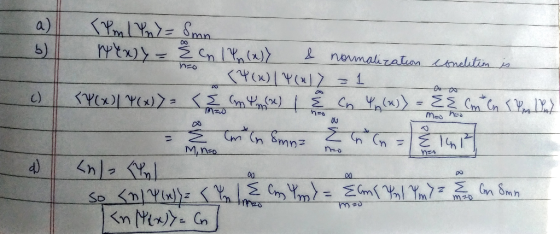
1 From Wavefunction to Bra-Ket In bra-ket notation, a state y(x) is written as a ket:...
Intro to Quantum Mechanics problem: . In a harmonic oscillator a normalized "coherent" state ya(x) is...
 Intro to Quantum Mechanics problem:
. In a harmonic oscillator a normalized "coherent" state ya(x) is defined in terms of the lowering operator a. by aXa(x) = a Xa(x) for some (complex) number a. /Coherent states have many applications in atomic, molecular, and optical physics, for instance lasers and Bose-Einstein condensates]. (a) Using the properties for any wavefunctions f(x) and g(x) that 00 00 if ag dx (a.f)g dx f a+g dx (a.)'g dx -00 -00 -00 calculate <x >...
Intro to Quantum Mechanics problem:
. In a harmonic oscillator a normalized "coherent" state ya(x) is defined in terms of the lowering operator a. by aXa(x) = a Xa(x) for some (complex) number a. /Coherent states have many applications in atomic, molecular, and optical physics, for instance lasers and Bose-Einstein condensates]. (a) Using the properties for any wavefunctions f(x) and g(x) that 00 00 if ag dx (a.f)g dx f a+g dx (a.)'g dx -00 -00 -00 calculate <x >...
4. (a) A particle in 1D has the wavefunction (x) = Ce-ex?12, where e > 0...
 4. (a) A particle in 1D has the wavefunction (x) = Ce-ex?12, where e > 0 and you may assume C > 0. i) Find the normalisation constant C. [4 marks] ii) For small e > 0, show that y is approximately a zero eigenvector of the momentum operator Ộ, i.e., show that lim lôy || = 0. €0+ Hint: for a > 0, recall that Se-ax?dx = Vola and Sox?e-ax?dx = Vra-312 [6 marks] (b) Let Ê be a...
Problem #1 The explicit wavefunction for a particle in the n-1 state of the quantum harmonic...
 Problem #1 The explicit wavefunction for a particle in the n-1 state of the quantum harmonic oscillator is p1(x)- Axe-bx2 where mo 2h and ?1/4 (Note: In last week's homework there was an "h" where there should have been ?. This has been corrected in this week's assignment.) (a) By applying the lowering operator to ),obtain an explicit form for o(x) (i.e. the n-0 wavefunction) (b) By applying the raising operator to x), obtain an explicit form for p2(x) (i.e....
5. A particle in the harmonic oscillator potential has the initial wave function Psi(x, 0) = A[\psi_{0}(x) + \psi_{1}(x)] for some constant A. Here to and ₁ are the normalized ground state and the first excited state wavefunctions of the harmonic oscill
 5. A particle in the harmonic oscillator potential has the initial wave function Psi(x, 0) = A[\psi_{0}(x) + \psi_{1}(x)] for some constant A. Here to and ₁ are the normalized ground state and the first excited state wavefunctions of the harmonic oscillator, respectively. (a) Normalize (r, 0). (b) Find the wavefunction (r, t) at a later time t and hence evaluate (x, t) 2. Leave your answers involving expressions in to and ₁. c) sing the following normalized expression of...
Question 3 Consider the one-dimensional harmonic oscillator, and denote its properly normalised e...
 ONLY (e) (f) NEEDED THANK YOU :)
Question 3 Consider the one-dimensional harmonic oscillator, and denote its properly normalised energy eigenstates by { | n〉, n = 0, 1, 2, 3, . . .). Define the state where α is a complex number, and C is a normalisation constant. (a) Use a Campbell-Baker-Hausdorff relation (or otherwise) to show that In other words, | α > is an eigenstate of the (non-Hermitian) lowering operator with (complex) eigenvalue α. (b) During lectures...
ONLY (e) (f) NEEDED THANK YOU :)
Question 3 Consider the one-dimensional harmonic oscillator, and denote its properly normalised energy eigenstates by { | n〉, n = 0, 1, 2, 3, . . .). Define the state where α is a complex number, and C is a normalisation constant. (a) Use a Campbell-Baker-Hausdorff relation (or otherwise) to show that In other words, | α > is an eigenstate of the (non-Hermitian) lowering operator with (complex) eigenvalue α. (b) During lectures...
First four harmonic oscillator normalized wavefunctions 1/4 Y.-(4)"-** 4, = 1/4 v2y ev2 1/4 Y, =|...
 First four harmonic oscillator normalized wavefunctions 1/4 Y.-(4)"-** 4, = 1/4 v2y ev2 1/4 Y, =| -1)ev¾2 1/4 - 3y)e¬v³½ y =ax 1. Consider a harmonic oscillator with a = 1. a) Prove that these eigenstates are all orthonormal b) Plot the first four eigenstates. How would doubling the mass change the eigenfunctions? c) Pick one eigenstate, and show that it is a solution to the Schrodinger Equation, that is, show that V? on (x) + w²ma? ¢n (x) =...
1. A quantum system goes into a time-dependent superposition of three real eigen- functions (ener...
 please show how to solve #5
1. A quantum system goes into a time-dependent superposition of three real eigen- functions (energies E, E 2, E, all equally likely). Write down the total wave- function, and calculate the probability density. Express your answer in terms of the (co)sinusoidal interference terms. 2. Write down the time-dependent wavefunction for the particle a box that is in a superposition of the n = 2 and n = 4 states. Assume there is a 30%...
please show how to solve #5
1. A quantum system goes into a time-dependent superposition of three real eigen- functions (energies E, E 2, E, all equally likely). Write down the total wave- function, and calculate the probability density. Express your answer in terms of the (co)sinusoidal interference terms. 2. Write down the time-dependent wavefunction for the particle a box that is in a superposition of the n = 2 and n = 4 states. Assume there is a 30%...
Problem 5. (30 points) Consider a Harmonic oscillator with H that H=(ata + 1 / 2)ho,...
 Problem 5. (30 points) Consider a Harmonic oscillator with H that H=(ata + 1 / 2)ho, where a=dma)X + i (a) (4 points) Show P, and a x 2h 2h 2moh P. Show also 2moh that [a, a]-l. (b) (6 points) Starting from the commuters la, HJand la', A), where H-H(h) show that the eigenvalues of Hare e,=(n+1/2) for n-0, 1,2, Show also that alm)-nln-l), and a l). (( points) Find the normalized ground state wavefunction by projecting alo)-0 on...
1 Particle in a Box with a Bump (based on B&J 4.11) Consider a particle of...
 1 Particle in a Box with a Bump (based on B&J 4.11) Consider a particle of mass m in a 1-D double well with potential given by Vo, 05\x\<b V(x) = { 0, b<\x<c 100, [x]>c . We will study the lowest energy states, for which 0 <E<V, corresponding to tunnelling between the two wells. (a) Write down the time-independent Schödinger equation in the three regions -c<x<-b, –b< <b, and b< I< c. Write down the most general wavefunction solution...
Activity: A Journey Through Calculus from A to Z sin(x-1) :- 1) x< h(x) kr2 -...
 Activity: A Journey Through Calculus from A to Z sin(x-1) :- 1) x< h(x) kr2 - 8x + 6. 13x53 Ver-6 – x2 +5, x>3 Consider f'(x), the derivative of the continuous functionſ defined on the closed interval -6,7] except at x 5. A portion of f' is given in the graph above and consists of a semicircle and two line segments. The function (x) is a piecewise defined function given above where k is a constant The function g(x)...
 Intro to Quantum Mechanics problem:
. In a harmonic oscillator a normalized "coherent" state ya(x) is defined in terms of the lowering operator a. by aXa(x) = a Xa(x) for some (complex) number a. /Coherent states have many applications in atomic, molecular, and optical physics, for instance lasers and Bose-Einstein condensates]. (a) Using the properties for any wavefunctions f(x) and g(x) that 00 00 if ag dx (a.f)g dx f a+g dx (a.)'g dx -00 -00 -00 calculate <x >...
Intro to Quantum Mechanics problem:
. In a harmonic oscillator a normalized "coherent" state ya(x) is defined in terms of the lowering operator a. by aXa(x) = a Xa(x) for some (complex) number a. /Coherent states have many applications in atomic, molecular, and optical physics, for instance lasers and Bose-Einstein condensates]. (a) Using the properties for any wavefunctions f(x) and g(x) that 00 00 if ag dx (a.f)g dx f a+g dx (a.)'g dx -00 -00 -00 calculate <x >...
 4. (a) A particle in 1D has the wavefunction (x) = Ce-ex?12, where e > 0 and you may assume C > 0. i) Find the normalisation constant C. [4 marks] ii) For small e > 0, show that y is approximately a zero eigenvector of the momentum operator Ộ, i.e., show that lim lôy || = 0. €0+ Hint: for a > 0, recall that Se-ax?dx = Vola and Sox?e-ax?dx = Vra-312 [6 marks] (b) Let Ê be a...
 Problem #1 The explicit wavefunction for a particle in the n-1 state of the quantum harmonic oscillator is p1(x)- Axe-bx2 where mo 2h and ?1/4 (Note: In last week's homework there was an "h" where there should have been ?. This has been corrected in this week's assignment.) (a) By applying the lowering operator to ),obtain an explicit form for o(x) (i.e. the n-0 wavefunction) (b) By applying the raising operator to x), obtain an explicit form for p2(x) (i.e....
 ONLY (e) (f) NEEDED THANK YOU :)
Question 3 Consider the one-dimensional harmonic oscillator, and denote its properly normalised energy eigenstates by { | n〉, n = 0, 1, 2, 3, . . .). Define the state where α is a complex number, and C is a normalisation constant. (a) Use a Campbell-Baker-Hausdorff relation (or otherwise) to show that In other words, | α > is an eigenstate of the (non-Hermitian) lowering operator with (complex) eigenvalue α. (b) During lectures...
ONLY (e) (f) NEEDED THANK YOU :)
Question 3 Consider the one-dimensional harmonic oscillator, and denote its properly normalised energy eigenstates by { | n〉, n = 0, 1, 2, 3, . . .). Define the state where α is a complex number, and C is a normalisation constant. (a) Use a Campbell-Baker-Hausdorff relation (or otherwise) to show that In other words, | α > is an eigenstate of the (non-Hermitian) lowering operator with (complex) eigenvalue α. (b) During lectures...
 First four harmonic oscillator normalized wavefunctions 1/4 Y.-(4)"-** 4, = 1/4 v2y ev2 1/4 Y, =| -1)ev¾2 1/4 - 3y)e¬v³½ y =ax 1. Consider a harmonic oscillator with a = 1. a) Prove that these eigenstates are all orthonormal b) Plot the first four eigenstates. How would doubling the mass change the eigenfunctions? c) Pick one eigenstate, and show that it is a solution to the Schrodinger Equation, that is, show that V? on (x) + w²ma? ¢n (x) =...
 please show how to solve #5
1. A quantum system goes into a time-dependent superposition of three real eigen- functions (energies E, E 2, E, all equally likely). Write down the total wave- function, and calculate the probability density. Express your answer in terms of the (co)sinusoidal interference terms. 2. Write down the time-dependent wavefunction for the particle a box that is in a superposition of the n = 2 and n = 4 states. Assume there is a 30%...
please show how to solve #5
1. A quantum system goes into a time-dependent superposition of three real eigen- functions (energies E, E 2, E, all equally likely). Write down the total wave- function, and calculate the probability density. Express your answer in terms of the (co)sinusoidal interference terms. 2. Write down the time-dependent wavefunction for the particle a box that is in a superposition of the n = 2 and n = 4 states. Assume there is a 30%...
 Problem 5. (30 points) Consider a Harmonic oscillator with H that H=(ata + 1 / 2)ho, where a=dma)X + i (a) (4 points) Show P, and a x 2h 2h 2moh P. Show also 2moh that [a, a]-l. (b) (6 points) Starting from the commuters la, HJand la', A), where H-H(h) show that the eigenvalues of Hare e,=(n+1/2) for n-0, 1,2, Show also that alm)-nln-l), and a l). (( points) Find the normalized ground state wavefunction by projecting alo)-0 on...
 1 Particle in a Box with a Bump (based on B&J 4.11) Consider a particle of mass m in a 1-D double well with potential given by Vo, 05\x\<b V(x) = { 0, b<\x<c 100, [x]>c . We will study the lowest energy states, for which 0 <E<V, corresponding to tunnelling between the two wells. (a) Write down the time-independent Schödinger equation in the three regions -c<x<-b, –b< <b, and b< I< c. Write down the most general wavefunction solution...
 Activity: A Journey Through Calculus from A to Z sin(x-1) :- 1) x< h(x) kr2 - 8x + 6. 13x53 Ver-6 – x2 +5, x>3 Consider f'(x), the derivative of the continuous functionſ defined on the closed interval -6,7] except at x 5. A portion of f' is given in the graph above and consists of a semicircle and two line segments. The function (x) is a piecewise defined function given above where k is a constant The function g(x)...
Most questions answered within 3 hours.
-
Where is the error in this code sequence?
String s1 = "Hello";
String s2 = "ello";...
asked 10 months ago -
Financial data for Joel de Paris, Inc., for last year
follow:
Joel de Paris, Inc.
Balance...
asked 10 months ago -
Consider this reaction:
Al2(SO4)3 (aq)+ BaCl3
(aq) Al2Cl6 (aq)- +
3BaSO4(s) . What is the...
asked 10 months ago -
Suppose that Savneet is considering increasing her
recent random sample from 20 car rentals to 40...
asked 10 months ago -
Trucks arrive at an unloading terminal at an average rate of 120
per hour.
Trucks arrive...
asked 10 months ago -
Why are methanol and ethanol completely soluble in water while
octanol is not very little soluble....
asked 10 months ago -
A facilities manager at a university reads in a research report
that the mean amount of...
asked 10 months ago -
When the CuSO4 is rehydrated by adding water to the anhydrous
compound, is this an endothermic...
asked 10 months ago -
A ray of sunlight is passing from diamond into crown glass; the
angle of incidence is...
asked 10 months ago -
A block of mass 0.249 kg is placed on top of a light, vertical
spring of...
asked 10 months ago -
how do the kidneys compensate in the presences of acidosis
a) trigger hyperventilate
b) reserve acid...
asked 10 months ago -
Question 501 pts
The rental rate of capital to the firm increases. Which of the
following...
asked 10 months ago