

Homework Answers

Add Answer to:
please Answer in Details showing all the steps.
Thank you
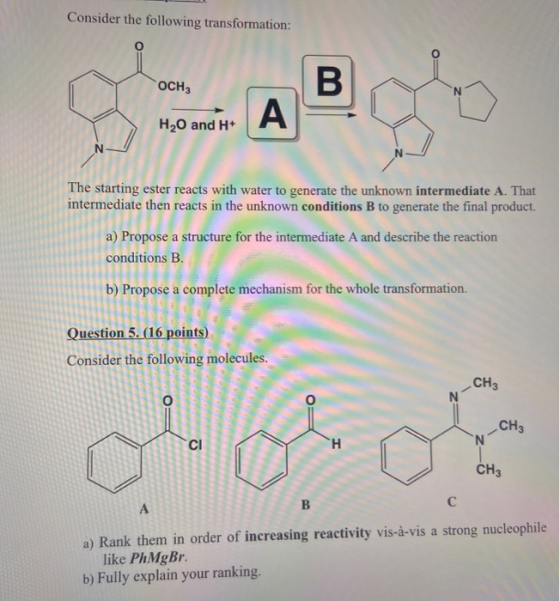
Look at the following reaction: Toluene...
Slide appropriate reactants into the boxes to conduct the following synthetic transformation. You don't need to...
 Slide appropriate reactants into the boxes to conduct the following synthetic transformation. You don't need to necessarily fill all the boxes, but if you don't use them all, fill from the top down. Unused boxes can be left empty. Br CH3CH2CH2Li 1. BH3-THF; 2. NaOH, H2O2, H2o Hg2+, H2O, H+ KCN, HCN H20, H+ CH3OH, H+ NaOH, H2O 1. (Sia 2BH; 2. NaOH, H2O2, H2O PhLi HOCH2CH2OH, H+ Nothing Needed PCC PhMgBr CH3CH2NH2, H+ H2Cr04 KCN NaBH4, MeOH (CH3CH2CH2)2Culi CH3CH2MgBr...
Please show the mechanistic steps for the following 2 reactions. Thank you for the help. CH.CH...
 Please show the mechanistic steps for the following 2
reactions. Thank you for the help.
CH.CH OH products Explanation: Reaction of tertiary alkyl halide with weak nucleophile.CH,CH,OH involves SN substitution reaction and produces racemic mixture of products, H20 - products Explanation: Reaction of tertiary alkyl halide with weak nucleophile,H,O involves SN, substitution reaction and produces racemic mixture of products.
Please show the mechanistic steps for the following 2
reactions. Thank you for the help.
CH.CH OH products Explanation: Reaction of tertiary alkyl halide with weak nucleophile.CH,CH,OH involves SN substitution reaction and produces racemic mixture of products, H20 - products Explanation: Reaction of tertiary alkyl halide with weak nucleophile,H,O involves SN, substitution reaction and produces racemic mixture of products.
can you solve 7 and 8 please? 7. Propose structure(s) for the major organic product(s) of...
 can you solve 7 and 8 please?
7. Propose structure(s) for the major organic product(s) of the following reactions or sequences of reactions. Show all relevant stereochemistry. a. O CH3CCH3 + CH3CH2MgBr 1. ether 2. H30* b. -[O] CrO3 H20 OH C. CH3 + CH3CH2NH2 1º amine 8. Write the complete stepwise mechanism for the Grignard reaction shown below. Show all intermediate structures and all electron flow with arrows. OH C-CH2CH3 1. in ether CH3 CH3CH2MgBr 2. H, H2O O=0...
can you solve 7 and 8 please?
7. Propose structure(s) for the major organic product(s) of the following reactions or sequences of reactions. Show all relevant stereochemistry. a. O CH3CCH3 + CH3CH2MgBr 1. ether 2. H30* b. -[O] CrO3 H20 OH C. CH3 + CH3CH2NH2 1º amine 8. Write the complete stepwise mechanism for the Grignard reaction shown below. Show all intermediate structures and all electron flow with arrows. OH C-CH2CH3 1. in ether CH3 CH3CH2MgBr 2. H, H2O O=0...
answer B & C asap please 4. Consider the following reaction and answer the questions: -...
 answer B & C asap please
4. Consider the following reaction and answer the questions: - Br HSCH, SCHE нс" HC HEC a) Draw the structure of the expected cation intermediate if the reactant underwent an SNl reaction b) The reaction produces almost an equal mixture of diastereomer products, does this indicate an Snl or Sn2 mechanism, explain your choice briefly? c) Even though a good nucleophile is present, explain in terms of reaction rates, why a mixture of products...
answer B & C asap please
4. Consider the following reaction and answer the questions: - Br HSCH, SCHE нс" HC HEC a) Draw the structure of the expected cation intermediate if the reactant underwent an SNl reaction b) The reaction produces almost an equal mixture of diastereomer products, does this indicate an Snl or Sn2 mechanism, explain your choice briefly? c) Even though a good nucleophile is present, explain in terms of reaction rates, why a mixture of products...
4.(18 points) Using the arrow, provide the detailed reaction conditions necessary to give the following. You...
 4.(18 points) Using the arrow, provide the detailed reaction conditions necessary to give the following. You do not need to provide any starting material or product, just the reaction conditions (see example below) 1.B Example: Show reagent 'B' followed by aqueous acid: 2. H30 a. Markovnikov addition of H2O to a double bond: b. Anti-Markovnikov addition of H2O to a double bond: c. Markovnikov addition to form an alkyl bromide from an alkene: d. Reaction conditions to change 1,2-dimethylcyclohexene into...
show all work please thank you!!! 3. (10 pts total) Consider the following alkene addition reaction:...
 show all work please thank you!!!
3. (10 pts total) Consider the following alkene addition reaction: Brz H2O НО Br a. (3 pts) This type of alkene addition reaction is mediated by both Lewis acids and bases. Of the two inorganic reactants (Br2 and H2O), place a triangle (1) around the one which functions as a Lewis acid in the above transformation b. (3 pts) of the two regioisomeric reaction products shown, only one is observed to form under the...
show all work please thank you!!!
3. (10 pts total) Consider the following alkene addition reaction: Brz H2O НО Br a. (3 pts) This type of alkene addition reaction is mediated by both Lewis acids and bases. Of the two inorganic reactants (Br2 and H2O), place a triangle (1) around the one which functions as a Lewis acid in the above transformation b. (3 pts) of the two regioisomeric reaction products shown, only one is observed to form under the...
please i need answer for all 12) How many transition states are present in the reaction...
 please i need answer for all
12) How many transition states are present in the reaction in the energy diagram? 12) A) 0 B) 1 D) 3 C)2 13) How many transition states and intermediates would the reaction profile have for the reaction shown below? 13) CH3 CHa CH3 CH3 Н.о OH H-CI step 2 step 1 step 3 A B A) Two transition states and three intermediates B) Three transition states and three intermediates C) Two transition states and...
please i need answer for all
12) How many transition states are present in the reaction in the energy diagram? 12) A) 0 B) 1 D) 3 C)2 13) How many transition states and intermediates would the reaction profile have for the reaction shown below? 13) CH3 CHa CH3 CH3 Н.о OH H-CI step 2 step 1 step 3 A B A) Two transition states and three intermediates B) Three transition states and three intermediates C) Two transition states and...
Answer all please! Thank you in advance. Many of the condensations we have studied are reversible....
 Answer all please! Thank you in advance.
Many of the condensations we have studied are reversible. The reverse reactions are often given the prefix retro-, the Latin word meaning "backward." Propose mechanisms to account for the following reactions 22-76 CH H CH CH3 н* (b) (а) CH С- (сн), —сно CH ОН (retro-aldol and further condensation) но. (retro-aldol) CH OH (d) "ОСн, CH OН OH H,C-CH-CN СООCH (retro-Michael) (retro-aldol and crossed Claisen)
Answer all please! Thank you in advance.
Many of the condensations we have studied are reversible. The reverse reactions are often given the prefix retro-, the Latin word meaning "backward." Propose mechanisms to account for the following reactions 22-76 CH H CH CH3 н* (b) (а) CH С- (сн), —сно CH ОН (retro-aldol and further condensation) но. (retro-aldol) CH OH (d) "ОСн, CH OН OH H,C-CH-CN СООCH (retro-Michael) (retro-aldol and crossed Claisen)
Help with part e please! 3. Consider the following Sw1 reaction. CHg CH,-Ẻ-CHCH + HO ---...
 Help with part e please!
3. Consider the following Sw1 reaction. CHg CH,-Ẻ-CHCH + HO --- ne bo pomem e no — a potom os CHE CH-C-CHÚCH + I" OH a. Draw a mechanism for this reaction using curved arrows. b. Draw an energy diagram. Label the axes, starting material, product, E, and . Assume that the starting material and product are equal in energy. c. Draw the structure of any transition states. d. What is the rate equation for...
Help with part e please!
3. Consider the following Sw1 reaction. CHg CH,-Ẻ-CHCH + HO --- ne bo pomem e no — a potom os CHE CH-C-CHÚCH + I" OH a. Draw a mechanism for this reaction using curved arrows. b. Draw an energy diagram. Label the axes, starting material, product, E, and . Assume that the starting material and product are equal in energy. c. Draw the structure of any transition states. d. What is the rate equation for...
please answer for me all questions 1-20 1) Identify the alkyl halide that reacts the fastest...
 please answer for me all questions 1-20
1) Identify the alkyl halide that reacts the fastest in a Sn2 reaction. A) chloromethane B) 2-chloro-2-methylpropane C) 2-chlorobutane D) 1-chlorobutane 2) Identify the alkyl halide that reacts the fastest in an SN 2 reaction. A) 1-bromopropane B) 1-fluoropropane C) 1-chloropropane D) 1-iodopropane 3) Which of the following alkyl halides gives the slowest SN2 reaction? A) CH3CH2C1 B) Ci CH3CCH2CH3 CH3 C) CH3CHCH2CH3 CH2 CH3CHCHCH3 C1 СН3 4) Which of the following alkyl...
please answer for me all questions 1-20
1) Identify the alkyl halide that reacts the fastest in a Sn2 reaction. A) chloromethane B) 2-chloro-2-methylpropane C) 2-chlorobutane D) 1-chlorobutane 2) Identify the alkyl halide that reacts the fastest in an SN 2 reaction. A) 1-bromopropane B) 1-fluoropropane C) 1-chloropropane D) 1-iodopropane 3) Which of the following alkyl halides gives the slowest SN2 reaction? A) CH3CH2C1 B) Ci CH3CCH2CH3 CH3 C) CH3CHCH2CH3 CH2 CH3CHCHCH3 C1 СН3 4) Which of the following alkyl...
 Slide appropriate reactants into the boxes to conduct the following synthetic transformation. You don't need to necessarily fill all the boxes, but if you don't use them all, fill from the top down. Unused boxes can be left empty. Br CH3CH2CH2Li 1. BH3-THF; 2. NaOH, H2O2, H2o Hg2+, H2O, H+ KCN, HCN H20, H+ CH3OH, H+ NaOH, H2O 1. (Sia 2BH; 2. NaOH, H2O2, H2O PhLi HOCH2CH2OH, H+ Nothing Needed PCC PhMgBr CH3CH2NH2, H+ H2Cr04 KCN NaBH4, MeOH (CH3CH2CH2)2Culi CH3CH2MgBr...
 Please show the mechanistic steps for the following 2
reactions. Thank you for the help.
CH.CH OH products Explanation: Reaction of tertiary alkyl halide with weak nucleophile.CH,CH,OH involves SN substitution reaction and produces racemic mixture of products, H20 - products Explanation: Reaction of tertiary alkyl halide with weak nucleophile,H,O involves SN, substitution reaction and produces racemic mixture of products.
Please show the mechanistic steps for the following 2
reactions. Thank you for the help.
CH.CH OH products Explanation: Reaction of tertiary alkyl halide with weak nucleophile.CH,CH,OH involves SN substitution reaction and produces racemic mixture of products, H20 - products Explanation: Reaction of tertiary alkyl halide with weak nucleophile,H,O involves SN, substitution reaction and produces racemic mixture of products.
 can you solve 7 and 8 please?
7. Propose structure(s) for the major organic product(s) of the following reactions or sequences of reactions. Show all relevant stereochemistry. a. O CH3CCH3 + CH3CH2MgBr 1. ether 2. H30* b. -[O] CrO3 H20 OH C. CH3 + CH3CH2NH2 1º amine 8. Write the complete stepwise mechanism for the Grignard reaction shown below. Show all intermediate structures and all electron flow with arrows. OH C-CH2CH3 1. in ether CH3 CH3CH2MgBr 2. H, H2O O=0...
can you solve 7 and 8 please?
7. Propose structure(s) for the major organic product(s) of the following reactions or sequences of reactions. Show all relevant stereochemistry. a. O CH3CCH3 + CH3CH2MgBr 1. ether 2. H30* b. -[O] CrO3 H20 OH C. CH3 + CH3CH2NH2 1º amine 8. Write the complete stepwise mechanism for the Grignard reaction shown below. Show all intermediate structures and all electron flow with arrows. OH C-CH2CH3 1. in ether CH3 CH3CH2MgBr 2. H, H2O O=0...
 answer B & C asap please
4. Consider the following reaction and answer the questions: - Br HSCH, SCHE нс" HC HEC a) Draw the structure of the expected cation intermediate if the reactant underwent an SNl reaction b) The reaction produces almost an equal mixture of diastereomer products, does this indicate an Snl or Sn2 mechanism, explain your choice briefly? c) Even though a good nucleophile is present, explain in terms of reaction rates, why a mixture of products...
answer B & C asap please
4. Consider the following reaction and answer the questions: - Br HSCH, SCHE нс" HC HEC a) Draw the structure of the expected cation intermediate if the reactant underwent an SNl reaction b) The reaction produces almost an equal mixture of diastereomer products, does this indicate an Snl or Sn2 mechanism, explain your choice briefly? c) Even though a good nucleophile is present, explain in terms of reaction rates, why a mixture of products...
 4.(18 points) Using the arrow, provide the detailed reaction conditions necessary to give the following. You do not need to provide any starting material or product, just the reaction conditions (see example below) 1.B Example: Show reagent 'B' followed by aqueous acid: 2. H30 a. Markovnikov addition of H2O to a double bond: b. Anti-Markovnikov addition of H2O to a double bond: c. Markovnikov addition to form an alkyl bromide from an alkene: d. Reaction conditions to change 1,2-dimethylcyclohexene into...
 show all work please thank you!!!
3. (10 pts total) Consider the following alkene addition reaction: Brz H2O НО Br a. (3 pts) This type of alkene addition reaction is mediated by both Lewis acids and bases. Of the two inorganic reactants (Br2 and H2O), place a triangle (1) around the one which functions as a Lewis acid in the above transformation b. (3 pts) of the two regioisomeric reaction products shown, only one is observed to form under the...
show all work please thank you!!!
3. (10 pts total) Consider the following alkene addition reaction: Brz H2O НО Br a. (3 pts) This type of alkene addition reaction is mediated by both Lewis acids and bases. Of the two inorganic reactants (Br2 and H2O), place a triangle (1) around the one which functions as a Lewis acid in the above transformation b. (3 pts) of the two regioisomeric reaction products shown, only one is observed to form under the...
 please i need answer for all
12) How many transition states are present in the reaction in the energy diagram? 12) A) 0 B) 1 D) 3 C)2 13) How many transition states and intermediates would the reaction profile have for the reaction shown below? 13) CH3 CHa CH3 CH3 Н.о OH H-CI step 2 step 1 step 3 A B A) Two transition states and three intermediates B) Three transition states and three intermediates C) Two transition states and...
please i need answer for all
12) How many transition states are present in the reaction in the energy diagram? 12) A) 0 B) 1 D) 3 C)2 13) How many transition states and intermediates would the reaction profile have for the reaction shown below? 13) CH3 CHa CH3 CH3 Н.о OH H-CI step 2 step 1 step 3 A B A) Two transition states and three intermediates B) Three transition states and three intermediates C) Two transition states and...
 Answer all please! Thank you in advance.
Many of the condensations we have studied are reversible. The reverse reactions are often given the prefix retro-, the Latin word meaning "backward." Propose mechanisms to account for the following reactions 22-76 CH H CH CH3 н* (b) (а) CH С- (сн), —сно CH ОН (retro-aldol and further condensation) но. (retro-aldol) CH OH (d) "ОСн, CH OН OH H,C-CH-CN СООCH (retro-Michael) (retro-aldol and crossed Claisen)
Answer all please! Thank you in advance.
Many of the condensations we have studied are reversible. The reverse reactions are often given the prefix retro-, the Latin word meaning "backward." Propose mechanisms to account for the following reactions 22-76 CH H CH CH3 н* (b) (а) CH С- (сн), —сно CH ОН (retro-aldol and further condensation) но. (retro-aldol) CH OH (d) "ОСн, CH OН OH H,C-CH-CN СООCH (retro-Michael) (retro-aldol and crossed Claisen)
 Help with part e please!
3. Consider the following Sw1 reaction. CHg CH,-Ẻ-CHCH + HO --- ne bo pomem e no — a potom os CHE CH-C-CHÚCH + I" OH a. Draw a mechanism for this reaction using curved arrows. b. Draw an energy diagram. Label the axes, starting material, product, E, and . Assume that the starting material and product are equal in energy. c. Draw the structure of any transition states. d. What is the rate equation for...
Help with part e please!
3. Consider the following Sw1 reaction. CHg CH,-Ẻ-CHCH + HO --- ne bo pomem e no — a potom os CHE CH-C-CHÚCH + I" OH a. Draw a mechanism for this reaction using curved arrows. b. Draw an energy diagram. Label the axes, starting material, product, E, and . Assume that the starting material and product are equal in energy. c. Draw the structure of any transition states. d. What is the rate equation for...
 please answer for me all questions 1-20
1) Identify the alkyl halide that reacts the fastest in a Sn2 reaction. A) chloromethane B) 2-chloro-2-methylpropane C) 2-chlorobutane D) 1-chlorobutane 2) Identify the alkyl halide that reacts the fastest in an SN 2 reaction. A) 1-bromopropane B) 1-fluoropropane C) 1-chloropropane D) 1-iodopropane 3) Which of the following alkyl halides gives the slowest SN2 reaction? A) CH3CH2C1 B) Ci CH3CCH2CH3 CH3 C) CH3CHCH2CH3 CH2 CH3CHCHCH3 C1 СН3 4) Which of the following alkyl...
please answer for me all questions 1-20
1) Identify the alkyl halide that reacts the fastest in a Sn2 reaction. A) chloromethane B) 2-chloro-2-methylpropane C) 2-chlorobutane D) 1-chlorobutane 2) Identify the alkyl halide that reacts the fastest in an SN 2 reaction. A) 1-bromopropane B) 1-fluoropropane C) 1-chloropropane D) 1-iodopropane 3) Which of the following alkyl halides gives the slowest SN2 reaction? A) CH3CH2C1 B) Ci CH3CCH2CH3 CH3 C) CH3CHCH2CH3 CH2 CH3CHCHCH3 C1 СН3 4) Which of the following alkyl...
Most questions answered within 3 hours.
-
Where is the error in this code sequence?
String s1 = "Hello";
String s2 = "ello";...
asked 11 months ago -
Financial data for Joel de Paris, Inc., for last year
follow:
Joel de Paris, Inc.
Balance...
asked 11 months ago -
Consider this reaction:
Al2(SO4)3 (aq)+ BaCl3
(aq) Al2Cl6 (aq)- +
3BaSO4(s) . What is the...
asked 11 months ago -
Suppose that Savneet is considering increasing her
recent random sample from 20 car rentals to 40...
asked 11 months ago -
Trucks arrive at an unloading terminal at an average rate of 120
per hour.
Trucks arrive...
asked 11 months ago -
Why are methanol and ethanol completely soluble in water while
octanol is not very little soluble....
asked 11 months ago -
A facilities manager at a university reads in a research report
that the mean amount of...
asked 11 months ago -
When the CuSO4 is rehydrated by adding water to the anhydrous
compound, is this an endothermic...
asked 11 months ago -
A ray of sunlight is passing from diamond into crown glass; the
angle of incidence is...
asked 11 months ago -
A block of mass 0.249 kg is placed on top of a light, vertical
spring of...
asked 11 months ago -
how do the kidneys compensate in the presences of acidosis
a) trigger hyperventilate
b) reserve acid...
asked 11 months ago -
Question 501 pts
The rental rate of capital to the firm increases. Which of the
following...
asked 11 months ago