During the extraction, indicate which substance(s) is (are) removed at each step with the following reagents: a. washing with water; b. washing with saturated sodium bicarbonate.
During the extraction, indicate which substance(s) is (are) removed at each step with the following reagents: a. washing with water; b. washing with saturated sodium bicarbonate.
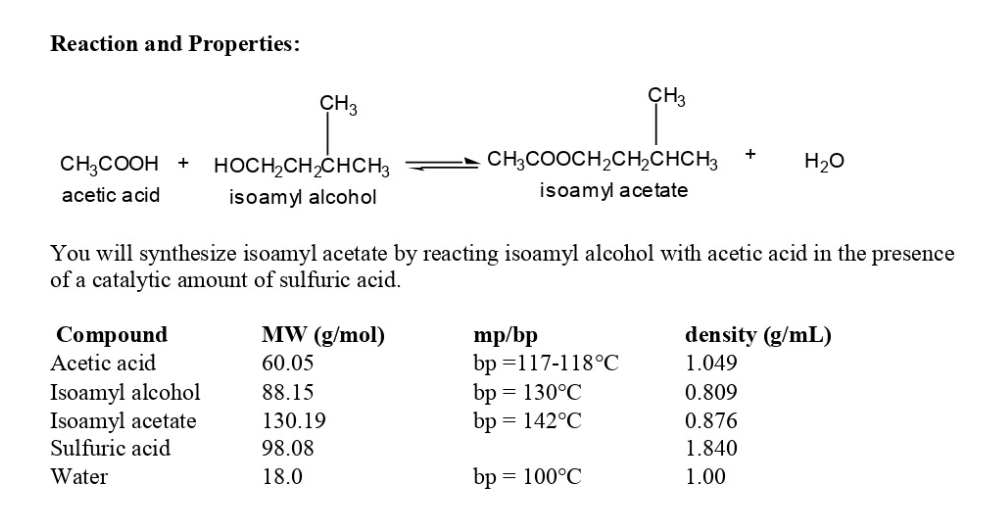
 experiment 6 reaction and compounds.png
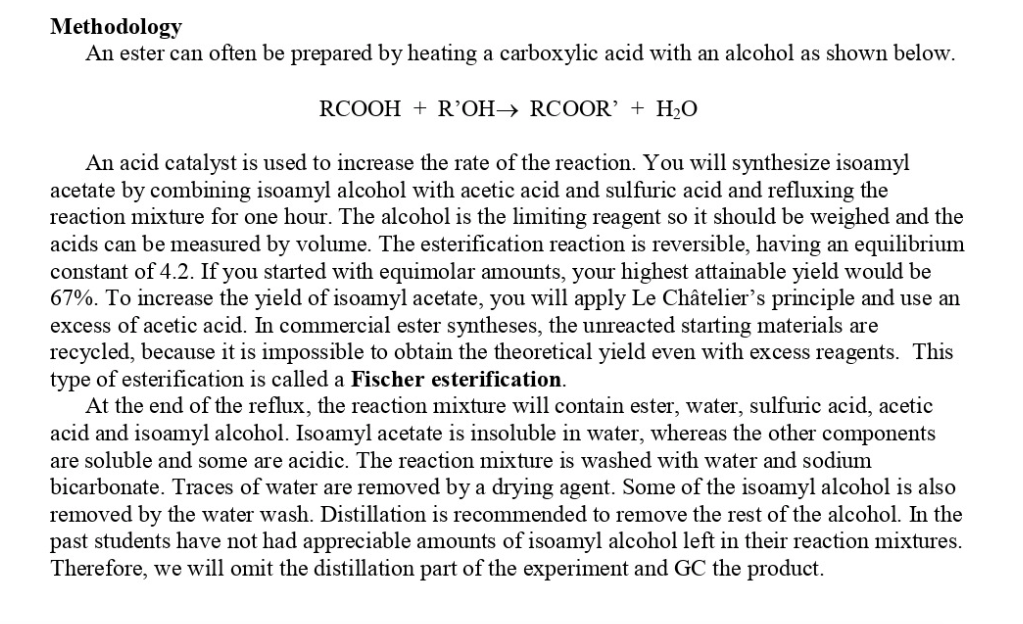
experiment 6 methodology 2.png
Homework Answers
Request Answer!
10 have requested this problem solution
The more requests, the faster the answer.
Add Answer to:
During the extraction, indicate which substance(s) is (are) removed at each step with the following reagents: a. washing with water; b. washing with saturated sodium bicarbonate.
The reaction is Esterification Acetic Acid + isoamyl alcohol yielding isoamyl acetate During the extraction indicate...
The reaction is Esterification Acetic Acid + isoamyl alcohol yielding isoamyl acetate During the extraction indicate which substance(s) is (are)) removed at each step with the following reagents: a. washing with water b. washing with saturated sodium bicarbonate. Since the reaction you will perform is reversible, give two ways you could push the equilibrium in the forward direction in the laboratory.
Acid/Base Extraction 1. Provide a flow chart detailing the acid/base extraction/separation of the compounds shown below....
 Acid/Base Extraction
1. Provide a flow chart detailing the acid/base
extraction/separation of the compounds shown below. Your answer
must employ the following reagents: methylene chloride,
hydrochloric acid (1M & 6M), sodium hydroxide (1M & 6M),
10% sodium bicarbonate (aq). Clearly indicate the product(s) and
layers formed following each step of your separation scheme.
IMPORTANT: p-cresol is soluble in sodium hydroxide solution but
insoluble in neutral water or sodium bicarbonate solution. 2-
ethylbenzoic acid is soluble in both sodium hydroxide and...
Acid/Base Extraction
1. Provide a flow chart detailing the acid/base
extraction/separation of the compounds shown below. Your answer
must employ the following reagents: methylene chloride,
hydrochloric acid (1M & 6M), sodium hydroxide (1M & 6M),
10% sodium bicarbonate (aq). Clearly indicate the product(s) and
layers formed following each step of your separation scheme.
IMPORTANT: p-cresol is soluble in sodium hydroxide solution but
insoluble in neutral water or sodium bicarbonate solution. 2-
ethylbenzoic acid is soluble in both sodium hydroxide and...
Provide a flow chart detailing the acid/base extraction/separation of the compounds show below. Your answer must...
 Provide a flow chart detailing the acid/base extraction/separation of the compounds show below. Your answer must employ the following reagents: methylene chloride, hydrochloric acid (1M & 6M), sodium hydroxide (1M & 6M), 10% sodium bicarbonate (aq). Clearly indicate the product(s) and layers formed following each step of your separation scheme. IMPORTANT: p-cresol is soluble in sodium hydroxide solution but insoluble in neutral water or sodium bicarbonate solution. 2-ethylbenzoic acid is soluble in both sodium hydroxide and sodium bicarbonate solutions. Use...
what is the purpose of each of the extractions (washings) the crude product? In other word,...
what is the purpose of each of the extractions (washings) the crude product? In other word, what is removed upon washing with (a) water (b) sodium bicarbonate and finally (c) ammonium chloride. The experiment I did is amide synthesis from carboxylic acid and amine and using EDCl with catalyst DMAP and DMF. By doing the extraction. I dilute my reaction mixture with 40 ml of water, pour the contents into separatory funnel. Then add approximately 20 mL of ethyl acetate...
Sodium bisulfite is used during the extraction to procedure to react with unreacted aldehyde according to...
 Sodium bisulfite is used during the extraction to procedure to react with unreacted aldehyde according to the following equation: a) Why is this done? Answer this question by explaining what would happen (and why) without bisulfite extraction versus with bisulfite extraction, assuming that not all of the aldehyde used during the reaction reacts. Focus on the isolated product from the reaction (2-methyl-3-heptanol) b) Saturated sodium bisulfite in water contains 42 g of sodium bisulfite per 100 mL of solution. What...
Acid/Base Extraction ACID/BASE EXTRACTION Provide a flow chart detailing the acid/base extraction/separation of the compounds shown...
 Acid/Base Extraction
ACID/BASE EXTRACTION Provide a flow chart detailing the acid/base extraction/separation of the compounds shown below. Your answer must employ the following reagents: methylene chloride, hydrochloric acid (1M & 6M), sodium hydroxide (1M & 6M), 10% sodium bicarbonate (aq). Clearly indicate the product(s) and layers formed following each step of your separation scheme. HINT: phenol is soluble in sodium hydroxide solution but insoluble in neutral water or sodium bicarbonate solution. Benzoic acid is soluble in both sodium hydroxide and...
Acid/Base Extraction
ACID/BASE EXTRACTION Provide a flow chart detailing the acid/base extraction/separation of the compounds shown below. Your answer must employ the following reagents: methylene chloride, hydrochloric acid (1M & 6M), sodium hydroxide (1M & 6M), 10% sodium bicarbonate (aq). Clearly indicate the product(s) and layers formed following each step of your separation scheme. HINT: phenol is soluble in sodium hydroxide solution but insoluble in neutral water or sodium bicarbonate solution. Benzoic acid is soluble in both sodium hydroxide and...
9. Then add slowly while mixing 1 mL of saturated sodium bicarbonate solution (NaHCO3) -IT WILL...
 9. Then add slowly while mixing 1 mL of saturated sodium bicarbonate solution (NaHCO3) -IT WILL BUBBLE! Add additional drops of saturated sodium bicarbonate solution with mixing until no additional bubbling occurs Congratulations! You have just made your first ester. Now you want to separate your ester product from the other stuff in the reaction mixture. CTQ3 Sodium bicarbonate is a base. How will it interact with any carboxylic acid molecules still present in your reaction mixture? 10. Add 1mL...
To do any extraction, you’ll need two liquids or solutions. They must be insoluble in each...
To do any extraction, you’ll need two liquids or solutions. They must be insoluble in each other. a. What does it mean to have 2 insoluble liquids or solutions? b. I have listed twelve liquids and solutions below. Identify if each solution is considered aqueous or organic. Water, acetone, 1.0 M NaOH, 1.0 M HCl, diethylether, brine (saturated sodium chloride in water), dichloromethane, 10% sodium bicarbonate solution, ethyl acetate, chloroform, ethanol, hexane. 2. Which of the organic liquid(s) from 1b...
[121 Which of the following drying agent is used during caffeine extraction experiment (A sodium chloride...
 [121 Which of the following drying agent is used during caffeine extraction experiment (A sodium chloride B magnesium sulfate C. calcium chloride D. Cesium fluoride
Given a solid mixture of the following molecules determine a separate scheme that can be used...
Given a solid mixture of the following molecules determine a separate scheme that can be used to separate the mixture using acid base extraction. - 2-hydroxybenzoic acid - 4-chloroanaline - trans-stillbene The following solvents and reagents will be available for use during the experiment 1. 5% sodium bicarbonate 2. 10% sodium hydroxide 3. Saturated sodium chloride 4. 5% hydrochloric acid 5. 6 M hydrochloric acid 6. Diethyl ether 7. Anhydrous sodium or magnesium sulfate *Can you include a experimental procedure...
 Acid/Base Extraction
1. Provide a flow chart detailing the acid/base
extraction/separation of the compounds shown below. Your answer
must employ the following reagents: methylene chloride,
hydrochloric acid (1M & 6M), sodium hydroxide (1M & 6M),
10% sodium bicarbonate (aq). Clearly indicate the product(s) and
layers formed following each step of your separation scheme.
IMPORTANT: p-cresol is soluble in sodium hydroxide solution but
insoluble in neutral water or sodium bicarbonate solution. 2-
ethylbenzoic acid is soluble in both sodium hydroxide and...
Acid/Base Extraction
1. Provide a flow chart detailing the acid/base
extraction/separation of the compounds shown below. Your answer
must employ the following reagents: methylene chloride,
hydrochloric acid (1M & 6M), sodium hydroxide (1M & 6M),
10% sodium bicarbonate (aq). Clearly indicate the product(s) and
layers formed following each step of your separation scheme.
IMPORTANT: p-cresol is soluble in sodium hydroxide solution but
insoluble in neutral water or sodium bicarbonate solution. 2-
ethylbenzoic acid is soluble in both sodium hydroxide and...
 Provide a flow chart detailing the acid/base extraction/separation of the compounds show below. Your answer must employ the following reagents: methylene chloride, hydrochloric acid (1M & 6M), sodium hydroxide (1M & 6M), 10% sodium bicarbonate (aq). Clearly indicate the product(s) and layers formed following each step of your separation scheme. IMPORTANT: p-cresol is soluble in sodium hydroxide solution but insoluble in neutral water or sodium bicarbonate solution. 2-ethylbenzoic acid is soluble in both sodium hydroxide and sodium bicarbonate solutions. Use...
 Sodium bisulfite is used during the extraction to procedure to react with unreacted aldehyde according to the following equation: a) Why is this done? Answer this question by explaining what would happen (and why) without bisulfite extraction versus with bisulfite extraction, assuming that not all of the aldehyde used during the reaction reacts. Focus on the isolated product from the reaction (2-methyl-3-heptanol) b) Saturated sodium bisulfite in water contains 42 g of sodium bisulfite per 100 mL of solution. What...
 Acid/Base Extraction
ACID/BASE EXTRACTION Provide a flow chart detailing the acid/base extraction/separation of the compounds shown below. Your answer must employ the following reagents: methylene chloride, hydrochloric acid (1M & 6M), sodium hydroxide (1M & 6M), 10% sodium bicarbonate (aq). Clearly indicate the product(s) and layers formed following each step of your separation scheme. HINT: phenol is soluble in sodium hydroxide solution but insoluble in neutral water or sodium bicarbonate solution. Benzoic acid is soluble in both sodium hydroxide and...
Acid/Base Extraction
ACID/BASE EXTRACTION Provide a flow chart detailing the acid/base extraction/separation of the compounds shown below. Your answer must employ the following reagents: methylene chloride, hydrochloric acid (1M & 6M), sodium hydroxide (1M & 6M), 10% sodium bicarbonate (aq). Clearly indicate the product(s) and layers formed following each step of your separation scheme. HINT: phenol is soluble in sodium hydroxide solution but insoluble in neutral water or sodium bicarbonate solution. Benzoic acid is soluble in both sodium hydroxide and...
 9. Then add slowly while mixing 1 mL of saturated sodium bicarbonate solution (NaHCO3) -IT WILL BUBBLE! Add additional drops of saturated sodium bicarbonate solution with mixing until no additional bubbling occurs Congratulations! You have just made your first ester. Now you want to separate your ester product from the other stuff in the reaction mixture. CTQ3 Sodium bicarbonate is a base. How will it interact with any carboxylic acid molecules still present in your reaction mixture? 10. Add 1mL...
 [121 Which of the following drying agent is used during caffeine extraction experiment (A sodium chloride B magnesium sulfate C. calcium chloride D. Cesium fluoride

Most questions answered within 3 hours.
-
Where is the error in this code sequence?
String s1 = "Hello";
String s2 = "ello";...
asked 10 months ago -
Financial data for Joel de Paris, Inc., for last year
follow:
Joel de Paris, Inc.
Balance...
asked 10 months ago -
Consider this reaction:
Al2(SO4)3 (aq)+ BaCl3
(aq) Al2Cl6 (aq)- +
3BaSO4(s) . What is the...
asked 10 months ago -
Suppose that Savneet is considering increasing her
recent random sample from 20 car rentals to 40...
asked 10 months ago -
Trucks arrive at an unloading terminal at an average rate of 120
per hour.
Trucks arrive...
asked 10 months ago -
Why are methanol and ethanol completely soluble in water while
octanol is not very little soluble....
asked 10 months ago -
A facilities manager at a university reads in a research report
that the mean amount of...
asked 10 months ago -
When the CuSO4 is rehydrated by adding water to the anhydrous
compound, is this an endothermic...
asked 10 months ago -
A ray of sunlight is passing from diamond into crown glass; the
angle of incidence is...
asked 10 months ago -
A block of mass 0.249 kg is placed on top of a light, vertical
spring of...
asked 10 months ago -
how do the kidneys compensate in the presences of acidosis
a) trigger hyperventilate
b) reserve acid...
asked 10 months ago -
Question 501 pts
The rental rate of capital to the firm increases. Which of the
following...
asked 10 months ago