
Homework Answers
Add Answer to:
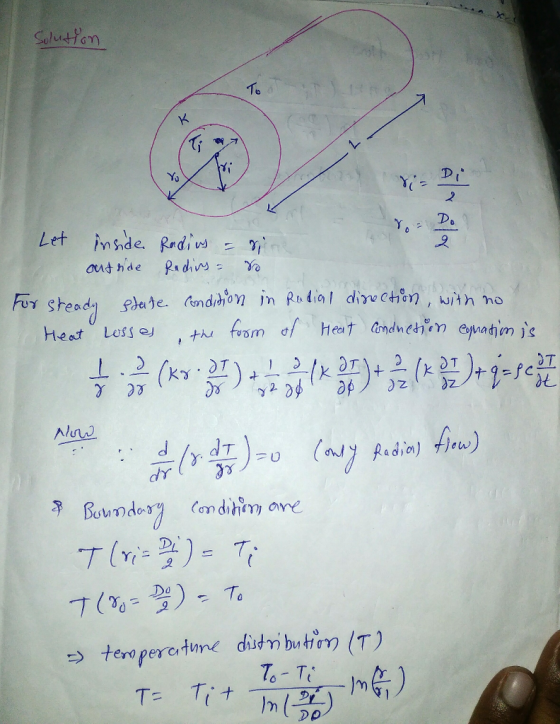
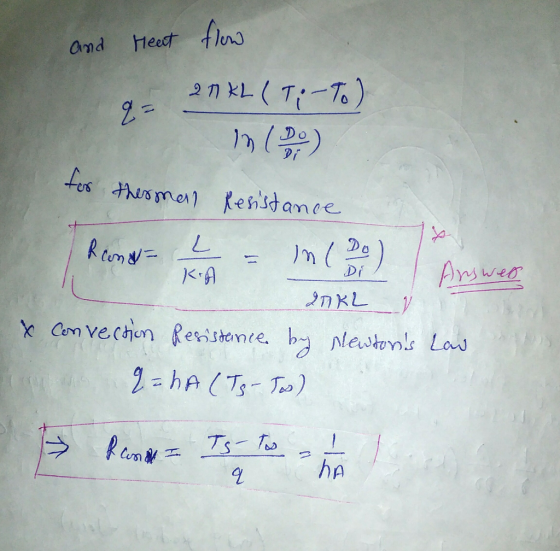
A hollow cylinder is made of material of thermal conductivity k. The dimensions of the cylinder...
18. A cylinder of radius r and made of a material of thermal conductivity kiis surrounded...
 18. A cylinder of radius r and made of a material of thermal conductivity kiis surrounded by a cylindrical shell of inner radius r and outer radius 2r. This outer shell is made of a material of thermal conductivity k2. The two ends of the combined system are maintained at two different temperatures. Under steady state conditions and no loss of heat across the cylindrical surface, the effective thermal conductivity of the arrangement would be: (a) k,+k2 (6) kk kitk,...
Consider a 4 m high, 6 m wide and 0.17 m thick wall whose thermal conductivity is k = 0.8 W/m.oC....
Consider a 4 m high, 6 m wide and 0.17 m thick wall whose thermal conductivity is k = 0.8 W/m.oC. On a certain day, the temperatures of the inner and the outer medium close to the wall are measured to be 14oC and 6oC, respectively. Both inner and outer surfaces are subjected to convection heat transfer. Assume that the convection heat transfer coefficient is the same for the two surfaces h = 5 W/m2 ∙ °C. 1. Draw the...
3/5 25 pts.J A slab of thickness L, made of material with constant thermal conductivity k,...
 3/5 25 pts.J A slab of thickness L, made of material with constant thermal conductivity k, is undergoing a 1-D, steady heat transfer. Its boundary surface at x 0 is insulated while the boundary surface at x= 1 is kept at constant temperature T= oc. Heat energy is generated within the slab at a rate of 2. qx)o cos(rx/2L) is the energy generation rate per unit volume (Wm) at x= 0. where qo a. Develop an expression for the steady-state...
A pipe with insulation material is used to carry steam to an operating plant. The conditions...
 A pipe with insulation material is used to carry steam to an operating plant. The conditions and dimensions for the system are as follows Variable Value Length of pipe, L 100 ft Inner diameter of pipe, Do 1 inch Outer diameter of pipe, D1 1.24 inches Outer diameter of insulation, D2 2 inches Inside film heat transfer coefficient for condensing saturated steam, ho 800 Btu/hr-ft2.oF Outside film heat transfer coefficient for air, ht 2 Btu/hr-ft2.oF Thermal conductivity of the pipe,...
ent material has the thermal conductivity k and thickness L. The temperature the material is of the form: distribution along the x-direction, T(x) in + Bx2 + C, where A, a, B, and C are constants...
 ent material has the thermal conductivity k and thickness L. The temperature the material is of the form: distribution along the x-direction, T(x) in + Bx2 + C, where A, a, B, and C are constants. The irradiation is fully the material and can be characterized by a uniform volumetric heat generation, W/m3). Assuming 1D steady-state conduction and constant properties. xpressions for the conduction heat fluxes (alx) at the top and bottom surfaces; absorbed by (4 points) (b) Derive an...
012 The brick wall (of thermal conductivity 0.96 W/m · ◦ C) of a building has...
012 The brick wall (of thermal conductivity 0.96 W/m · ◦ C) of a building has dimensions of 1.7 m by 15 m and is 19 cm thick. How much heat flows through the wall in a 18.6 h period when the average inside and outside temperatures are, respectively, 24◦C and 6◦C? Answer in units of MJ.
(b) The brick wall of a building has dimensions of 4 m by 10 m, and it is 15 cm thick with a coefficient of thermal con...
 (b) The brick wall of a building has dimensions of 4 m by 10 m, and it is 15 cm thick with a coefficient of thermal conductivity of 0.8 W.m1ec1. How much heat flows through the wall in a 12-hour period when the average inside and outside temperatures are 20 °C and 5 °C respectively? Will a 2 kW heater operating in the room compensate for the heat loss? Justify your answer. A layer of insulating material of thickness 5...
A long cylinder of diameter D 0.012 m, thermal conductivity k 358 W/(mK), density p -...
 A long cylinder of diameter D 0.012 m, thermal conductivity k 358 W/(mK), density p - 7614 kg/m3, specific heat c 418 J/(kgK) is initially at a uniform temperature of Ti-74°C. The cylinder is suddenly exposed to a gas at T,-18 ℃ The convection coefficient is h -17 W/(m2K). Verify that a lumped capacitance analysis can be used for the transient response of the cylinder temperature. What is the time t in seconds for the cylinder temperature to become Tf-32...
Consider a rectangular bar of thermal conductivity k W/m-K and total length 2L, as shown in...
 Consider a rectangular bar of thermal conductivity k W/m-K and
total length 2L, as shown in the figure, is connected to a hot
surface that is at a temperature T1. The connection between the bar
and the surface is imperfect and results in a thermal contact
resistance of R’’ m2-K/W. The width of the rod into the depth of
the paper is W meters and the thickness of the rod is t meters. The
first section of the rod of...
Consider a rectangular bar of thermal conductivity k W/m-K and
total length 2L, as shown in the figure, is connected to a hot
surface that is at a temperature T1. The connection between the bar
and the surface is imperfect and results in a thermal contact
resistance of R’’ m2-K/W. The width of the rod into the depth of
the paper is W meters and the thickness of the rod is t meters. The
first section of the rod of...
Question You are studying heat transfer through a spherical shell container with a thermal conductivity k....
 Question You are studying heat transfer through a spherical shell container with a thermal conductivity k. The inner and outer radii are identified as a and b, respectively. The inside surface of the shell is exposed to a constant heat flux in the outward direction. The outside surface temperature of the container is measured at Note that only the variables values provided in the problem statement are known. Assume steady one-dimensional radial heat transfer a. Give the mathematical formulation of...
 18. A cylinder of radius r and made of a material of thermal conductivity kiis surrounded by a cylindrical shell of inner radius r and outer radius 2r. This outer shell is made of a material of thermal conductivity k2. The two ends of the combined system are maintained at two different temperatures. Under steady state conditions and no loss of heat across the cylindrical surface, the effective thermal conductivity of the arrangement would be: (a) k,+k2 (6) kk kitk,...
 3/5 25 pts.J A slab of thickness L, made of material with constant thermal conductivity k, is undergoing a 1-D, steady heat transfer. Its boundary surface at x 0 is insulated while the boundary surface at x= 1 is kept at constant temperature T= oc. Heat energy is generated within the slab at a rate of 2. qx)o cos(rx/2L) is the energy generation rate per unit volume (Wm) at x= 0. where qo a. Develop an expression for the steady-state...
 A pipe with insulation material is used to carry steam to an operating plant. The conditions and dimensions for the system are as follows Variable Value Length of pipe, L 100 ft Inner diameter of pipe, Do 1 inch Outer diameter of pipe, D1 1.24 inches Outer diameter of insulation, D2 2 inches Inside film heat transfer coefficient for condensing saturated steam, ho 800 Btu/hr-ft2.oF Outside film heat transfer coefficient for air, ht 2 Btu/hr-ft2.oF Thermal conductivity of the pipe,...
 ent material has the thermal conductivity k and thickness L. The temperature the material is of the form: distribution along the x-direction, T(x) in + Bx2 + C, where A, a, B, and C are constants. The irradiation is fully the material and can be characterized by a uniform volumetric heat generation, W/m3). Assuming 1D steady-state conduction and constant properties. xpressions for the conduction heat fluxes (alx) at the top and bottom surfaces; absorbed by (4 points) (b) Derive an...
 (b) The brick wall of a building has dimensions of 4 m by 10 m, and it is 15 cm thick with a coefficient of thermal conductivity of 0.8 W.m1ec1. How much heat flows through the wall in a 12-hour period when the average inside and outside temperatures are 20 °C and 5 °C respectively? Will a 2 kW heater operating in the room compensate for the heat loss? Justify your answer. A layer of insulating material of thickness 5...
 A long cylinder of diameter D 0.012 m, thermal conductivity k 358 W/(mK), density p - 7614 kg/m3, specific heat c 418 J/(kgK) is initially at a uniform temperature of Ti-74°C. The cylinder is suddenly exposed to a gas at T,-18 ℃ The convection coefficient is h -17 W/(m2K). Verify that a lumped capacitance analysis can be used for the transient response of the cylinder temperature. What is the time t in seconds for the cylinder temperature to become Tf-32...
 Consider a rectangular bar of thermal conductivity k W/m-K and
total length 2L, as shown in the figure, is connected to a hot
surface that is at a temperature T1. The connection between the bar
and the surface is imperfect and results in a thermal contact
resistance of R’’ m2-K/W. The width of the rod into the depth of
the paper is W meters and the thickness of the rod is t meters. The
first section of the rod of...
Consider a rectangular bar of thermal conductivity k W/m-K and
total length 2L, as shown in the figure, is connected to a hot
surface that is at a temperature T1. The connection between the bar
and the surface is imperfect and results in a thermal contact
resistance of R’’ m2-K/W. The width of the rod into the depth of
the paper is W meters and the thickness of the rod is t meters. The
first section of the rod of...
 Question You are studying heat transfer through a spherical shell container with a thermal conductivity k. The inner and outer radii are identified as a and b, respectively. The inside surface of the shell is exposed to a constant heat flux in the outward direction. The outside surface temperature of the container is measured at Note that only the variables values provided in the problem statement are known. Assume steady one-dimensional radial heat transfer a. Give the mathematical formulation of...
Most questions answered within 3 hours.
-
Where is the error in this code sequence?
String s1 = "Hello";
String s2 = "ello";...
asked 11 months ago -
Financial data for Joel de Paris, Inc., for last year
follow:
Joel de Paris, Inc.
Balance...
asked 11 months ago -
Consider this reaction:
Al2(SO4)3 (aq)+ BaCl3
(aq) Al2Cl6 (aq)- +
3BaSO4(s) . What is the...
asked 11 months ago -
Suppose that Savneet is considering increasing her
recent random sample from 20 car rentals to 40...
asked 11 months ago -
Trucks arrive at an unloading terminal at an average rate of 120
per hour.
Trucks arrive...
asked 11 months ago -
Why are methanol and ethanol completely soluble in water while
octanol is not very little soluble....
asked 11 months ago -
A facilities manager at a university reads in a research report
that the mean amount of...
asked 11 months ago -
When the CuSO4 is rehydrated by adding water to the anhydrous
compound, is this an endothermic...
asked 11 months ago -
A ray of sunlight is passing from diamond into crown glass; the
angle of incidence is...
asked 11 months ago -
A block of mass 0.249 kg is placed on top of a light, vertical
spring of...
asked 11 months ago -
how do the kidneys compensate in the presences of acidosis
a) trigger hyperventilate
b) reserve acid...
asked 11 months ago -
Question 501 pts
The rental rate of capital to the firm increases. Which of the
following...
asked 11 months ago