What would you have observed if you had added a concentration solution of NaCl to the...
What would you have observed if you had added a concentration solution of NaCl to the CoCl2/ Co(H2O)6 equilibrium system? Explain your answer in the terms of shifts or LeChatelier's principle.
A question in Chemistry Lab Book
Homework Answers
Here Cl- ions are common to CoCl2 so the reaction moves to left side i.e reactant side
Add Answer to:
What would you have observed if you had added a concentration
solution of NaCl to the...
The solution you will use for this experiment was prepared by making a 0.25 M CoCl2...
The solution you will use for this experiment was prepared by making a 0.25 M CoCl2 solution in a solvent that already contains 4.0 M NaCl. Recall that as an ionic compound, CoCl2 will dissociate into Co(II) and chloride ions. What will the concentration of chloride ions be? 2. If all of the Co(II) ions described in the previous problem form the [Co(H2O)6 ] 2+ complex, what will its initial concentration be? 3. Suppose that the initial concentration of [CoCl4...
QUESTIONS 2C if more A is added; if more B is added; if 1. How is...
 QUESTIONS 2C if more A is added; if more B is added; if 1. How is the equilibrium shifted in A+B some of C is removed from the reaction? 2. State Le Chatelier's Principle in clear terms. 3. When a system is at equilibrium, are any chemical reactions going on? NH + OH what would happen if 4. In the equilibrium reaction NH +H,O more ammonium salt were added? If HCI were added? forms under acid conditions, how would you...
D. KOH and NaOH are both strong bases but had different effects when added to the...
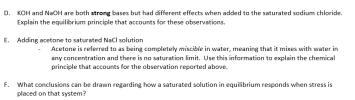 D. KOH and NaOH are both strong bases but had different effects when added to the saturated sodium chloride. Explain the equilibrium principle that accounts for these observations. E. Adding acetone to saturated NaCl solution Acetone is referred to as being completely miscible in water, meaning that it mixes with water in any concentration and there is no saturation limit. Use this information to explain the chemical principle that accounts for the observation reported above. F. What conclusions can be...
For Activity 2: Observations and Interpretations CH,COOH(aq) C CHCOO (aq) + 1) What was the color...
 For Activity 2: Observations and Interpretations CH,COOH(aq) C CHCOO (aq) + 1) What was the color of the solution after adding the drop of methyl orange indicator red indicator showing high (H+] 2) What color did you observe after adding the sodium acetate, CH,COONa? it went on orange: indicator housing less 3) Assume that the dynamic equilibrium represented in the equation given above is present in the original solution you placed in the test tube. Based on LeChatelier's Principle, as...
A ALLICI Evidence of a shift in equilibrium by a change in concentration can easily be observed i...
 #1 and #2 please!
A ALLICI Evidence of a shift in equilibrium by a change in concentration can easily be observed if one of the substances involved in the equilibrium is colored. The appearance of a preeinitnte NAME REPORT FOR EXPERIMENT 24 (continued) E. Cobalt(II) Chloride Solution 1. What was the evidence for a shift in equilibrium when conc. hydrochlorie acid was added to the cobalt chloride solution? 2. (a) Write the equilibrium equation for this system. (b) State whether...
#1 and #2 please!
A ALLICI Evidence of a shift in equilibrium by a change in concentration can easily be observed if one of the substances involved in the equilibrium is colored. The appearance of a preeinitnte NAME REPORT FOR EXPERIMENT 24 (continued) E. Cobalt(II) Chloride Solution 1. What was the evidence for a shift in equilibrium when conc. hydrochlorie acid was added to the cobalt chloride solution? 2. (a) Write the equilibrium equation for this system. (b) State whether...
You are given the equilibrium system BiCl_3 (aq) bismuth (III) chloride(colorless) + H_2, O(l) BiOCl (s)...
 You are given the equilibrium system BiCl_3 (aq) bismuth (III) chloride(colorless) + H_2, O(l) BiOCl (s) bismuth(III) oxychloride (white) + 2HCl (aq) at a point at which the solution is colorless and no BiOCl (s) is observed. a. which way should the equilibrium shift, to the left or to the right, when water is added until a change is observed? What would be observed? Explain the shift in terms of lessthanorequalto Chatelier's principle. b. Which way should the equilibrium shift...
FesCN (aq), and LeChâtelier's Explain in terms of the equation, Fe" (aq) + SCN (aq) Principle...
 FesCN (aq), and LeChâtelier's Explain in terms of the equation, Fe" (aq) + SCN (aq) Principle (4 ) Observation after adding KSCN: turned darker more red like original solution brown Explain in terms of the equation, Fe (aq) + SCN (aq) + FeSCN- (aq), and LeChâtelier's Principle. (ps.) Observation after adding AgNO3: Turned milky white + thieverf less transparent Using the ions present in the solution, write a net ionic equation that would explain the precipitate observed Use the above...
a When in solution NaCl will dissociate into Na+ and Cl- ions? What concentration would you...
a When in solution NaCl will dissociate into Na+ and Cl- ions? What concentration would you need to add a NaCl solution at to observe the same rates of plasmolysis as with a 0.8M sucrose solution? b If you placed your onion cells in a slightly acidic environment would you expect there to be any change in the pH of the cytosol due to the open water channels? Why? c Why are changes in turgor pressure important with respect to...
» What color did you observe after adding the 3M H2SO, solution? 4) What color did...
 » What color did you observe after adding the 3M H2SO, solution? 4) What color did you observe after adding the IM NaOH solution? Assume that the dynamic equilibrium represented in the equation in I is present in the original solution you placed in the test tube. Based on LeChatelier's Principle, as stated above on page one, you will interpret the observations made in 2, above: (Note that H SO, produces H+ in solution.) a) When sulfuric acid was added,...
less than more than equal to Question 2 3 pts In Reaction 1, you added HCl...
 less than
more than
equal to
Question 2 3 pts In Reaction 1, you added HCl to your solution of 1.0 M COCl2. As mentioned in the lab procedure, HCl is a strong acid, which completely dissociates in water, forming Ht and Cl. Using your lab data to help you, answer the following questions below. 2+ + 4 cl COCI4. (aq) + 6 H20 (1) CO(H20)6 + (aq) pink blue Immediately following the addition of HCl to your reaction: •...
less than
more than
equal to
Question 2 3 pts In Reaction 1, you added HCl to your solution of 1.0 M COCl2. As mentioned in the lab procedure, HCl is a strong acid, which completely dissociates in water, forming Ht and Cl. Using your lab data to help you, answer the following questions below. 2+ + 4 cl COCI4. (aq) + 6 H20 (1) CO(H20)6 + (aq) pink blue Immediately following the addition of HCl to your reaction: •...
 QUESTIONS 2C if more A is added; if more B is added; if 1. How is the equilibrium shifted in A+B some of C is removed from the reaction? 2. State Le Chatelier's Principle in clear terms. 3. When a system is at equilibrium, are any chemical reactions going on? NH + OH what would happen if 4. In the equilibrium reaction NH +H,O more ammonium salt were added? If HCI were added? forms under acid conditions, how would you...
 D. KOH and NaOH are both strong bases but had different effects when added to the saturated sodium chloride. Explain the equilibrium principle that accounts for these observations. E. Adding acetone to saturated NaCl solution Acetone is referred to as being completely miscible in water, meaning that it mixes with water in any concentration and there is no saturation limit. Use this information to explain the chemical principle that accounts for the observation reported above. F. What conclusions can be...
 For Activity 2: Observations and Interpretations CH,COOH(aq) C CHCOO (aq) + 1) What was the color of the solution after adding the drop of methyl orange indicator red indicator showing high (H+] 2) What color did you observe after adding the sodium acetate, CH,COONa? it went on orange: indicator housing less 3) Assume that the dynamic equilibrium represented in the equation given above is present in the original solution you placed in the test tube. Based on LeChatelier's Principle, as...
 #1 and #2 please!
A ALLICI Evidence of a shift in equilibrium by a change in concentration can easily be observed if one of the substances involved in the equilibrium is colored. The appearance of a preeinitnte NAME REPORT FOR EXPERIMENT 24 (continued) E. Cobalt(II) Chloride Solution 1. What was the evidence for a shift in equilibrium when conc. hydrochlorie acid was added to the cobalt chloride solution? 2. (a) Write the equilibrium equation for this system. (b) State whether...
#1 and #2 please!
A ALLICI Evidence of a shift in equilibrium by a change in concentration can easily be observed if one of the substances involved in the equilibrium is colored. The appearance of a preeinitnte NAME REPORT FOR EXPERIMENT 24 (continued) E. Cobalt(II) Chloride Solution 1. What was the evidence for a shift in equilibrium when conc. hydrochlorie acid was added to the cobalt chloride solution? 2. (a) Write the equilibrium equation for this system. (b) State whether...
 You are given the equilibrium system BiCl_3 (aq) bismuth (III) chloride(colorless) + H_2, O(l) BiOCl (s) bismuth(III) oxychloride (white) + 2HCl (aq) at a point at which the solution is colorless and no BiOCl (s) is observed. a. which way should the equilibrium shift, to the left or to the right, when water is added until a change is observed? What would be observed? Explain the shift in terms of lessthanorequalto Chatelier's principle. b. Which way should the equilibrium shift...
 FesCN (aq), and LeChâtelier's Explain in terms of the equation, Fe" (aq) + SCN (aq) Principle (4 ) Observation after adding KSCN: turned darker more red like original solution brown Explain in terms of the equation, Fe (aq) + SCN (aq) + FeSCN- (aq), and LeChâtelier's Principle. (ps.) Observation after adding AgNO3: Turned milky white + thieverf less transparent Using the ions present in the solution, write a net ionic equation that would explain the precipitate observed Use the above...
 » What color did you observe after adding the 3M H2SO, solution? 4) What color did you observe after adding the IM NaOH solution? Assume that the dynamic equilibrium represented in the equation in I is present in the original solution you placed in the test tube. Based on LeChatelier's Principle, as stated above on page one, you will interpret the observations made in 2, above: (Note that H SO, produces H+ in solution.) a) When sulfuric acid was added,...
 less than
more than
equal to
Question 2 3 pts In Reaction 1, you added HCl to your solution of 1.0 M COCl2. As mentioned in the lab procedure, HCl is a strong acid, which completely dissociates in water, forming Ht and Cl. Using your lab data to help you, answer the following questions below. 2+ + 4 cl COCI4. (aq) + 6 H20 (1) CO(H20)6 + (aq) pink blue Immediately following the addition of HCl to your reaction: •...
less than
more than
equal to
Question 2 3 pts In Reaction 1, you added HCl to your solution of 1.0 M COCl2. As mentioned in the lab procedure, HCl is a strong acid, which completely dissociates in water, forming Ht and Cl. Using your lab data to help you, answer the following questions below. 2+ + 4 cl COCI4. (aq) + 6 H20 (1) CO(H20)6 + (aq) pink blue Immediately following the addition of HCl to your reaction: •...
Most questions answered within 3 hours.
-
Where is the error in this code sequence?
String s1 = "Hello";
String s2 = "ello";...
asked 10 months ago -
Financial data for Joel de Paris, Inc., for last year
follow:
Joel de Paris, Inc.
Balance...
asked 10 months ago -
Consider this reaction:
Al2(SO4)3 (aq)+ BaCl3
(aq) Al2Cl6 (aq)- +
3BaSO4(s) . What is the...
asked 10 months ago -
Suppose that Savneet is considering increasing her
recent random sample from 20 car rentals to 40...
asked 10 months ago -
Trucks arrive at an unloading terminal at an average rate of 120
per hour.
Trucks arrive...
asked 10 months ago -
Why are methanol and ethanol completely soluble in water while
octanol is not very little soluble....
asked 10 months ago -
A facilities manager at a university reads in a research report
that the mean amount of...
asked 10 months ago -
When the CuSO4 is rehydrated by adding water to the anhydrous
compound, is this an endothermic...
asked 10 months ago -
A ray of sunlight is passing from diamond into crown glass; the
angle of incidence is...
asked 10 months ago -
A block of mass 0.249 kg is placed on top of a light, vertical
spring of...
asked 10 months ago -
how do the kidneys compensate in the presences of acidosis
a) trigger hyperventilate
b) reserve acid...
asked 10 months ago -
Question 501 pts
The rental rate of capital to the firm increases. Which of the
following...
asked 10 months ago