The solution you will use for this experiment was prepared by making a 0.25 M CoCl2...
The solution you will use for this experiment was prepared by making a 0.25 M CoCl2 solution in a solvent that already contains 4.0 M NaCl. Recall that as an ionic compound, CoCl2 will dissociate into Co(II) and chloride ions. What will the concentration of chloride ions be?
2. If all of the Co(II) ions described in the previous problem form the [Co(H2O)6 ] 2+ complex, what will its initial concentration be?
3. Suppose that the initial concentration of [CoCl4 ] 2- is 0, and that it increases to some value “x” by the time the reaction reaches equilibrium. Write an expression in terms of “x” for the [Co(H2O)6 ] 2+ and chloride ions.
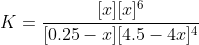
4. Write an equation for the equilibrium constant for the reaction in terms of “x.”
Homework Answers
1. First off, you have to remember that both your compounds are ionic compounds. You will assume complete dissociation. Therefore, from the NaCl solution, you would get:
NaCl ---> Na+ + Cl-
As the reaction ratio is 1:1 for the chloride, you get 4M concentration of Cl-.
For the second compound:
CoCl2 ---> Co2+ + 2Cl-
The ratio for the chloride in this reaction is 1:2. Given so, you would have twice the concentration of CoCl2, for Cl-, which would be 0.5 M.
This gives a total of 4.5 M of chloride ions.
2. Given that you are considering all the Co is used to form the complex ion, you would get a 0.25 M concentration.
3. The reaction that is taking place in this problem is
(Co(H2O)6)2+ + 4Cl− <---> CoCl42- + 6H2O
0.25 M 4.5M 0 0 initial
0.25 - x 4.5 - 4x x x equilibrium
4. The equilibrium constant for this reaction is obtained by the following expression:
Add Answer to:
The solution you will use for this experiment was prepared by
making a 0.25 M CoCl2...
(4 pts) The 0.040 M solution of CoCl2 used in Experiment 7 is prepared in the...
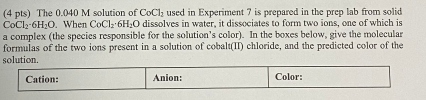 (4 pts) The 0.040 M solution of CoCl2 used in Experiment 7 is prepared in the prep lab from solid CoCl2:6H2O. When CoCl2:6H2O dissolves in water, it dissociates to form two ions, one of which is a complex (the species responsible for the solution's color). In the boxes below, give the molecular formulas of the two ions present in a solution of cobalt(II) chloride, and the predicted color of the solution. Cation: Anion: Color:
For the following reaction, 0.500 M of COCl2 is placed in a reaction vessel. Calculate the...
 For the following reaction, 0.500 M of COCl2 is placed in a reaction vessel. Calculate the equilibrium concentrations of all gases at equilibrium. COCl2(g) 2 CO(g) + Cl2(g) Kc = 1.70 x 10⁻⁴ 4 NH3(g) + 3 O2(g) = 2 N2(g) + 6 H2O(g) When 0.256 g of NH3 and 0.480 g if O2 are initially placed in a 1.00 L container at a certain temperature, the N2 concentration at equilibrium is 1.96 x 10 M. Calculate K, for the...
What would you have observed if you had added a concentration solution of NaCl to the...
What would you have observed if you had added a concentration solution of NaCl to the CoCl2/ Co(H2O)6 equilibrium system? Explain your answer in the terms of shifts or LeChatelier's principle. A question in Chemistry Lab Book
An aqueous solution is made by mixing 5.1 mL of 0.40 M Co(NO3)2 and 7.9 mL...
An aqueous solution is made by mixing 5.1 mL of 0.40 M Co(NO3)2 and 7.9 mL of 12.0 M HCl, and the following is the equilibrium reaction that takes place. [Co(H2O)6]2+(aq) + 4Cl- (aq) <-----> [CoCl4]2- (aq) + 6H2O(l) Assuming the above reaction is exothermic in the forward direction (toward the product side), predict whether the following statements (in relation to the above equilibrium reaction in aqueous solution) are "True" or "False". Addition of H2O causes the equilibrium to shift...
2. Which of the following bari0m salts hould dissolve in a A solution is prepared initially conta...
 number three please
2. Which of the following bari0m salts hould dissolve in a A solution is prepared initially containing 0.050 M be the concentration of all ions after precipitation of PbEa 3. bNOa and 0.20 M NaF.What will A solution is made which is initially 0.10 M in Ca"2 and 1.0 [CdONH3)4]12 complex ion to form, as shown in the eq concentration of free Cd*2 ion in this solution. CHa42 4. Ca"2 and 1.0 M in NHs. This causes...
number three please
2. Which of the following bari0m salts hould dissolve in a A solution is prepared initially containing 0.050 M be the concentration of all ions after precipitation of PbEa 3. bNOa and 0.20 M NaF.What will A solution is made which is initially 0.10 M in Ca"2 and 1.0 [CdONH3)4]12 complex ion to form, as shown in the eq concentration of free Cd*2 ion in this solution. CHa42 4. Ca"2 and 1.0 M in NHs. This causes...
Phosgene (carbonyl chloride), COCl2, is an extremely toxic gas that is used in manufacturing certain dyes...
Phosgene (carbonyl chloride), COCl2, is an extremely toxic gas that is used in manufacturing certain dyes and plastics. Phosgene can be produced by reacting carbon monoxide and chlorine gas at high temperatures: CO(g)+Cl2(g)⇌COCl2(g) Carbon monoxide and chlorine gas are allowed to react in a sealed vessel at 453 ∘C . At equilibrium, the concentrations were measured and the following results obtained: Gas Partial Pressure (atm) CO 0.760 Cl2 1.23 COCl2 0.180 What is the equilibrium constant, Kp, of this reaction?...
In aqueous solution cobalt(II) ion is surrounded by 4 water molecules and has a light pink...
 In aqueous solution cobalt(II) ion is surrounded by 4 water molecules and has a light pink color. When high concentrations of chloride ion are introduced, a cobalt-chloride complex ion forms that has a distinctive blue color. One way to represent this equilibrium is: Cocl,"(aq) = Co2+ (aq) + 4 CI" (aq) An experiment was run to demonstrate that a dynamic equilibrium exists between these two ions. Starting with a special form of CoC142(aq) where one of the chloride ions was...
Le Chatelier's Principle 3. For Part Ill, use Le Châteller's Principle to explain the colour changes...
 Le Chatelier's Principle 3. For Part Ill, use Le Châteller's Principle to explain the colour changes observed in test tubes 2 and 3 upon the addition of HC and A . Also, explain the observed colour changes in the test tubes placed in hot and cold water. (4 marks) Test Tube 2: Test Tube 3: Hot Water bath: Cold Water bath: Extension: 1. NaCl(aq) + HCl(aq) = NaCl(aq) + H2O + Cl2(g) When the above system is cooled, gas bubbles...
(a) Saturated Sodium Chloride. Watch Video-3a where to 4 mL of saturated (5.4 M) NaCl in...
 (a) Saturated Sodium Chloride. Watch Video-3a where to 4 mL of saturated (5.4 M) NaCl in a 13 x 100mm test tube, 2 mL of concentrated (12 M) HC) is added. Write down the chemical reaction(s) involved, being sure to include the state of matter of all reactants and products so it is clear if there is a solid/precipitate expected. (1 point) Calculate the total Cl concentration in the NaCl solution after adding 2 mL of 12 M HCl to...
Consider the insoluble compound cobalt(II) carbonate , CoCO3 . The cobalt(II) ion also forms a complex with ammonia . Wr...
Consider the insoluble compound cobalt(II) carbonate , CoCO3 . The cobalt(II) ion also forms a complex with ammonia . Write a balanced net ionic equation to show why the solubility of CoCO3 (s) increases in the presence of ammonia and calculate the equilibrium constant for this reaction. For Co(NH3)62+ , Kf = 1.3×10⁵ . Use the pull-down boxes to specify states such as (aq) or (s). Knet = Consider the insoluble compound silver chloride, AgCl. The silver ion also...
 (4 pts) The 0.040 M solution of CoCl2 used in Experiment 7 is prepared in the prep lab from solid CoCl2:6H2O. When CoCl2:6H2O dissolves in water, it dissociates to form two ions, one of which is a complex (the species responsible for the solution's color). In the boxes below, give the molecular formulas of the two ions present in a solution of cobalt(II) chloride, and the predicted color of the solution. Cation: Anion: Color:
 For the following reaction, 0.500 M of COCl2 is placed in a reaction vessel. Calculate the equilibrium concentrations of all gases at equilibrium. COCl2(g) 2 CO(g) + Cl2(g) Kc = 1.70 x 10⁻⁴ 4 NH3(g) + 3 O2(g) = 2 N2(g) + 6 H2O(g) When 0.256 g of NH3 and 0.480 g if O2 are initially placed in a 1.00 L container at a certain temperature, the N2 concentration at equilibrium is 1.96 x 10 M. Calculate K, for the...
 number three please
2. Which of the following bari0m salts hould dissolve in a A solution is prepared initially containing 0.050 M be the concentration of all ions after precipitation of PbEa 3. bNOa and 0.20 M NaF.What will A solution is made which is initially 0.10 M in Ca"2 and 1.0 [CdONH3)4]12 complex ion to form, as shown in the eq concentration of free Cd*2 ion in this solution. CHa42 4. Ca"2 and 1.0 M in NHs. This causes...
number three please
2. Which of the following bari0m salts hould dissolve in a A solution is prepared initially containing 0.050 M be the concentration of all ions after precipitation of PbEa 3. bNOa and 0.20 M NaF.What will A solution is made which is initially 0.10 M in Ca"2 and 1.0 [CdONH3)4]12 complex ion to form, as shown in the eq concentration of free Cd*2 ion in this solution. CHa42 4. Ca"2 and 1.0 M in NHs. This causes...
 In aqueous solution cobalt(II) ion is surrounded by 4 water molecules and has a light pink color. When high concentrations of chloride ion are introduced, a cobalt-chloride complex ion forms that has a distinctive blue color. One way to represent this equilibrium is: Cocl,"(aq) = Co2+ (aq) + 4 CI" (aq) An experiment was run to demonstrate that a dynamic equilibrium exists between these two ions. Starting with a special form of CoC142(aq) where one of the chloride ions was...
 Le Chatelier's Principle 3. For Part Ill, use Le Châteller's Principle to explain the colour changes observed in test tubes 2 and 3 upon the addition of HC and A . Also, explain the observed colour changes in the test tubes placed in hot and cold water. (4 marks) Test Tube 2: Test Tube 3: Hot Water bath: Cold Water bath: Extension: 1. NaCl(aq) + HCl(aq) = NaCl(aq) + H2O + Cl2(g) When the above system is cooled, gas bubbles...
 (a) Saturated Sodium Chloride. Watch Video-3a where to 4 mL of saturated (5.4 M) NaCl in a 13 x 100mm test tube, 2 mL of concentrated (12 M) HC) is added. Write down the chemical reaction(s) involved, being sure to include the state of matter of all reactants and products so it is clear if there is a solid/precipitate expected. (1 point) Calculate the total Cl concentration in the NaCl solution after adding 2 mL of 12 M HCl to...
Most questions answered within 3 hours.
-
Where is the error in this code sequence?
String s1 = "Hello";
String s2 = "ello";...
asked 11 months ago -
Financial data for Joel de Paris, Inc., for last year
follow:
Joel de Paris, Inc.
Balance...
asked 11 months ago -
Consider this reaction:
Al2(SO4)3 (aq)+ BaCl3
(aq) Al2Cl6 (aq)- +
3BaSO4(s) . What is the...
asked 11 months ago -
Suppose that Savneet is considering increasing her
recent random sample from 20 car rentals to 40...
asked 11 months ago -
Trucks arrive at an unloading terminal at an average rate of 120
per hour.
Trucks arrive...
asked 11 months ago -
Why are methanol and ethanol completely soluble in water while
octanol is not very little soluble....
asked 11 months ago -
A facilities manager at a university reads in a research report
that the mean amount of...
asked 11 months ago -
When the CuSO4 is rehydrated by adding water to the anhydrous
compound, is this an endothermic...
asked 11 months ago -
A ray of sunlight is passing from diamond into crown glass; the
angle of incidence is...
asked 11 months ago -
A block of mass 0.249 kg is placed on top of a light, vertical
spring of...
asked 11 months ago -
how do the kidneys compensate in the presences of acidosis
a) trigger hyperventilate
b) reserve acid...
asked 11 months ago -
Question 501 pts
The rental rate of capital to the firm increases. Which of the
following...
asked 11 months ago