An aqueous solution is made by mixing 5.1 mL of 0.40 M Co(NO3)2 and 7.9 mL...
An aqueous solution is made by mixing 5.1 mL of 0.40 M Co(NO3)2 and 7.9 mL of 12.0 M HCl, and the following is the equilibrium reaction that takes place.
[Co(H2O)6]2+(aq) + 4Cl- (aq) <-----> [CoCl4]2- (aq) + 6H2O(l)
Assuming the above reaction is exothermic in the forward direction (toward the product side), predict whether the following statements (in relation to the above equilibrium reaction in aqueous solution) are "True" or "False".
Addition of H2O causes the equilibrium to shift to the
left (reactant side).
Heating does not cause the equilibrium to shift to either side, it
only speeds up the reaction.
Addition of HCl causes the equilibrium to shift to the left
(reactant side).
In the ddition of HCl, equilibrium will not be shifted to either
side because H+ ions (from HCl) react with
NO3- (from cobalt (II) nitrate) and form
HNO3.
The above equilibrium reaction has a negative enthalpy change in
the reverse direction (toward the reactant side).
Homework Answers

Add Answer to:
An aqueous solution is made by mixing 5.1 mL of 0.40 M
Co(NO3)2 and 7.9 mL...
1. In a small beaker mix together 5.0 mL of 0.10 M Co(NO3)2 . 6H2O with...
1. In a small beaker mix together 5.0 mL of 0.10 M Co(NO3)2 . 6H2O with 5.0 mL of concentrated HCl. Be sure to mix thoroughly with your glass stirring rod. This is your equilibrium mixture. 2. Place 1.0 mL of your equilibrium mixture in a small test tube add 1.0 mL of concentrated HCl. Observe any color changes and state in which direction (if any) the equilibrium shifted. Place a new 1.0 mL sample of your equilibrium mixture in...
1. Addition of chloride ion, Cl-(aq) to the cobalt complex, [Co(H2O)6]2+ causes the formation of a...
1. Addition of chloride ion, Cl-(aq) to the cobalt complex, [Co(H2O)6]2+ causes the formation of a second cobalt complex, [CoCl4]2- and H2O(l). Write a balanced net ionic equation for this reaction. 2. Re-write the balanced equation from above this time including heat in the equation as either a reactant or product.
4. In the cobalt lab you manipulated the following equilibrium, Co(H2O)2+ (aq) + 4C1- (aq) +...
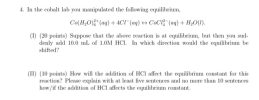 4. In the cobalt lab you manipulated the following equilibrium, Co(H2O)2+ (aq) + 4C1- (aq) + COCl - (aq) + H2O(l). (1) (20 points) Suppose that the above reaction is at equilibrium, but then you sud- denly add 10.0 mL of 1.0M HCl. In which direction would the equilibrium be shifted? (II) (10 points) How will the addition of HCI affect the equilibrium constant for this reaction? Please explain with at least five sentences and no more than 10 sentences...
Indicate the direction( left or right) of equilibrium shift when the acompanying stress is applied to...
Indicate the direction( left or right) of equilibrium shift when the acompanying stress is applied to the system: HCL (aq) is added to 4CL- (aq) + Co(H2O)62+ = CoCL42- (aq) + 6H2O(l) ****please address how the common-ion effect is observed in this reaction and how it influences the equilibrium****
Determine if the system shifted toward reactants or products for each of the changes. Explain how...
Determine if the system shifted toward reactants or products for each of the changes. Explain how each change affected the equilibrium in terms of Le Châtelier’s principle. For the forward reaction, is the system endothermic or exothermic? Fe+3(aq) + SCN–(aq) ⇋ Fe(SCN)+2(aq) a. The addition of KSCN b. The addition of Fe(NO3)3 c. The addition of NaF (s) d. hot water bath e. ice water bath [CoCl4]–2(alcohol) + 6 H2O(ℓ) ⇋ [Co(H2O)6]+2(aq) + 4 Cl–(aq) a. addition of HCl b....
QUESTION 1 43.2 mL of aqueous 0.255 M Pb(NO3)2 is mixed with 36.1 mL of 0.415...
QUESTION 1 43.2 mL of aqueous 0.255 M Pb(NO3)2 is mixed with 36.1 mL of 0.415 M NaCl. The equation for the precipitate reaction is: Pb(NO3)2 (aq) + 2 NaCl (aq) --> PbCl2 (s) + 2 NaNO3 (aq) How many moles of PbCl2 are formed? (with correct sig figs) QUESTION 2 What volume (in mL!!!) of 1.28 M HCl is required to react with 3.33 g of zinc (65.41 g/mol) according to the following reaction? Zn(s) + 2 HCl (aq)...
Le Chateler's principle In the chart below: • Indicate the color of each solution as darker...
 Le
Chateler's principle
In the chart below: • Indicate the color of each solution as darker or lighter than the control after the addition of the specified substance. • Indicate the direction the equilibrium shifted as "toward products" or "toward reactants" based on the color change. • Based on the direction of the shift, indicate the substance(s) that increased which will either be the two reactants present on the reactant side of the equilibrium equation or the complex present on...
Le
Chateler's principle
In the chart below: • Indicate the color of each solution as darker or lighter than the control after the addition of the specified substance. • Indicate the direction the equilibrium shifted as "toward products" or "toward reactants" based on the color change. • Based on the direction of the shift, indicate the substance(s) that increased which will either be the two reactants present on the reactant side of the equilibrium equation or the complex present on...
An aqueous solution of 0.40 M silver nitrate, AgNO3, and 0.40 M iron(II) nitrate, Fe(NO3)2, is...
An aqueous solution of 0.40 M silver nitrate, AgNO3, and 0.40 M iron(II) nitrate, Fe(NO3)2, is allowed to reach equilibrium according to the following chemical reaction. Ag+(aq) + Fe2+(aq) equilibrium reaction arrow Fe3+(aq) + Ag(s) If the equilibrium constant, Kc, for the reaction is 1.7 at a certain temperature, determine the equilibrium concentrations of Ag+, Fe2+, and Fe3+.
Le Chatelier's Principle 3. For Part Ill, use Le Châteller's Principle to explain the colour changes...
 Le Chatelier's Principle 3. For Part Ill, use Le Châteller's Principle to explain the colour changes observed in test tubes 2 and 3 upon the addition of HC and A . Also, explain the observed colour changes in the test tubes placed in hot and cold water. (4 marks) Test Tube 2: Test Tube 3: Hot Water bath: Cold Water bath: Extension: 1. NaCl(aq) + HCl(aq) = NaCl(aq) + H2O + Cl2(g) When the above system is cooled, gas bubbles...
are theses correct? please correct me if they are not. Results Fe Test Tube 2: FeSCN...
 are
theses correct?
please correct me if they are not.
Results Fe Test Tube 2: FeSCN (aa) SCN () Fe Chemical equation: Explanation: The equilibrium shifted toward the increased the due to the addition of Fe(NO,)) because it of the Test Tube 3: FESCN 0) SCN () (as Chemical equation: Fe(ag) Explanation: Test Tube 4: Chemical equation: Fe(agk FeSCN( (aq)h Explanation: Test Tube 5: Chemical equation: Fe"( SCN () FESCN 3+ + (sq) Explanation: Test Tube 6 Chemical equation: Fe(a...
are
theses correct?
please correct me if they are not.
Results Fe Test Tube 2: FeSCN (aa) SCN () Fe Chemical equation: Explanation: The equilibrium shifted toward the increased the due to the addition of Fe(NO,)) because it of the Test Tube 3: FESCN 0) SCN () (as Chemical equation: Fe(ag) Explanation: Test Tube 4: Chemical equation: Fe(agk FeSCN( (aq)h Explanation: Test Tube 5: Chemical equation: Fe"( SCN () FESCN 3+ + (sq) Explanation: Test Tube 6 Chemical equation: Fe(a...
 4. In the cobalt lab you manipulated the following equilibrium, Co(H2O)2+ (aq) + 4C1- (aq) + COCl - (aq) + H2O(l). (1) (20 points) Suppose that the above reaction is at equilibrium, but then you sud- denly add 10.0 mL of 1.0M HCl. In which direction would the equilibrium be shifted? (II) (10 points) How will the addition of HCI affect the equilibrium constant for this reaction? Please explain with at least five sentences and no more than 10 sentences...
 Le
Chateler's principle
In the chart below: • Indicate the color of each solution as darker or lighter than the control after the addition of the specified substance. • Indicate the direction the equilibrium shifted as "toward products" or "toward reactants" based on the color change. • Based on the direction of the shift, indicate the substance(s) that increased which will either be the two reactants present on the reactant side of the equilibrium equation or the complex present on...
Le
Chateler's principle
In the chart below: • Indicate the color of each solution as darker or lighter than the control after the addition of the specified substance. • Indicate the direction the equilibrium shifted as "toward products" or "toward reactants" based on the color change. • Based on the direction of the shift, indicate the substance(s) that increased which will either be the two reactants present on the reactant side of the equilibrium equation or the complex present on...
 Le Chatelier's Principle 3. For Part Ill, use Le Châteller's Principle to explain the colour changes observed in test tubes 2 and 3 upon the addition of HC and A . Also, explain the observed colour changes in the test tubes placed in hot and cold water. (4 marks) Test Tube 2: Test Tube 3: Hot Water bath: Cold Water bath: Extension: 1. NaCl(aq) + HCl(aq) = NaCl(aq) + H2O + Cl2(g) When the above system is cooled, gas bubbles...
 are
theses correct?
please correct me if they are not.
Results Fe Test Tube 2: FeSCN (aa) SCN () Fe Chemical equation: Explanation: The equilibrium shifted toward the increased the due to the addition of Fe(NO,)) because it of the Test Tube 3: FESCN 0) SCN () (as Chemical equation: Fe(ag) Explanation: Test Tube 4: Chemical equation: Fe(agk FeSCN( (aq)h Explanation: Test Tube 5: Chemical equation: Fe"( SCN () FESCN 3+ + (sq) Explanation: Test Tube 6 Chemical equation: Fe(a...
are
theses correct?
please correct me if they are not.
Results Fe Test Tube 2: FeSCN (aa) SCN () Fe Chemical equation: Explanation: The equilibrium shifted toward the increased the due to the addition of Fe(NO,)) because it of the Test Tube 3: FESCN 0) SCN () (as Chemical equation: Fe(ag) Explanation: Test Tube 4: Chemical equation: Fe(agk FeSCN( (aq)h Explanation: Test Tube 5: Chemical equation: Fe"( SCN () FESCN 3+ + (sq) Explanation: Test Tube 6 Chemical equation: Fe(a...
Most questions answered within 3 hours.
-
Where is the error in this code sequence?
String s1 = "Hello";
String s2 = "ello";...
asked 10 months ago -
Financial data for Joel de Paris, Inc., for last year
follow:
Joel de Paris, Inc.
Balance...
asked 10 months ago -
Consider this reaction:
Al2(SO4)3 (aq)+ BaCl3
(aq) Al2Cl6 (aq)- +
3BaSO4(s) . What is the...
asked 10 months ago -
Suppose that Savneet is considering increasing her
recent random sample from 20 car rentals to 40...
asked 10 months ago -
Trucks arrive at an unloading terminal at an average rate of 120
per hour.
Trucks arrive...
asked 10 months ago -
Why are methanol and ethanol completely soluble in water while
octanol is not very little soluble....
asked 10 months ago -
A facilities manager at a university reads in a research report
that the mean amount of...
asked 10 months ago -
When the CuSO4 is rehydrated by adding water to the anhydrous
compound, is this an endothermic...
asked 10 months ago -
A ray of sunlight is passing from diamond into crown glass; the
angle of incidence is...
asked 10 months ago -
A block of mass 0.249 kg is placed on top of a light, vertical
spring of...
asked 10 months ago -
how do the kidneys compensate in the presences of acidosis
a) trigger hyperventilate
b) reserve acid...
asked 10 months ago -
Question 501 pts
The rental rate of capital to the firm increases. Which of the
following...
asked 10 months ago