
Homework Answers

Add Answer to:
The pressure of water flowing through a pipe is measured by the arrangement shown in the...
- question will save this response Question 4 The pressure of water flowing through a pipe...
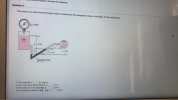 - question will save this response Question 4 The pressure of water flowing through a pipe is measured by the arrangement shown in the fire. For the value given 1 - The angle is degree 2-The manometrud height 3-The pressure in the pipe Pois 4-The pressure difference P -PAS t a P
Water is flowing through a horizontal pipe with an inside diameter of 8.00cm. The pipe narrows...
 Water is flowing through a horizontal pipe with an inside diameter of 8.00cm. The pipe narrows to an inside diameter of 3.75cm. Assume the water is an ideal incompressible fluid. What is the velocity of the fluid initially, v_1 (when It is flowing in the 8.00cm diameter section) if the velocity of the water in the narrow part of the pipe is measured at V_2 = 27m/s? If the initial pressure is known to be 670 kPa what is the...
QUUESTION1 Water flows through a pipe as shown in Figure 1. The losses in the pipe can be express...
 QUUESTION1 Water flows through a pipe as shown in Figure 1. The losses in the pipe can be expressed as 0.025 V2 per meter length of pipe, where V is the velocity in the pipe. The length AB is 6 m and BC is 11 m, determine the discharge and the pressure at B 2m 3m 5m 20mm diameter Figure 1: Schematic of water flowing from a tank through the pipe.
QUUESTION1 Water flows through a pipe as shown in...
QUUESTION1 Water flows through a pipe as shown in Figure 1. The losses in the pipe can be expressed as 0.025 V2 per meter length of pipe, where V is the velocity in the pipe. The length AB is 6 m and BC is 11 m, determine the discharge and the pressure at B 2m 3m 5m 20mm diameter Figure 1: Schematic of water flowing from a tank through the pipe.
QUUESTION1 Water flows through a pipe as shown in...
Water is flowing through a 10-cm-diameter water pipe at a rate of 0.1 m/s. Then, a...
 Water is flowing through a 10-cm-diameter water pipe at a rate of 0.1 m/s. Then, a diffuser with an outlet diameter of 20 cm is bolted to the pipe in order to slow down water as it exits the diffuser to atmospheric pressure, as shown in the given figure. Disregarding frictional effects, determine the force exerted on the bolts due to the water flow. Take the density of water to be 1000 kg/m3 -t- d 10 cmm D = 20...
1) Water is flowing through the 50-mm galvanized-iron pipe system shown in the figure. The average...
 1) Water is flowing through the 50-mm galvanized-iron pipe system shown in the figure. The average velocity in the pipe is V=3.5 m/s. Assume the temperature is 20°C. a) What is friction loss between Points A and B? b) What is the pressure at Point A, if Point B is a free jet? Use the Moody Diagram to solve. 50 mm 2) For the same conditions in Problem #1, use the "Fully-Rough" equation to determine the friction factor, f. Compare...
A pipe carries water horizontally at a pressure of 1.4 atm, with the water flowing at...
A pipe carries water horizontally at a pressure of 1.4 atm, with the water flowing at a speed of 2.0 m/s. The water is then to be diverted downwards and continue through a horizontal pipe located 4.0 m below the first segment of pipe (labelled as h in the diagram below). If the width of the pipe remains constant, what is the pressure of the water in the lower pipe (in atm)? Note that the density of water is 1000...
1. Water is flowing in a pipe as shown in the figure. The diameter of the...
 1. Water is flowing in a pipe as shown in the figure. The diameter of the cross section area A1 is twice the diameter of A2. The velocity of flow v1 is 2.00m/s while h and h2 are 5.00 cm and 30.0 cm, respectively. Take the density of water to be 1000. kg/m3 (a) Find v2 (b) Calculate the pressure difference P P2 between the two ends of the pipe 2
04 Water is flowing through a Tee in a horizontal plane as shown in Figure 3....
 04 Water is flowing through a Tee in a horizontal plane as shown in Figure 3. Neglecting losses, calculate: (i) the pressure in pipes 2 and 3; (ii) the resultant force needed to hold the Tee in place. 100 kPa 2 0.24 m/s 30% 150 mm diameter Water 450 mm. Dia 0.6 m3ls 300 mm diameter 45 0.36 m3/s Figure 3: Tee pipe
Determine the density of air flowing in a pipe, if the measured static pressure on the...
 Determine the density of air flowing in a pipe, if the measured static pressure on the manometer is -15 cm (h1a), the air temperature is 23.9°C and the atmospheric pressure is 1.01325 bar. Assume that the manometer fluid is water with a density of 1000 kg/m3. Take R- 287 kJ/kg.K
Consider water flowing to three faucets in a building through the very simple plumbing network shown...
 Consider water flowing to three faucets in a building through the very simple plumbing network shown below. Every section of pipe in the figure is 25 ft long. Ali of the piping is nominal half-inch type L copper piping. The inlet pressure to the main pipe is constant at 50 psi and the pressure of the water leaving each faucet is 0 psi. The water has a temperature of 140°F. For the purposes of this analysis assume that there are...
 - question will save this response Question 4 The pressure of water flowing through a pipe is measured by the arrangement shown in the fire. For the value given 1 - The angle is degree 2-The manometrud height 3-The pressure in the pipe Pois 4-The pressure difference P -PAS t a P
 Water is flowing through a horizontal pipe with an inside diameter of 8.00cm. The pipe narrows to an inside diameter of 3.75cm. Assume the water is an ideal incompressible fluid. What is the velocity of the fluid initially, v_1 (when It is flowing in the 8.00cm diameter section) if the velocity of the water in the narrow part of the pipe is measured at V_2 = 27m/s? If the initial pressure is known to be 670 kPa what is the...
 QUUESTION1 Water flows through a pipe as shown in Figure 1. The losses in the pipe can be expressed as 0.025 V2 per meter length of pipe, where V is the velocity in the pipe. The length AB is 6 m and BC is 11 m, determine the discharge and the pressure at B 2m 3m 5m 20mm diameter Figure 1: Schematic of water flowing from a tank through the pipe.
QUUESTION1 Water flows through a pipe as shown in...
QUUESTION1 Water flows through a pipe as shown in Figure 1. The losses in the pipe can be expressed as 0.025 V2 per meter length of pipe, where V is the velocity in the pipe. The length AB is 6 m and BC is 11 m, determine the discharge and the pressure at B 2m 3m 5m 20mm diameter Figure 1: Schematic of water flowing from a tank through the pipe.
QUUESTION1 Water flows through a pipe as shown in...
 Water is flowing through a 10-cm-diameter water pipe at a rate of 0.1 m/s. Then, a diffuser with an outlet diameter of 20 cm is bolted to the pipe in order to slow down water as it exits the diffuser to atmospheric pressure, as shown in the given figure. Disregarding frictional effects, determine the force exerted on the bolts due to the water flow. Take the density of water to be 1000 kg/m3 -t- d 10 cmm D = 20...
 1) Water is flowing through the 50-mm galvanized-iron pipe system shown in the figure. The average velocity in the pipe is V=3.5 m/s. Assume the temperature is 20°C. a) What is friction loss between Points A and B? b) What is the pressure at Point A, if Point B is a free jet? Use the Moody Diagram to solve. 50 mm 2) For the same conditions in Problem #1, use the "Fully-Rough" equation to determine the friction factor, f. Compare...
 1. Water is flowing in a pipe as shown in the figure. The diameter of the cross section area A1 is twice the diameter of A2. The velocity of flow v1 is 2.00m/s while h and h2 are 5.00 cm and 30.0 cm, respectively. Take the density of water to be 1000. kg/m3 (a) Find v2 (b) Calculate the pressure difference P P2 between the two ends of the pipe 2
 04 Water is flowing through a Tee in a horizontal plane as shown in Figure 3. Neglecting losses, calculate: (i) the pressure in pipes 2 and 3; (ii) the resultant force needed to hold the Tee in place. 100 kPa 2 0.24 m/s 30% 150 mm diameter Water 450 mm. Dia 0.6 m3ls 300 mm diameter 45 0.36 m3/s Figure 3: Tee pipe
 Determine the density of air flowing in a pipe, if the measured static pressure on the manometer is -15 cm (h1a), the air temperature is 23.9°C and the atmospheric pressure is 1.01325 bar. Assume that the manometer fluid is water with a density of 1000 kg/m3. Take R- 287 kJ/kg.K
 Consider water flowing to three faucets in a building through the very simple plumbing network shown below. Every section of pipe in the figure is 25 ft long. Ali of the piping is nominal half-inch type L copper piping. The inlet pressure to the main pipe is constant at 50 psi and the pressure of the water leaving each faucet is 0 psi. The water has a temperature of 140°F. For the purposes of this analysis assume that there are...
Most questions answered within 3 hours.
-
Where is the error in this code sequence?
String s1 = "Hello";
String s2 = "ello";...
asked 11 months ago -
Financial data for Joel de Paris, Inc., for last year
follow:
Joel de Paris, Inc.
Balance...
asked 11 months ago -
Consider this reaction:
Al2(SO4)3 (aq)+ BaCl3
(aq) Al2Cl6 (aq)- +
3BaSO4(s) . What is the...
asked 11 months ago -
Suppose that Savneet is considering increasing her
recent random sample from 20 car rentals to 40...
asked 11 months ago -
Trucks arrive at an unloading terminal at an average rate of 120
per hour.
Trucks arrive...
asked 11 months ago -
Why are methanol and ethanol completely soluble in water while
octanol is not very little soluble....
asked 11 months ago -
A facilities manager at a university reads in a research report
that the mean amount of...
asked 11 months ago -
When the CuSO4 is rehydrated by adding water to the anhydrous
compound, is this an endothermic...
asked 11 months ago -
A ray of sunlight is passing from diamond into crown glass; the
angle of incidence is...
asked 11 months ago -
A block of mass 0.249 kg is placed on top of a light, vertical
spring of...
asked 11 months ago -
how do the kidneys compensate in the presences of acidosis
a) trigger hyperventilate
b) reserve acid...
asked 11 months ago -
Question 501 pts
The rental rate of capital to the firm increases. Which of the
following...
asked 11 months ago