
Homework Answers
Solution
From the given data we have,
R(θ) =V02√2 [ sin(2θ)-cos(2θ)-1]/32 where R(θ) is the distance traveled up the incline,
in the above equation let,
V02√2 / 32 =A (for mathematical convinience while solving and representation)
thus
R(θ)= A[sin(2θ)-cos(2θ)-1]
but sin(2θ) =2sinθcosθ
cos2θ = 1-2sin2θ
substituting the above values in given equation we get,
R(θ) = A[2sinθcosθ-1+2sin2θ-1]
=>R(θ)=2A[sinθcosθ+sin2θ-1]
=>R(θ)=2A[sinθ(sinθ+cosθ)-1] , substituting the value of A we get,
R(θ) =2(V02√2 / 32)[sinθ(sinθ+cosθ)-1]
=>R(θ) =V02√2[sinθ(sinθ+cosθ)-1]/16 ;which is required to prove hence PROVED ....(answer)
Add Answer to:
10) An object is propelled upward at an angle e, 45° << 90°, to the horizontal...
P. The horizontal distance of a projectile (in feet) is given by x (vo cos e)t,...
 P. The horizontal distance of a projectile (in feet) is given by x (vo cos e)t, and the height of the projectile is given by y = -16t2 + (vo sin 0)t + yo where vo is the initial velocity, e is the angle of inclination, and yo is the initial height. Suppose an object is propelled upward from the ground at an angle e to the horizontal with an initial velocity of vo ft/sec. a. Find a formula for...
An object is propelled upward at an initial velocity of 32 feet per second at a....
 An object is propelled upward at an initial velocity of 32 feet per second at a. initial elevation of 48 feet above the ground. The free-fall model used to describe the motion is: s(t) = -16t2 + 326 +48 for Osts 3 (t seconds from release of object). Reference: Drop the Ball Activity The average velocity between t = 0 sec and t = 2 sec A) O feet per second B) 24 feet per second C) 12 feet per...
fired at an angle of 45° with the horizontal at an initial speed of 130 feet...
 fired at an angle of 45° with the horizontal at an initial speed of 130 feet per second. What are the components when the projectile is at its maximum height? Use the equations below to find the tangential and normal components of acceleration for a projectile h r(e)= (vot cos(0)i + vot sin(e)- 162)i + v(t) Vo cos(6e)i + (vo sin(0) -32t)j a(t) -32j (Vo cos(0))i + (vo sin(0) - 32t)j vo2 Vw(cos) T(t) + (vo sin(0) 32t)2 (Vo sin(e)-...
An object is propelled upward at an initial velocity of 32 feet per second at an...
 An object is propelled upward at an initial velocity of 32 feet per second at an initial elevation of 48 feet above the ground. The free-fall model used to describe the motion is: s(t) = -1672 + 32t +48 for 03033 (t seconds from release of object). Reference: Drop the Ball Activity The average velocity between t = 2 sec and t = 3 sec A) -48 feet per second B) -24 feet per second C) 16 feet per second...
An object is launched with an angle of 25 upward with the horizontal. The initial velocity...
 An object is launched with an angle of 25 upward with the horizontal. The initial velocity of the object is 20 m/'s in a direction making. What is the vertical velocity of object at the maximum height reached by the object? 0.00 O 15.11 O 18.40 O 21.20
If an object is thrown with a velocity of v feet per second at an angle...
If an object is thrown with a velocity of v feet per second at an angle of θ with the horizontal, then its flight can be modeled by, x = (v cos θ ) t and y = v (sin θ ) t - 16 t2 + h where t is in seconds and h is the object's initial height in feet above the ground. x is the horizontal position and y is the vertical position, and - 16 t2...
an object of mass 10kg rests on an inclined plane of 30 degree angle with horizontal....
 an object of mass 10kg rests on an inclined plane of
30 degree angle with horizontal. a force P=200 N acts on it upward
along the inclined plane and moves it 20m. the coefficient of
friction UK=0.25.
2 4 x (cm) 6. An object of mass 10 kg rests on an inclined plane of 30 angle with horizontal. A force 0° angle with horizontal. A force P 200 N acts on it upward along the inclined plane and moves it...
an object of mass 10kg rests on an inclined plane of
30 degree angle with horizontal. a force P=200 N acts on it upward
along the inclined plane and moves it 20m. the coefficient of
friction UK=0.25.
2 4 x (cm) 6. An object of mass 10 kg rests on an inclined plane of 30 angle with horizontal. A force 0° angle with horizontal. A force P 200 N acts on it upward along the inclined plane and moves it...
Paragraph 2. A ball is thrown with an initial velocity of 10 feet per second, at...
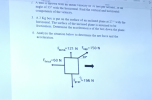 Paragraph 2. A ball is thrown with an initial velocity of 10 feet per second, at an angle of 35° with the horizontal. Find the vertical and horizontal components of the velocity. 3. A 2 Kg box is put on the surface of an inclined plane at 27° with the horizontal. The surface of the inclined plane is assumed to be frictionless. Determine the acceleration a of the box down the plane. 4. Analyze the situation below to determine the...
The position vector r describes the path of an object moving in space. Position Vector Time...
 The position vector r describes the path of an object moving in space. Position Vector Time r(t) = 12; + tj + 243/2k t = 4 (a) Find the velocity vector, speed, and acceleration vector of the object. v(t) = s(t) a(t) (b) Evaluate the velocity vector and acceleration vector of the object at the given value of t. (4) = a(4) 11 Use the model for projectile motion, assuming there is no air resistance and g = 32 feet...
10. An object of mass m is thrown with initial velocity vo at an angle o...
 10. An object of mass m is thrown with initial velocity vo at an angle o to the horizontal. The object strikes the ground after time t = t. Find: a. The change in object's momentum during its flight. b. The average value of the momentum during this time.
 P. The horizontal distance of a projectile (in feet) is given by x (vo cos e)t, and the height of the projectile is given by y = -16t2 + (vo sin 0)t + yo where vo is the initial velocity, e is the angle of inclination, and yo is the initial height. Suppose an object is propelled upward from the ground at an angle e to the horizontal with an initial velocity of vo ft/sec. a. Find a formula for...
 An object is propelled upward at an initial velocity of 32 feet per second at a. initial elevation of 48 feet above the ground. The free-fall model used to describe the motion is: s(t) = -16t2 + 326 +48 for Osts 3 (t seconds from release of object). Reference: Drop the Ball Activity The average velocity between t = 0 sec and t = 2 sec A) O feet per second B) 24 feet per second C) 12 feet per...
 fired at an angle of 45° with the horizontal at an initial speed of 130 feet per second. What are the components when the projectile is at its maximum height? Use the equations below to find the tangential and normal components of acceleration for a projectile h r(e)= (vot cos(0)i + vot sin(e)- 162)i + v(t) Vo cos(6e)i + (vo sin(0) -32t)j a(t) -32j (Vo cos(0))i + (vo sin(0) - 32t)j vo2 Vw(cos) T(t) + (vo sin(0) 32t)2 (Vo sin(e)-...
 An object is propelled upward at an initial velocity of 32 feet per second at an initial elevation of 48 feet above the ground. The free-fall model used to describe the motion is: s(t) = -1672 + 32t +48 for 03033 (t seconds from release of object). Reference: Drop the Ball Activity The average velocity between t = 2 sec and t = 3 sec A) -48 feet per second B) -24 feet per second C) 16 feet per second...
 An object is launched with an angle of 25 upward with the horizontal. The initial velocity of the object is 20 m/'s in a direction making. What is the vertical velocity of object at the maximum height reached by the object? 0.00 O 15.11 O 18.40 O 21.20
 an object of mass 10kg rests on an inclined plane of
30 degree angle with horizontal. a force P=200 N acts on it upward
along the inclined plane and moves it 20m. the coefficient of
friction UK=0.25.
2 4 x (cm) 6. An object of mass 10 kg rests on an inclined plane of 30 angle with horizontal. A force 0° angle with horizontal. A force P 200 N acts on it upward along the inclined plane and moves it...
an object of mass 10kg rests on an inclined plane of
30 degree angle with horizontal. a force P=200 N acts on it upward
along the inclined plane and moves it 20m. the coefficient of
friction UK=0.25.
2 4 x (cm) 6. An object of mass 10 kg rests on an inclined plane of 30 angle with horizontal. A force 0° angle with horizontal. A force P 200 N acts on it upward along the inclined plane and moves it...
 Paragraph 2. A ball is thrown with an initial velocity of 10 feet per second, at an angle of 35° with the horizontal. Find the vertical and horizontal components of the velocity. 3. A 2 Kg box is put on the surface of an inclined plane at 27° with the horizontal. The surface of the inclined plane is assumed to be frictionless. Determine the acceleration a of the box down the plane. 4. Analyze the situation below to determine the...
 The position vector r describes the path of an object moving in space. Position Vector Time r(t) = 12; + tj + 243/2k t = 4 (a) Find the velocity vector, speed, and acceleration vector of the object. v(t) = s(t) a(t) (b) Evaluate the velocity vector and acceleration vector of the object at the given value of t. (4) = a(4) 11 Use the model for projectile motion, assuming there is no air resistance and g = 32 feet...
 10. An object of mass m is thrown with initial velocity vo at an angle o to the horizontal. The object strikes the ground after time t = t. Find: a. The change in object's momentum during its flight. b. The average value of the momentum during this time.
Most questions answered within 3 hours.
-
Where is the error in this code sequence?
String s1 = "Hello";
String s2 = "ello";...
asked 11 months ago -
Financial data for Joel de Paris, Inc., for last year
follow:
Joel de Paris, Inc.
Balance...
asked 11 months ago -
Consider this reaction:
Al2(SO4)3 (aq)+ BaCl3
(aq) Al2Cl6 (aq)- +
3BaSO4(s) . What is the...
asked 11 months ago -
Suppose that Savneet is considering increasing her
recent random sample from 20 car rentals to 40...
asked 11 months ago -
Trucks arrive at an unloading terminal at an average rate of 120
per hour.
Trucks arrive...
asked 11 months ago -
Why are methanol and ethanol completely soluble in water while
octanol is not very little soluble....
asked 11 months ago -
A facilities manager at a university reads in a research report
that the mean amount of...
asked 11 months ago -
When the CuSO4 is rehydrated by adding water to the anhydrous
compound, is this an endothermic...
asked 11 months ago -
A ray of sunlight is passing from diamond into crown glass; the
angle of incidence is...
asked 11 months ago -
A block of mass 0.249 kg is placed on top of a light, vertical
spring of...
asked 11 months ago -
how do the kidneys compensate in the presences of acidosis
a) trigger hyperventilate
b) reserve acid...
asked 11 months ago -
Question 501 pts
The rental rate of capital to the firm increases. Which of the
following...
asked 11 months ago