


Homework Answers
Problem-1
Let  be the angular
frequency of the supply voltage.
be the angular
frequency of the supply voltage.
Given details are


Now the inductive reactance will be


(a)
Since the three components are connected in series, the equivalent impedance of the circuit will be


The magnitude of the equivalent impedance will be given as

(b)
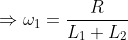
Let  be the angular
frequency at which
be the angular
frequency at which 





(c)
The equivalent impedance at the frequency of is

Given the peak-to-peak voltage is 
So, the RMS voltage is 
So, the phasor representation of the source voltage is given as

The current through the circuit will be

The voltage drop across the resistor is

So, the peak-to-peak voltage across the resistor is

By observing the expression for the line current it is evident that the current lags the source voltage by 45 degrees.
Problem-2
Given details are


the resonant frequency is given by

At the resonant frequency, we have 
The impedance of the circuit will be given by

The current through the circuit is

So, the phase angle difference between the current and voltage at the resonance is 0 degrees
The voltage drop across the resistor is given by

Note: According to the guidelines, only one question can be answered. I have answered two questions. please post the remaining two questions separately.
Add Answer to:
(2 points) Two driven inductors A R = 1 kΩ resistor, a L1 = 20 mH...
RLC frequency limits Last week you studied the driven RC circuit and the driven RL circuit....
RLC frequency limits Last week you studied the driven RC circuit and the driven RL circuit. Consider the driven series RLC circuit. Its impedance is Z=R+j(ωL−1/(ωC)) . (a) For very high frequencies the driven RLC circuit behaves like an RL circuit (the effect of the capacitor becomes negligible). In this case does the current lead or lag the applied voltage in phase? A. lags B. leads C. neither What value in degrees does |ϕ| approach as ω→∞ ? (b) For...
The RLC circuit below is being driven by an AC source with a frequency of 47.77...
 The RLC circuit below is being driven by an AC source with a
frequency of 47.77 Hz resulting in a maximum current Imax = 0.25
amps.
24) In this circuit, the voltage
across the capacitor __________ the current through the capacitor
and the voltage across the resistor __________ the current through
the resistor.
leads, lags
leads, leads
lags, leads
lags, lags
lags, is in phase with
is in phase with, leads
Totally unrelated question....
25) A local radio station broadcasts
at the...
The RLC circuit below is being driven by an AC source with a
frequency of 47.77 Hz resulting in a maximum current Imax = 0.25
amps.
24) In this circuit, the voltage
across the capacitor __________ the current through the capacitor
and the voltage across the resistor __________ the current through
the resistor.
leads, lags
leads, leads
lags, leads
lags, lags
lags, is in phase with
is in phase with, leads
Totally unrelated question....
25) A local radio station broadcasts
at the...
What is the impedance of a 1.35 kΩ resistor, a 160 mH inductor, and a 25.3...
What is the impedance of a 1.35 kΩ resistor, a 160 mH inductor, and a 25.3 μF capacitor connected in series with a 60.0 Hz ac generator? An RLC circuit has a resonance frequency of 1.6 kHz .If the inductance is is 0.11 mH , what is the capacitance?
An RLC series circuit has a 1.00 kΩ resistor, a 150 mH inductor, and a 25.0...
An RLC series circuit has a 1.00 kΩ resistor, a 150 mH inductor, and a 25.0 nF capacitor. (a) Find the circuit's impedance (in Ω) at 505 Hz. (b) Find the circuit's impedance (in Ω) at 7.50 kHz. (c) If the voltage source has Vrms = 408 V, what is Irms (in mA) at 505 Hz and 7.5 Hz? (d) What is the resonant frequency (in kHz) of the circuit? (e) What is Irms (in mA) at resonance?
You have a 220 Ohm resistor, a 0.400 H inductor, and a 7.00 mu F capacitor....
 You have a 220 Ohm resistor, a 0.400 H inductor, and a 7.00 mu F capacitor. Suppose you take the resistor and inductor and make a series circuit with a voltage source that has voltage amplitude 30.0 V and an angular frequency of 250 rad/s. (a) What is the impedance of the circuit? Ohm (b) What is the current amplitude? A (c) What are the voltage amplitudes across the resistor and across the inductor? V (across the resistor) V (across...
F capacitor. It is driven istor, a 50 mH inductor, and a 25 4. A series...
 F capacitor. It is driven istor, a 50 mH inductor, and a 25 4. A series RCL circuit consists of a 60 S2 resistor, a 50 ml in quency 400 rad/s. by an alternating source with rms voltage 120 V and angular frequency 400 rady (a) What is the inductive reactance of the circuit? (b) What is the capacitive reactance of the circuit? (c) What is the impedance of the circuit? (d) What is the phase difference between the voltage...
An inductor (L = 365 mH), a capacitor (C = 4.43 uF), and a resistor (R...
 An inductor (L = 365 mH), a capacitor (C = 4.43 uF), and a resistor (R = 6052) are connected in series. A 50.0 Hz AC source produces a peak current of 250 mA in the circuit. (a) Calculate the required peak voltage AV max (b) Determine the phase angle by which the current leads or lags the applied voltage. Step 1 The total impedance depends on the frequency and the resistance of the circuit. The voltage amplitude is in...
An inductor (L = 400 mH), a capacitor (C = 4.43 uF), and a resistor (R...
 An inductor (L = 400 mH), a capacitor (C = 4.43 uF), and a resistor (R = 500 2) are connected in series. A 52.0-Hz AC generator connected in series to these elements produces a maximum current of 440 mA in the circuit. (a) Calculate the required maximum voltage AV max. (b) Determine the phase angle by which the current leads or lags the applied voltage. The current ---Select--- the voltage by a magnitude of
A resistor (R = 9.00 x 102.2), a capacitor (C = 0.250 uF), and an inductor...
 A resistor (R = 9.00 x 102.2), a capacitor (C = 0.250 uF), and an inductor (L = 1.70 H) are connected in series across a 2.40 x 10²-Hz AC source for which AVmax = 1.50 x 10² V. (a) Calculate the impedance of the circuit. Ο ΚΩ (b) Calculate the maximum current delivered by the source. (c) Calculate the phase angle between the current and voltage. (d) is the current leading or lagging behind the voltage? The current leads...
An RLC series circuit has a 1.00 k Ohm resistor, a 155 mH inductor, and a...
 An RLC series circuit has a 1.00 k Ohm resistor, a 155 mH inductor, and a 25.0 nF capacitor. (a) Find the circuit's impedance at 525 Hz. Ohm (b) Find the circuit's impedance at 7.50 kHz. Ohm (c) If the voltage source has V_rms = 408 V, what is I_rms at each frequency? mA (at 525 Hz) mA (at 7.50 kHz) (d) What is the resonant frequency of the circuit? kHz (e) What is I_rms resonance? mA
 The RLC circuit below is being driven by an AC source with a
frequency of 47.77 Hz resulting in a maximum current Imax = 0.25
amps.
24) In this circuit, the voltage
across the capacitor __________ the current through the capacitor
and the voltage across the resistor __________ the current through
the resistor.
leads, lags
leads, leads
lags, leads
lags, lags
lags, is in phase with
is in phase with, leads
Totally unrelated question....
25) A local radio station broadcasts
at the...
The RLC circuit below is being driven by an AC source with a
frequency of 47.77 Hz resulting in a maximum current Imax = 0.25
amps.
24) In this circuit, the voltage
across the capacitor __________ the current through the capacitor
and the voltage across the resistor __________ the current through
the resistor.
leads, lags
leads, leads
lags, leads
lags, lags
lags, is in phase with
is in phase with, leads
Totally unrelated question....
25) A local radio station broadcasts
at the...
 You have a 220 Ohm resistor, a 0.400 H inductor, and a 7.00 mu F capacitor. Suppose you take the resistor and inductor and make a series circuit with a voltage source that has voltage amplitude 30.0 V and an angular frequency of 250 rad/s. (a) What is the impedance of the circuit? Ohm (b) What is the current amplitude? A (c) What are the voltage amplitudes across the resistor and across the inductor? V (across the resistor) V (across...
 F capacitor. It is driven istor, a 50 mH inductor, and a 25 4. A series RCL circuit consists of a 60 S2 resistor, a 50 ml in quency 400 rad/s. by an alternating source with rms voltage 120 V and angular frequency 400 rady (a) What is the inductive reactance of the circuit? (b) What is the capacitive reactance of the circuit? (c) What is the impedance of the circuit? (d) What is the phase difference between the voltage...
 An inductor (L = 365 mH), a capacitor (C = 4.43 uF), and a resistor (R = 6052) are connected in series. A 50.0 Hz AC source produces a peak current of 250 mA in the circuit. (a) Calculate the required peak voltage AV max (b) Determine the phase angle by which the current leads or lags the applied voltage. Step 1 The total impedance depends on the frequency and the resistance of the circuit. The voltage amplitude is in...
 An inductor (L = 400 mH), a capacitor (C = 4.43 uF), and a resistor (R = 500 2) are connected in series. A 52.0-Hz AC generator connected in series to these elements produces a maximum current of 440 mA in the circuit. (a) Calculate the required maximum voltage AV max. (b) Determine the phase angle by which the current leads or lags the applied voltage. The current ---Select--- the voltage by a magnitude of
 A resistor (R = 9.00 x 102.2), a capacitor (C = 0.250 uF), and an inductor (L = 1.70 H) are connected in series across a 2.40 x 10²-Hz AC source for which AVmax = 1.50 x 10² V. (a) Calculate the impedance of the circuit. Ο ΚΩ (b) Calculate the maximum current delivered by the source. (c) Calculate the phase angle between the current and voltage. (d) is the current leading or lagging behind the voltage? The current leads...
 An RLC series circuit has a 1.00 k Ohm resistor, a 155 mH inductor, and a 25.0 nF capacitor. (a) Find the circuit's impedance at 525 Hz. Ohm (b) Find the circuit's impedance at 7.50 kHz. Ohm (c) If the voltage source has V_rms = 408 V, what is I_rms at each frequency? mA (at 525 Hz) mA (at 7.50 kHz) (d) What is the resonant frequency of the circuit? kHz (e) What is I_rms resonance? mA
Most questions answered within 3 hours.
-
Where is the error in this code sequence?
String s1 = "Hello";
String s2 = "ello";...
asked 10 months ago -
Financial data for Joel de Paris, Inc., for last year
follow:
Joel de Paris, Inc.
Balance...
asked 10 months ago -
Consider this reaction:
Al2(SO4)3 (aq)+ BaCl3
(aq) Al2Cl6 (aq)- +
3BaSO4(s) . What is the...
asked 10 months ago -
Suppose that Savneet is considering increasing her
recent random sample from 20 car rentals to 40...
asked 10 months ago -
Trucks arrive at an unloading terminal at an average rate of 120
per hour.
Trucks arrive...
asked 10 months ago -
Why are methanol and ethanol completely soluble in water while
octanol is not very little soluble....
asked 10 months ago -
A facilities manager at a university reads in a research report
that the mean amount of...
asked 10 months ago -
When the CuSO4 is rehydrated by adding water to the anhydrous
compound, is this an endothermic...
asked 10 months ago -
A ray of sunlight is passing from diamond into crown glass; the
angle of incidence is...
asked 10 months ago -
A block of mass 0.249 kg is placed on top of a light, vertical
spring of...
asked 10 months ago -
how do the kidneys compensate in the presences of acidosis
a) trigger hyperventilate
b) reserve acid...
asked 10 months ago -
Question 501 pts
The rental rate of capital to the firm increases. Which of the
following...
asked 10 months ago